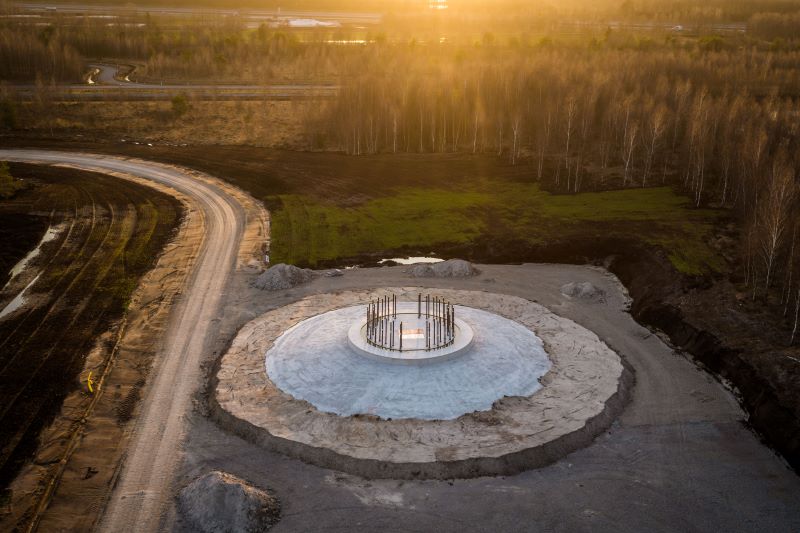
Construction of Mercedes-Benz’s planned 140 MW wind farm at its Papenburg test track in northern Germany is underway following the receipt of all key permits and the completion of major contractor and financing agreements. First announced in September 2025, the project will feature 20 Nordex wind turbines. It is expected to begin operations in 2027. Once complete, the 140 MW wind farm will supply enough renewable electricity to cover around 20% of Mercedes-Benz’s annual power consumption in Germany. This is under a 25-year power purchase agreement (PPA) with developer UKA.
Recent milestones at the wind farm, including turbine procurement, financial close support from lenders LBBW and Helaba, and continued site works, have reinforced the project’s status as one of Germany’s largest onshore wind developments. It is also a cornerstone of Mercedes-Benz’s strategy to power its operations with renewable energy. This is a strategy also being mirrored offshore, with projects such as Germany’s largest in the Baltic Sea, Gennaker wind farm, which has signed a PPA with Amazon for about 60% of its capacity.
Construction Progress on Site
In an update provided to Construction Review Online, UKA’s Head of Corporate Communication, Politics & Brand, Matthias Harenburg, said works at the Papenburg site are progressing as planned, though tough weather conditions are posing additional hurdles to the project. On-site access roads and cable-laying are almost finished and the wind farm’s substation is under construction, with the first large turbine components due to be delivered to site by the end of summer.
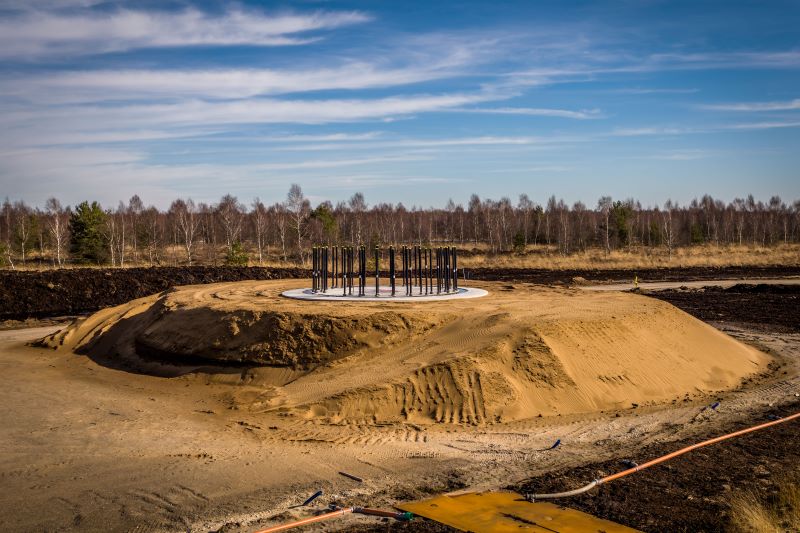
Tower supplier Max Bögl Wind AG confirmed the latest structural progress to Construction Review Online: the project is on schedule, 12 of the turbine foundations are complete, and the first concrete tower installation began this week.
Max Bögl on the Towers and Foundations
Responding to questions from Construction Review Online, Max Bögl Wind AG set out its role on the project. The company is supplying the foundations and the concrete sections of the hybrid towers for all 20 turbines. The foundations are cast in in-situ concrete, while the tower elements are prefabricated and installed by Max Bögl, including the internal systems — a wall-guided ladder system and the post-tensioning.
The towers pair a concrete lower section with a steel upper section to reach a hub height of 164 metres. Max Bögl explained that high hub heights allow modern turbines with large rotor diameters to operate in more efficient wind layers, with yield increasing for every additional metre of height. The concrete section’s high compressive strength allows the turbine to reach that height while effectively transferring loads, and combining it with steel upper sections is, the company said, the most cost-effective solution at this hub height.
The concrete components are produced nearby at Max Bögl’s facility in Emden and transported to site mainly by electric trucks. The design is standardised and optimised for standard trucks, so only a single heavy-haul transport — the transition piece between the concrete and steel sections — is required per tower. Logistics are nonetheless demanding: the peat terrain and the ongoing operations at the Mercedes-Benz test site add complexity, and because not all concrete parts can be stored directly on site, some are held at a temporary storage facility and delivered to the crane pads just in time, requiring close coordination of every interface so assembly can proceed smoothly.
“New generations of wind turbines depend on a reliable and long-lasting foundation to ensure efficient operation for more than 20 years,” said Josef Knitl, member of the board of Max Bögl Wind AG. “The combination of Nordex’s cutting-edge turbine technology and our proven Hybrid Tower Bögl provides exactly this basis for successfully capturing wind energy. We are proud to contribute to this landmark project for Mercedes — basically the company’s largest PPA project — jointly realized with UKA and Nordex, and to advance the growth of wind energy in Germany through this strong collaboration.”
Financing Secured from LBBW and Helaba
Contacted by Construction Review Online, LBBW pointed to its press release of 21 May 2026, which sets out the financing behind the project. The bank confirmed that, in cooperation with Helaba, it has arranged a syndicated financing for the Papenburg wind farm amounting to a nine-figure euro sum — in the hundreds of millions — with LBBW acting not only as a lender but as the structuring bank for what it describes as one of Germany’s largest industrial wind farms.
Jens Heil, Head of Sustainable Energy Finance at LBBW, said the deal “impressively illustrates our strengths as a medium-sized universal bank.” His colleague Alexander Bagiaos added that the long-term power purchase agreement sends an important signal to the markets that electricity from renewables can be an attractive source of supply, while Lars Vogel, Head of Financing and Asset Management at the UKA Group, described Papenburg as an exceptional project in both its scale and its rapid realisation. Commissioning remains planned for 2027.
Mercedes-Benz to Build 140 MW Wind Farm at its Papenburg Test Track in Germany
Reported September 18, 2025 – Mercedes-Benz AG and energy park developer UKA (Umweltgerechte Kraftanlagen GmbH & Co. KG) have received approval to begin construction of the Papenburg wind farm, a large-scale wind farm at the Mercedes-Benz test track in Papenburg, northern Germany. Scheduled for completion by 2027, the project will feature 20 wind turbines delivering a total capacity of 140 megawatts (MW), supplying around 20% of Mercedes-Benz Group AG’s annual electricity needs in Germany under a long-term Power Purchase Agreement (PPA).
A Major Step Toward Sustainability
The Papenburg wind farm forms a key element of Mercedes-Benz’s long-term strategy to decarbonize its production network. By 2030, the company aims to reduce CO₂ emissions from production by 80% compared to 2018 levels and to source 70% of its energy from renewables at its own sites. Globally, all production plants are targeted to run on 100% renewable energy with zero CO₂ emissions by 2039.
Joerg Burzer, Member of the Board of Management of Mercedes-Benz Group AG, emphasized the importance of the new facility:
“The wind farm in Papenburg is an important building block of our sustainable business strategy – from an ecological and also an economic perspective. We are proud, together with our partners, to expand the use of wind energy in Germany.”
Collaboration with Leading Partners
UKA, the owner of the future wind farm, will supply Mercedes-Benz with electricity for the next 25 years. The 20 turbines will be supplied by German manufacturer Nordex. Max Bögl Wind AG will provide the concrete foundations and hybrid tower components with hub heights of 164 metres. UKA is also building over 1.5 GW of onshore wind capacity in Germany, positioning the Papenburg project as a flagship initiative.
Gernot Gauglitz, Managing Partner of the UKA Group, also highlighted the project’s speed and scale:
“Despite challenges at the construction site, our team is pressing ahead in record time. This wind farm is a flagship project in our portfolio.”
Ecologically Managed Test Track
The wind farm will be built on the company’s 800-hectare Papenburg test track. Papenburg has been an integral research and development site since 1998. Planning and implementation are being coordinated closely with local authorities and stakeholders to ensure sustainable land use.
As a whole, Germany has made great strides in installing wind energy farms, one of the most notable being the Nordseecluster offshore wind project, which comprises Phase A (660 MW) and Phase B (900 MW) for a total capacity of an impressive 1.6 GW.
Factsheet: Papenburg Wind Farm
Location: Mercedes-Benz test track, Papenburg, northern Germany
Capacity: 140 MW (20 turbines)
Completion: By 2027
Construction status: 12 of 20 turbine foundations complete; first concrete tower installation begun; access roads and cabling nearly finished; substation under construction (as of end June 2026)
Energy Supply: 20% of Mercedes-Benz’s annual electricity demand in Germany
Turbine Manufacturer: Nordex (Germany)
Foundations & Towers: Max Bögl Wind AG — in-situ concrete foundations and prefabricated concrete hybrid-tower sections (including ladder system and post-tensioning) for all 20 turbines; hub height 164 m; concrete produced in Emden
Ownership & Operation: UKA Group (Power Purchase Agreement with Mercedes-Benz for 25 years)
Financing: Syndicated nine-figure (hundreds of millions of euros) facility from LBBW (structuring bank) and Helaba
Site Size: 800 hectares
About Max Bögl Wind AG
Max Bögl Wind AG is part of the Max Bögl Group, one of Germany’s largest construction companies, and specialises in hybrid wind-turbine towers combining prefabricated concrete sections with steel upper sections. Its Hybrid Tower Bögl system is designed to enable high hub heights, allowing modern turbines with large rotor diameters to reach more efficient wind layers.
About The UKA Group
As an energy park developer, the UKA Group plans, builds, operates, and sells wind, photovoltaic (PV) and battery storage projects. It contributes to a sustainable power supply in Germany, Europe and America that is independent of fossil fuel imports, ensures lower power prices, and is climate-friendly. UKA is an owner-managed company that has been pursuing a long-term business strategy since its founding in 1999. The company’s employees are committed to delivering the best possible project results that meet the highest economic and quality standards. All projects are systematically advanced, even when external circumstances require an extra measure of patience and perseverance.
The UKA Group is one of the leading project developers for renewable energies in Germany with 1.6 GW of onshore wind projects under construction in its home market. Furthermore, an impressive project pipeline of currently 7 GW in the international markets alone underlines its attractive business prospects abroad.


Leave a Reply