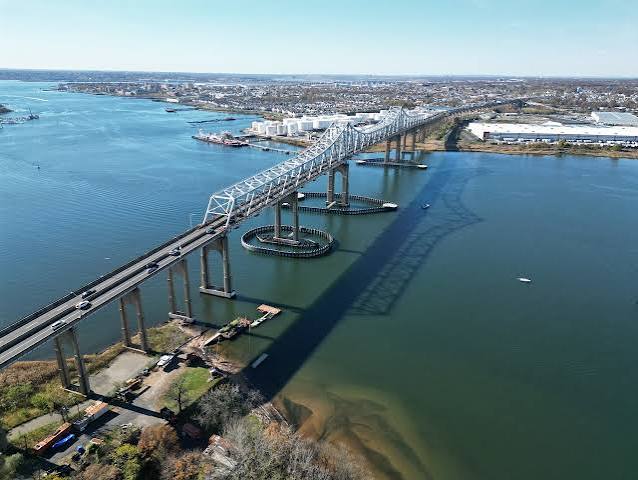
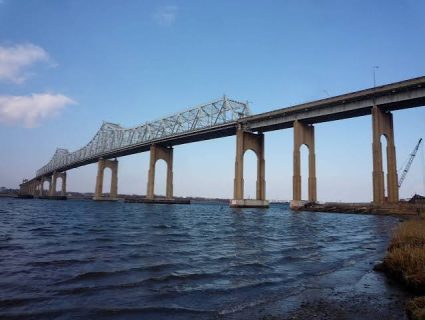
The Port Authority of New York and New Jersey is moving toward a replacement strategy for the aging Outerbridge Crossing after an engineering feasibility study found that widening the existing bridge could cost almost twice as much and take nearly twice as long as constructing an entirely new crossing. The findings highlight the structural limitations of the nearly century-old bridge and the challenges of expanding its capacity while maintaining traffic between Staten Island, New York, and Perth Amboy, New Jersey.
The findings are detailed in the Outerbridge Crossing Widening Feasibility Study’s Scheme Development Package, dated September 30, 2026, prepared for the Port Authority by HDR and its engineering team. The assessment examined whether the existing four-lane crossing could be expanded to accommodate six traffic lanes, modern highway design standards and a shared-use path for pedestrians and cyclists.
The study’s conclusions reinforce the Port Authority’s longer-term plan to prepare for a replacement crossing, while continuing to invest in the existing structure to maintain its condition and operational safety.
Structural limitations make widening increasingly complicated
The feasibility assessment identified a fundamental problem with the existing bridge: its structural components do not have sufficient reserve capacity to support the additional loads associated with widening.
Engineers evaluated six preliminary widening configurations before advancing two alternatives for more detailed assessment: Symmetrical Scheme S2 and Asymmetrical Scheme A2. The first would expand the existing alignment on both sides, while the second would concentrate the expansion on the northern side of the bridge.
Both alternatives would require extensive reconstruction and reinforcement of existing bridge components, including the foundations, concrete piers, bearings, trusses, girders and floor systems. Additional structural elements, new columns and foundations would also be necessary to support the widened crossing.
The engineering analysis found that approximately 57% of the north truss members under Scheme S2 and 55% under Scheme A2 would require significant strengthening. The work would involve installing reinforcement plates and replacing thousands of existing rivets, creating substantial construction challenges around the bridge’s existing structural framework.
Maintaining traffic throughout the construction process would be another major obstacle. The study estimates that the strengthening work alone could require upwards of five years, while the overall construction staging could cause significant roadway closures and impacts on motorists and surrounding communities for up to eight years.
Replacement offers a longer-term infrastructure solution
Beyond the construction challenges, the study raises questions about the long-term value of investing in an extensively widened structure. Its findings indicate that retaining the existing century-old structural elements would limit the widened bridge’s remaining service life to approximately 30 years, compared with at least 100 years for a completely new bridge.
The assessment also highlights potential impacts on up to 33 properties and existing utility infrastructure, including sanitary, drainage, communications, electricity, gas, water and fuel networks. Widening would further constrain future improvements to the Arthur Kill navigation channel because the existing pier locations would need to remain in place.
These findings provide important context for the Port Authority’s longer-term infrastructure planning. Under its approved 2026–2035 Capital Plan, the agency has allocated $336 million for a comprehensive rehabilitation of the Outerbridge Crossing, covering its structure, roadway and deck over four years while keeping the crossing open to traffic. The plan also provides for preliminary planning for a replacement crossing, with that work expected to take place early in the 2036–2045 capital plan period.
The rehabilitation investment is intended to maintain the existing bridge during the years leading up to its eventual replacement, rather than treating widening as the long-term solution.
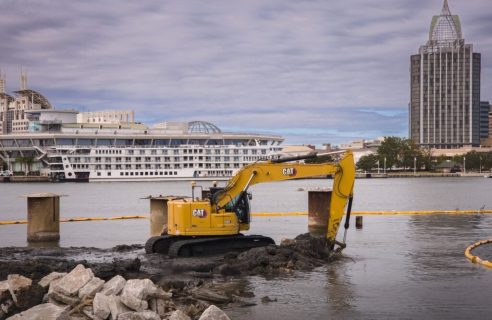
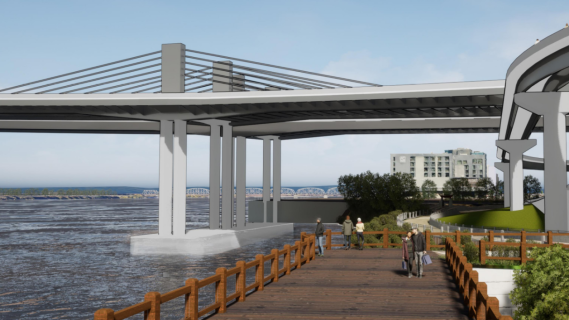
The engineering challenges identified at the Outerbridge Crossing also provide a useful comparison with major new bridge construction elsewhere in the United States. In Alabama, for example, the $3.2 billion I-10 Mobile River Bridge and Bayway Project is progressing through tower foundation and approach bridge construction, illustrating the scale of investment involved in delivering new highway crossings.
With the widening study now documenting the technical and economic disadvantages of expanding the existing structure, the Port Authority’s immediate priorities remain maintaining the current crossing and advancing the planning work needed for its eventual replacement. No final replacement construction cost or construction start date has been established in the study.

Leave a Reply