Constructionreview

Blog

  • $3B Gathering Complex in Forsyth Sets Stage for NHL Expansion Bid, Atlanta

    $3B Gathering Complex in Forsyth Sets Stage for NHL Expansion Bid, Atlanta

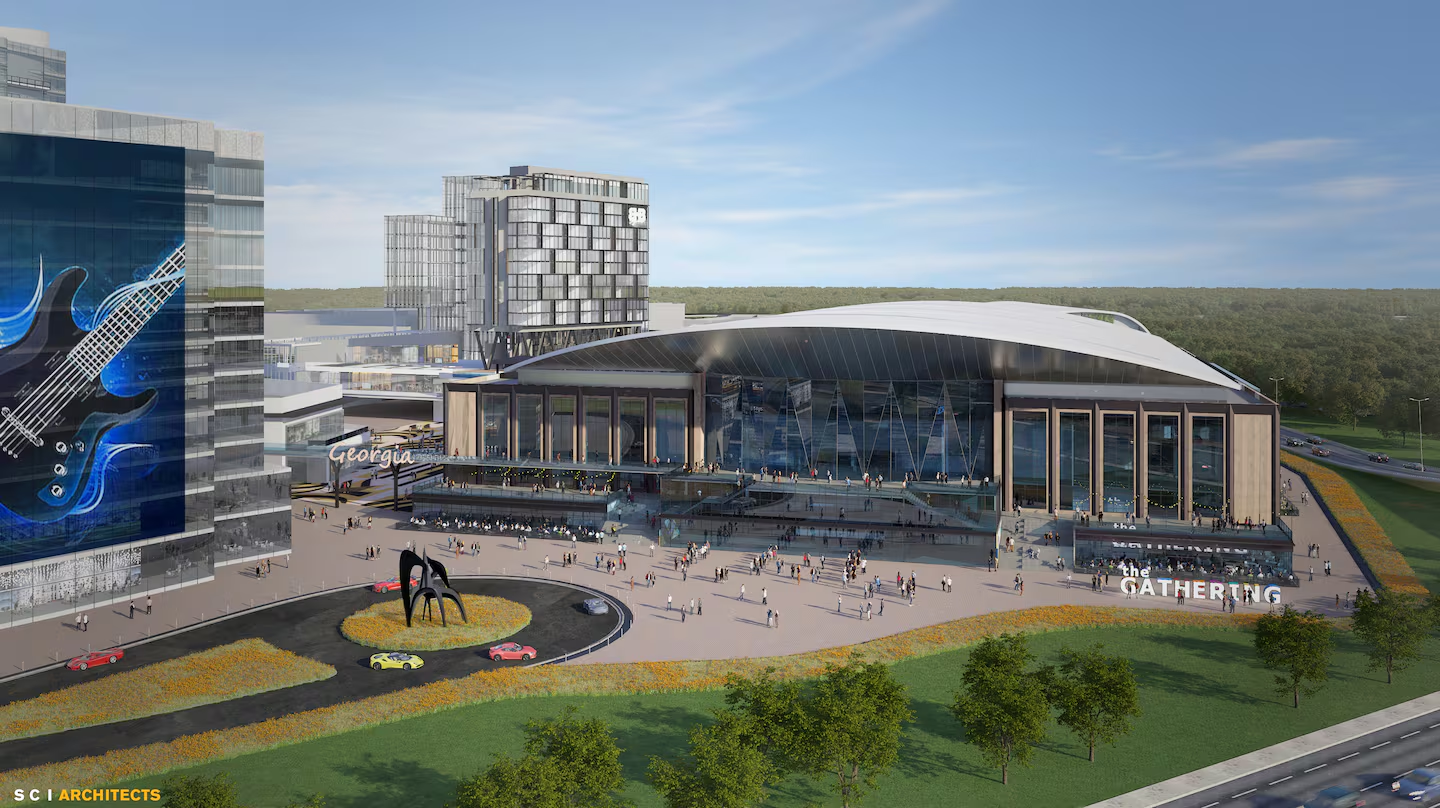
    On Wednesday, Forsyth County, a key suburb northeast of Atlanta, took a major step toward welcoming the NHL back to Georgia when County officials voted to approve the concept for The Gathering. The proposed $3 billion mixed-use entertainment complex anchored by an NHL-ready arena. This decisive move brings the region one step closer to securing a new professional hockey franchise for the first time since the Thrashers relocated in 2011.

    A Smart Bet on Sports, Retail, and Housing

    The Gathering is led by Vernon Krause and his Krause Group, and features an 18,500-seat arena at its core. Beyond sports, the plan outlines hotels, retail spaces, restaurants, offices, and nearly 2,000 new homes spread across roughly 100 acres off GA-400 and Union Hill Road. This mixed-use concept mirrors successful developments like The Battery Atlanta and is viewed as a transformative addition to suburban Forsyth County.

    Also Read Georgia Power announces 765 MW BESS projects across Georgia State

    Strong Financial Backing Opens the Door

    With the county’s approval of tax allocation and zoning overlays, The Gathering is now officially shovel-ready. Forsyth County plans to issue $225 million in bonds to support arena construction, with taxpayers also voting to allow a tax allocation district to repay the debt Next, Vernon Krause and his team will pitch their proposal to NHL Commissioner Gary Bettman, a critical step toward landing the city’s 33rd franchise. 

    Also Read $107 Million GSU Revamp of Downtown Atlanta Campus

    Atlanta Poised for NHL Return, with a Suburban Twist

    Although Atlanta previously hosted NHL teams, the Flames in the 1970s and the Thrashers through 2011, both relocations stemmed from arena and financial challenges. This new bid stands out because it focuses on suburban development: placing the arena within a thriving mixed-use district designed to support year-round activity. Additionally, this mirrors the Braves’ move to Truist Park in Cobb County in 2017. While success isn’t guaranteed, strong community support and financial structure position Forsyth County as a top contender for future NHL expansion.

    The Gathering NHL Atlanta Project Overview

    Project Name: The Gathering at South Forsyth

    Total Investment: Estimated $3 billion mixed-use development

    Location: Approximately 100‑to‑100.3 acres at Union Hill Road & Ronald Reagan Boulevard, Forsyth County, Georgia

    Developer: Vernon Krause with Krause Sports & Entertainment

    Central Feature: A 18,500–18,700‑seat NHL-level arena (approx. $700M construction cost)

    Additional Components:

    Up to 1,800 apartments and 150 single-family homes + 500 hotel rooms

    Parking decks with up to 8,780 spaces

    Public amenities including green spaces, community center, fire station, and sheriff’s substation

    Financial Structure:

    Forsyth County to issue $225M in bonds, repaid via a Tax Allocation District (TAD) tied to the site’s future tax revenue

    County incentives may reach up to $390M in public funding contingent on securing an NHL franchise

    Timeline:

    Public referendum held Nov 2024 approving creation of TAD and redevelopment powers 

    Next step: Pitch to NHL Commissioner Bettman; arena expected to break ground soon after franchise approval


  • JetZero plane factory project set for Piedmont Triad International Airport

    JetZero plane factory project set for Piedmont Triad International Airport

    JetZero, an innovative aviation company based in Long Beach, California, has chosen Piedmont Triad International Airport (PTI) in Greensboro, North Carolina, as the site for its $4.7 billion manufacturing plant. The JetZero Piedmont Triad International Airport project is expected to create at least 14,560 jobs over the next decade, marking one of the largest economic development commitments in North Carolina’s history.

    Z4 Aircraft to Be Built in Greensboro

    The company plans to manufacture its flagship aircraft, the Z4 — promoted as the “world’s first commercial blended wing body airplane” — at the new JetZero Piedmont Triad International Airport project. The Z4 is designed for medium-range routes with a 250-passenger capacity and a 5,000-nautical-mile range. Test flights are scheduled for 2027, with commercial flights expected by 2030.

    High-Paying Jobs and Economic Incentives

    JetZero’s new facility will generate jobs in aerospace engineering, manufacturing, R&D, administration, HR, and customer service, with average annual wages of $89,340. In exchange, JetZero is eligible for up to $1.57 billion in Job Development Investment Grant (JDIG) incentives, distributed over 39 years. Guilford County has pledged an additional $75.9 million in performance-based incentives over 20 years.

    Read Also: Milwaukee Mitchell International Airport Breaks Ground on $75 Million Air Cargo Facility

    Airport Megasite Sees Largest Employer Yet

    The JetZero Piedmont Triad International Airport project will occupy nearly 1,000 acres, making it the largest employment commitment at the airport’s growing aviation megasite. This site also hosts major industry players such as Boom Supersonic, Honda Aircraft Co., and FedEx. JetZero will utilize most of PTI’s remaining undeveloped land, according to the Greensboro Chamber of Commerce.

    Competing Cities and Site Requirements

    JetZero considered over 25 sites in 17 states before selecting Greensboro, with Huntsville, Alabama identified as a strong competitor. Key requirements included a 10,000-foot runway and a site large enough to support major aircraft production — which PTI satisfied with ease.

    Next Steps in Production Plan

    JetZero must now finalize an engine supplier and complete Z4 prototype testing. At full production capacity, the plant aims to manufacture 20 aircraft per month. The facility will be comparable in size to Boeing’s widebody plant in Everett, Washington.

    The JetZero Piedmont Triad International Airport project represents a transformative investment for the region, positioning North Carolina as a future leader in next-generation aviation manufacturing.

  • World’s First Underwater Data Center to Launch in Shanghai

    World’s First Underwater Data Center to Launch in Shanghai

    China has unveiled the world’s first commercial underwater data center, marking a groundbreaking achievement in green computing. Officially launched on Tuesday, the commercial project will be located in Shanghai’s Lin-gang Special Area and powered entirely by offshore wind energy.

    The initiative — jointly developed by the Lin-gang Special Area Administrative Committee, Shanghai Lingang Special Area Investment Holding Group, and Shanghai Hicloud Technology Co., Ltd. — aims to merge computing infrastructure with renewable energy in a bid to meet global demand for low-carbon digital solutions.

    “This project establishes a new model for underwater data centers, blending high-quality computing power with AI-ready scenarios,” said Chen Jinshan, head of the Lin-gang administrative committee. “It supports our goal to make Lingang a global hub for AI, cross-border data, and intelligent connectivity.”

    Wind-Powered and Water-Cooled

    According to the agreement, Hicloud will invest 1.6 billion yuan (approximately $222.7 million) in the two-phase Shanghai Lingang UDC project. The facility will use natural seawater for cooling and offshore wind to supply over 90% of its energy needs — enabling zero carbon emissions.

    The first phase involves a 2.3 MW demonstration facility expected to be operational by September 2025. The second phase will scale capacity to 24 MW, targeting a power usage effectiveness (PUE) below 1.15 — a benchmark in energy-efficient data centers.

    The world’s first underwater data center will host modular computing units cooled directly by seawater. This reduces refrigeration power usage from up to 50% to under 10%, slashing total energy consumption by 30–40% compared to conventional land-based centers.

    Also Read: Amazon to Invest $20B in Expansion of its Data Centers and AI Infrastructure in Pennsylvania

    Based on Proven Technology

    The project draws inspiration from Hicloud’s successful 2022 deployment in Hainan, which hosts data modules over 30 meters underwater. With over 675 petaflops of computing power and zero server failures to date, the Hainan model proved the feasibility of subsea computing.

    Now, Shanghai’s UDC takes the concept further by adding offshore wind integration, making it not only more sustainable but commercially scalable.

    The facility is expected to support industries like AI, 5G, industrial IoT, and global e-commerce — further solidifying China’s position as a leader in green tech infrastructure.

    Also Read Data center construction boom 

    FACTSHEET: World’s First Underwater Data Center (Shanghai)

    • Location: Lin-gang Special Area, Shanghai
    • Developer: Shanghai Hicloud Technology Co., Ltd.
    • Investment: ¥1.6 billion (~$222.7 million)
    • Power Source: Offshore wind (90%+), zero carbon emissions
    • Cooling System: Natural seawater cooling
    • Energy Efficiency: PUE < 1.15
    • Phase 1: 2.3 MW demo unit (operational by Sept 2025)
    • Phase 2: 24 MW full capacity
    • Key Benefits:
      • 30–40% lower energy use vs. land data centers
      • Reduced land usage
      • No server failures reported in trial models
    • Target Applications: AI, 5G, industrial IoT, cross-border e-commerce
    • Significance: First commercial deployment of a subsea data center powered by renewable energy
  • Morocco Finalizes Prequalification on the $700M Guercif-Nador Highway Project

    Morocco Finalizes Prequalification on the $700M Guercif-Nador Highway Project

    Morocco has finalized the prequalification process on the $700 million Guercif-Nador highway project. Spearheaded by the Equipment, Transport and Logistics Ministry, several Chinese and local firms have been prequalified. The scope of the project entails three lots of the 40-kilometer (km) section two of the Guercif to Nador highway. It is located between the regions of Saka and Driouch. The prequalified contractors are divided into three lots, with those from the first lot including local-based companies such as Mojazine Groupe and Les Grands Travaux Routiers (GTR).

    Furthermore local-based companies NGE Contracting and Capep are in the lot alongside China-based China Road & Bridge Corporation (CRBC). Lot 2 entails most companies from the first lot alongside local-based Societe Bioui Travaux (SBTX) and Starport. International-based China International Water & Electric Corporation is also in the lot. Lastly, lot 3 entails companies from both lots such as SBTX, CRBC and Mojazine Group. Two major contractors, China Railway Construction Engineering Group and Enterprise Houar failed prequalification.

    Also read:

    Morocco to build second Rabat-Casablanca highway

    The Scope of Implementation on the Guercif-Nador Highway Project

    Guercif-Nador Highway Project
    Morocco has finalized the prequalification process on the $700 million Guercif-Nador highway project.

    The 104 kilometers Guercif-Nador highway project is being implemented in three sections with prequalification for section 1 from Guercif to Saka done in late March. Estimated to cost $700 million, the project is being funded partly by the African Development Bank. On the other hand, Morocco is funding the remaining part of the cost. The project is part of the kingdom’s plans to upgrade its public infrastructure ahead of the 2030 Fifa World Cup. The tournament is a co-hosting between Morocco, Portugal and Spain. The plan entails the expansion of over 1,000 kilometers of highways across the nation. In May, Societe Nationale des Autoroutes du Maroc awarded $540 million of contractors for nine packages. The packages covered construction works on the Rabat-Casablanca continental expressway. The commitment shown by Morocco to improve its infrastructure shows its readiness to host the tournament and better transport across the nation.

    Also read:

    Morocco Awards Early Works Tender on $1.6 Billion Casablanca Airport Expansion Project

    Plans to improve Alawi Kingdom roads and highways

  • The $1.2B Roper St Francis Healthcare Hospital Campus in North Charleston

    The $1.2B Roper St Francis Healthcare Hospital Campus in North Charleston

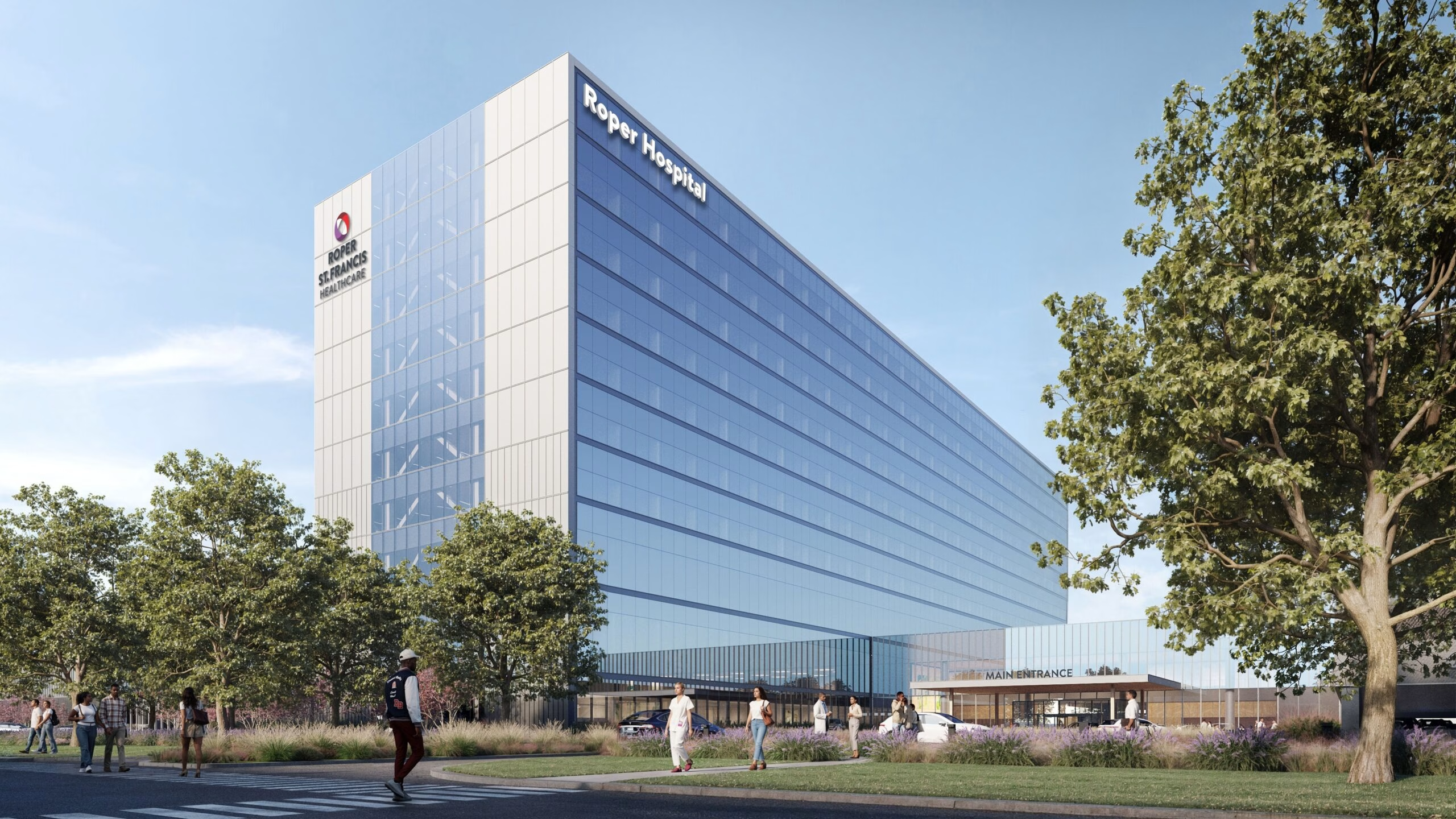
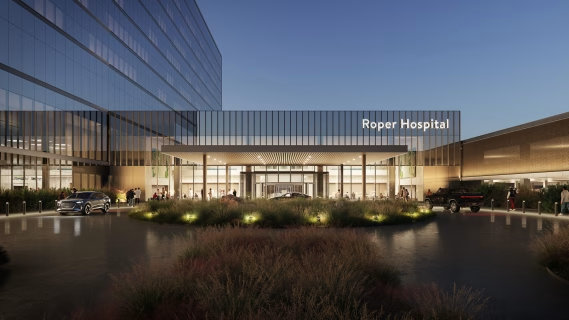
    In a landmark step toward reimagining healthcare for the Lowcountry, Roper St. Francis Healthcare has initiated construction of its future flagship hospital campus in North Charleston. The $1.2 billion project vows to transform the delivery of care across the region—blending cutting-edge medical technology, climate sustainability, and an extraordinarily patient-focused design.

    The new campus will be located on a 27-acre site just off Mall Drive behind North Charleston City Hall.

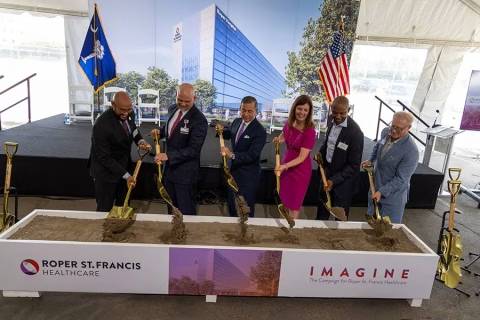
    Development partners E4H Environments for Health Architecture, Skidmore, Owings & Merrill (SOM), Barton Malow, and Edifice Construction were invited by Roper leadership to the groundbreaking ceremony, which kicked off a construction project already being touted as one of the South’s most ambitious hospital projects.

    Projected economic impact

    Upon completion in 2029, the facility is expected to be an economic stimulus for the region, generating $2.5 billion in impact and removing approximately 3,600 jobs.

    “Not only is this campus a construction endeavor—but it’s a living proof of our mission,” said Joseph DeLeon, president and CEO of Roper St. Francis Healthcare. “Every beam, every brick symbolizes the lives we’re striving to touch with compassion, faith, and clinical excellence. We’re building care of the future on near 170 years of heritage.”

    The Roper Hospital will be the fourth to be named Roper as the system has grown since its formation in 1856. As the healthcare system continues with its 2030 Strategic Plan to expand access and meet the Lowcountry’s growing healthcare demands, the Roper St. Francis expansion into North Charleston is a continued effort. The company has a current presence in the city, including the Roper Hospital Diagnostics & ER – Northwoods, two Express Care locations, and the Greer Transitions Clinic.

    Read also: Children’s Mercy Hospital Kansas Unveils $152M Expansion Plan

    Design for the Roper’s future hospital campus in North Charleston

    This new facility is being designed with direct input from those most familiar with patient care: the clinicians. More than 550 hours in the past year have been spent in collaborative design sessions involving nurses, doctors, and employees. Using full-scale mockup rooms, 3D plans, and interactive virtual reality walking tours, the staff worked through details from emergency bay configuration to hybrid operating suite traffic.

    Besides aesthetics and functionality, the new hospital is also being designed to be durable. Its building will undergo rigorous specifications to resist hurricanes, floods, and earthquakes. Something critical in a coastal region with erratic weather.

    The design is being led by E4H and SOM—firms with experience on high-profile institutions such as Baylor Scott & White, New York-Presbyterian, and Emory Winship Cancer Center. The building is supported by construction giants Barton Malow Builders and Edifice Construction, both of which are contributing to the expanding landscape of key healthcare construction projects across the United States.

    Although this growth is a strategic move out of downtown Charleston, Roper St. Francis promises the public it’s not leaving behind the city center’s historic core. There are plans underway to maintain and even grow the health system’s presence in the city center where its story first started on Queen and Logan streets nearly two centuries ago, much like how North Dakota has begun construction on its new $300 million state hospital in Jamestown, ensuring continued access to vital healthcare services while modernizing facilities.

    Read also: Sunnyvale to Welcome New El Camino Health Rehabilitation Hospital by 2027

    Roper St Francis Healthcare Breaks Ground on $1.2B Hospital Campus in North Charleston
    Roper St Francis Healthcare Breaks Ground on $1.2B Hospital Campus in North Charleston

    Some of the key features of the Roper’s new North Charleston Campus are:

    A full-service, 24-hour emergency department that is trauma and critical care focused

    Multiple state-of-the-art operating rooms, including hybrid surgical suites

    Patient-centered inpatient rooms with upgraded safety and comfort features

    A medical office building dedicated to outpatient and specialty care

    A green belt promoting easy wayfinding and wellness across the campus

    Enhanced security systems, such as sophisticated weapons-recognition technology

    A new café with a test kitchen highlighting local culinary talent

    To support this groundbreaking transformation, Roper St. Francis Foundation launched Imagine. The Campaign for Roper St. Francis Healthcare, a $100 million capital campaign. Over 2030, the campaign will drive innovation, expand access, and help support the relocation and expansion of services to North Charleston.

    Read also: Ascension Saint Thomas to Build $148M Hospital in Clarksville, TN

    Roper Hospital North Charleston Campus: Project Factsheet

    Project Overview

    Owner: Roper St. Francis Healthcare

    Project Type: New flagship hospital campus

    Location: 27-acre site off Mall Drive behind North Charleston City Hall

    Total Investment: $1.2 billion

    Groundbreaking: June 11, 2025

    Completion: 2029

    Roper St Francis Healthcare Breaks Ground on $1.2B Hospital Campus in North Charleston
    Roper St Francis Healthcare Breaks Ground on $1.2B Hospital Campus in North Charleston

    Economic Impact

    Total Economic Impact: $2.5 billion

    Job Creation: 3,600 estimated jobs

    Fundraising Campaign: $100 million (Imagine: The Campaign for Roper St. Francis Healthcare, running through 2030)

    Design and Construction Team for Roper’s New North Charleston Hospital Campus

    Architecture:

    E4H Environments for Health Architecture

    Skidmore, Owings & Merrill (SOM)

    Construction Team:

    Barton Malow

    Edifice Construction

    Read also: Health First Unveils $230M Expansion of Palm Bay Hospital to Meet Surging Community Needs

  • Geronimo brings 120MW Ross and 47.5MW Fayette Solar Projects online in Ohio with others in development

    Geronimo brings 120MW Ross and 47.5MW Fayette Solar Projects online in Ohio with others in development

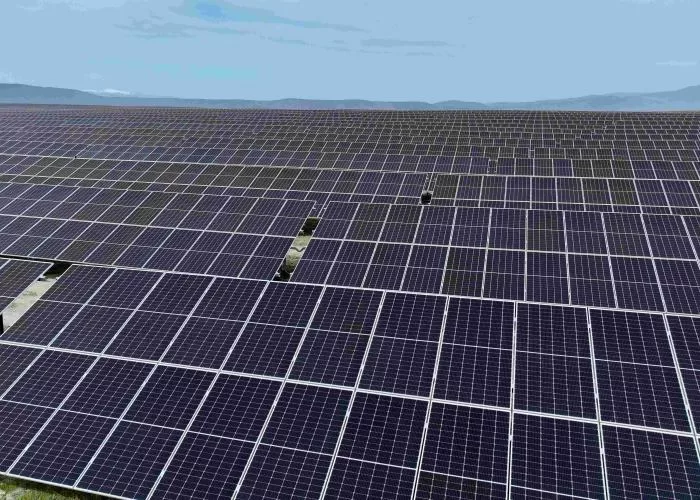
    Geronimo Power announced the official start of operations at its Ross and Fayette Solar Projects, adding a combined 167.5 megawatts (MW) of clean energy generation capacity across Ross, Fayette, and Highland counties in Ohio. Geronimo Power is currently engaging the community of Fairfield Country, Ohio as of 11th August with regards to its proposed Carnation Solar Project. It will be a 142MW capacity project that will further increase Geronimo’s footprint in Ohio.

    The Ross County Solar project will produce 120 MW, while the Fayette Solar project contributes 47.5 MW. These developments join the previously operational Yellowbud Solar project and mark a significant step forward in Geronimo Power’s growing renewable energy footprint in the region.

    In total, the Ross and Fayette Solar Projects are projected to generate $29.5 million in new tax revenue, benefitting local counties, school districts, emergency services, and the state’s PILOT (Payment in Lieu of Taxes) Program.

    Also Read: Hardin III Solar Energy Center, a 250-MW Plant in Ohio, Goes Live

    The announcement comes on the heels of Geronimo Power’s recent groundbreaking for two additional Ohio-based solar farms—Dodson Creek and Sycamore Creek. Once fully operational, the six projects will collectively deliver over 800 MW of clean, renewable energy to Ohio’s grid. Also in August Geronimo broke ground on the 125 MW Solar Project in Jackson County, Michigan further increasing its persence in the region.

    Duane Ross, a landowner involved in the Fayette project, emphasized the positive local impact. “I have lived in the area for more than 45 years and have found the nearby solar facilities to provide a welcome change to my community,” he said. “The Ross and Fayette solar projects will provide essential revenue streams for residents in this area, and I hope to see more solar projects producing clean energy in the future.”

    Ross and Fayette Solar Projects Background

    The Ross Solar Project spans portions of Ross and Highland counties and was developed with significant input from local stakeholders to ensure long-term benefits for surrounding communities. It occupies former agricultural land and integrates environmentally responsible design, including native vegetation plantings and wildlife corridors.

    The Fayette Solar Project, located in Fayette County, similarly reflects Geronimo Power’s commitment to sustainable energy development and rural economic support. Both projects began construction in 2023 and created hundreds of local construction jobs during their build-out phases. Now operational, they are expected to power tens of thousands of homes annually with clean electricity, while supporting Ohio’s broader transition to renewable energy.