Constructionreview

Blog

  • All to Know About the $32.5M Mombasa SGR Terminus and 26-Kilometer CBD Rail Link Line

    All to Know About the $32.5M Mombasa SGR Terminus and 26-Kilometer CBD Rail Link Line

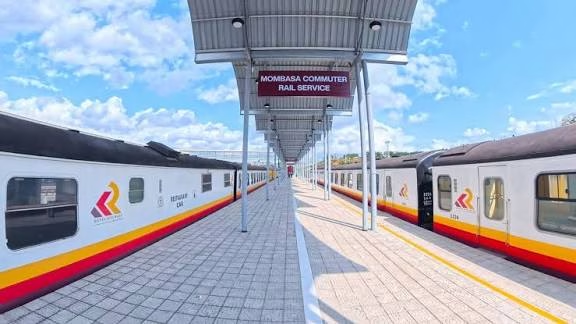
    Updated September 17, 2025- President William Ruto has commissioned the Mombasa SGR Terminus and 26-Kilometer CBD Rail Link Line.

    The project involved the construction of modern passenger stations in Mombasa town and Miritini. It also involved the building of a 2.3-kilometre railway bridge across the ocean at Makupa and the rehabilitation of 16.6 kilometres of existing Metre Gauge Railway (MGR) line.

    During the commissioning event, Ruto also announced a Ksh 41 billion investment for the Port of Mombasa expansion. Also, he said that resources would be allocated to complete road projects in the county.

    The Mombasa Commuter Rail Service is designed to enhance last-mile connectivity for passengers using the Madaraka Express Passenger Service, while also serving local commuters along the corridor.

    Passengers will pay a 50 Shillings fare charge to use the train. The train will make stops at Miritini, Changamwe West, Changamwe East, Shimanzi, Mazeras, and Mombasa CBD.

    20th August 2025 Kenya Railways announced that it has completed the construction of the $32.5 million Mombasa SGR Terminus and 26-Kilometer CBD Rail Link. The Kenya Railway Corporation (KRC) is currently finalizing the operationalization of the Ksh4.2B Mombasa SGR Terminus and 26-Kilometer CBD Rail Link Line. Earlier this week, Transport Principal Secretary Mohamed Daghar visited the site for an inspection. Recent images from the project show that it is complete and is soon to be unveiled. However, the project has had its ups and downs over the years since its launch in 2022. During a briefing for the National Assembly Committee on Implementation that was led by Budalangi Member of Parliament (MP), Raphael Wanjala, during an inspection tour of SGR operations in Mombasa, KRC Managing Director (MD) Philip Mainga revealed that that the railway infrastructure project is ready for launching.

    16th June 2025 – The Kenya Railway Corporation (KRC) is currently finalizing the operationalization of the Ksh4.2B Mombasa SGR Terminus and 26-Kilometer CBD Rail Link Line.

    During a briefing for the National Assembly Committee on Implementation that was led by Budalangi Member of Parliament (MP), Raphael Wanjala, during an inspection tour of SGR operations in Mombasa, KRC Managing Director (MD) Philip Mainga revealed that that the railway infrastructure project is ready for launching.

    Also read: Kenya’s 170-Kilometer Nakuru-Nairobi Highway Construction to Commence in July

    Mombasa SGR Terminus and 26-Kilometer CBD Rail Link Line Project Factsheet

    Cost: Ksh4.2 Billion (approximately $32 million)

    Length: 26 kilometers

    Components:

    • Rehabilitation of the existing Meter Gauge Railway (MGR) line to Miritini.
    • Construction of a new MGR passenger station at Mombasa Terminus.
    • It also entails the construction of four mini-stations at Changamwe East, Changamwe West, Miritini, and Shimanzi.
    •  A pedestrian bridge linking the SGR and MGR platforms.
    • A locomotive turntable.
    • Construction of a 480-meter railway bridge across the Makupa Causeway.
    • Rehabilitation of the historic Mombasa Central Railway Station.

    Operator: Kenya Railway Corporation (KRC)

    Commencement Date

    The railway infrastructure project was initiated in September of the year 2022. However, the project was subjected to delays as a result of land acquisition challenges. In what is termed as a boost for the project, The Ministry of Transport subsequently earmarked a total of Ksh1.1 billion to the National Land Commission. This funds were to be utilized in the facilitation of land acquisition for the project. Therefore, this paved way for the rehabilitation of the Mombasa Metre Gauge Railway (MGR) line to Miritini.

    Once operations kick off, passengers who will be using the Madaraka Express and the seven SGR stations arriving at or departing from Mombasa will be able to link to the CBD through the MGR line.

    Also read: Kenya’s Government Partners with World Bank in the 165-Kilometer Nairobi Rail Expansion Plan

    Scope of the Mombasa SGR Terminus and 26-Kilometer CBD Rail Link Line Project

    Additionally, the project entails the rehabilitation of the historic Mombasa Central Railway Station and the construction of four mini-stations that will be located in Changamwe East, Changamwe West, Miritini, and Shimanzi

    Furthermore, the project involves the construction of a pedestrian bridge that connects the SGR and MGR platforms, a locomotive turntable and also a railway bridge that will boast a total length of 480 meters across the Makupa Causeway.

    The commuter train will offer Mombasa residents an alternative mode of transport. This will therefore reduce the pressure that usually mounts on road transport.

    Significance of the Project

    This commuter rail is part of the Mass Rapid Transit System (MRT) that the Ministry of Roads and Transport is implementing. Also, it entaila the Bus Rapid Transit System (BRT) for travelers that will enable them to move safely and efficiently.

    The Managing Director affirmed that the Corporation is competitive and has been rebranded. Furthermore, he encouraged Kenyans to use rail transport so that they can experience the transformation.

    Also read: $13.8 Billion Kenya-Ethiopia Railway Construction Plans Resume
  • 73 unit Marglyn at Matthews Rental Community Project in NC ground breaking takes place

    73 unit Marglyn at Matthews Rental Community Project in NC ground breaking takes place

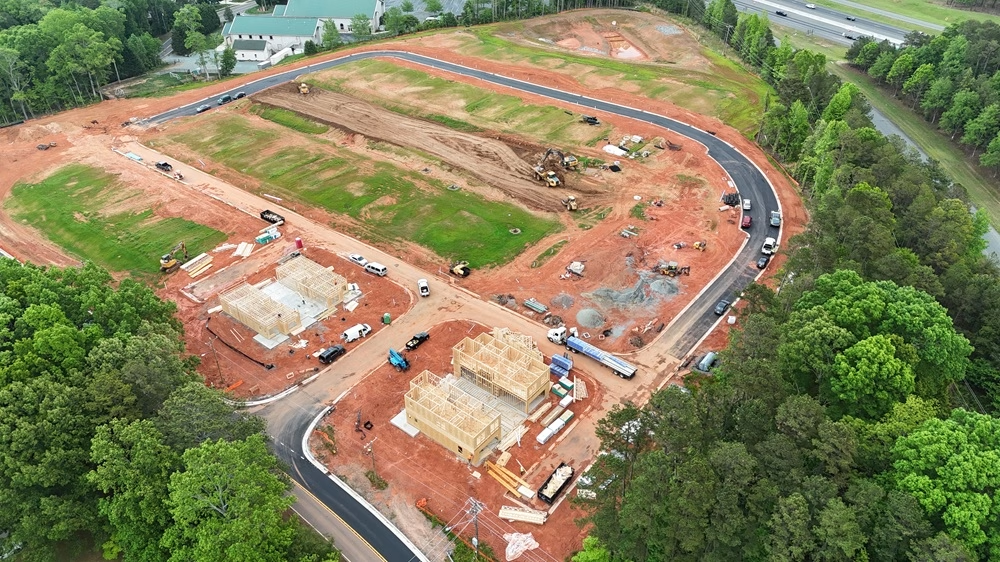
    Center Park Group, in collaboration with Canvas Residential Partners, is excited to announce that construction is officially underway at Marglyn at Matthews, a brand-new, 73-unit townhome rental community located just minutes from the heart of historic downtown Matthews. Designed with modern lifestyles in mind, this thoughtfully planned neighborhood offers spacious 3- and 4-bedroom townhomes, each featuring attached 2-car garages and private, fenced-in yards — a rare find in today’s rental market.

    “Marglyn at Matthews represents our continued commitment to building high-quality, intentionally located rental communities that meet the growing demand for flexible living,” said Jason Esposito, CEO and managing partner of Center Park Group. “We are proud to partner with Canvas Residential on this BTR community.”

    Nestled in a prime location, Marglyn at Matthews provides residents with the perfect blend of suburban tranquility and urban convenience. Just a short drive from Matthews’ charming downtown district, residents will enjoy easy access to local shops, restaurants, craft breweries, and vibrant community events such as the Matthews Farmers Market and Matthews Alive Festival.

    [internal_link url=”https://constructionreviewonline.com/news/amazon-to-invest-10b-to-expand-its-data-center-infrastructure-in-richmond-county-north-carolina/”]

    Key features include:

    • Spacious 3- and 4-bedroom floor plans
    • Attached 2-car garages
    • Private, fenced-in yards perfect for pets and entertaining
    • Modern, open-concept kitchens with premium appliances and quartz countertops
    • Smart home technology packages, including Google Fiber
    • Professional on-site management and maintenance, including weekly lawn care
    • Resident-friendly spaces with a community pavilion, ample green spaces, walkways, community garden, off-leash dog park and grilling stations
  • Scatec Reaches Egypt’s Obelisk Hybrid Solar and BESS Project Financial Close

    Scatec Reaches Egypt’s Obelisk Hybrid Solar and BESS Project Financial Close

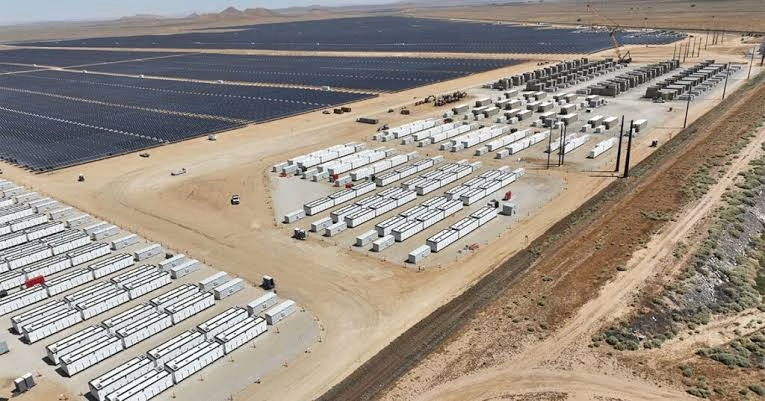
    The European Bank for Reconstruction and Development (EBRD), African Development Bank (AfDB), and British International Investment (BII), the United Kingdom’s development finance institution and impact investor, are expected to issue a total of US$ 479.1 million of funds to Obelisk Solar Power SAE following the Obelisk Hybrid Solar and BESS Project Financial Close that was reached today. The renewable energy project is a special-purpose vehicle incorporated in and owned by Scatec ASA.

    The funds from this Obelisk Hybrid Solar and BESS Project Financial Close be provided will be utilized in the development of a 1.1 GW solar photovoltaic (PV) power plant integrated with a 200 MWh battery energy storage system (BESS) in Egypt’s Nagaa Hammadi region.

    Factsheet

    Name: Obelisk Hybrid Solar and Battery Energy Storage System (BESS) Project

    Location: Nagaa Hammadi

    Developer and operator: Scatec ASA

    Cost: Approximately $590 million

    Project type: Hybrid Solar PV Plant with integrated Battery Energy Storage System (BESS)

    Capacity:

    Solar PV: 1.1 GWac (Gigawatt-alternating current)

    Battery Energy Storage System (BESS): 100 MW / 200 MWh

    Also read: Scatec Commences Construction of 1.1GW Obelisk Solar PV and BESS Project in Egypt

    How Stakeholders will Contribute Funds as Per the Obelisk Hybrid Solar and BESS Project Financial Close

    EBRD

    The EBRD is expected to provide a loan of up to US$ 173.5 million. Out of this, $ 101.9 million will benefit from a European Fund for Sustainable Development (EFSD+) first-loss cover guarantee for the first 18 years. This will be in addition to a US$ 6.5 million grant from the EBRD Shareholder Special Fund.

    AfDB

    Furthermore, the AfDB’s funding package of US$ 184.1 million will include a total of $ 125.5 million of ordinary resources. There will also be a concessional funding from AfDB-managed special funds the Sustainable Energy Fund for Africa that will be worth US$20 million and another $18.6 million from the Canada-African Development Bank Climate Fund. This is a joint partnership between the AfDB and the government of Canada. Lastly, a further $20 million will be channelled from the CIF’s Clean Technology Fund via the AfDB.

    BII Contribution in the Obelisk Hybrid Solar and BESS Project Financial Close

    According to this Obelisk Hybrid Solar and BESS Project Financial Close, BII funding will include a US$ 100 million concessional loan. Also, it will include a $15 million returnable grant that helps reduce especially the overall cost of the BESS part of the project. Therefore, this will make it even more financially viable and affordable while attracting private-sector participation and creating models for future investments. BII’s funding is subject to drawdown conditions.

    The renewable energy project joint financing of $ 479.1 million is roughly 80 per cent of the overall estimated capital expenditure of $590 million.

    Also read: Africa’s largest solar photovoltaic farm Obelisk solar project in Egypt to receive US$184m

    Developer

    The entire integrated power plant project will be developed by Scatec. Scatec is a leading renewable energy solutions provider.

    Furthermore, the project will be built in two phases. The first phase will consist of 561MW of solar and 100 MW/200 MWh of battery storage. Additionally, it will commence its operations in the first half of the year 2026.

    As for the second phase it will consist of 564MW of solar. This phase aims to kick off operations in the second half of 2026. The energy from the project will be sold under a US dollar-denominated 25-year power purchase agreement with the Egyptian Electricity Transmission Company with the support of a sovereign guarantee.

    Also read: Egypt’s 650MW GOS II Wind Farm Project Complete, with EWA Group Playing Crucial Logistics Role

    Significance of the Project and Obelisk Hybrid Solar and BESS Project Financial Close

    Once completed the project will be the first integrated solar photovoltaic and battery storage project of this scale in Egypt. This funding marks a significant milestone in the country’s general energy transition.

    Egypt has ambitious goals of attaining 42 per cent of renewables in its power mix by 2030. The solar power plant is expected to produce roughly 3,000 GWh annually of additional renewable energy. This is expected to enhance Egypt’s grid stability and manage peak demand. Lastly, it will also reduce carbon dioxide emissions by up to 1.4 million metric tonnes per year.

    Also read: AMEA Power Commissions Amunet Wind Power Plant Project in Egypt, Africa’s Largest Wind Power Plant

  • Morocco Awards $320 Million Sidi Slimane Stadium Construction Contract to a Local Consortium, Africa’s Largest Stadium Project

    Morocco Awards $320 Million Sidi Slimane Stadium Construction Contract to a Local Consortium, Africa’s Largest Stadium Project

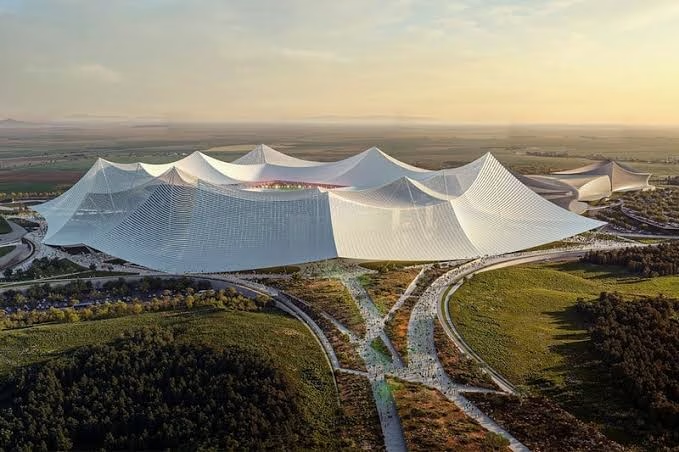
    Morocco has made a big step in its preparations for the 2030 FIFA World Cup after the country awarded a $320 million Sidi Slimane Stadium Construction Contract to a local consortium that will foresee the construction of the mega stadium project.

    Additionally, the upcoming new 115,000 seater Sidi Slimane Grand Stadium will be located on a 100-hectare site near Benslimane north of Casablanca. The modern stadium will become the largest stadium in Africa upon completion.

    Project Factsheet

    Official name: Grand Stade Hassan II

    Location: Near Benslimane, north of Casablanca, Morocco

    Capacity: 115,000 spectators

    Construction cost: Approximately $320 million

    Architects: Populous in collaboration with Oualalou + Choi

    Also read: Morocco Launches Construction Tender of $320 Million Hassan II Stadium, World’s Largest Stadium

    Sidi Slimane Stadium Construction Contract Winners

    The winning bid on the stadium project was submitted by Casablanca-based construction leaders TGCC and SGTM. The duo were the only consortium out of the others in the race to meet both the technical and financial requirements. This was revealed by Morocco’s official public procurement platform.

    The upcoming stadium is expected to rise and become the heart of a sprawling sports city which consists of a 25,000-seat athletics stadium and an Olympic-sized indoor swimming pool.

    Furthermore, other key features of the new stadium include a multipurpose arenas and luxury hotels. Also, it will have a state-of-the-art conference centre.

    The stadium’s plan transport infrastructure is important and its location will have easy access to major highways that serve the country’s capital Rabat, Casablanca, and Marrakech, and Mohammed V International Airport .

    Also read: Morocco Unveils Designs for the Grand Stade Hassan II, Set to Be the World’s Largest Football Stadium

    Completion Date

    The construction works of the stadium are expected to be finished in December of 2027. This timeline is ahead of the 2030 FIFA World Cup which will be hosted jointly by Morocco, Spain and Portugal .

    The upcoming Sidi Slimane Stadium is expected to be one of the world cup tournament flagship venues. Lastly, the stadium complements upgrades in Rabat, Casablanca, Tangier, Marrakech, Fes, and Agadir.

    Also read: Morocco Selects US-based Populous as Lead Architect on the World’s Largest Football Stadium

  • £500 Million Investment Planned for UK’s First Regional Hydrogen Transport and Storage Network

    £500 Million Investment Planned for UK’s First Regional Hydrogen Transport and Storage Network

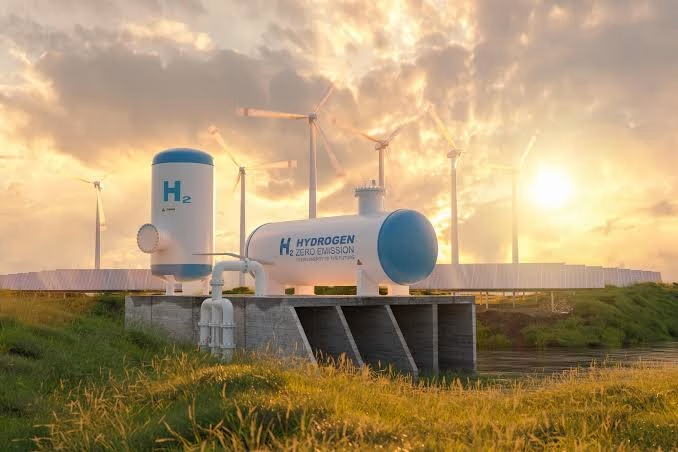
    The government of UK has just confirmed that more than £500 million will be released for developing UK’s First Regional Hydrogen Transport and Storage Network. This is aimed at creating thousands of skilled clean energy jobs in the regions of Merseyside, Teesside and the Humber.

    This announcement is part of a wider Plan for Change strategy that intends to position Britain as a clean energy superpower and cut its general dependence on volatile fossil fuel markets.

    UK’s First Regional Hydrogen Transport and Storage Network Factsheet

    Funding: more than £500 million government funding confirmed for hydrogen infrastructure.

    Network components and infrastructure:

    • Regional networks: The initial focus on the project is on creating regional networks. This is particularly in industrial heartlands such as Merseyside, Teesside, and the Humber.
    • Pipelines: there will be the development of new dedicated hydrogen pipelines. Also, existing natural gas pipelines will be repurposed for hydrogen transport (e.g., Project Union by National Gas Transmission wants to set up a 2,000km hydrogen backbone by repurposing existing infrastructure).

    Storage:

    • Underground storage: geological formations will be utilized such as the salt caverns. For example HyNet is repurposing salt caverns in Cheshire for hydrogen storage. Additionally, the UK has significant potential for large-scale underground hydrogen storage.

    Above-ground storage: Specialist tanks and vessels for smaller volumes will be erected. These are deemed suitable for both industrial use and refueling stations.

    Also read: Essar Energy Transition to build the UK’s Largest Hydrogen Plant

    Significance of the Funding

    The new funding will boost the development of the UK’s first regional hydrogen transport and storage network. The network is expected to link producers with industrial users and power stations.

    Energy secretary Ed Miliband stated that the investment is foreseen to “deliver jobs and energy security for Britain” and “bring in the investment that is needed across the country to deliver our Plan for Change”.

    Additionally, the government stated that the investment placed will also support hydrogen’s role in decarbonising hard-to-abate sectors such as iron, steel, chemicals and heavy transport and also enable long-term energy storage for periods of peak demand.

    The announcement made by the UK government builds on previous support for low-carbon hydrogen production. This is expected to be achieved through the Hydrogen Allocation Rounds (HAR) which includes £2 billion allocated to 11 projects under the first HAR.

    Also read: Xlink Pauses UK-Morocco Undersea Cable Construction

    Furthermore, Hydrogen UK head of policy Brett Ryan welcomed the announcement by UK government, calling networks “critical for a secure and resilient hydrogen sector”.

    Also, Dr Emma Guthrie who is the CEO of the Hydrogen Energy Association, mentioned that the plan would “galvanise the UK’s regional hydrogen hubs” and support the “creation of skilled sector areas like Merseyside, Teesside and the Humber”.

    Private Investment in UK’s Hydrogen Sector

    The hydrogen sector has already attracted a total of £400 million of private investment across the UK. This includes projects in Milford Haven and High Marnham.

    Lastly, in addition to hydrogen, the Spending Review confirmed financing for new nuclear and fusion developments. Additionally, it confirmed the support for the Acorn and Viking carbon capture projects.

    Also read: Construction to begin soon on largest blue hydrogen plant in UK

  • Rwanda Allocates $499 Million for Bugesera Airport Project Funding

    Rwanda Allocates $499 Million for Bugesera Airport Project Funding

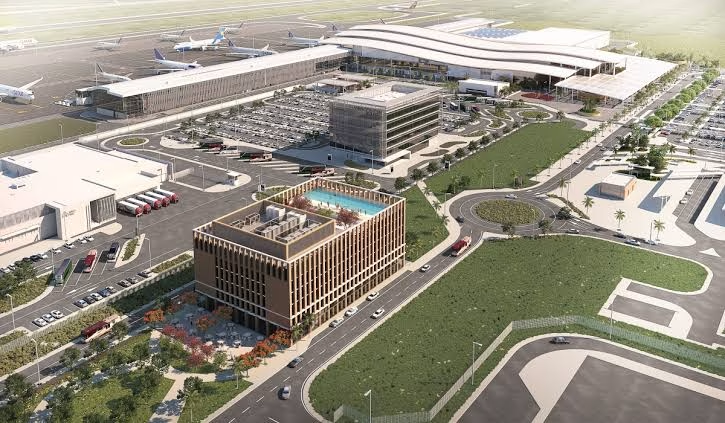
    The ministers of Rwanda have approved an investment package that amounts to Rwf699 billion ($499 million) in the 2025/26 budget to go to the Bugesera Airport Project Funding. This airport project is expected to cost approximately $2 billion by the time it reaches completion.

    Additionally, the completion deadline of the airport project was extended to the year 2028 from 2026. This was as a result of the delays in delivery of construction materials for the project.

    Project Factsheet

    Project name: New Bugesera International Airport (NBIA)

    Cost: approximately $2 billion

    Construction commencement: August 2017

    Phase 1 completion: expected by 2027

    Full completion (Phase 2): expected by 2032.

    Key infrastructure and features:

    • The airport project will entail a 3,750-meter runway. There are also plans for two runways in later phases.
    • There will be construction of a modern passenger terminal building.
    • Also, a presidential terminal will be built.
    • Office buildings for stakeholders will be constructed.
    • Latest features for cargo handling, aircraft maintenance, catering services will be incorporated.
    • As for the support infrastructure, a 14 km Expressway will be built to link the airport to Kigali.
    • The airport project will be designed for maximum operational flexibility and future expansion.
    • Lastly, the construction project will incorporates green building concepts.

    Bugesera airport project was originally launched in the year 2017. The airport project is being developed in two phases. Once the first is completed, the airport facility is expected to serve 7 million passengers every year. Furthermore, phase two is expected to be finished in the year 2032. It will expand the total capacity of the airport to 14 million passengers per year. Additionally, the site will also include a cargo terminal that will have a capacity of 150,000 tons per year.

    Also read: $2 Billion Rwanda’s Bugesera Airport Operations Commencement Set at 2028

    The Overall Cost of Bugesera Airport Project Funding

    Generally, the full airport project is valued at nearly $2 billion and is part of Rwanda’s strategy to position itself as the second aviation hub in the East Africa region, just behind Ethiopia. Qatar Airways, which holds a total of 60% stake in RwandAir is a key partner in the airport’s development and is expected to help increase passenger traffic once operations begin.

    Lastly, Rwanda is also seeking a $200 million loan from the Asian Infrastructure Investment Bank. This funding is expected to help finance the Bugesera airport project.

    Also read: Bugesera International Airport (BIA), Rwanda’s 3rd int’l airport