Rio Tinto and its Rhodes Ridge Joint Venture partners are investing A$28 million in a five-year conservation initiative – the Pilbara Toad Containment Project. The initiative aims to prevent invasive cane toads from spreading into Western Australia’s Pilbara region.
It is being developed with Curtin University. Together, the partners will establish a large-scale Toad Containment Zone by modifying pastoral water infrastructure across northern Western Australia.
Announced on November 3, 2026, the project will create a 7,500-square-kilometre “waterless barrier”. It will stretch between the Indian Ocean and the Great Sandy Desert, south of Broome. Meanwhile, early works are underway, with implementation scheduled to begin in 2027. The initiative will protect the Pilbara’s sensitive ecosystems, including habitats around Rio Tinto’s iron ore operations.
Of the A$28 million investment, Rio Tinto and the Rhodes Ridge Joint Venture will each contribute A$14 million. The joint venture comprises three partners. Rio Tinto holds a 50% interest, while Mitsui owns 40%. The remaining 10% is held by AMB Holdings.
Unlike conventional infrastructure projects, the initiative will rely on environmental engineering rather than roads, bridges or buildings. Instead, the main works will involve modifying, securing or removing access to artificial water points. These water sources help cane toads survive during dry conditions.
The project will cover six pastoral stations. Additionally, it will modify 685 infrastructure items, including water points and related pastoral facilities. As a result, fewer artificial water sources will be available to cane toads. This will help create a dry corridor and limit their southward movement towards the Pilbara.
Project Scope and Environmental Infrastructure
The proposed Toad Containment Zone will reduce water availability at key points along the cane toad invasion front. Consequently, it will create a controlled landscape. Meanwhile, researchers and land managers will work across the area south of Broome to stop the species from spreading into the Pilbara.
The Western Australian Government describes the barrier as a roughly 150-kilometre zone with reduced artificial water availability. Meanwhile, the wider containment area covers approximately 7,500 square kilometres. These figures represent two different aspects: the linear barrier and the broader area where water infrastructure will be modified.
The proposed works include upgrades to pastoral water infrastructure. Additionally, contractors will modify artificial watering points and restrict cane toads’ access to water during dry periods.
The engineering approach considers cane toad biology. According to research, the animals need water every few days during the dry season. Therefore, dams, troughs, tanks and other artificial water points become vital refuges where natural water sources are scarce.
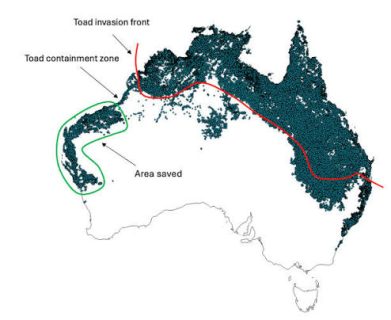
Restricting access to these water sources could make it more difficult for cane toads to survive and advance through the containment area. However, the project is designed to prevent further spread rather than eradicate cane toads throughout Australia.
The engineering specifications will vary for each water point. This will depend on its design, livestock and wildlife use, and local hydrology. Additionally, the modifications must support ongoing pastoral operations.
Construction and Implementation Requirements
The Toad Containment Zone will require coordinated fieldwork across six pastoral stations. To achieve this, landholders, Traditional Owners, environmental researchers, government agencies and infrastructure specialists will work together.
The programme will focus on modifying existing water infrastructure. Rather than building a continuous wall or fence, it will restrict access to artificial water sources. This approach is important because the barrier must reduce water access across a large and diverse landscape.
Key implementation activities include:
Water infrastructure upgrades: Modifying or securing artificial water points to reduce access by cane toads while considering the needs of livestock and other wildlife.
Site assessments: Mapping existing dams, tanks, troughs and other water facilities to determine which modifications are required.
Civil and mechanical works: Carrying out the physical alterations needed to water storage and distribution systems.
Environmental monitoring: Tracking cane toad movement. Also, assessing whether the modified water points reduce the likelihood of southward expansion.
Pastoral coordination: Scheduling work around station operations and maintaining essential water supplies for livestock.
Indigenous land management: Working with Traditional Owners and ranger groups to incorporate local knowledge and protect cultural heritage.
The project will need to balance environmental objectives with the practical demands of pastoral land use. Water infrastructure remains essential to cattle operations, meaning the design and implementation of each modification must consider how to maintain productive station activities while reducing opportunities for cane toads to survive.
The precise construction costs, equipment specifications, contractor appointments and quantities of materials have not been separately disclosed in the public announcement. The A$28 million figure is the total partnership funding commitment, not a confirmed civil construction contract value.
Biodiversity Protection Around Pilbara Iron Ore Operations
The Pilbara is recognised for its distinctive biodiversity and contains habitats that support numerous native species. Rio Tinto’s announcement identifies the northern quoll and ghost bat among the wildlife potentially affected if cane toads reach the region. The company says an estimated 25 native species could be significantly affected by an invasion.
Cane toads produce toxins that can kill predators that attempt to eat them. Their spread across Australia has created conservation challenges because many native predators have not evolved to recognise or tolerate the toxins.
The Australian Government identifies cane toads as an invasive species that can poison native wildlife and damage ecological relationships. Its management guidance emphasises reducing their impacts on affected ecosystems, given the difficulty of achieving broad-scale eradication.
Preventing their arrival in the Pilbara could therefore reduce future pressure on vulnerable wildlife populations. It could also help protect ecological values in a region where mining, pastoralism, Indigenous land management and biodiversity conservation operate across overlapping landscapes.
For Rio Tinto, the initiative forms part of its wider environmental management responsibilities in Western Australia. The company operates extensive iron ore infrastructure in the Pilbara, including mines, railways and port facilities. Protecting the surrounding environment is relevant to long-term land management and relationships with Traditional Owners and regional communities. This is as it continues to progress the development of its biggest iron ore project in the world at the Simandou iron ore project in Guinea.
However, the containment project’s primary purpose is biodiversity protection. It should not be interpreted as a mining expansion or as construction of infrastructure directly serving an individual iron ore mine.
Government and Research Partnerships
The Pilbara Toad Containment project builds on earlier government-supported research. In 2024, the Western Australian Government provided A$340,000 through the Department of Water and Environmental Regulation to Rangelands Natural Resource Management for initial exploratory work with local land managers. The department convened a workshop in 2025 to examine approaches to cane toad mitigation, including the containment zone concept.
Curtin University is a key research partner, with support from Deakin University. Their involvement will help connect the practical modification of water infrastructure with research into cane toad behaviour, movement and survival.
Traditional Owners, Indigenous ranger groups and pastoral landholders are also important to implementation. Their participation will be necessary to identify suitable sites, plan work and monitor the effectiveness of the barrier over time.
The project’s long-term success will depend on whether cane toads can be prevented from finding alternative water sources or bypassing the modified areas. Continued monitoring and adaptive management will therefore be important after the initial works are completed.
Pilbara Toad Containment Project Timeline and Next Steps
The initiative has moved from preliminary research and consultation towards implementation.
2024: The Western Australian Government provided A$340,000 for initial exploratory research and engagement with local land managers.
2025: Government and environmental specialists examined options for restricting cane toad movement through northern Western Australia.
November 3, 2026: Rio Tinto and the Rhodes Ridge Joint Venture announced the A$28 million funding commitment.
2026: Early works began to prepare for implementation.
2027: The Toad Containment Zone project is scheduled to begin its main implementation phase.
Following implementation: Monitoring will be required to assess the effectiveness of the barrier and identify any necessary modifications.
The next stage will involve coordinating the required water infrastructure modifications across the six pastoral stations. Project partners will also need to establish monitoring arrangements and agree on how progress will be measured.
Pilbara Toad Containment Project Fact Sheet
Location: Northern Western Australia, south of Broome
Project type: Environmental infrastructure and invasive species containment
Total funding commitment: A$28 million over five years
Rio Tinto contribution: A$14 million
Rhodes Ridge Joint Venture contribution: A$14 million
Lead research partner: Curtin University
Supporting research institution: Deakin University
Project area: Approximately 7,500 square kilometres
Containment corridor: Approximately 150 kilometres
Pastoral stations involved: Six
Infrastructure items to be modified or contained: 685
Early works: Underway as announced in November 2026
Main implementation: Scheduled to begin in 2027
Primary objective: Prevent cane toads from spreading south into the Pilbara
Key beneficiaries: Native wildlife, Traditional Owner communities, pastoral landholders and regional ecosystems
Pilbara Toad Containment Project Team
Industry funding partner: Rio Tinto.
Joint venture partner: Rhodes Ridge Joint Venture.
Joint venture participants: Rio Tinto, Mitsui and AMB Holdings.
Lead research partner: Curtin University.
Supporting research institution: Deakin University.
Government partner: Western Australian Department of Water and Environmental Regulation.
Land management and consultation partner: Rangelands Natural Resource Management.
Local implementation partners: Traditional Owners, Indigenous range groups and pastoral landholders.



Leave a Reply