
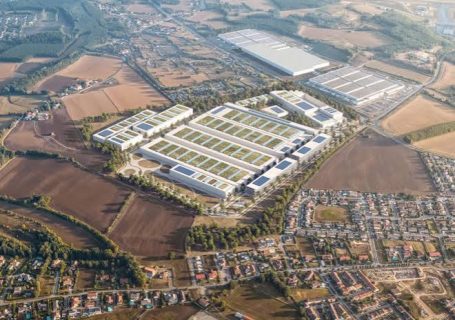
Saint-Éloi du Futur, a proposed $980 million engine pylon production facility, will expand Airbus’ aerospace manufacturing capacity in Cornebarrieu, near Toulouse, France. The project involves developing a new industrial complex on a 48-hectare site near Toulouse-Blagnac Airport. Airbus plans to establish specialised manufacturing, assembly, research and maintenance facilities to support future aircraft production requirements.
The proposed investment amounts to €900 million. Furthermore, the development will address capacity constraints at Airbus’ existing Saint-Éloi manufacturing operations in Toulouse. The company intends to implement the project in two phases, with initial operations targeted for 2031. Meanwhile, the second phase will expand production capacity by 2037. The development also forms part of Airbus’ wider strategy to modernise its industrial infrastructure and strengthen its European manufacturing network.
Saint-Éloi du Futur to Expand Engine Pylon Production Capacity
The proposed development will occupy a 48-hectare site known as Barquil 3 in Cornebarrieu. Airbus already owns the land, which lies close to its principal aerospace manufacturing facilities. The proposed complex will accommodate approximately 260,000 square metres of buildings.
The development will include manufacturing workshops, assembly facilities, research and development spaces, logistics infrastructure and training facilities. Additionally, Airbus plans to incorporate administrative offices, parking and security infrastructure.
The project responds to increasing demand for aircraft and limitations affecting existing manufacturing facilities. Airbus currently produces its commercial aircraft engine pylons at its Saint-Éloi operations in Toulouse. These components connect aircraft engines to their wings and withstand substantial structural forces.
The existing Saint-Éloi facility and its satellite operations produced more than 1,500 pylons in 2025. Together, the operations employ approximately 2,500 people, including 1,550 Airbus employees. However, Airbus anticipates that existing facilities cannot accommodate its future manufacturing requirements.
Consequently, the proposed complex will provide additional production capacity while preserving established manufacturing expertise. Airbus also intends to modernise its industrial processes and strengthen maintenance capabilities.
Two-Phase Construction Programme for Saint-Éloi du Futur
Airbus plans to implement Saint-Éloi du Futur through two development phases. The first phase will establish facilities for manufacturing elementary components used in engine pylon assembly. It will also accommodate after-sales repair activities and serial production of potential new pylon designs.
Construction could begin in 2029, subject to the necessary planning and regulatory approvals. Airbus targets initial operational readiness around 2031.
The second phase will increase manufacturing capacity through additional component production facilities. Furthermore, it will enable higher production rates and support the manufacturing requirements of Airbus’ aircraft programmes.
The second phase targets operational readiness around 2037. However, its implementation depends partly on amendments to Toulouse Métropole’s local urban planning framework.
The expansion will also support Airbus’ intention to consolidate strategic manufacturing activities within its European industrial network. In December 2025, Airbus completed its acquisition of selected Spirit AeroSystems operations.
The transaction included A220 engine pylon manufacturing activities previously located in Wichita, Kansas. Therefore, the new Toulouse complex could support the integration of these manufacturing capabilities.
The development aligns with Airbus’ longer-term production ambitions. The manufacturer has identified demand for more than 42,000 new aircraft over the next two decades. Consequently, expanding component manufacturing capacity will remain important to supporting higher aircraft production rates.
Saint-Éloi du Futur Enters Public Consultation
The proposed development entered its statutory public consultation phase on November 24, 2026. The consultation will continue until February 16, 2027, under France’s National Commission for Public Debate (CNDP).
The process will allow residents, local authorities and other stakeholders to examine the development. Participants can submit observations concerning environmental impacts, agricultural land use, industrial risks and construction activities.
Additionally, the consultation programme includes dedicated discussions about environmental and agricultural considerations. Another workshop will examine potential construction impacts, including traffic and construction-related disturbances.
The development will generate employment opportunities during construction and subsequent manufacturing operations. Airbus estimates approximately 700 additional full-time-equivalent jobs associated with the project.
Meanwhile, the completed industrial site could accommodate approximately 3,500 people, including employees and external contractors. Construction activities could also mobilise approximately 1,000 workers.
However, the development remains subject to consultation outcomes and the necessary planning procedures. The proposed construction therefore represents a significant long-term investment in Toulouse’s aerospace manufacturing infrastructure.
France is also strengthening its industrial manufacturing capacity through investments in other strategic sectors. The proposed Saint-Éloi du Futur development complements the country’s efforts to expand domestic production infrastructure, including the CARBON photovoltaic manufacturing gigafactory in Fos-sur-Mer. The project, which targets Europe’s largest photovoltaic production factory, aims to strengthen France’s solar manufacturing capabilities and create approximately 3,000 jobs. Both developments demonstrate France’s commitment to expanding domestic industrial production, strengthening supply chains and creating employment through large-scale manufacturing investments.

Leave a Reply