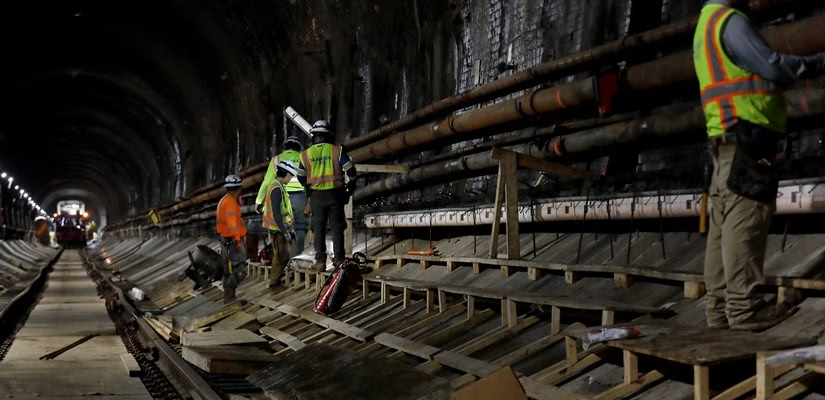
The Howard Street Tunnel Project is a major public-private infrastructure initiative that is set to expand vertical clearances along CSX’s I-95 rail corridor and allow double-stacked intermodal trains between Baltimore and Philadelphia. Recently, tje tunnel project has successfully wrapped up key milestones. Executed as a progressive design-build project by a joint venture of Skanska and Fay, S&B USA Construction alongside engineering firm Hatch, the $495 million expansion project lowered the 1.7-mile, 131-year-old historic tunnel’s floor by approximately 18 inches while completing clearance upgrades at over 20 additional structures across Maryland, Delaware, and Pennsylvania. Delivered substantially below its original $566 million budget, the project cleared the final major bottleneck in seamless double-stack freight capacity along the East Coast corridor and directly connected the Port of Baltimore’s Helen Delich Bentley facility to major consumer markets in the Midwest.
The construction was completed ahead of initial long-term timelines and official double-stack rail operations at the Port of Baltimore were formally launched with state and federal leaders. The expanded corridor is projected to increase container shipping capacity by up to 160,000 containers annually, generate over 13,000 jobs in logistics, port operations, and supply chain management, and eliminate localized truck traffic to cut regional highway congestion and emissions.
Similar Projects
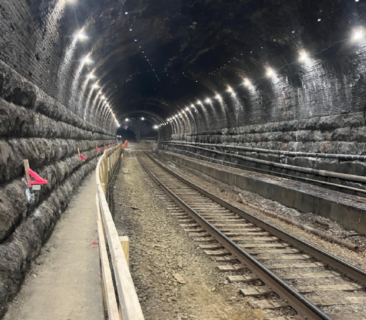
In another similar development, the US also seeks to construct the Line 5 Tunnel Project. Both the Howard Street Tunnel Project and the Enbridge Line 5 Great Lakes Tunnel Project represent major U.S. infrastructure efforts aimed at replacing or retrofitting aging 19th- and mid-20th-century transport corridors to safeguard trade and supply chain continuity. While the Howard Street Tunnel focuses on expanding rail freight capacity by lowering the bed of a 130-year-old Baltimore tunnel to accommodate double-stack container trains, the Line 5 project centers on energy transportation by constructing a modern concrete tunnel beneath the bed of the Straits of Mackinac to re-house a critical crude oil and natural gas liquids pipeline. Beyond their structural differences, both high-profile engineering projects share a core economic goal: replacing or modernizing constrained, legacy transport routes to boost capacity while reducing environmental and logistical risks, replacing thousands of long-haul truck trips and open-water shipping hazards with safer, more efficient underground alternatives.
October 1, 2025
Construction on CSX’s Howard Street Tunnel in Baltimore has reached substantial completion, nearly two years ahead of the original August 2027 target. The $450 million project, managed by a joint venture of Skanska and Fay under S&B USA Construction, is part of CSX’s broader efforts to remove clearance limitations for double-stack freight trains along the corridor between Baltimore and Philadelphia.
The 8,700-foot-long tunnel, originally built in 1895, was raised by two feet—from 19 to 21 feet—without altering its historic brick-and-stone arch. The work involved demolishing and excavating the tunnel floor and installing nearly 1,200 precast concrete slabs, each roughly 18–19 feet wide, through the utilization of railcar-mounted specialized equipment.
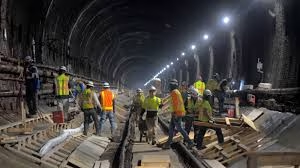
Project managers credited the use of a progressive design-build approach for allowing adjustments to engineering plans during construction, reducing costs, and accelerating the schedule. Crews operated around the clock for seven and a half months to complete the work.
Officials said the improvement will increase freight capacity and efficiency on the Mid-Atlantic corridor and into the Midwest, serving the interests of shippers and supporting supply chains connecting the Port of Baltimore.
While the Howard Street Tunnel modernization has been completed, Skanska continues to expand its presence in the U.S., with its latest project being the $323 million Skanska–Flatiron JV contract at Los Angeles International Airport, announced on September 29, 2025.
CSX’s Howard Street Tunnel Modernization Project Completed: Factsheet
Location: Baltimore, Maryland, USA
Owner: CSX Transportation
Construction JV: S&B USA Construction (Skanska + Fay)
Project Value: $450 million
Original Completion Date: August 2027
Actual Substantial Completion: Mid-September 2025
Tunnel Length: 8,700 feet
Original Tunnel Height: 19 feet
Upgraded Tunnel Height: 21 feet
Construction Highlights:
Preserved the original 1895 brick-and-stone arch.
Demolished and excavated the tunnel floor to increase clearance.
Installed 1,200 precast concrete invert slabs, each 18–19 feet wide.
Used specialized railcar-mounted gantry crane for slab placement.
Operated 24/7 over seven and a half months.
Project Methodology: Progressive design-build approach allowing plan adjustments during construction, cost optimization, and accelerated schedule.
Impact:
Increased clearance for double-stack freight trains.
Boosted freight capacity and efficiency along the Baltimore–Philadelphia corridor and into the Midwest.
Enhanced supply chain reliability, including access to the Port of Baltimore.
Extended tunnel lifespan without constructing a new structure.
Key Partners:
Lead Designer: Hatch
Engineering Consultant: WRA


Leave a Reply