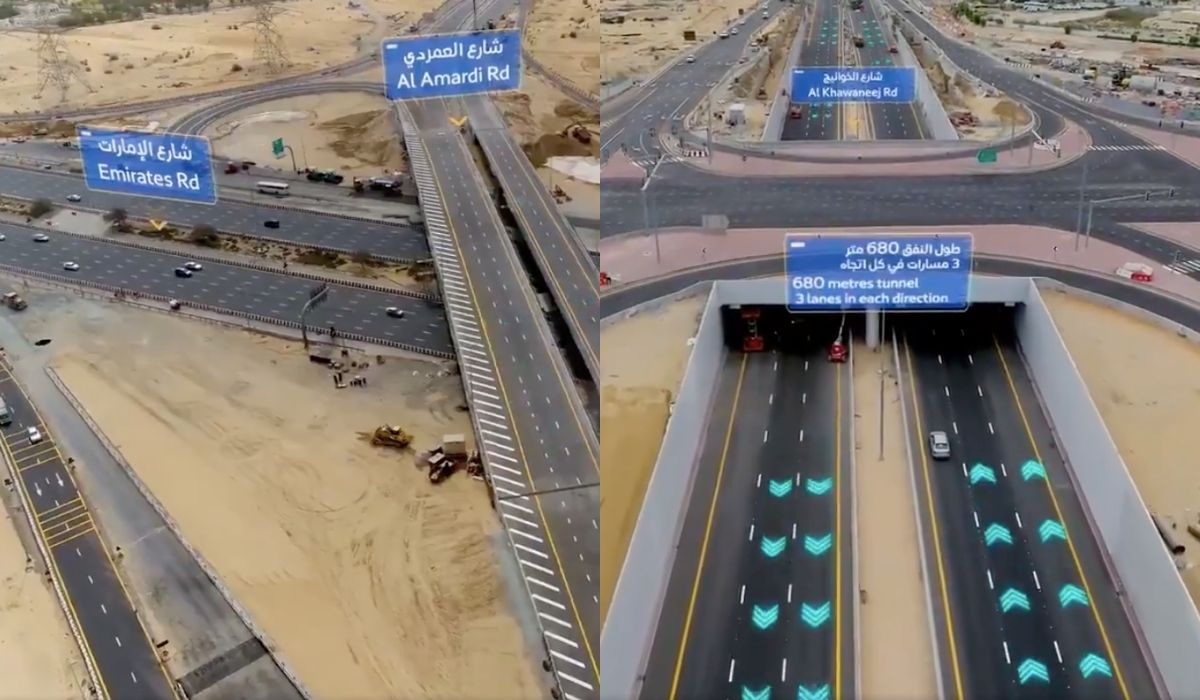
The Dubai-Sharjah Road Project has transitioned into its operational phase after the completion of major construction works designed to improve connectivity between the UAE’s two busiest emirates. The project delivered key road upgrades, bridge infrastructure, and traffic-flow improvements aimed at reducing travel times and easing congestion along one of the country’s most heavily used commuter corridors. As traffic volumes continue to grow between Dubai and Sharjah, the completed infrastructure forms part of a broader strategy to enhance regional mobility and support economic development.
According to the Road and Transport Authority of Sharjah, the project built a 600-meter lane on Al Ittihad Street. Seamlessly, the brand-new lane connects to the Al Kholafaa Al Rashideen Bridge.
In an effort to meet the infrastructural needs of road users, the project also made adjustments to the service road pavements. An extra lane that connects to the Khulafa Al-Rashideen Bridge was also added as part of the project.
Dubai-Sharjah Road Project Current Status Update (2026)
As of 2026, the Dubai-Sharjah Road Project is fully operational and continues to serve as a critical transport link between the two emirates. The completed improvements have contributed to smoother traffic movement and increased corridor capacity. Meanwhile, UAE authorities have launched additional road and highway initiatives to further address congestion on the Dubai-Sharjah commuter route, including the proposed Fourth Federal Corridor and several new Sharjah road expansion projects. These complementary investments demonstrate that improving inter-emirate connectivity remains a national infrastructure priority.
The project’s completion has also helped support wider transportation planning efforts across the UAE. Authorities continue to evaluate additional road upgrades, tunnels, bridges, and public transport solutions to accommodate increasing commuter demand between Dubai, Sharjah, and neighboring emirates.
The completed scheme remains an important component of the UAE’s long-term mobility strategy, which seeks to improve traffic efficiency, strengthen economic links, and enhance accessibility across major urban centers.
Regional governments are increasingly investing in major transport infrastructure to address rising traffic demand. A notable example is Saudi Arabia’s $2.6 billion Riyadh Road Development Program, which will deliver 40km of upgraded road corridors, 33 bridges, five tunnels, and capacity for more than 950,000 vehicles daily, further highlighting the scale of mobility investments underway across the Gulf.
Significance of the newly improved Al Ittihad Road, along the Dubai-Sharjah corridor
According to the Road and Transport Authority of Sharjah, the enhancements aim to accommodate the growing population of Sharjah.
As quoted by Khaleej Times, a Sharjah Resident, Abbas Malik said that commuters are happy with the completion of the project. This is because it was able to relieve some of the traffic congestion in areas such as Rolla, Al-Majaz, and Corniche.
Also Read: First Rashidun Caliph Mosque opened in Sharjah, UAE
Initially, it would take 15 minutes to clear the traffic near the mall. However, the successful upgrade works of the Al Ittihad Road along the Dubai-Sharjah corridor have slashed it down to five minutes. As a result, commuters travelling to industrial areas have also had an easier time, especially those heading towards Ajman and King Faisal Road.
As a whole, the project is part of the region’s commitment to enhancing infrastructure and improving roads. Back in 2018, the UAE’s Ministry of Infrastructure Development made an announcement of a project worth AED 230 million, with the aim of improving traffic flow and road capacity.
Project Fact Sheet
Project Name: Dubai-Sharjah Road Project
Location: Dubai and Sharjah, United Arab Emirates
Status: Completed and operational
Sector: Transport Infrastructure
Project Type: Road and Interchange Development
Primary Objective: Improve connectivity between Dubai and Sharjah
Key Components:
- Road widening works
- New bridges
- Traffic-flow improvements
- Junction and interchange upgrades
Benefits:
- Reduced travel times
- Improved traffic movement
- Increased road capacity
- Enhanced regional connectivity
Strategic Importance:
- Supports inter-emirate mobility
- Strengthens economic integration
- Improves commuter experience
Current Operational Status (2026): In service and supporting daily traffic movements
Project Team
Project Owners:
- Roads and Transport Authority (Dubai)
- Sharjah Roads and Transport Authority (Sharjah)
Government Stakeholder: Government of Dubai
Government Stakeholder: Government of Sharjah
Transport Authority: Ministry of Energy and Infrastructure
Design Consultant: Not publicly disclosed
Engineering Consultant: Not publicly disclosed
Main Contractor: Not publicly disclosed
Project Management Consultant: Not publicly disclosed
Current Status: Completed and operational (2026)




Leave a Reply