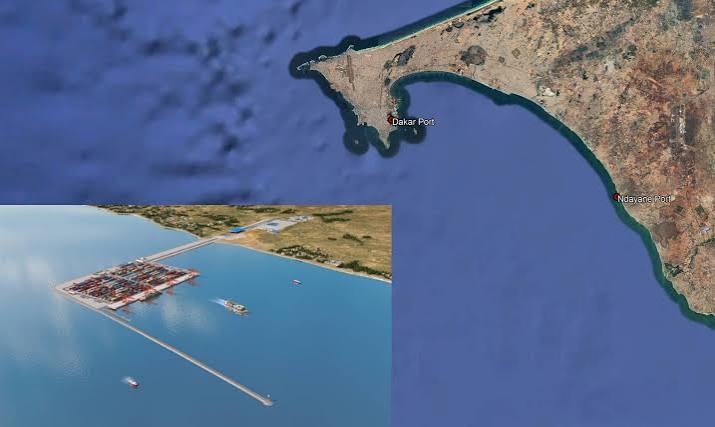
Ndayane port project has reached a significant construction milestone after DP World completed the project’s capital dredging works 13 months ahead of schedule in Senegal. The achievement unlocks the next phase of marine construction, allowing contractors to accelerate quay wall development and supporting infrastructure.
Consequently, the $1.2 billion deep-water port remains on track for completion in 2028, reinforcing Senegal’s strategy to establish a regional maritime and logistics hub in West Africa. The milestone also demonstrates steady progress on one of the country’s largest infrastructure investments.
The early completion of dredging removes one of the project’s most technically challenging activities. As a result, construction teams can immediately advance marine civil works while maintaining the overall delivery schedule.
The development will ultimately replace capacity-constrained facilities at the Port of Dakar and position Senegal to accommodate larger container vessels and growing regional trade volumes.
Ndayane Port Project enters accelerated marine construction phase
DP World completed the capital dredging campaign after mobilizing works in December 2024. The program involved excavating a five-kilometer navigation channel, a turning basin and the future berth pocket for the new container terminal.
Although the original completion date was September 2027, the contractor finished the works in July 2026, gaining a 13-month schedule advantage.
The marine works presented considerable engineering challenges. More than 95% of the excavated material consisted of hard rock with compressive strengths exceeding 100 megapascals.
The material was removed without blasting. In a clarification provided to Construction Review Online, dredging contractor Jan De Nul Group confirmed that the works were carried out using its cutter suction dredger Willem Van Rubroeck, supported by the vessels De Bougainville, Boussole and Le Guerrier, alongside advanced excavation techniques. This approach improved efficiency while limiting environmental disturbance during construction.
With dredging complete, contractors have shifted their attention to quay wall construction, marine structures and terminal infrastructure.
Therefore, the project team expects stronger coordination between offshore and onshore activities as construction gathers pace over the coming months. More than 1,000 workers currently support the development across multiple work fronts.
Ndayane Port Project will transform Senegal’s maritime infrastructure
The Ndayane Port Project lies approximately 50 kilometers south of Dakar. Once operational, it will become Senegal’s primary deep-water container port and relieve congestion at the Port of Dakar, where expansion opportunities remain limited. The new facility will also strengthen shipping connections between West Africa and international markets.
Phase one includes an 840-metre container quay with an annual handling capacity of 1.2 million twenty-foot equivalent units. A second phase will add another 410 meters of quay, creating additional capacity to meet future cargo demand. The long-term master plan provides for more than three kilometers of quay infrastructure and extensive container storage facilities.
Beyond the port itself, the development supports Senegal’s broader economic ambitions. Plans include an adjacent special economic zone linked to Blaise Diagne International Airport, creating an integrated logistics and industrial corridor.
The investment aims to attract manufacturing industries, improve regional supply chains and expand export opportunities. According to project estimates, the development could contribute around 3% to Senegal’s GDP while supporting significant employment and trade growth over the coming decade.
Construction will now focus on completing marine infrastructure, container handling facilities and landside support works before commissioning in 2028. If progress continues at its current pace, the Ndayane Port Project will rank among West Africa’s most important maritime infrastructure developments and strengthen Senegal’s position as a regional logistics gateway.
The Ndayane Port Project forms part of Senegal’s wider strategy to modernise its maritime infrastructure. The government is also advancing the Port of Bargny-Sendou Project, another major development designed to expand bulk cargo handling capacity and strengthen the country’s position as a regional logistics hub.
Project Fact Sheet
Name: Ndayane Port Project
Location: Ndayane, approximately 50km south of Dakar, Senegal
Value: $1.2 billion
Type: Deep-water container port development
Current status: Capital dredging completed 13 months ahead of schedule; marine construction progressing
Construction commencement: December 2024 (capital dredging phase)
Expected completion: 2028
Navigation channel: 5km
Phase Two: Additional 410-metre quay extension
Turning basin: Constructed to accommodate ultra-large container vessels
Phase one infrastructure: 840-metre container quay
Phase one capacity: 1.2 million TEUs annually
Long-term development: More than 3km of quay and large-scale container storage yards
Current workforce: More than 1,000 workers
Economic impact: Designed to ease congestion at Dakar Port and strengthen Senegal’s regional trade competitiveness
Associated development: Special Economic Zone linked to Blaise Diagne International Airport
Project Team
Owner: Government of Senegal
Developer and future operator: DP World
Strategic investment partner: British International Investment (BII)
Marine construction lead: DP World Marine Services
Dredging contractor: Jan De Nul Group
Key marine equipment: Willem Van Rubroeck and Les Alizés cutter suction dredgers
Project management: DP World Africa
Engineering and marine delivery: DP World Projects Division
Future terminal operator: DP World
Key stakeholders:
- Government of Senegal
- Ministry of Fisheries
- Maritime and Port Infrastructure
- British International Investment
- DP World.



Leave a Reply