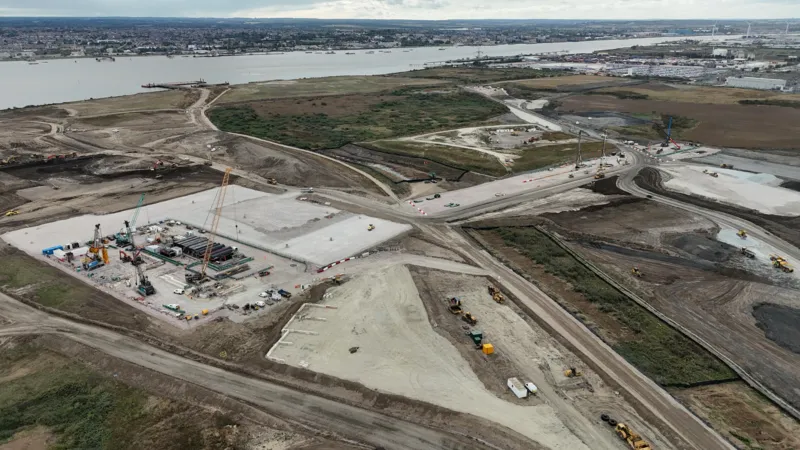
Lower Thames Crossing works are now reshaping construction sites across Kent and Essex as the £10.6 billion project moves into delivery. National Highways has begun extensive preparation ahead of the main tunneling operation beneath the River Thames.
The 14.5-mile (23km) crossing will connect Kent with Thurrock and Essex through twin road tunnels. Meanwhile, construction activity now includes haul roads, environmental works, ground investigations and site preparation. These works establish the infrastructure needed before major tunnel construction begins in 2028.
Lower Thames Crossing works reshape early construction sites
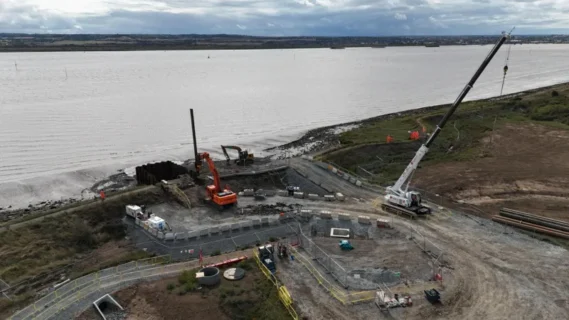
The current construction phase is already changing several locations along the planned route. At Coalhouse Point beside the Thames, crews are moving earth to create a new wetland. The planned wetland will cover an area equivalent to around 50 football pitches.
The habitat forms part of wider environmental measures accompanying the construction program. National Highways also plans around 1,000 hectares of new habitat during the early works. The program aims to establish habitats before the largest construction activities begin.
At Coalhouse Fort, archaeologists are excavating areas affected by the future route. Ground investigations are also examining soil, rock and groundwater conditions for detailed engineering designs.
Elsewhere, contractors are building haul roads for construction traffic along the route. These roads will move materials between docks, compounds and construction areas while limiting traffic on local roads. The approach creates visible construction activity before the main road and tunnel structures emerge.
Lower Thames Crossing works prepare for major tunnel construction
The underground section represents the project’s largest engineering challenge. National Highways selected the company responsible for constructing the tunnel boring machine in July 2026. The machine will measure 16.4 meters in diameter and weigh more than 5,000 tones. It will arrive in sections through the Port of Tilbury before tunnel operations begin.
The machine will excavate two parallel tunnels beneath the Thames. Each tunnel will accommodate three lanes and carry traffic at speeds up to 70mph. The tunnel drive is scheduled to begin in autumn 2028. National Highways expects the completed crossing to open during the early-to-mid 2030s.
The project will also almost double road capacity across the Thames east of London. It aims to provide an alternative to the heavily used Dartford Crossing. The new route will connect the A2 and M2 in Kent with the A13 and M25 in Essex and Greater London.
Construction funding and delivery structure
The project has entered construction while the UK government develops its planned private-financing structure. The preferred model uses a Regulated Asset Base arrangement for construction and operation.
A Highways Financing Bill introduced in September would enable private investment through that model. Meanwhile, government funding remains committed for the current enabling works.
The latest assured project cost stands at approximately £10.6 billion. Government records show £3.1 billion in total public investment, including spending already incurred. The three principal delivery partners are already engaged across the construction program.
The Lower Thames Crossing also forms part of the UK’s wider programme to expand strategic road capacity. For further context on major UK road construction, see the A9 Dualling Tomatin to Moy project, where the Scottish Government revised the section’s estimated cost to £150 million and changed its procurement strategy after the initial tender process failed.
Project Fact Sheet
Project: Lower Thames Crossing
Type: Major road and tunnel infrastructure project
Estimated cost: £10.6 billion
Location: Kent, Thurrock and Essex, United Kingdom
Route length: Approximately 14.5 miles (23km)
River crossing: Twin-bored tunnels beneath the River Thames
Road configuration: Three lanes in each direction
Tunnel diameter: 16.4 meters
Tunnel construction start: Autumn 2028
Expected opening: Early-to-mid 2030s
Development consent: Granted in March 2025
Construction status: Early enabling and preparation works underway
Main objectives: Increase Thames crossing capacity and reduce pressure on Dartford Crossing
Environmental program: Around 1,000 hectares of new habitat planned
Funding model: Proposed Regulated Asset Base model
Current public investment: £3.1 billion, including expenditure to date
Project Team
Owner and delivery authority: National Highways
Government department: Department for Transport
Tunnels and systems delivery partner: Bouygues Travaux Publics Murphy Joint Venture
Kent roads delivery partner: Skanska Construction UK
Roads north of the Thames delivery partner: Balfour Beatty Civil Engineering
Tunnel boring machine contractor: Herrenknecht
Environmental and community program: National Highways and its delivery partners
Regulatory oversight: Office of Rail and Road
Planning authority: Planning Inspectorate
Funding framework: UK Government through the proposed Regulated Asset Base model



Leave a Reply