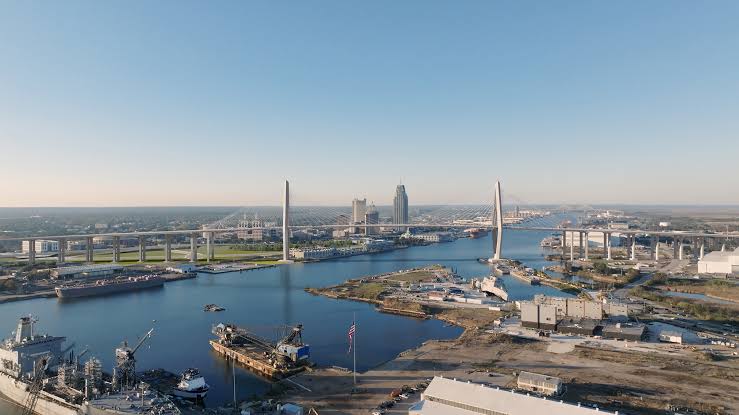
The Alabama Department of Transportation has closed the final major financing gap for the Mobile River Bridge and Bayway Project after securing a $2.52 billion federal loan, the largest individual funding component behind what officials describe as the biggest infrastructure project in state history. The U.S. Department of Transportation’s Build America Bureau approved the low-interest loan this week, paving the way for construction of the six-lane Interstate 10 crossing to start in Mobile, Alabama, as early as October.
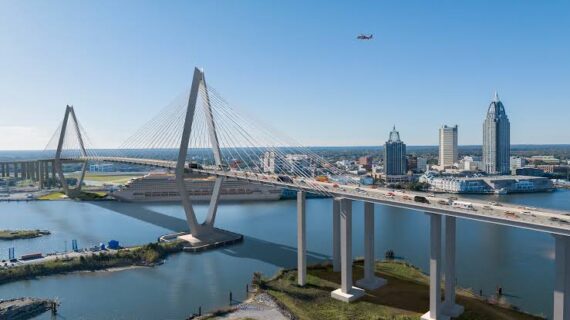
The loan, provided through the Transportation Infrastructure Finance and Innovation Act (TIFIA), takes the project’s overall financing package beyond $3.5 billion, with most of the funding supporting a $3.2 billion guaranteed maximum price contract awarded by the Alabama Department of Transportation. Combined with federal and state grants, the financing will fund a new cable-stayed bridge rising 215 feet above the Mobile River, a Bayway carrying three lanes in each direction, and redesigned interchanges intended to reduce cross-bay travel times by up to 30 minutes.
Another of Alabama’s long-delayed bridge projects has also entered construction. Work started in August on the first phase of the Highway 280 Pedestrian Bridge project connecting Homewood and Mountain Brook, following more than a decade of coordination between ALDOT, Jefferson County and three city governments. The $5.5 million first phase includes new sidewalks along Hollywood Boulevard, while a second phase will widen the bridge and introduce a protected pedestrian lane after it goes to bid in 2027. Like the Mobile crossing, the Hollywood Boulevard bridge demonstrates how funding assembled across cities, counties and the state can ultimately bring a project to full financing.
Mobile River Bridge and Bayway Project Funding Draws From Five Distinct Sources
The Mobile River Bridge and Bayway Project combines federal grants, federal lending and state funding to cover its $3.2 billion construction cost.
The project received a $125 million grant through the federal Nationally Significant Multimodal Freight and Highway Projects programme, known as INFRA. Another $550 million was awarded in 2024 through the Bridge Investment Program, ranking among the largest awards made through the programme.
ALDOT has also committed at least $250 million of its own funding, with officials expecting that contribution to increase before construction is completed. In addition, approximately $500 million that ALDOT has already spent since 1997 on right-of-way purchases and engineering studies has helped bring the project to what officials call a shovel-ready stage.
The financing shortfall was resolved this week through the $2.52 billion TIFIA loan. The debt will sit as second-lien financing behind the project’s revenue bonds and will be repaid through toll revenue after the bridge opens.
Kiewit Massman Traylor Steps In After 2025 Contractor Shake-Up
ALDOT has awarded construction of the Mobile River Bridge and Bayway Project to Kiewit Massman Traylor, a New Orleans-based joint venture comprising Kiewit, Massman Construction Co. and Traylor Bros., Inc. The consortium assumed responsibility for the wider project in May 2025 after ALDOT and its former contractor separated for undisclosed reasons.
Kiewit Massman Traylor had already been chosen to design and construct the cable-stayed bridge portion, meaning the expanded assignment allowed pre-construction activities to proceed without starting the procurement process again. The team has since completed pile load testing at six locations along the bridge alignment to verify the capacity of the concrete foundation piles supporting the new structures.
Meanwhile, Michael Baker International remains ALDOT’s owner’s engineer, providing support for procurement, design review and construction oversight throughout the project.
New I-10 Corridor Aims to Cut Travel Times and Aid Hurricane Evacuation
When finished, the Mobile River Bridge and Bayway Project will carry six lanes of Interstate 10 across Mobile Bay on a cable-stayed bridge with 215 feet of clearance above the navigation channel, allowing oceangoing vessels to pass beneath it.
ALDOT estimates that the new crossing could reduce cross-bay travel times by as much as 30 minutes while providing trucks carrying hazardous materials with an alternative to the aging George Wallace Tunnel and downtown Mobile. Hurricane evacuation is another major consideration, as the existing tunnels and Bayway have long been regarded as congestion points when coastal residents need to evacuate quickly.
Additionally, the Mobile River Bridge and Bayway Project is expected to strengthen freight connections to the Port of Mobile, one of the Gulf Coast’s busiest ports, by addressing a longstanding bottleneck affecting truck movements.
Tolls Will Repay Part of the Financing, But Legacy Routes Stay Free
Approximately $625 million of the project’s borrowing is expected to be repaid through toll collections once the new bridge opens. Drivers using an ALGO transponder will pay as little as $3 per crossing, while a $60 monthly pass will provide unlimited trips.
Vehicles without a transponder will face higher charges of up to $15.40 per crossing. Existing crossings, including the Wallace Tunnel, Bankhead Tunnel, Causeway and Africatown Bridge, will nevertheless remain toll-free after the new bridge opens, giving motorists an alternative if they choose not to pay the new toll.
Project Overview
- Project Name: Mobile River Bridge and Bayway Project (I-10 Mobile River Bridge and Bayway Widening Project)
- Owner and Managing Agency: Alabama Department of Transportation (ALDOT)
- Financing Authority: Alabama Toll Road, Bridge, and Tunnel Authority
- Location: Mobile and Baldwin counties, Alabama, along the Interstate 10 corridor across Mobile Bay
- Project Type: Cable-stayed bridge and interstate widening with all-electronic tolling
- Project Value: $3.2 billion guaranteed maximum price for Phase One construction; total program financing exceeds $3.5 billion
- Capacity: Six-lane cable-stayed bridge with 215 feet of vertical clearance over the Mobile River; Bayway restriped to three lanes in each direction
- Phasing: Phase One covers the bridge and Bayway restriping; a new Bayway crossing (Phase Two) is deferred to a future funding round
- Status: Financing closed in September 2026; full construction authorization expected in early October 2026
- Construction Start: Expected fall 2026
- Target Completion: Around 2031
- Funding Sources: $125 million INFRA grant, $550 million Bridge Investment Program grant (2024), $2.52 billion TIFIA loan, at least $250 million in ALDOT funds
- Tolling: $3 minimum crossing rate with an ALGO transponder, up to $15.40 without one, $60 monthly unlimited pass; existing tunnels, Causeway and Africatown Bridge remain free
- Economic Impact: Expected to cut cross-bay travel time by up to 30 minutes and improve freight access to the Port of Mobile
- Regulatory Framework: Financed in part through the federal Transportation Infrastructure Finance and Innovation Act (TIFIA) program administered by the Build America Bureau
Project Team
Owner and Financing
- Owner and Managing Agency: Alabama Department of Transportation
- Financing Authority: Alabama Toll Road, Bridge, and Tunnel Authority (administered through ALDOT)
- Federal Loan Program: Build America Bureau, U.S. Department of Transportation
Design-Build Team
- Lead Design-Builder: Kiewit Massman Traylor (KMT) joint venture
- Joint Venture Partner: Kiewit
- Joint Venture Partner: Massman Construction Co.
- Joint Venture Partner: Traylor Bros., Inc.
Consultants and Advisors
- Owner’s Engineer: Michael Baker International
Public Bodies
- Governor of Alabama: Kay Ivey
- Federal Oversight: U.S. Department of Transportation
- Regional Planning Partners: Mobile Metropolitan Planning Organization and Eastern Shore Metropolitan Planning Organization

Leave a Reply