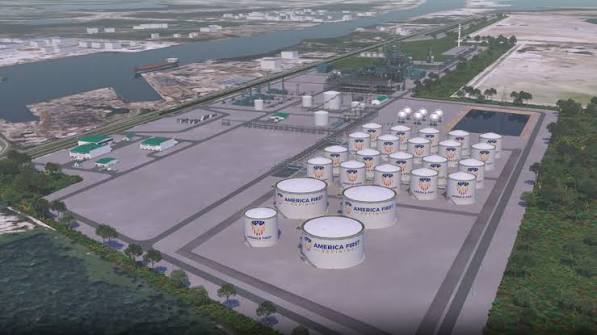
Plans for a proposed refinery at the Port of Brownsville, Texas, have advanced with front-end engineering and design work for the facility’s storage tank farm.
America First Refining said Matrix Service Company had been selected to carry out the design work. The value of the contract was not disclosed.
The tank farm would form part of the refinery’s supporting infrastructure, providing facilities to receive, store and transfer crude oil and refined petroleum products.
The announcement marks a new engineering milestone for the wider project. However, America First Refining said the work would support the project as it moves toward a Final Investment Decision (FID). The company did not say that the decision had already been made.
Refinery planned for Brownsville
America First Refining plans to develop the refinery on more than 240 acres within the Port of Brownsville.
The facility is expected to process approximately 60 million barrels of domestic crude oil annually. AFR says the refinery will be designed to process 100% U.S. light shale oil. And produce ultra-low-sulfur diesel, jet fuel and specialized gasoline.
The Port of Brownsville has described the development as the first new large-scale refinery on the U.S. Gulf Coast in nearly 50 years. The project is being positioned as a greenfield refinery rather than an expansion of an existing refining complex.
The port’s location would give the refinery access to marine, rail and road transportation. The site has six liquid-cargo docks, 13 general-cargo docks and direct rail connections, infrastructure that could support the movement of crude and refined products once the facility is operational.
The City of Brownsville and the port have cited projected employment benefits from the development, including about 2,000 construction jobs and 500 permanent positions.
Tank farm supports refinery operations
A storage tank farm would support the movement of crude oil into the refinery and the transfer of finished products after processing.
For a refinery designed to handle approximately 60 million barrels of crude annually, storage infrastructure would provide an interface between incoming crude supplies, the refinery’s processing units and outgoing petroleum products.
The latest announcement does not disclose the planned storage capacity, number of tanks, design cost or expected completion date for the engineering work.
It also does not provide the refinery’s total capital cost or a confirmed date for the start of full construction.
The project’s next major milestone is the Final Investment Decision. America First Refining has not announced when that decision will be made.
Project has a long development history
The Port of Brownsville said the refinery project had been in development for more than 10 years when it announced the America First Refining project in March 2026.
Earlier federal and state environmental records identify a proposed Brownsville facility linked to Jupiter Brownsville LLC and the name Centurion Brownsville. Those records describe a proposed heavy-condensate processing facility and include environmental permits for that earlier project.
The latest America First Refining announcements do not clarify whether the current proposal shares the same ownership, design or permits as the earlier Centurion Brownsville proposal. Without further documentation, the two projects should not be treated as identical.
Engineering work continues to take shape
The Matrix award follows other engineering and technology appointments for the proposed refinery.
Fluor announced in April that it had been selected to provide engineering and design services for the America First Refining facility.
AFR has also selected Axens as the refinery’s technology licensor, while other project announcements outline additional engineering work for the proposed facility.
These appointments show that AFR continues to develop the technical packages the refinery needs, but they do not confirm that AFR has started full construction.
The latest Matrix award covers the storage tank farm, adding another element to the project’s engineering scope as AFR works toward its investment decision.
Planned oil supply arrangement
The City of Brownsville says the project is linked to a 20-year agreement covering the purchase and processing of 1.2 billion barrels of U.S. light shale oil from the Permian Basin in West Texas.
AFR has said the refinery could process approximately 60 million barrels of domestic crude annually. Over a 20-year period, that annual capacity would broadly correspond to 1.2 billion barrels. Although actual throughput would depend on the facility’s operating performance and commercial arrangements.
The city also cites projected long-term values of approximately $125 billion for the crude and $175 billion for refined products.
Those figures represent the expected value of the proposed supply and production arrangements. They do not represent the construction cost of the refinery.
A final construction budget has not been provided in the project announcements reviewed for this report.
What is confirmed
The latest confirmed development is the award of front-end engineering and design work for the proposed refinery’s storage tank farm.
The wider project remains in the engineering and development stage, with a Final Investment Decision described as a future milestone.
America First Refining has announced the project’s proposed location, processing capacity, products and projected employment benefits. The company has not disclosed the final construction cost, the value of the tank-farm contract or a confirmed date for full refinery construction.
Additionally, the Brownsville refinery is part of a broader wave of investment in U.S. fuel infrastructure. The $5 billion Western Gateway Pipeline has reached a Final Investment Decision and is moving into execution. The approximately 1,300-mile refined-products pipeline will connect Midcontinent and Gulf Coast supplies with markets in Arizona and California. With planned capacity of 230,000 barrels per day and an in-service target of 2029. Unlike the Brownsville refinery, Western Gateway has already reached FID, highlighting the different stages at which major U.S. fuel infrastructure projects are advancing.
In Louisiana, CITGO Petroleum Corporation has approved a $310 million investment for a depentanization and naphtha-upgrading project at its Lake Charles Refinery. The project will add processing facilities to convert lower-value refinery streams into higher-value gasoline blend components, with operations targeted for 2029.
Project factsheet: America First refinery project at Port of Brownsville
- Location: Port of Brownsville, Texas
- Latest development: Front-end engineering and design work awarded for the proposed storage tank farm
- Developer: America First Refining
- Engineering contractor: Matrix Service Company
- Contract value: Not disclosed
- Planned crude processing: Approximately 60 million barrels annually
- Feedstock: Domestic U.S. light shale oil
- Planned products: Ultra-low-sulfur diesel, jet fuel and specialized gasoline
- Planned site: More than 240 acres
- Projected construction jobs: About 2,000
- Projected permanent jobs: About 500
- Current status: Engineering and project development
- Final Investment Decision: Not confirmed as completed
- Full construction start: Not confirmed
- Final project cost: Not disclosed

Leave a Reply