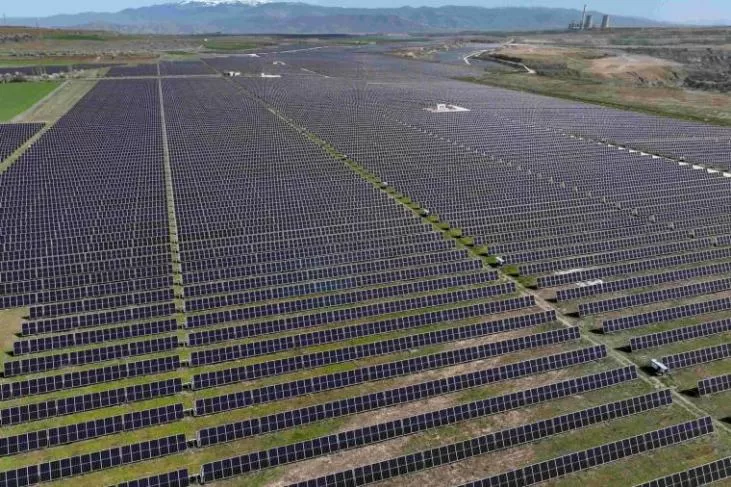
Darden Clean Energy Project continues to gain momentum as one of the world’s largest integrated solar and battery energy storage developments following California Energy Commission approval and the commencement of compliance-stage construction activities.
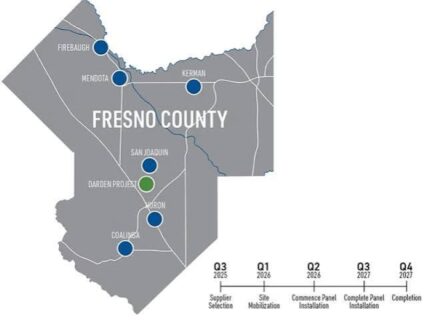
The project is located in western Fresno County, California. It features 1,150MW of solar photovoltaic (PV) generation paired with a 4,600MWh battery energy storage system (BESS) across approximately 9,500 acres. Darden is expected to strengthen California’s grid reliability and advance the state’s transition toward 100% clean electricity. This will be alongside others such as the Aratina solar project in Kern County with over 900 MWh of battery energy storage.
Once operational, the development is expected to become the world’s largest battery storage project and a landmark in utility-scale renewable energy deployment.
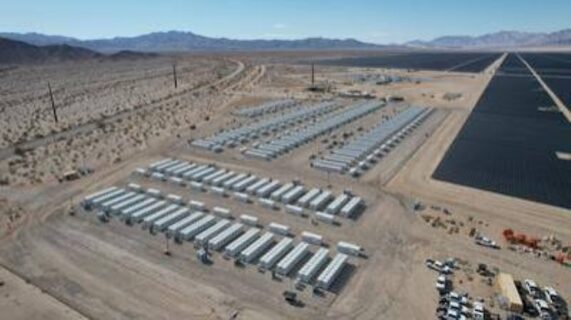
Darden Clean Energy Project: The World’s Largest Battery Energy Storage System Given Go Ahead
Reported June 13, 2025 – The California Energy Commission (CEC) has given the green light to the Darden Clean Energy Project (DCEP), now officially the largest battery energy storage system in the world once completed joining a list of massive BESS projects being constructed around the world. This landmark project, situated on 9,500 acres of non-arable land in western Fresno County, also marks a major milestone in the state’s push toward 100% clean electricity by 2045.
Governor Gavin Newsom celebrated the approval, stating, “California is moving faster than ever before to build the clean energy we need – now with the world’s largest solar and battery project.” He emphasized the dual benefit of the project: advancing climate goals while boosting local job creation and economic growth.
Project Details: Scope and Capacity
Owned by IP Darden I, LLC, a subsidiary of Intersect Power, DCEP will integrate a 1,150-megawatt (MW) solar facility and a 4,600 megawatt-hour (MWh) battery system. The system will be capable of powering approximately 850,000 homes for four hours. This makes it a critical addition to California’s energy resilience strategy.
Additionally, with about 3.1 million solar panels, the project is designed for efficiency and scale. This is expected to ensure long-term impact on both emissions reduction and energy reliability.
Economic and Community Benefits
Beyond clean energy production, the Darden project is designed to create more than 2,000 prevailing-wage construction jobs. It is also expected to generate an estimated $169 million in economic value over its 35-year lifespan.
The project will also invest $2 million in community programs. It will begin with a $320,000 contribution to Centro La Familia Advocacy Services, a nonprofit supporting crime victims and rural families.
CEC Commissioner Noemí Gallardo stressed, “Today’s clean energy projects must do more than just deliver megawatts. They should also create value in the communities where they’re built.”
Also reads: California Welcomes 300 MW of Solar Power with Unveiling of Sandrini Projects
A New Model for Energy Permitting and Safety
The DCEP is the first to be permitted under California’s Opt-In Certification program. The program was created under Assembly Bill 205. It aims to streamline environmental reviews for eligible clean energy projects.
Amid California’s rapid expansion of energy storage – over 15,700 MW from more than 200 utility-scale and 250,000 residential/commercial systems – Governor Newsom’s administration has also prioritized battery safety. This is through the introduction of state-level standards and updates to the fire code.
Darden Clean Energy Project (DCEP): Fact Sheet
- Location: Western Fresno County, California
- Land Area: 9,500 acres (non-agricultural)
- Solar Capacity: 1,150 MW (3.1 million panels)
- Battery Storage: 4,600 MWh
- Homes Powered: 850,000 (for four hours)
- Construction Jobs: 2,000+
- Community Investment: $2 million (over 10 years)
- Economic Impact: $169 million over 35 years
- Owner: IP Darden I, LLC (Intersect Power)
- Permitting Program: Opt-In Certification (AB 205)
- Target Completion: TBD (Construction 18–36 months)
This bold project exemplifies how clean energy infrastructure can align environmental innovation with meaningful community impact.
Leave a Reply