When it comes to ADA compliance on construction sites and public projects, most teams focus on the permanent build. Ramps, doorways, parking, and restrooms inside the finished structure get engineered and inspected carefully.
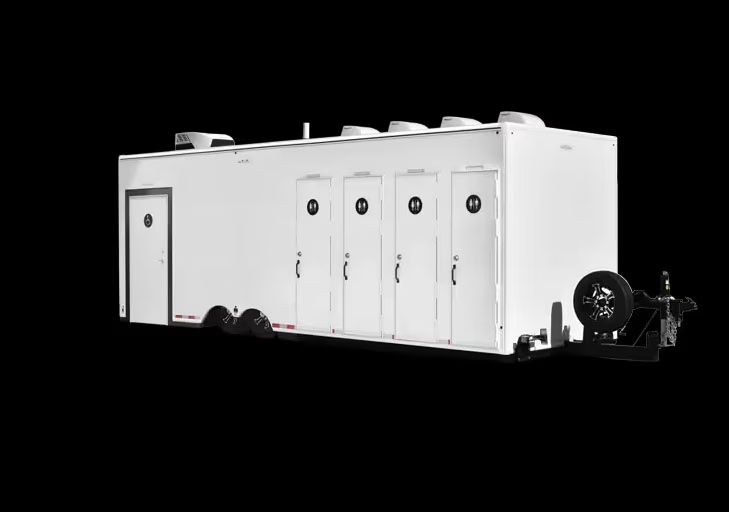
Temporary sanitation is subject to accessibility requirements as well, and a search for an ADA restroom trailer for sale often begins only after a compliance officer flags the gap mid-project. The wrong setup at that point creates liability exposure on federally funded and public-facing projects, and a scramble to fix it on a live jobsite.
Here’s what contractors need to know before they source accessible sanitation, not after.
When ADA Accessibility Requirements Apply to Temporary Restrooms
Accessibility requirements are not limited to buildings that are already standing. Any project open to the public, or receiving federal or state funding, generally needs to provide accessible temporary facilities alongside standard units for the duration of construction. This applies to public works projects, government contracts, transportation and infrastructure builds, and any commercial site where the public or visitors have access during construction. Contractors sometimes assume that accessibility only matters once occupancy begins; project owners and compliance officers do not share that assumption, nor does the law.
What Makes a Restroom Trailer ADA-Compliant (Clearance, Grab Bars, Door Width, Ramp Access)
An ADA-compliant restroom trailer differs from a standard unit in a handful of specific, measurable ways. Entry doors need a minimum clear width, generally around 32 inches, to accommodate a wheelchair without a tight squeeze. Interior floor space needs enough clearance, typically a 60-inch diameter, for a wheelchair to turn around inside the stall. Grab bars need to be mounted near the toilet at the correct height for stability during transfers. And entry needs a gently sloped ramp rather than steps, so access does not depend on someone’s ability to climb. These are not cosmetic differences: a trailer missing any one of them does not meet the standard, regardless of what the vendor calls it.
Public Works and Federally Funded Projects: Higher Stakes for Compliance
The stakes rise sharply on public works and federally funded jobs. These projects are more likely to be inspected specifically for accessibility compliance, and non-compliance can affect funding disbursement, not just create citation risk. Project managers on government contracts should treat accessible sanitation as a line item that is specced and confirmed before mobilization, rather than addressed reactively once a subcontractor or inspector raises it.
Restroom Trailers vs Standard Portable Units: Key Differences for Accessible Projects
Standard portable units can be retrofitted with some accessibility features, but restroom trailers are generally the more reliable path to full compliance on larger or longer-duration projects.
Trailers offer more interior square footage to meet clearance requirements, more stable footing for ramps, and, in many cases, running water and climate control, making extended use more practical for workers or visitors with mobility limitations.
For short-duration, small-crew projects, a compliant standalone unit may be sufficient. For anything larger, longer, or public-facing, a trailer is usually the safer spec.
There is also a practical maintenance argument for trailers on longer projects. A retrofitted standalone unit can drift out of compliance over time as ramps shift, hardware loosens, or servicing crews swap components without checking specs against the original design.
A trailer built to the standard from the manufacturing stage does not carry that same drift risk, which matters on a project that could run for a year or more between inspections.
How to Evaluate an ADA Restroom Trailer for Sale: Specs to Check Before You Buy or Rent
Before purchasing or renting, contractors should confirm the exact door clearance, interior turning radius, grab bar placement, and ramp slope against the current ADA Standards for Accessible Design, rather than simply taking a vendor’s word that a unit is “ADA-compliant.”
Satellite Industries manufactures ADA restroom trailers built to these specifications directly, which means the specs come from the people who engineered the unit rather than a reseller repeating a spec sheet. That distinction matters when a project owner or inspector asks for documentation.
Common Mistakes Contractors Make When Sourcing Accessible Portable Sanitation
The most common mistake is treating accessibility as an add-on requested after the sanitation plan is already set, rather than a spec built in from the start.
Others include assuming that a “wheelchair accessible” label meets full ADA requirements without checking clearance and grab-bar specifics, under-ordering accessible units because they cost more per unit than standard toilets, and failing to document compliance during an inspection.
A related mistake is placing an accessible unit in a location that technically meets the spec sheet but is not actually reachable, at the far end of a site behind active equipment routes, for instance, which defeats the purpose of having one on site at all. Each of these is avoidable with a sourcing process that treats accessible sanitation as a compliance requirement with real specs, not a checkbox.
Accessible sanitation is a small line item relative to overall project cost, but it carries outsized risk when it is wrong. Contractors who spec it correctly from mobilization avoid the liability exposure and the mid-project scramble that comes from treating it as an afterthought.