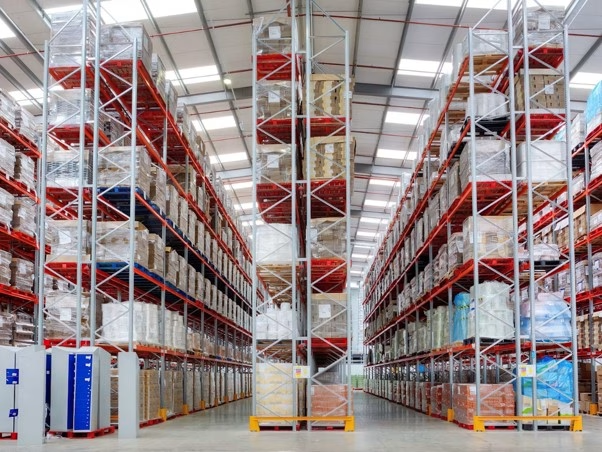
Industrial construction has emerged as one of the strongest segments of the commercial real estate market over the past decade. While office development has faced headwinds and retail construction continues to evolve, demand for logistics facilities remains remarkably resilient. Across the United States, developers, investors, and construction firms are responding to growing demand for modern distribution infrastructure, and few markets illustrate this trend better than New Jersey.
The state’s strategic location near some of the nation’s largest consumer markets has transformed it into one of the most important logistics hubs in North America. As businesses seek faster delivery times, greater supply chain resilience, and improved inventory positioning, demand for warehouse space continues to fuel new industrial construction projects throughout the region.
E-Commerce and Supply Chain Modernization Are Reshaping Industrial Development
The modern warehouse bears little resemblance to the industrial buildings constructed a generation ago. Today’s facilities are larger, more technologically sophisticated, and designed to accommodate automation, robotics, advanced inventory systems, and high-volume fulfillment operations. Ceiling heights continue to increase, truck court requirements have expanded, and developers are incorporating infrastructure capable of supporting future technological upgrades.
The growth of e-commerce remains a major driver behind this evolution. Retailers, manufacturers, wholesalers, and direct-to-consumer brands increasingly require facilities that can process large volumes of orders while maintaining rapid delivery schedules. This shift has created sustained demand for strategically located distribution centers. A warehouse in New Jersey offers direct access to major population centers including New York City, Philadelphia, Boston, and Washington, D.C., making the region particularly attractive for logistics operators seeking efficient access to Northeast markets.
Developers have responded by pursuing both speculative and build-to-suit industrial projects. In many cases, competition for available industrial land has become a significant factor influencing development decisions.
Why Investors Continue to Favor Logistics Real Estate
Industrial assets have become increasingly attractive to institutional investors due to strong occupancy rates, long-term tenant demand, and the continued expansion of supply chain infrastructure. Unlike many commercial real estate sectors, logistics facilities benefit from structural changes in consumer behavior rather than cyclical market trends alone. Businesses increasingly view warehouse capacity as a strategic necessity, creating sustained demand for modern industrial space.
The New Jersey warehouse market has been one of the primary beneficiaries of this trend. Large logistics operators, transportation companies, e-commerce businesses, and third-party logistics providers continue seeking facilities capable of supporting increasingly complex distribution networks. For investors, this demand often translates into lower vacancy rates and stronger long-term leasing prospects compared to many other commercial asset classes.
Construction firms have responded accordingly, with industrial projects representing a growing share of development pipelines. New facilities frequently include expanded trailer parking, sophisticated loading infrastructure, energy-efficient building systems, and layouts specifically designed for automated operations. Recent coverage across the construction industry has highlighted how logistics-related projects are increasingly influencing regional development patterns, transportation infrastructure investments, and industrial land acquisition strategies.
The Growing Influence of Third-Party Logistics Providers
Another important factor driving construction activity is the expansion of third-party logistics companies. As more businesses outsource warehousing and fulfillment operations, 3PL providers continue expanding their facility footprints to meet customer demand. This growth has created additional requirements for large-scale distribution centers capable of supporting multiple clients and diverse inventory profiles.
Providers such as ARDI Express, which operates a 3PL warehouse in New Jersey, reflect a broader industry trend. Rather than investing in their own facilities, many businesses now rely on logistics specialists that already possess the infrastructure needed to support regional and national distribution. This model allows companies to scale more efficiently while simultaneously contributing to demand for new industrial development.
For construction firms, the implications are significant. Modern logistics facilities increasingly require advanced engineering, specialized site planning, high-capacity utility infrastructure, and designs that support future automation technologies. As a result, warehouse construction projects are becoming more technically complex and capital-intensive.
The relationship between logistics and industrial construction is likely to strengthen throughout the coming years. Rising consumer expectations, supply chain diversification, and continued e-commerce growth are expected to sustain demand for strategically located warehouse facilities. Markets that offer strong transportation networks, access to major population centers, and established logistics ecosystems will remain particularly attractive to developers and investors.
New Jersey sits at the center of many of these trends. Its combination of geography, infrastructure, and market access continues to attract businesses seeking efficient distribution capabilities. For the construction industry, that demand represents more than a short-term opportunity. It reflects a long-term transformation in how goods move through the economy and how industrial real estate is planned, designed, and built. As logistics continues to evolve, warehouse development will remain a defining driver of growth in industrial construction.