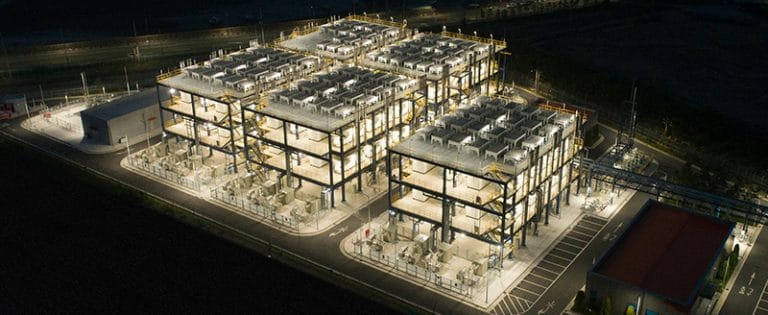
The Daesan Hydrogen Fuel Cell Power Plant is a 50 MW byproduct hydrogen generating station located inside the Daesan Industrial Complex at Seosan in South Chungcheong Province, and it is no longer the largest of its kind. Construction started in September 2025 on the 108 MW Gyeongju Gangdong plant, an 819.1 billion won scheme due for completion in March 2028.
What the Daesan Hydrogen Fuel Cell Power Plant Still Does Better Than Anyone
Scale aside, no rival matches the fuel. Daesan remains the only plant of this size running purely on hydrogen recovered from neighbouring petrochemical production, with Doosan contracted to maintain its cells for 20 years. Korea’s appetite for tight industrial builds continues elsewhere, as SK Pharmteco’s Sejong peptide plant showed in August 2026.
Project Overview
- Project Name: Daesan Hydrogen Fuel Cell Power Plant
- Location: Daesan Industrial Complex, Seosan, South Chungcheong Province, South Korea
- Project Value: US$212 million, reported locally as 255 billion won
- Client and Owner: Daesan Green Energy, a special purpose company in which Hanwha Energy holds 49 percent, Korea East West Power 35 percent, Doosan 10 percent and financial investors the balance, according to POWER magazine
- Main Contractor: Hanwha Engineering and Construction
- Key Components: 114 phosphoric acid fuel cells rated at 440 kW each for 50 MW combined, an underground hydrogen pipeline from the adjacent petrochemical plant, and a 20,000 square metre site
- Output: Up to 400,000 MWh a year, enough for roughly 160,000 households
- Construction Start: July 2018
- Completion: Commercial operation from June 2020, with the completion ceremony held on 28 July 2020
- Strategic Impact: The first large plant anywhere to run solely on recycled byproduct hydrogen, since passed in capacity by Korea’s 79 MW Shin Incheon Vision Dream and the 108 MW Gyeongju Gangdong project
Project Team
- Owner and Operator: Daesan Green Energy, led by Hanwha Energy
- Main Contractor: Hanwha Engineering and Construction
- Fuel Cell Supplier and Maintenance Provider: Doosan Fuel Cell
- Renewable Energy Certificate Offtaker: Korea East West Power
- Hydrogen Supplier: Hanwha TotalEnergies Petrochemical, known as Hanwha Total Petrochemical when the plant was built
- Financial Investor: SK Securities
- Government Body: Ministry of Trade, Industry and Energy, Republic of Korea
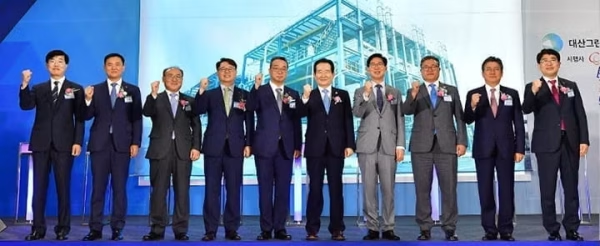
Reported 24th August 2020: Hanwa Engineering & Construction, the company behind the world’s first hydrogen fuel cell power plant located in Seosan, South Chungcheong Province celebrated the completion of the 50 MW plant. The project that cost $212 million and that occupies 20,000 sq m of the Daesan Industrial Complex began construction nearly one year ago. Hanwha Engineering & Construction says it is the largest industrial hydrogen-fuel-cell power plant in the world and the first to only use hydrogen recycled from petrochemical manufacturing, a huge achievement for Korea and the world as it was one of their goals to reduce the amount of waste from petrochemical manufacturers.
Hydrogen fuel cell energy differs greatly from fossil fuel electricity generation. Conventional fossil fuel technology relies on combustion to produce steam and spin a turbine. Hydrogen fuel cells, meanwhile, combine hydrogen and oxygen in an electrochemical reaction to generate electricity. The only byproducts from this reaction are heat and water vapor, making hydrogen fuel cells an appealing way to cut carbon emissions, according to Hanwha Energy.
Also Read: Samsung Electronics expands its foundry capacity with a new production line in Pyeongtaek, Korea.
The plant will be able to generate up to 400,000 MWh of electricity per year, the electricity needs of 160,000 homes will be met. The recycled hydrogen will come from Hanwha Total Petrochemical plant located within the same Daesan Industrial Complex who will pump the recycled hydrogen into the new power plant via underground pipes and feeds it directly into the fuel cells. Electricity is then generated by an electrochemical reaction between hydrogen and oxygen. The result of the byproduct of the fuel cells is only pure water. Unlike fossil-fuel-electricity generation, hydrogen fuel cells do not emit environmental pollutants such as greenhouse gases, sulfur oxide (SOx), and nitrogen oxide (NOx).
Korea East-West Power buys the renewable energy produced by the hydrogen-fuel-cell power plant, while Doosan Corporation supplies and maintains the hydrogen fuel cells.



Leave a Reply