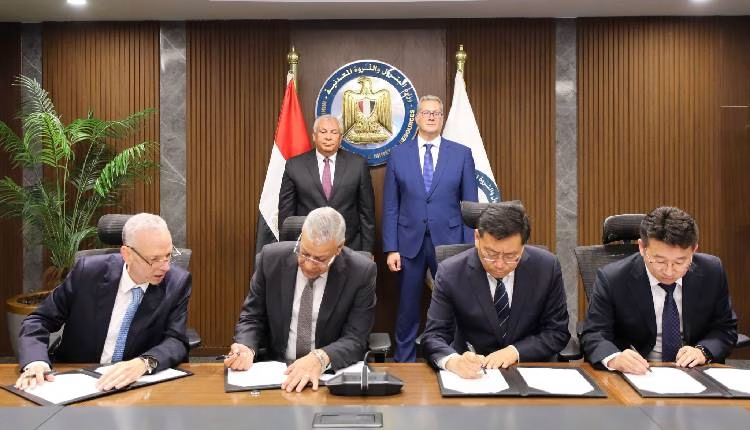
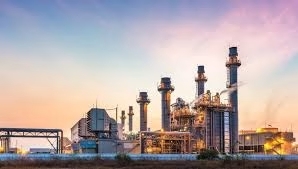
Egypt has signed final contracts on Sunday that will pave way the commencement of construction works on the $658 million Abu Tartur Phosphoric Acid Complex Project in the Western Desert. This marks a major step in Egypt’s push to shift from raw mineral exports to high-value industrial processing. This was revealed by a statement from the petroleum ministry.
Also, just to note, the deal of the production complex was signed in the presence of Petroleum and Mineral Resources Minister Karim Badawy and New Valley Governor Mohamed El-Zamlout at the ministry’s headquarters in the New Administrative Capital.
Abu Tartur Phosphoric Acid Complex Project Factsheet
Location: Abu Tartur Plateau, New Valley Governorate, Western Desert, Egypt.
Investment/cost:
Initial investment: Approximately $658 million as of June 2025 contract signing.
Total anticipated investment: approximately $1-1.2 billion is expected to fund for the entire project.
Capacity:
First phase: this phase will have a capacity of 250,000 tons per year of high-grade phosphoric acid.
Target capacity for the full project: Up to 500,000 tons per year will be produced.
Location
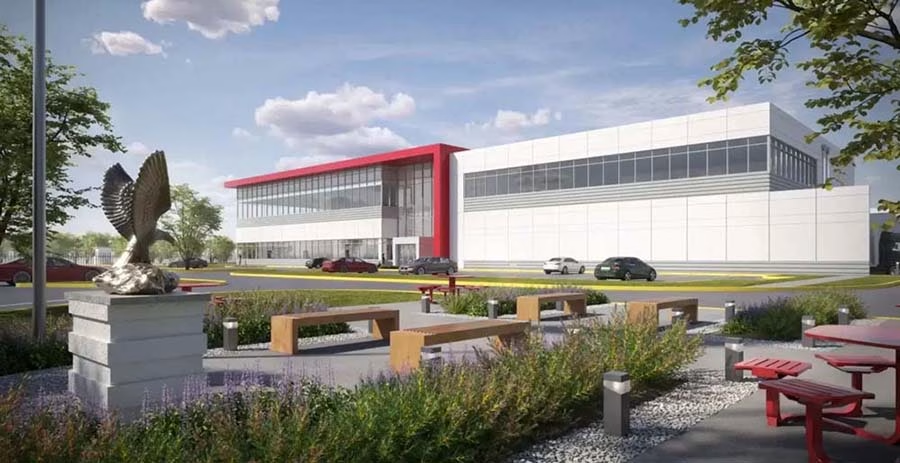
The phosphoric acid production complex project is located at Abu Tartur Plateau in the New Valley Governorate. This upcoming project will use domestically sourced phosphate ore to produce 250,000 tons per year of high-grade phosphoric acid in its first phase. Furthermore, the project is unique as it is Egypt’s largest industrial investments in the mining sector.
“This is a historic move that will enable us to shift from exporting raw materials to launching an integrated industrial value chain,” Minister Badawy stated. “It symbolizes the third pillar of our strategy which outlines maximising returns from mineral wealth.”
Developers of the Project
The construction of this project will be led by a Chinese consortium that comprises of China State Construction Engineering Corporation (CSCEC) and East China Engineering Science and Technology Co., Ltd. (ECEC). This consortium will be partnering with Income Egypt.
Furthermore, the project is being developed under the umbrella of the Abu Tartur Phosphoric Acid Company. Also, it is being supported by several Egyptian state-owned firms inclusive of Phosphate Misr, Abu Qir Fertilizers, and Petrojet.
Additionally, agreements that were signed included a shareholders’ framework and an EPC (engineering, procurement, and construction) contract with the Chinese alliance.
Significance of the Abu Tartur Phosphoric Acid Complex Project Project
According to Governor El-Zamlout, the project is a “turning point” for the New Valley which is Egypt’s largest governorate by area but overlooked in terms of industrial development.
“This project will be a key aspect in transforming the region into a strategic hub for mining-based industries,” he stated. Also, he noted that it would generate hundreds of jobs. Additionally, it would attract further investment to the Western Desert.
Furthermore, the project is in line with Egypt’s broader strategy to localise key industries, increase the contribution of the mining sector to GDP, and generally cut the country’s reliance on raw material exports.
Mohamed Abdel Azim, Chairman of Phosphate Misr hailed that the facility would serve as a launchpad for future downstream industries based on the vast phosphate reserves that the country possesses.
“Lastly, we view this project not as an endpoint. Also, it will be a foundation for a series of value-added industrial projects. Such projects are expected to turn Egypt into a key player in the global phosphate supply chain,” he mentioned.
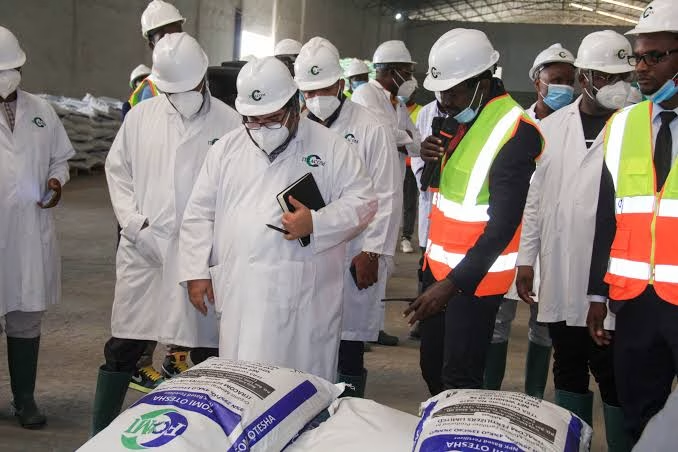
Tanzania’s ambitious plans of becoming a leading agricultural hub in Africa has gained significant momentum following the inauguration of the $180 million Itracom Fertilizer Limited Facility in Nala Industrial Area, Dodoma. This facility is an important investment which is expected to reduce the country’s dependence on imports and address the persistent shortages of fertilizer that are usually experienced in the region.
This facility was launched by the President of Tanzania Samia Suluhu alongside her Burundian counterpart President Èveriste Ndayishimiye on June 28, 2025. Currently, the fertilizer plant has a production capacity of one million tonnes. However, the plant is expected to triple its production capacity in the coming years. The facility is located on 21 hectares of land.
Official production commencement date: October 19, 2022
Inauguration date: June 28, 2025. The inauguration was officiated by President Samia Suluhu Hassan of Tanzania and President Evariste Ndayishimiye of Burundi.
Cost: $180 million
Number of Jobs Generated by the Facility
Additionally, it currently offers employment opportunities to a total of 1,805 staff. Furthermore, more than 3,000 indirect jobs are expected to be generated as operations in the facility scale up.
The Itracom Fertilizer Limited Plant had already procured a total of 100,000 tonnes of manure from the local livestock keepers. This injected a total of Sh15 billion to the rural economies.
Tanzania’s Future Plans on Fertilizer Production
Tanzania plans to ensure that at least 80 per cent of the fertilizer that is used in the country is acquired from local sources.
Furthermore, the Tanzanian government is currently holding discussions with potential investors who are interested in the production sector. The government aims to utilize the country’s coal reserves in order to increase the capacity of fertilizer manufacturing.
Significance of the Itracom Fertilizer Limited Facility
“This facility is more than just a factory. It is a symbol of agricultural transformation and regional cooperation,” President Samia Suluhu said.
“Through this facility we can now create job opportunities for the youth. Additionally, it strengthens the agricultural value chain of the country,” she added.
“The affordable access to fertilizer for a long time has been a hurdle to our farmers. This fertilizer plant will greatly help in improving availability and affordability for fertilizer not just to Tanzania but for the entire region,” President Samia Suluhu stated.
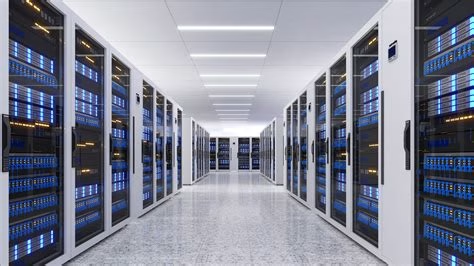
The rapid expansion of cloud computing, artificial intelligence, and internet services has triggered a surge in demand for data centers across the United States and investments in them. These facilities, which store and process the digital information powering everything from social media to streaming, have become a strategic focus for both tech companies and local governments. As a result, U.S. states are increasingly engaged in fierce competition to attract multi-billion-dollar data center projects.
Why States Are Racing for Data Centers
Data centers bring significant economic value. Although they don’t always generate high employment numbers like factories, they offer substantial tax revenue, construction jobs, and long-term infrastructure investments. States are realizing that landing a data center means more than hosting servers—it means anchoring themselves in the future of digital commerce and communications.
To attract these investments, states are Competing for Data Center Investments by offering a combination of tax incentives, low-cost energy, and fast-track development approvals. Access to land, robust power grids, and fiber connectivity are crucial. Additionally, tech companies now prioritize renewable energy availability and sustainability regulations when choosing where to build.
Energy Capital Partners, the parent company of Calpine Corporation, has announced a groundbreaking $5 billion data center project at the York 2 Energy Center in southern York County. The project is set to make Pennsylvania a key hub in the nation’s AI and tech infrastructure boom with the data center set to join the ranks of the giga datacenters being planned around the country.This initiative is part of a sweeping $90 billion investment across Pennsylvania, aimed at expanding data center capacity, energy infrastructure, and workforce development to support the rapid rise of artificial intelligence technologies.
Virginia Sets the Benchmark
Virginia—especially Loudoun County—remains the country’s top data center destination. Often called “Data Center Alley,” it hosts the highest concentration of data centers globally. This leadership is thanks to a mature digital infrastructure, a business-friendly climate, and proximity to major network exchanges.
In Sterling County the PowerHouse Pacific Data Center is expected to be completed end of 2026 beginning of 2027. It will be a 265 MW and will consist of three buildings totalling roughly 1.2 million square feet, as well as a 2-acre power substation. Indicating that Loudoun County is nto teh only destination.
In August 2025 Google announced it would be investing $9 billion to expand its Virginia data centers, including a new Chesterfield County campus and expansions in Loudoun and Prince William counties. The project strengthens Virginia’s role as a global tech hub, adds advanced AI-ready infrastructure, and includes free AI training programs at local colleges to prepare the workforce for future digital opportunities.
However, as Virginia becomes saturated and competing for data Center investments intensifies, other states are seizing the opportunity to carve out their share of the market. LEts take a look at some of the major data center investments reporteda round the country.
Mitsubishi’s recent announcement that the Japanese company will be investing in data center campuses across the US, Virginia appears to have emerged on top with a 430MW data Center to be built in Loudoun County. This will be one of Mitsubishi’s campuses that will have a total capacity of 2.8GW. Other locations so far confirmed will be Illinois and Georgia.
Rising Challengers
Arkansas
Google’s $4 billion data center development dubbed Project Pyramid is a landmark investment in West Memphis, Arkansas. Approved by the Arkansas Public Service Commission on October 4, 2025, the project will be powered by a 600-MW solar facility and a 350-MW battery storage system developed with Entergy. Spanning nearly 1,200 acres, the campus will feature five data centers, office buildings, and advanced cloud and AI infrastructure. Google plans to integrate demand-response programs to reduce peak energy use, marking a first for its U.S. data centers. The initiative is projected to create thousands of jobs and boost local revenues.
Pennsylvania
In Pennsylvania CoreWeave has lined up $4 billion in funding toward its $6 billion AI data center campus planned for Lancaster, Pennsylvania, through a partnership with Blue Owl Capital, Chirisa Technology Parks (CTP), and Machine Investment Group (MIG). First announced during a White House event in July, the project will launch with 100 megawatts of capacity and could scale up to 300 MW as demand grows. Alongside its computing capabilities, the initiative includes about $200 million in upgrades to the local power grid. The campus is expected to support around 600 jobs during construction and create approximately 70 permanent operations roles, while also contributing to broader community benefits such as workforce training and education initiatives.
Texas
Texas is fast becoming a key player in the data center industry. Its deregulated energy market, expansive land, and fast-growing tech hubs like Austin and Dallas make it attractive for hyperscale builds. Arizona is another contender, offering a stable climate, strong solar energy resources, and aggressive tax incentives for data center developers. Recently Energy Capital Partners (ECP), a major private power and renewables owner in the U.S., together with global investment firm KKR, who unveiled the plans to build the 190 MW hyperscale data center campus in Bosque County, Texas. In West Texas Galaxy Digital Inc. has obtained a $1.4 billion project financing facility to fast-track the next phase of its Helios AI data center campus. Their strategy has 2.7 gigawatts of additional power capacity under review and the potential to scale up to 3.5 GW at full build-out. Once completed, it is expected to rank among the largest AI-focused data center campuses worldwide.
In another big win for Texas Vantage Data Centers in August 2025 unveiled its most ambitious project yet, “Frontier”—a $25 billion hyperscale campus planned for Shackelford County, Texas. Designed to deliver 1.4 gigawatts of capacity dedicated to artificial intelligence applications, the development marks the company’s largest undertaking globally and strengthens Texas’ role as an emerging hub for AI-focused digital infrastructure.
Equinix, a global data-center operator, has announced plans for a new facility in West Dallas, backed by an estimated US $835 million investment. Construction is expected to start in February 2026 and wrap up by October 2027. The project represents one of the region’s largest commitments to data-center infrastructure, highlighting the rising demand for cloud, colocation, and interconnection services in the Dallas area.
Georgia
Georgia has passed laws offering sales tax exemptions for large data centers, while Iowa and North Carolina continue to attract giants like Microsoft and Apple with favorable land prices and energy options.
Arizona
Arizona-based Vermaland, LLC has announced plans for a massive $33 billion data center industrial park in Pinal County, strategically located between Phoenix and Tucson. Dubbed the La Osa Project, the development would cover 3,300 acres and deliver up to 3 gigawatts of power capacity. If realized, it could become the largest data center complex in the United States, positioning itself as a rival to Northern Virginia’s renowned “Data Center Alley.”
Utah
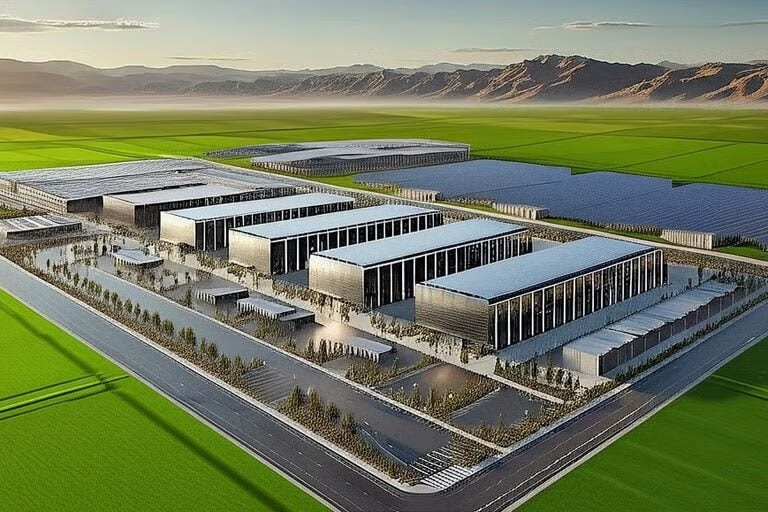
In Utah Joule in partnership with Caterpillar Inc. and Wheeler Machinery Co. have announced plans to build a Data Center Campus in Utah, which it aims to make the largest single campus in the state and among the most advanced data centers in the world. The Data Center will deliber 4.4GW of power capacity suppored by 1.1 GWh battery energy storage.
Joule Capital Partners rendering of thier data centre in Utah
New Mexico
Doña Ana County, New Mexico, is weighing a transformative $165 billion proposal—Project Jupiter, a hyperscale AI data center campus in Santa Teresa. Led by Austin-based BorderPlex Digital Assets, the project would rank among the world’s largest data centers, creating at least 750 full-time jobs and generating $300 million in county payments over 30 years. County commissioners voted 4-1 to advance the deal, with a final decision due September 19. Financing would involve industrial revenue bonds, repaid by BorderPlex, ensuring no taxpayer liability.
Indiana
In a report released in September 2025 OpenAI is shifting its focus to the American heartland, with Indiana emerging as a potential location for a massive 1-gigawatt (GW) data center. The facility would form part of Project Stargate, a $500 billion mega-infrastructure initiative aimed at significantly expanding AI computing capacity across the United States—marking a clear move away from earlier speculation about overseas sites.
Mississippi
The state has entered the fray to win data center investment dollars and though a late entrant the state has secured a $6 billion Taurus Data Center Campus in Brandon that will be developed by AVAIO Digital Partners. The 329-acre campus is planned as a multi-phased project, with its first facilities being online in the first half of 2027.
Another entrant in the state is Amazon Web Services (AWS). The company will invest $3 billion to build a major data center campus in Vicksburg, Mississippi, making it the largest project in Warren County’s history. The facility, set to begin construction in 2026, will support generative AI, machine learning, and large-scale cloud operations. The project will create 200 permanent jobs and around 1,000 construction jobs, strengthening Mississippi’s emerging “Digital Delta” technology corridor. This investment follows AWS’s recent $10 billion development in Madison County, bringing its total commitment in the state to $13 billion. With upgraded power infrastructure and strong local support, Vicksburg is poised to become a key digital hub.
Wisconsin
Meta is developing a nearly US $1 billion data center on an 830-acre site in Beaver Dam, Wisconsin, revealed in state records as an US $837 million project under another name. While not officially confirmed, the scale strongly indicates Meta’s involvement. The facility will anchor Meta’s expansion of AI and cloud computing infrastructure, part of its projected US $65 billion 2025 capital plan.
Also in Wisconsin, QTS Data Centers is developing a $12 billion data center campus in DeForest and Vienna, backed by a $50 million community investment. The project will generate over 5,000 construction jobs, expand renewable-energy use through a partnership with Alliant Energy, and draw from 750 MW of clean power. Led by Tag Greason and David Robey, QTS is collaborating with Alliant Energy and local colleges to support training and research, with zoning approval expected in November 2025.
Meta is moving ahead with a $10 billion hyperscale data center in Richland Parish, Louisiana, its largest U.S. investment of this kind to date. Spanning more than 1.25 million square feet, the facility will deliver high-capacity cloud and AI services while driving local jobs, tax revenue and infrastructure growth. To meet the center’s massive power demand, Entergy Louisiana has secured regulatory approval to build three combined-cycle gas plants, new transmission lines, and up to 1,500 MW of solar resources. The agreement accelerates Meta’s long-planned project and underscores Louisiana’s emergence as a competitive hub for next-generation data center development.
Oklahoma
Construction has begun on Project Clydesdale this November. The project is a $1 billion data center campus in Tulsa County by Beale Infrastructure, marking a major step in Oklahoma’s expanding digital economy. The 506-acre project will feature multiple data center buildings developed in phases
Each of these projects represents more than just infrastructure—they signal long-term commitments by tech giants to specific regions. And with the rise of AI and edge computing, more facilities will be needed in decentralized locations spuring competition for data Center investments.
Some of the Billion dollar Data center projects planned in the USA
Google US $4 Billion Data Center Campus in West Memphis, Arkansas
Google US$2 billion Fort Wayne Data Centre
Meta US $10B AI Data Center in Richland Parish, Louisiana
Amazon US $20B in Expansion of its Data Centers and AI Infrastructure in Pennsylvania
Amazon US $11B Investment for New Data Center in Indiana
As demand grows, competition will intensify. States that can offer not only tax advantages but also renewable energy, reliable water supply, and workforce readiness will stand out. Data centers are no longer niche industrial facilities—they are the backbone of our digital lives. The states that win this race today could become the digital capitals of tomorrow.
But its not all roses
Despite initla enthusiasim there is an emerging reassessment from communities who feel that the job opportunites are too few given the huge investments. For instance an investment of US$10billion though offering thousands of jobs during construction, once operations begin the centers offer as little as 500 jobs. In addition their energy needs to power up the data centers can be similar to that of a small city putting immense pressure on the grid. While cooling the plants also causes major challenges. Recently Amazon reportedly cancelled plans to put up a data center in Becker Minnesota after legislative changes rolled back tax incentives previously granted to data center development. These have caused some data centers to be delayed or cancelled altogether.
Updated 23rd September 2025 – The Laramie Range wind project is facing a major setback following the Laramie Country Commissioner’s decision to discontinue the project. The project which is a 650MW wind project would have generated enough electricity to power 300,000 homes and inject a substantial $1billion into the local economy.
The three to one vote by the commissioners leaves Repsol the developers of the project a window to appeal the decision to forestall the shutdown.
The decision seems to echo the federal governments opposition to wind energy projects that is negatively impacting the future growth of renewable energy development. The Chokecherry and Sierra Madre Wind Energy Project another project in Wyoming has faced continued delays taht have pushed the completion date to 2026.
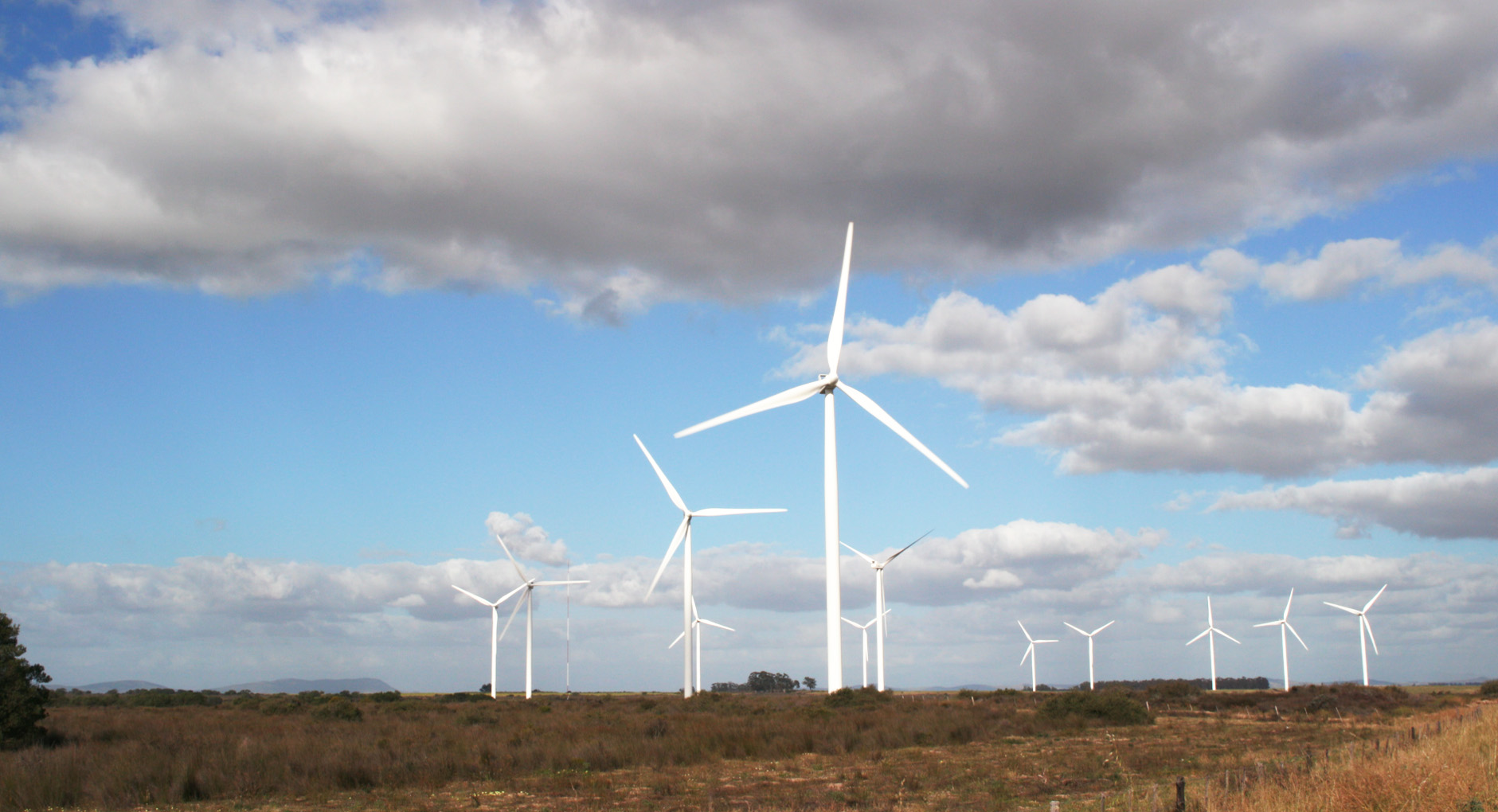
28th June 2025 – A proposed wind energy project could soon transform the landscape of northwest Laramie County, Wyoming. Repsol, a global energy company based in Madrid, Spain, is planning to build the Laramie Range Wind Project, a 650-megawatt (MW) wind farm that would span over 56,000 acres and feature up to 170 wind turbines, about 20 miles north of Cheyenne.
The project is being proposed in two phases—the first delivering 400 MW, and the second adding 250 MW, with full operations expected by 2029.
Permitting and Investment Outlook
Though no permit applications have been submitted yet, Repsol intends to file with Laramie County by the end of June and with the Wyoming Department of Environmental Quality by October. The Laramie Range Wind Project represents a $1.1 billion investment and is projected to operate for at least 35 years.
According to Repsol, the site was chosen for its proximity to an existing 345kV transmission line and low anticipated environmental impacts.
Economic and Employment Impact
The Laramie Range Wind Project is expected to create significant economic benefits for Laramie County:
An average of 131 construction workers during the build-out
23 permanent full-time jobs
Long-term tax revenue and annual lease payments to landowners
Charles Farthing sees the project as a critical source of diversification:
“The cattle business is cyclical. This is a way to sustain the ranch for future generations.”
Factsheet: Laramie Range Wind Project
Location: Northwest Laramie County, ~20 miles north of Cheyenne
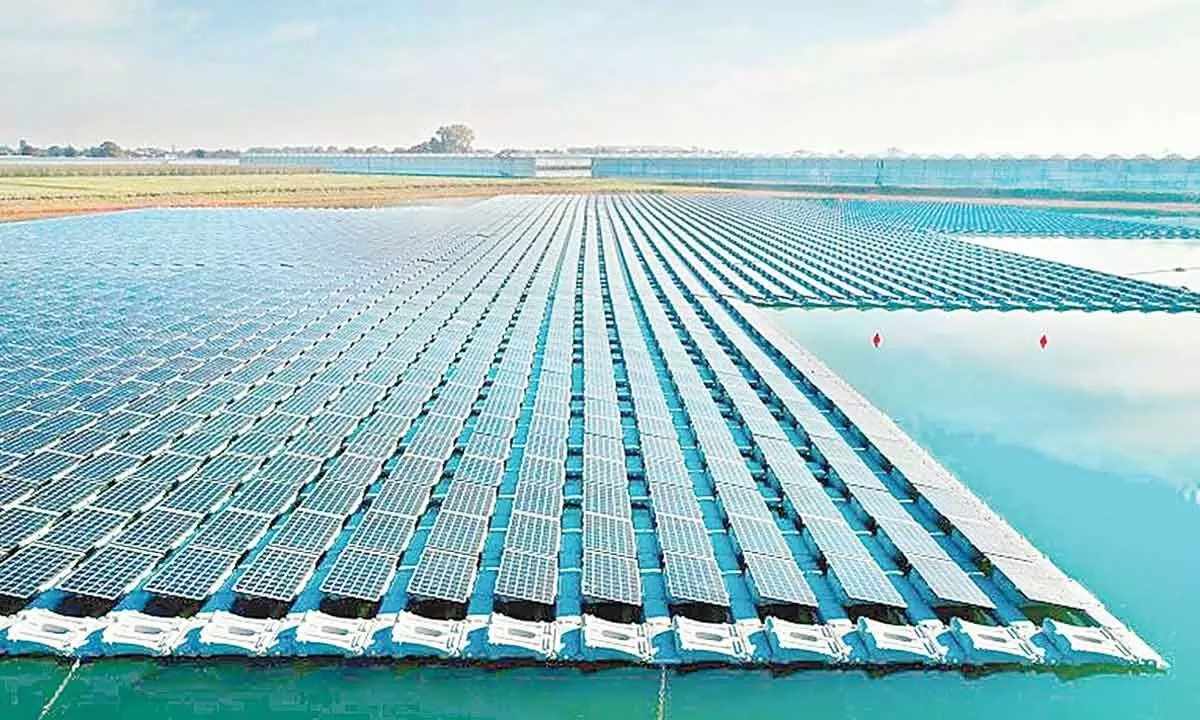
Updated September 17, 2025- Zimbabwe is seeking as much as a total of $350 million for the ambitious Kariba Dam Floating Solar Project. Currently, they have secured a total of $4.4 million from the African Export-Import Bank for a feasibility study on the solar project. The Kariba Dam Floating Solar Project, led by a consortium of the country’s major industrial and mining companies known as the Intensive Energy Users Group (IEUG), is designed to bolster Zimbabwe’s energy capacity and reduce its dependence on inconsistent hydropower and imported electricity. The floating solar plant is planned to be implemented in phases, with a pilot phase targeting an initial 500 MW capacity to provide stable and competitively priced power to energy-intensive industries under a 20-year power purchase agreement.
“We kick off the study immediately,” Eddie Cross, chairman of the Intensive Energy User Group, said to Bloomberg. “The total investment will depend on the study and open public tenders, however we have asked for a total of $350 million.”
Kariba Dam Floating Solar Project Factsheet
Location: Lake Kariba, on the border of Zambia and Zimbabwe.
Capacity: plans include an initial 250MW phase with a potential expansion to 1GW.
Key stakeholders:
Zambezi River Authority (ZRA)
African Development Bank (AfDB) / Sustainable Energy Fund for Africa (SEFA)
Zambia Electricity Supply Corporation (ZESCO)
Consulting firms: Firms selected to conduct the feasibility studies
The IEUG, made up of mining companies inclusive of a former local unit of Rio Tinto and Mimosa has made plans of a 1,000 megawatt hybrid floating solar panel facility in Lake Kariba. Lake Kariba is the world’s largest man-made lake. It aims to complete a 500 megawatt pilot by the end of 2026.
Zimbabwe was stricken by power cuts in 2024 after a severe drought curbed hydro-electricity generation at Kariba Dam. This artificial lake produces half of the southern African nation’s power. Zimbabwe currently generates a total of 430 megawatts at Kariba against an installed capacity of 1,050 megawatts.
Project funding for the solar project will be structured as 70% debt and 30% equity, stated Caleb Dengu, chief executive officer of Green Hybrid Power Ltd., which is helping its development. Additionally, he stated that the debt would carry a 10-year tenure.
“We hope to finish the study by the month of December 2025 and close by March and kick off construction in the second quarter of the year 2026,” he stated via telephone from the Nigerian capital, Abuja, where he and Cross were in attendance of the annual general meeting of the Afreximbank.
The Rock Island Generation Project, a planned 122-megawatt natural gas power plant in southeast Texas.. It is the first project to receive a state-backed loan from the Texas Energy Fund (TEF).
Location: The plant will be located in Colorado County, approximately 80 miles west of Houston and 10 miles south of Columbus, Texas. This places it near one of the state’s largest electricity demand areas within the Electric Reliability Council of Texas (ERCOT) grid.
Purpose: The natural gas-fired plant is designed to provide “dispatchable” power, which can be turned on quickly to meet energy demands and stabilize the grid.
Timeline: The project is scheduled to begin commercial operations by 2027
Financing
Source: The project is being financed by the Kerrville Public Utility Board (KPUB). The loan was approved in June.
Texas Energy Fund: KPUB is receiving a 20-year loan of up to $105 million through the state’s TEF program. The loan has a 3% interest rate and was approved by the Texas Public Utilities Commission. The TEF is a $10 billion program created to incentivize the construction of new power sources.
This is a landmark occasion for our utility,” KPUB CEO Mike Wittler exclaimed. “It allows us to move forward with a project that increases grid reliability and protects our customers from market price volatility.”.
The Texas Energy Fund, created by the legislature in 2023 and approved by voters in a constitutional amendment, is designed to accelerate development of firm, on-demand power generation across the state. KPUB will receive a 20-year loan at a 3% interest rate, financing roughly 60% of the project’s estimated $175 million cost under the deal.
The development, located about 10 miles south of Columbus, is in close proximity to the South Texas Electric Cooperative’s Rock Island Substation within the ERCOT South Load Zone. Its proximity to the Houston metropolitan area; one of the country’s fastest-growing electricity markets—makes it a strategically valuable addition to the state grid.
When operational, the plant will have six high-efficiency natural gas engines that have the ability to ramp up quickly in the event of peak demand or emergency circumstance. That kind of flexibility is becoming more useful in Texas, where hot summers, rapid population growth, and the advent of intermittent renewable energy have placed extra pressure on the power system.
The Rock Island generation project is exactly the kind of project we envisioned when the Energy Fund was created,” said Thomas Gleeson, Chairman of the Public Utility Commission of Texas. “It brings new dispatchable capacity onto the grid and helps ensure the reliable, affordable electricity Texans need to thrive.”.
Approved Loans
As of October 31, 2025, the Texas Energy Fund (TEF) has approved five loans for natural gas power plants in Texas. These loans are intended to add new, dispatchable generation to the ERCOT grid.
Rock Island Generation Project: Approved in June 2025, the project, developed by the Kerrville Public Utility Board (KPUB), received up to a $105 million loan for a 122 MW natural gas plant in Colorado County.
NRG facility in Houston: A loan was approved in August 2025 for a 456 MW natural gas facility at NRG’s existing TH Wharton Generating Station. It is expected to begin operations in the summer of 2026.
NRG facility in Chambers County: In September 2025, another NRG project received a $562 million loan for a 721 MW natural gas facility at its Cedar Bayou Generating Station.
Calpine facility in Freestone County: A loan for a 460 MW natural gas power plant was announced in October 2025. It will be built by Calpine Corporation and is estimated to begin generating power before summer 2026.
CPV Basin Ranch Energy Center: A massive 1,350 MW combined-cycle natural gas power plant in West Texas, the largest project so far under TxEF.
Expected construction start
Construction will begin later this year, with initial activities focusing on site preparation, final engineering, and equipment procurement. KPUB has partnered with Sky Global Partners as project developer, Summit Industrial Construction as contractor, and MAN Energy Solutions as engine provider. Kinder Morgan will secure gas supply for the facility under a firm, no-notice contract.
In addition to improving grid reliability, the Rock Island generation project will introduce up to 200 construction jobs and millions of dollars in new local tax revenue to Colorado County. When complete, it will provide long-term price stability for KPUB’s 24,500 customers. Who currently rely on market-based energy purchases for a substantial portion of their electricity.
“This is not only about one utility,” Wittler added. “It’s about building a stronger, more resilient grid for all Texans.”
The Rock Island generation project is the first to receive money under the Energy Fund’s In-ERCOT Generation Loan Program. But state officials say more approvals are on the way. With demand still growing and pressure on the ERCOT grid building, the fund should be a key player in the construction of Texas’s power infrastructure over the coming years.
Current status
As of July 2025, the project was in the procurement phase. Construction firms are awaiting a tender to bid for the engineering, procurement, and construction (EPC) contract.
To provide the best experiences, we use technologies like cookies to store and/or access device information. Consenting to these technologies will allow us to process data such as browsing behavior or unique IDs on this site. Not consenting or withdrawing consent, may adversely affect certain features and functions.
Functional
Always active
The technical storage or access is strictly necessary for the legitimate purpose of enabling the use of a specific service explicitly requested by the subscriber or user, or for the sole purpose of carrying out the transmission of a communication over an electronic communications network.
Preferences
The technical storage or access is necessary for the legitimate purpose of storing preferences that are not requested by the subscriber or user.
Statistics
The technical storage or access that is used exclusively for statistical purposes.The technical storage or access that is used exclusively for anonymous statistical purposes. Without a subpoena, voluntary compliance on the part of your Internet Service Provider, or additional records from a third party, information stored or retrieved for this purpose alone cannot usually be used to identify you.
Marketing
The technical storage or access is required to create user profiles to send advertising, or to track the user on a website or across several websites for similar marketing purposes.
To provide the best experiences, we use technologies like cookies to store and/or access device information. Consenting to these technologies will allow us to process data such as browsing behavior or unique IDs on this site. Not consenting or withdrawing consent, may adversely affect certain features and functions.
Functional
Always active
The technical storage or access is strictly necessary for the legitimate purpose of enabling the use of a specific service explicitly requested by the subscriber or user, or for the sole purpose of carrying out the transmission of a communication over an electronic communications network.
Preferences
The technical storage or access is necessary for the legitimate purpose of storing preferences that are not requested by the subscriber or user.
Statistics
The technical storage or access that is used exclusively for statistical purposes.The technical storage or access that is used exclusively for anonymous statistical purposes. Without a subpoena, voluntary compliance on the part of your Internet Service Provider, or additional records from a third party, information stored or retrieved for this purpose alone cannot usually be used to identify you.
Marketing
The technical storage or access is required to create user profiles to send advertising, or to track the user on a website or across several websites for similar marketing purposes.