Constructionreview

Blog

  • Saudi Arabia Drops France’s EDF from Desert Megacity Project, The Line

    Saudi Arabia Drops France’s EDF from Desert Megacity Project, The Line

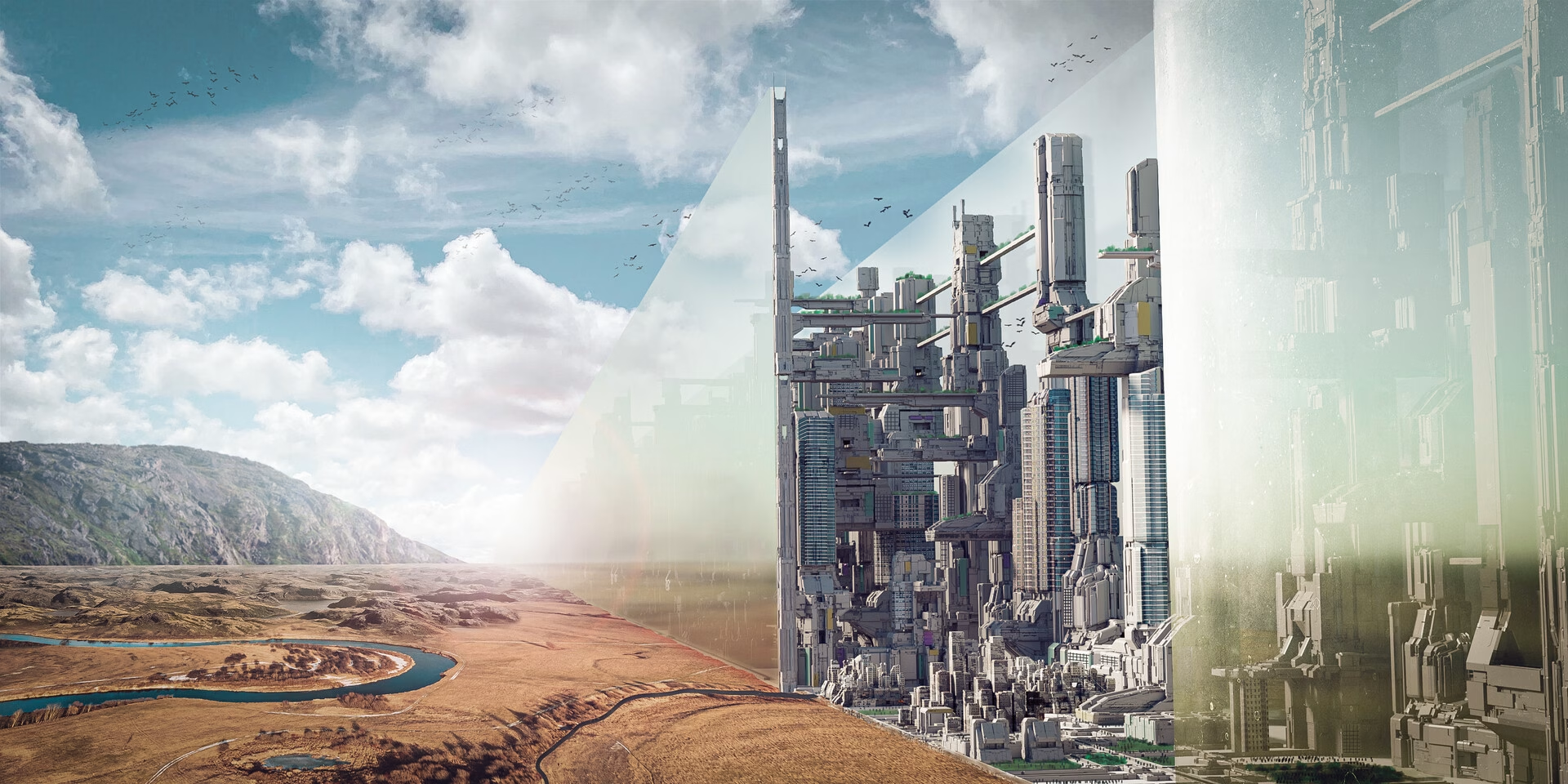
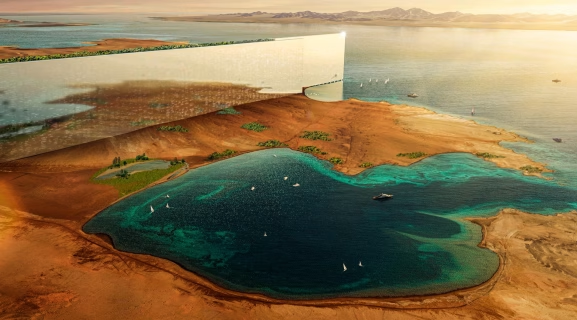
    French energy giant EDF has been dropped from Saudi Arabia’s megacity project aligned with NEOM, the Line. This is as the kingdom scales back its futuristic desert city amid various concerns such as the project’s safety, technical challenges and ballooning costs. EDF won the tender in January 2023 to carry out preliminary studies on the conception and construction of a power plant. It entailed the construction of a hydroelectric power plant in Saudi Arabia’s futuristic megacity in the desert. However, the Saudi authorities have quietly cancelled the contract, an investigation by Radio France revealed on Tuesday. The kingdom informed EDF in March that they no longer required the hydroelectric power plant. Instead, NEOM officials noted that they are focused on a mix of photovoltaic panels, wind power, and batteries. Through this, they aim to scale down the megaproject and power the reduced development.

    Also read:

    The World’s Most Ambitious Construction Project Struggles as it Seeks Funding From China: Saudi Arabia’s NEOM

    Scope of Implementation on Saudi Arabia’s The Line

    Launched in 2017 as part of Saudi’s Prince flagship Vision 2030 project, NEOM aimed to construct the 170-kilometer linear city. However, concerns regarding the project’s environmental impact and the costs are making it difficult to be accomplished. At EDF’s hydraulic engineering centre in La Motte-Servolex, Savoie, staff expressed mixed feelings. “This abandonment is good news because employees will no longer be at odds with this project,” said Florian Chollet, a CGT union rep at EDF Hydro. Some EDF employees had already expressed discomfort over the NEOM project.

    The Line.
    French energy giant EDF has been dropped from Saudi Arabia’s megacity project aligned with NEOM, the Line.

    With over 100,000 workers mobilized across an area the size of Belgium, the project has struggled with overcrowded camps. Furthermore, inadequate infrastructure, and multiple safety incidents, according to reports in The Wall Street Journal, described the megaproject as a “dystopia” in the desert. Despite such setbacks, Crown Prince Mohammed bin Salman appears determined to continue with a scaled-down version of NEOM. The project, owned by the kingdom’s $940-billion sovereign wealth fund, remains central to Saudi efforts to diversify away from its dependency on oil.

    Also read:

    NEOM leadership changes, THE LINE partners named as progress continues

    NEOM Prepares to Tender Construction Work for The Line


  • Largest Data Centers around the world with over 1GW Capacity Under Construction

    Largest Data Centers around the world with over 1GW Capacity Under Construction

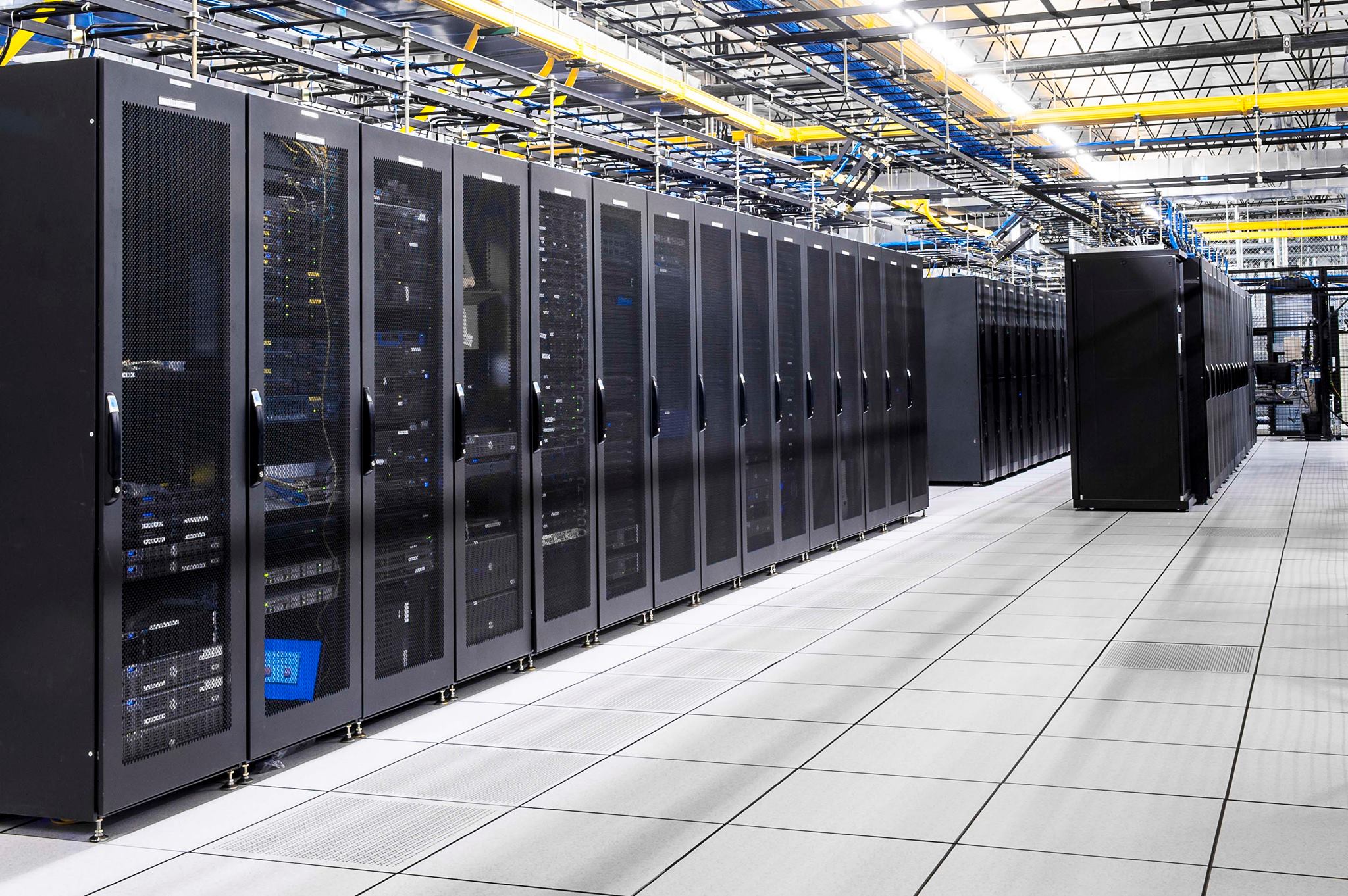
    As global demand for artificial intelligence, cloud computing, and massive data storage intensifies, a new generation of gigawatt-scale data centers is emerging. These facilities are not only engineering marvels but also strategic digital infrastructure projects that will shape how countries and corporations process and store information. In the coming years, modular design promises to increase this crop of gigawatt sized data centers as evidenced by the approach taken by modular designs by Bechtel’s and NVIDIA as reported recently.

    Here are the largest data centers currently under construction—each aiming to exceed 1 gigawatt (GW) of power capacity.

    UAE Solar and Battery Energy Storage System (BESS) Project – 1GW

    Capacity:
    5.2 GW solar PV generation integrated with 19 GWh battery energy storage (BESS)
    Delivers up to 1 GW of round-the-clock baseload renewable power

    Developer:
    Masdar, in collaboration with Emirates Water and Electricity Company (EWEC)

    Purpose:
    To develop the world’s largest integrated solar and BESS facility, capable of supplying 24/7 renewable baseload power at a globally competitive tariff, supporting the UAE’s Net Zero 2050 Strategy.

    Highlights:

    Project Name:
    UAE Solar and BESS Mega Project

    Location:
    United Arab Emirates

    Total Investment:
    USD 6 billion

    Technology and Design:

    • Integration of a 5.2 GW solar PV plant with a 19 GWh battery storage system

    • Features AI-enhanced forecasting, intelligent dispatch, and predictive analytics for optimized performance

    • AI-ready infrastructure for smart grid management and system efficiency

    Power Supply:
    Delivers 1 GW of baseload renewable energy, 24 hours a day, seven days a week

    Community Impact:

    • Creates over 10,000 new jobs across construction, manufacturing, and services

    • Reduces approximately 5.7 million tonnes of CO₂ emissions annually

    Status:
    Groundbreaking completed in 2025, witnessed by Sheikh Theyab bin Mohamed bin Zayed Al Nahyan

    Timeline:
    Construction: 2025–2027
    Scheduled Operation: 2027

    Significance:

    • Marks the world’s largest combined solar and BESS project

    • Serves as a global blueprint for 24/7 renewable energy generation

    • Reinforces the Middle East’s leadership in large-scale renewable and energy storage developments, alongside Saudi Arabia’s record-breaking BESS initiatives

    CleanArc Data Centers Virginia Campus Expansion – 1 GW

    Capacity: 1 GW total critical power (phased implementation; full buildout by 2035)

    Developer: CleanArc Data Centers

    Purpose: To expand CleanArc’s flagship VA1 hyperscale data center campus to meet rising global demand for sustainable, high-capacity digital infrastructure supporting AI, cloud computing, and data-intensive workloads.

    Highlights:

    Project Name: VA1 Hyperscale Campus Expansion

    Location: Caroline County, Virginia, USA

    Site Area: Additional 87.5 acres acquired for expansion

    Power Source: Renewable-integrated grid connection, emphasizing energy efficiency and sustainability

    Initial Capacity: 600 MW (existing and under development)

    Planned Expansion: +300 MW (Phase 1), +300 MW (Phase 2), +300 MW (Phase 3)

    Community Impact: Supports local economic development through partnership with Caroline County

    Status: Planning and permitting phase

    ADS-TEC Germany Energy 1GW

    Capacity: 1 GW output / 2 GWh storage (phased implementation; full commissioning by 2029)

    Developer: ADS-TEC Energy

    Purpose: To develop one of the world’s largest battery energy storage systems (BESS) to enhance Germany’s grid stability, capacity and ancillary services.

    Highlights:

    • Project Name: Flagship BESS Project (Southern Germany)

    • Location: Southern Germany

    • Grid Connection: Extra-high voltage grid (positive TSO assessment secured)

    • Solar Integration: Onsite PV in the double-digit MWp range to supply internal demand and lower operating costs

    • Estimated Revenues: ~€230 million annually (based on 2024 market data)

    • Status: Approved by local city council; development and financing underway

    • Timeline:

      • September 2025 – Project announced; approvals and grid connection assessment secured

      • Mid-2026 – Development and financing completion target

      • 2026–2029 – Construction and phased implementation

      • 2029 – Full commissioning and operations start

    • Strategic Role: Supports Germany’s renewable integration and demonstrates ADS-TEC Energy’s push into large-scale storage markets

    Blue Owl-Led AI Data Center Hub

    Capacity: 1.2 GW (Phase 1 – 206 MW; Phase 2 – 1.1 GW)

    Developer / Operator: Blue Owl Capital, Crusoe, Primary Digital Infrastructure

    Purpose: To build one of the largest AI-optimized data center campuses in Texas, supporting hyperscale cloud and machine learning workloads.

    Highlights:

    • Part of the Lancium Clean Campus spanning 800+ acres in Abilene, Texas

    • Phase 1: Two Tier III buildings, 206 MW total, initial 100 MW leased to a Fortune 100 hyperscale tenant

    • Phase 2: Expansion to eight buildings adding 1.1 GW capacity, full build-out targeted by early 2030s

    • Powered by West Texas wind and solar, reinforced with new substations and grid upgrades

    • Cooling: Air-cooled, water-free high-density racks (AI/Machine Learning optimized)

    • Financing: $2.3 B package by Newmark for Phase 1; $15 B led by J.P. Morgan for Phase 2

    • Jobs: Hundreds of construction and permanent roles in Phase 1; thousands of construction and several hundred permanent roles in Phase 2

    Project Matador 11GW Data Center in Texas

    Capacity: Up to 11 GW (Initial 1 GW by late 2026)

    Developer: Fermi America (co-founded by former U.S. Energy Secretary Rick Perry)

    Purpose: To build the largest U.S. energy-and-AI data center complex, combining nuclear, natural gas, and solar power in Amarillo, Texas.

    Highlights:

    • Project Name: Hypergrid (also referred to as Project Matador)

    • Scale: 18 million sq ft hyperscale campus on ~5,800 acres near the DOE’s Pantex Plant

    • Partners: Texas Tech University System

    • Energy Mix: Early stages anchored by natural gas; long-term plan prioritizes nuclear with four 1-GW reactors under NRC review; solar integration planned

    • Near-Term Capacity: Acquired 600 MW of natural gas generation across two deals (nine turbines) to meet initial demand

    • Launch Date: Formal launch planned for July 4, 2025

    • Strategic Location: Adjacent to major gas pipelines and large natural gas fields, positioning it among the largest data centers worldwide

    Vantage 1.4GW Data Center in Texas

    Capacity: 1.4 GW at full build-out (10 hyperscale facilities)

    Developer: Vantage Data Centers (backed by DigitalBridge Group)

    Purpose: To create one of the world’s largest AI-optimized hyperscale campuses and cement Texas as a leading digital infrastructure hub.

    Highlights:

    • Project Name: Frontier Campus

    • Location: 1,200-acre site in Shackelford County, Texas

    • Total Investment: $25 billion (largest project in Vantage’s global portfolio)

    • Scale: 10 data centers totaling 3.7 million sq ft engineered for GPU/AI workloads

    • Rack Density: Ultra-high (>250 kW per rack) with advanced liquid cooling

    • Cooling Technology: Closed-loop chiller design conserving billions of gallons of water annually

    • Sustainability: LEED certification pursuit and sustainable-by-design technologies

    • Status / Timeline: Already under construction; first building scheduled online second half of 2026

    Google 1GW Data Center in India

    Capacity: 1 GW
    Developer: Google (Alphabet Inc.)
    Purpose: To expand Google’s cloud and AI computing capacity in India.
    Highlights:

    • Alphabet’s First Data Center Investment in India

    • Largest Data Center in Asia by Capacity and Investment

    • $2 Billion Dedicated to Renewable Energy Capacity

    • Supports Andhra Pradesh’s Goal to Build 6 GW of Data Centers in 5 Years

    • Will Drive Major Energy Infrastructure Growth — Estimated 10 GW Needed

    • Includes Development of Three New Cable Landing Stations in Visakhapatnam

    • Part of Google’s $75 Billion Global Data Center Expansion This Year

    Meta’s  AI Data Center in Richland Parish, Louisiana

    • Capacity: 2 GW
    • Developer: Meta
    • Purpose: To train Meta’s Llama AI models.
    • Highlights:
      • Meta’s Largest Data Center Yet
      • Renewable Energy Commitment – 1.5GW Clean Power via Geaux Zero
      • Lead to massive energy infrastructure upgrades, including:

    Meta says this data center will be its 23rd data center in the United States and 27th in the world.

    Meta’s  AI Data Center in El Paso, Texas

    Capacity: 1 GW
    Developer: Meta Platforms, Inc. (Parent company of Facebook and Instagram)
    Purpose: To expand Meta’s global AI computing and data infrastructure network.

    Highlights:

    • $1.5 Billion Investment — Marks Meta’s latest large-scale commitment to AI infrastructure.

    • Meta’s 29th Data Center Worldwide — Strengthens its presence in Texas and the U.S. Southwest.

    • 1,000-Acre Hyperscale Campus in Northeast El Paso — Designed to support both traditional and next-generation AI hardware.

    • Groundbreaking Announced October 15, 2025 — Hosted by the Borderplex Alliance.

    • Target Completion by 2028 — Facility will reach up to 1 GW of total power capacity.

    • Sustainability Leadership — 100% renewable energy use and restoration of 200% of water consumed to local watersheds.

    • Water-Free Operation Most of the Year — Through advanced closed-loop liquid cooling technology.

    • Economic Boost for El Paso — About 1,800 construction jobs and 100 high-paying permanent positions expected.

    • State Support — Texas Governor Greg Abbott called the project “an incredible moment for El Paso and Texas.”

    • City Incentives — 80% rebate on city property taxes for 25 years per development phase.

    • Broader Commitment — Accompanied by Meta’s 400 MW solar project in Yoakum County.

    • Regional Impact — Establishes El Paso as a major AI and technology hub in the U.S. Southwest.

    Stargate Data Center – Abu Dhabi, UAE

      • Capacity: 1 GW (Phase 1: 200 MW by 2026)

    • Developer: G42 & OpenAI (with Oracle and Nvidia partnership)

    • Purpose: Dedicated to AI and supercomputing workloads

    • Highlights:

      • The flagship facility in OpenAI’s global “Stargate” program

      • Hosts one of the world’s largest sovereign AI infrastructures

      • Strategically located in a region with growing tech investment and energy capacity

    This facility marks the UAE’s bold move to become a global leader in AI infrastructure, powered by strong government backing and deep-pocketed investors.

    Neom Oxagon Data Center – Saudi Arabia

    • Capacity: Targeting 1.5 GW

    • Developer: ZeroPoint DC & Neom

    • Purpose: Net-zero, AI-native data center for industrial, cloud, and defense data

    • Highlights:

      • Part of Saudi Arabia’s futuristic NEOM city

      • Renewable-powered, using solar and hydrogen

      • Advanced cooling and modular construction design

    This is expected to be one of the largest and greenest hyperscale campuses in the world, central to Saudi Arabia’s digital ambitions.

    Haenam (Salaseido) AI Cluster – South Korea

    • Capacity: 3 GW (Phase 1: 300 MW by 2028)

    • Developer: Government of Jeollanam-do + Private partners

    • Purpose: AI research, cloud, sovereign data processing

    • Highlights:

      • Built in 25 blocks of 40 MW each

      • Full completion expected by 2028

      • Near the sea, using local renewables and energy-efficient cooling

    This site is part of South Korea’s national plan to decentralize data infrastructure and attract AI industries to underdeveloped regions.

    Tsukuba Data Center Campus – Japan

    • Capacity: 1 GW (Phase 1: 50 MW by 2026)

    • Developer: Goodman Group

    • Purpose: Regional hyperscale cloud and AI workloads

    • Highlights:

      • Located in Tsukuba Science City

      • Covers 45 hectares of high-tech, disaster-resistant land

      • Serves both Japanese tech companies and global cloud clients

    This project underscores Japan’s renewed focus on digital infrastructure resilience and regional technology leadership.

    Gangwon Hyperscale Cluster – South Korea

    • Capacity: ~1 GW

    • Developer: Private sector + government-backed energy firms

    • Purpose: General-purpose cloud, AI, and edge deployments

    • Highlights:

      • Located near surplus power sources like nuclear and coal

      • Power cost efficiencies by selling excess directly to tenants

      • Multiple facilities being planned across Gangneung and Donghae

    This effort will help South Korea meet soaring AI compute needs while reducing power transmission costs by localizing data hubs.

    Teesside AI Growth Zone– United Kingdom

    • Capacity: 6 GW by 2030

    • Developer: Google

    • Purpose: Regional hyperscale cloud and AI workloads

    • Highlights:

      • Located in Teesside, near Redcar in northern England

      • Covers 46.45 hectares as designated AI Growth Zone

      • Multiple technological-based facilities to be developed in the area

    Project Marvel – Bessemer, Alabama

    Capacity: 1.2 GW IT capacity at full build-out

    Developer: Logistics Land Investment, LLC (affiliated with TPA Group)

    Purpose: Hyperscale data-center campus supporting high-performance computing and cloud infrastructure

    Highlights:

    • Located on approximately 700 acres off Rock Mountain Lake Road in Bessemer, Alabama

    • Rezoning approved by Bessemer City Council in a 5–2 vote on November 18, 2025

    • Plans include 18 hyperscale data-center buildings

    • Projected capital expenditure: $14.5 billion

    • Expected to create 1,000 construction jobs and 330 permanent high-paying roles

    • Economic impact estimated at over $4 billion regionally over 30 years, including ~$800 million for Bessemer City Schools

    • Key concerns: environmental impact, water use, emissions, strain on local utilities, and public transparency

    • Next steps: environmental permitting, detailed engineering, and utility coordination

    Why 1GW Matters

    A 1 gigawatt (1,000 MW) data center can:

    • Host millions of servers

    • Consume power equivalent to a small city

    • Cost $5–10 billion+ to build and operate

    • Support large-scale AI model training, 5G networks, and global cloud storage

    As tech companies and governments compete to build digital sovereignty, gigawatt-scale facilities are becoming strategic infrastructure, not just corporate assets.
  • The Bulli Creek Clean Energy Park latest updates

    The Bulli Creek Clean Energy Park latest updates

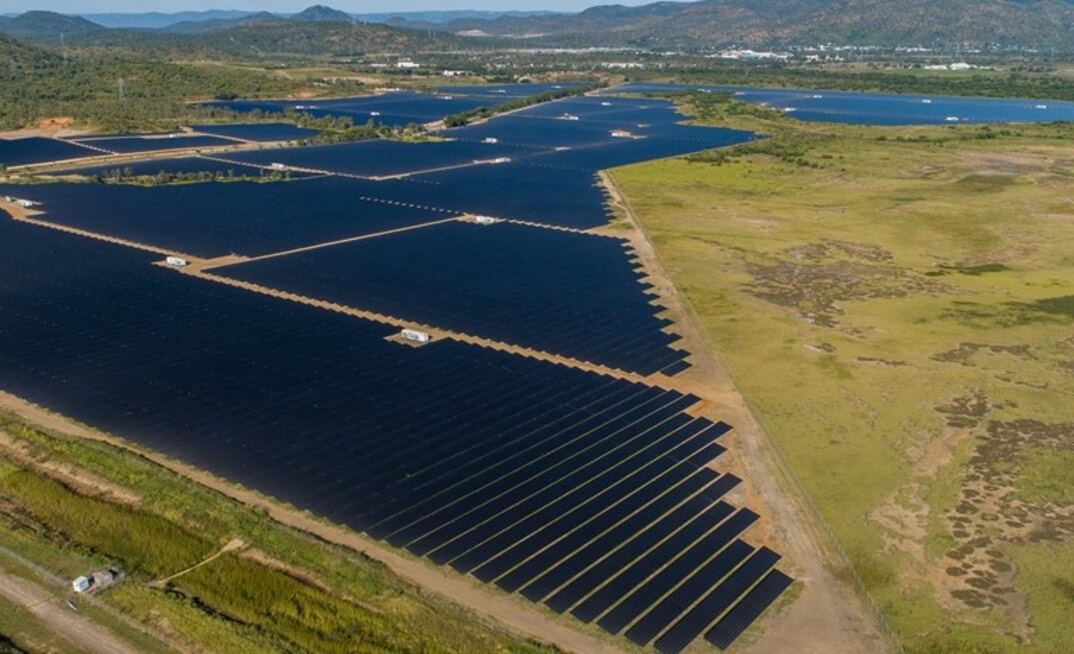
    The Bulli Creek Clean Energy Park is a large-scale renewable energy development spanning 5,000 hectares, located approximately 120 km south-west of Toowoomba, Queensland. Its Stage 1 involves a 775 MW solar farm, forming part of the project’s planned 2 GW total capacity.

    Once operational, Stage 1 will be supported by the addition of a battery energy storage system (BESS) of up to 600 MW/2,400 MWh, with further expansions in both solar generation and storage capacity under consideration.

    The project’s viability is underpinned by a 15-year offtake agreement with state-owned Stanwell Corporation, securing up to 550 MW of generated power and providing long-term financial certainty. When completed the project will boost Qeenslands renewable power supply alside the Aldoga Solar Farm a 380 MW solar project located near Gladstone, Queensland that was completed in April 2025.

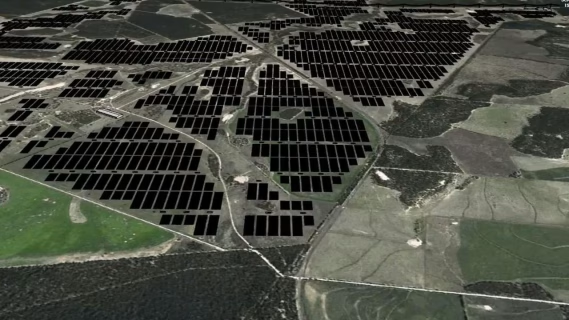
    Reported June 26 2025 – New procurement and work packages have been announced by Genex Power and Canada’s PCL Construction for the first stage of the 775 MW Bulli Creek solar farm in Queensland. This marks a significant milestone in the progress of the project. The site will host over 1.5 million bifacial solar modules, 204,000 steel foundation piles, and 232 integrated power skids with inverters, MV transformers, and switchgear. The complex includes a substation with four main 250 MVA transformers, linked by a 3.5 km, 330 kV dual-circuit overhead line to the Powerlink switchyard. In other words, this is engineering on a colossal scale, preparing the groundwork for what may become the largest solar facility in the Southern Hemisphere. In 2024, the contractor for the project PCL Construction, was appointed by Genex Power Limited following an extensive tender process.

    Also Read Egypt Inks $200 Million Deal with China’s Sunrev Solar to Construct the Ain Sokhna Solar Energy Complex Project

    Local Suppliers Set to Shine

    Importantly, Genex and PCL are keen to underline local value. They have invited trade contractors and suppliers to register an EOI through ICN Gateway, ensuring that regional firms get “full, fair, and reasonable opportunities” to participate. Since Genex is now wholly owned by J-Power, the company emphasizes that the project supports Australian industry participation, especially from businesses close to the site. With up to 800 construction jobs, including roles in a dedicated workers’ camp near Millmerran, the ripple effects are expected to boost local economies and services. 

    Clean Energy in Phases

    This 775 MW Stage 1 forms part of the massive 2GW Bulli Creek Clean Energy Park spanning 5,000 hectares. It is located about 120 km south-west of Toowoomba. Once the solar array is operational, the plan is to add a battery storage system of up to 600 MW/2,400 MWh, followed by potential expansions of solar and storage capacity. Furthermore, stage 1 is backed by a 15-year offtake with state-owned Stanwell, locking in up to 550 MW of generated power, which strengthens the project’s financial viability.

    Also Read UK Approves 140 MW Oaklands Farm Solar Park in South Derbyshire

    Timeline & What’s Next

    Looking ahead, Genex aims for a final investment decision by late 2025, with construction slated to kick off in early 2026. The workers’ accommodation has also been approved, allowing for up to 400 onsite residents, aiding logistics for construction crews. Once operational, the solar farm will power around 260,000 homes annually, cementing its status as a clean-energy anchor for the region. In sum, this is a project that weaves together big-picture green goals, local enterprise, and long-term regional uplift. 

    Bulli Creek Solar Farm
    Bulli Creek Solar Farm

    Bulli Creek Solar Farm Project Overview

    Name: Bulli Creek Clean Energy Park (Stage 1: 775 MW Solar Farm)

    Location: 45 km south-west of Millmerran, 125 km south‑west of Toowoomba, Queensland; covers, 5,000 ha

    Developers: Genex Power (now wholly owned by J‑Power) with EPC contractor PCL Construction

    Technical Scope & Infrastructure

    Stage 1 Scope:

    775 MW solar farm, Australia’s largest grid‑connected solar farm on completion

    Over 1.5 million bifacial PV modules, 204,000 steel pile foundations

    232 integrated inverter/transformer skids; substation featuring four 250 MVA main transformers

    Energy transmission via 3.5 km of 330 kV dual-circuit overhead line to Powerlink switchyard

    Future Expansion:

    Planned battery energy storage (Stage 2) up to 400–600 MW capacity (1,600–2,400 MWh)

    Further solar/storage expansion envisaged to reach full project capacity of up to 2 GW

    Offtake & Financial Structure

    Offtake Agreement:

    15-year PPA with Queensland Govt-owned Stanwell for up to 550 MW of Stage 1 output

    Project Financing:

    Around A$1 billion (US $632 million) in project finance secured from a consortium including China Construction Bank, CEFC, DBS, Deutsche Bank, and others

    Timeline & Employment Impact

    Milestones:

    Development approvals, land acquisition, preliminary engineering, and PPA setup completed
    Final investment decision targeted for late 2025 (originally late 2024)

    Construction & Workforce:

    On-site work begins early 2025; operations expected in H2 2027

    800 construction jobs; camp accommodating 400–800 workers approved near Millmerran

    Local procurement emphasized; community and supplier engagement via ICN Platform

    Strategic & Community Context

    Regional & Policy Goals:

    Contributes to Queensland’s renewables target: 70% by 2032, 80% by 2035

    Local economic uplift through workforce housing, energy rebates, funding for public spaces, and school contributions

    Future Vision:

    Fully integrated solar + battery park reaching up to 2 GW

    Strengthens grid stability, supports thermal plant phase‑outs, and accelerates Queensland’s transition to clean energy

  • Balfour Beatty awarded £833 million contract for NetZero Teesside Power Plant

    Balfour Beatty awarded £833 million contract for NetZero Teesside Power Plant

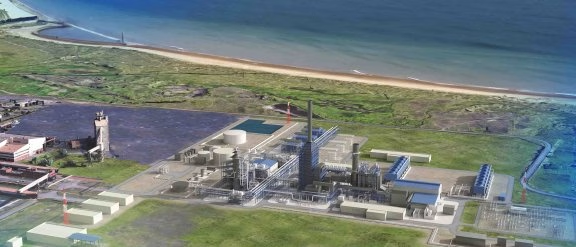
    Balfour Beatty, one of UK’s infrastructure powerhouses, announced a landmark £833 million contract from Technip Energies to build Net Zero Teesside Power, a major gas-fired power plant on UK soil. The contract was handed by the French energy giant and marks a major step towards bolstering clean energy and cutting reliance on imported fuel. Starting later this year, the project will mobilize 1,500 workers, with expectations set on a 2028 completion to coincide with national energy objectives.

    Also Read UK Approves 140 MW Oaklands Farm Solar Park in South Derbyshire

    Collaboration at Scale

    In addition, this venture isn’t a solo act. Balfour Beatty will team up with Technip and GE Vernova, a major American energy equipment company. Together, they will deliver the combined cycle gas-turbine segment of the Net Zero Teesside Power plant, a joint effort involving BP and Equinor. Collectively, their goal is to produce up to 742 MW of flexible, low-carbon power, enough to supply over one million homes annually.

    Policy-Driven Push for Clean Energy

    Moreover, the UK government is fast-tracking initiatives to lower energy bills and cut carbon footprints. With an industry strategy unveiled just this week, the government is rolling out exemptions for heavy energy users and other incentives aimed at balancing costs and sustainability. Further, that broader backdrop underscores why Teesside matters, not just as a power plant, but as a catalyst in reviving local economies and supporting a national energy transformation.

    Also Read £500 Million Investment Planned for UK’s First Regional Hydrogen Transport and Storage Network

    Jobs, Emissions, and Economic Growth

    Finally, Balfour Beatty CEO Leo Quinn summed it up: this is not merely an energy asset, it is a cornerstone for “net zero” targets and a major economic boon for North-East England. In fact, 3,000 construction jobs will be supported during the build, with 1,000 ongoing roles upon operation. What’s more, the plant is designed to capture and store around two million tones of CO₂ annually, underlining its role in the global push to tame climate change.

    Balfour Beatty NetZero Teesside Power Overview

    Name: Net Zero Teesside Power (NZT Power)

    Location: Teesside, North‑East England

    Joint Venture Partners: BP (75%) and Equinor (25%); Northern Endurance Partnership (NEP) also involved for CO₂ storage

    Technology & Capacity

    Type: Combined‑cycle gas turbine (CCGT), powered by GE Vernova 9HA.02 turbine

    Carbon Capture: Shell’s CANSOLV® via Technip Energies’ Canopy by T.EN™ system, capturing 95% of CO₂

    Output: Up to 742 MW, serving approximately 1 million UK homes annually

    CO₂ Transport & Storage: 2 million tonnes per year piped and stored offshore by NEP (BP, Equinor, TotalEnergies)

    Timeline & Economic Impact

    Financial Close: December 2024; official engineering go‑ahead issued mid‑December 2024

    Construction Phase: Begins mid‑2025; onshore civil works (Balfour Beatty, Technip Energies & GE Vernova)

    Operational Target: Full commercial operations expected by 2028

    Job Creation: 3,000 construction jobs; 1,500 on‑site at peak; up to 1,000 long‑term roles; minimum 5% apprenticeships via Balfour Beatty’s 5% Club

    Strategic & Policy Context

    UK Government Support: £21.7 billion CCUS funding boost in 2024, aligned with 2030 clean power goals

    Net‑Zero Alignment: Gas‑with‑CCS seen as essential to UK’s 2035 and 2050 carbon budgets; supports 6% of future electricity mix with CCS

    Regional Benefits: Revitalizes North‑East industrial skills base, retains legacy workforce; part of wider East Coast Cluster aiming to decarbonize heavy industry

    Risk & Challenges

    Legal & Environmental Concerns: Government promised compensation if court halts onshore development; some critics argue lifecycle emissions may still be substantial

    Scale-Up Imperative: NZT is first of its kind, UK will need 10 GW of CCS gas plants by 2035. Success here is vital to technology rollout

    Also Read Tanzania Launches the Construction of $100 Million Tanga International Energy Terminal for Liquefied Petroleum Gas Project

  • The Phoenix Tucson Passenger Rail Project and where its at now

    The Phoenix Tucson Passenger Rail Project and where its at now

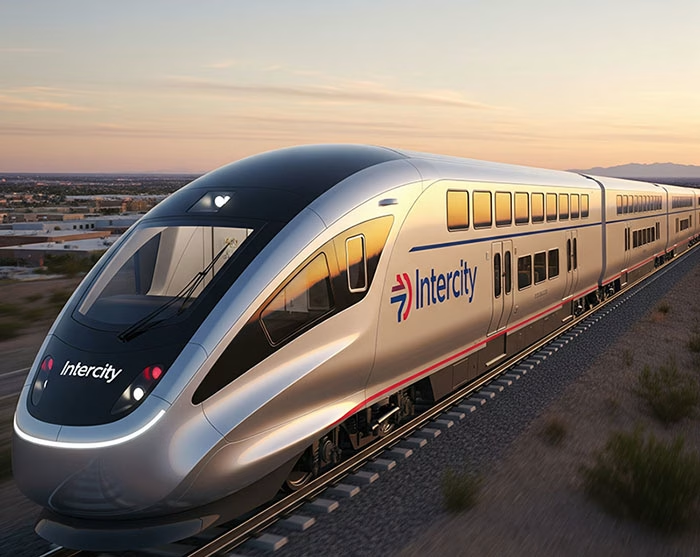
    The Arizona Department of Transportation (ADOT) has announced the completion of the first stage of planning for the Phoenix Tucson intercity passenger rail project. This milestone follows the Federal Railroad Administration’s (FRA) approval of the initial step in the Corridor Identification and Development Program (CIDP), which marks the official beginning of efforts to establish a passenger rail service between Arizona’s two largest metro areas.

    Project Overview and Scope

    The proposed 158–160 mile Phoenix Tucson Passenger Rail Project would stretch from Buckeye, west of Phoenix, to Tucson, offering an alternative to vehicular travel on the congested I-10 corridor. The recently approved first step involved outlining the project’s scope, timeline, and a $10.6 million budget. This phase also sets the groundwork for the creation of a Service Development Plan that will include technical evaluations and stakeholder engagement.

    What Comes Next: Step Two Planning

    Pending approval of a federal grant, ADOT will enter Step 2 of the program, which is expected to span the next two to three years. This phase will include:

    • Determining station locations
    • Analyzing ridership and travel patterns
    • Studying environmental and transportation impacts
    • Estimating capital and maintenance costs
    • Engaging with stakeholders and the public
    • Identifying funding and service management strategies

    This detailed planning process aims to ensure the Phoenix Tucson Passenger Rail Project meets Arizona’s future mobility and sustainability goals.

    [internal_link url=”https://constructionreviewonline.com/biggest-projects/brightline-miami-project-timeline-and-what-you-need-to-know/”]

    Coordination with Amtrak and Other Studies

    ADOT’s planning effort aligns with Amtrak’s concurrent study of the proposed Daily Sunset Limited service between Los Angeles and New Orleans, which includes a reestablished route through Phoenix. Although the two services will share the Union Pacific Railroad tracks, they are designed to be complementary, and ADOT will coordinate closely with Amtrak officials.

    Future Steps and Funding Considerations

    Step 3, the final phase, will require FRA approval and will consist of detailed engineering work and environmental analysis. This stage would take an additional two to three years and require a 20% state match for federal funding. Governor Katie Hobbs has already committed $3.5 million to support the planning process.

    Long-Term Vision

    While construction is not yet funded, the Phoenix Tucson Intercity Passenger Rail Corridor Study is a vital step toward building an efficient, sustainable transportation option between Arizona’s two largest cities. It promises to relieve highway congestion, reduce carbon emissions, and provide reliable travel times for residents and visitors alike.

  • NJ Transit Breaks Ground on Phase 2 of Raritan River Bridge Replacement

    NJ Transit Breaks Ground on Phase 2 of Raritan River Bridge Replacement

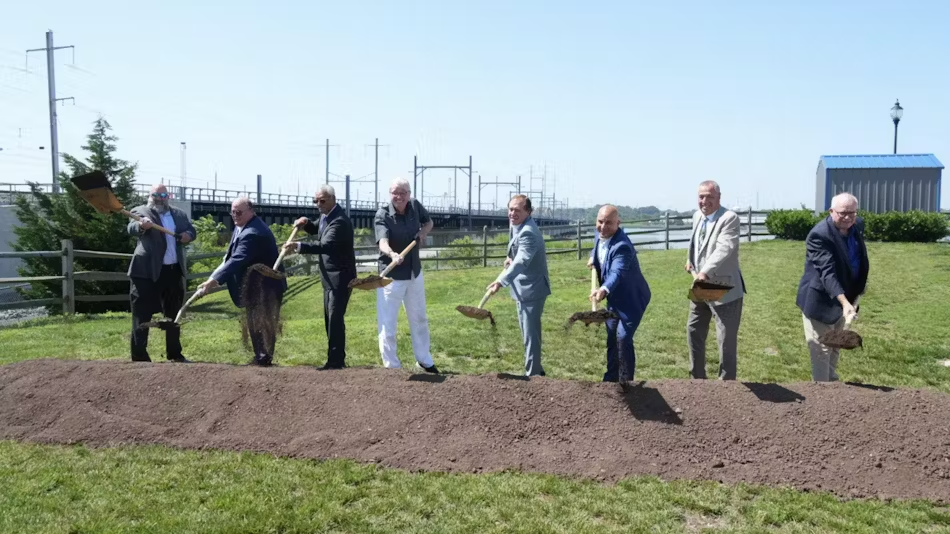
    NJ Transit has embarked on phase 2 of the Raritan River Bridge replacement, moving forward with the construction of a new vertical lift span that will improve rail service between Perth Amboy and South Amboy. Groundbreaking took place on June 25, marking a milestone in overhauling one of the region’s oldest movable rail bridges.

    This phase includes the construction of the bridge’s center span, which will rise vertically to allow marine traffic to pass—a major advance from the existing 117-year-old swing bridge, which swings open. The new bridge is meant to improve operating efficiency, weather resilience, and travel times on the busy North Jersey Coast Line.

    NJ Transit President and CEO Kris Kolluri spoke to the broader importance of the project. “Breaking ground on the lift span brings us one step closer to a stronger, modernized transportation network,” he said. “It represents our ongoing investment in replacing older infrastructure to bring reliability and connectivity to customers.”

    The Raritan River Bridge is a critical link on the North Jersey Coast Line, serving some 11,500 weekday passengers and 2 million tons of Conrail freight each year. Due to its important role in passenger and freight traffic, the project is being viewed as a crucial piece of the region’s transportation future.

    In New Jersey there is another bridge the Portal North Bridge project which will deliver a new two-track, high-level fixed-span bridge, built to modern standards and aimed at boosting both capacity and reliability along the Northeast Corridor.

    Read also: New Raritan River Bridge project progress as Skanska gets $444M construction contract award

    The New Bridge

    The new bridge will have two tracks and will be relocated somewhat from the current position before connecting to the mainline at both ends. It will also be taller than the current structure, which will take it above the 100-year floodplain. All improvements should double the speed of trains crossing the bridge—from the current 30 miles per hour to as much as 60.

    Governor Phil Murphy touted the advantages for everyday commuters. “This Raritan River Bridge replacement project brings us a step closer to quicker, more dependable service,” he stated. “That’s more time at home helping the kids with homework or having dinner with family and less time spent stuck in transit.”

    The replacement of the bridge became an urgent requirement following Superstorm Sandy in 2012, which caused extensive damage. Ocean surges and debris displaced the deck out of alignment and required an 18-day shutdown. NJ Transit later confirmed that the original structure, in service since 1908, was never designed to withstand such lateral forces.

    Read also: Orange County Advances Plans for Futuristic $35M I-Drive Pedestrian Bridge

    Phase 2 Contract

    Carteret-based Skanska Koch Inc. signed a $444.3 million contract in December 2024 to undertake the second phase. Their work includes constructing the lift span, building flanking spans, and adding important systems like signals, communications, and catenary wires.

    Phase one began in May 2020 and was finished last year under George Harms Construction Co. Inc. That segment was initially costed at $248 million and paved the way for this phase.

    Design

    The bridge design is being shared by Hardesty & Hanover and Gannett Fleming, while construction management is being carried out by AECOM and Mott MacDonald under an nearly $34 million contract approved back in 2019.

    The replacement bridge will be 10 feet wider than its predecessor and constructed with a steel superstructure on reinforced concrete piers. Kolluri indicated that rising steel prices—particularly between pre-pandemic planning and post-pandemic letting of contracts—have been a significant cost driver.

    The project is already over budget

    The initial two phases of the project have cost over $692.3 million to date, which exceeds the original $595 million appropriated for the whole three-phase project. Demolition of the current bridge will be the third and last stage.

    To help finance, NJ Transit reallocated roughly $240 million from the abandoned Transitgrid power backup project to the bridge program.

    Upon completion, the new Raritan River Bridge not only will be safer and longer-lasting, but it also is expected to significantly improve the daily commute for thousands of commuters and freight carriers.

    Read also: Design Unveiled for New Cable-Stayed Brent Spence Companion Bridge

    Raritan River Bridge Replacement Project

    Project Overview

    Location: Between Perth Amboy and South Amboy, NJ

    Line: North Jersey Coast Line

    Current Usage: 11,500 weekday commuters, 2 million tons Conrail freight annually

    Bridge Type: New vertical lift span replacing 117-year-old swing bridge

    Project Phases

    Phase 1 (Completed)

    Timeline: May 2020 – 2024

    Contractor: George Harms Construction Co. Inc.

    Cost: $248 million (estimated)

    Scope: Foundation work

    Phase 2 of Raritan River Bridge Replacement Project (Current)

    Groundbreaking: June 25, 2025

    Contractor: Skanska Koch Inc.

    Contract Value: $444.3 million

    Scope: Lift span construction, flanking spans, signals, communications, catenary systems

    Phase 3 (Future)

    Scope: Demolition of existing bridge

    Key Improvements

    Speed: Train speeds double from 30 mph to 60 mph

    Height: Above 100-year floodplain

    Width: 10 feet wider than current bridge

    Design: Steel superstructure with reinforced concrete piers

    Tracks: Two-track configuration

    Project Costs

    Original Budget: $595 million (all three phases)

    Current Cost: $692.3+ million (phases 1-2 only)

    Key Partners

    Phase 2 contractor: Skanska Koch Inc.

    Design: Hardesty & Hanover / Gannett Fleming joint venture

    Oversight: AECOM / Mott MacDonald ($34 million contract)

    Read also: KYTC Unveils Timeline and Design Plans for New Licking River Bridge