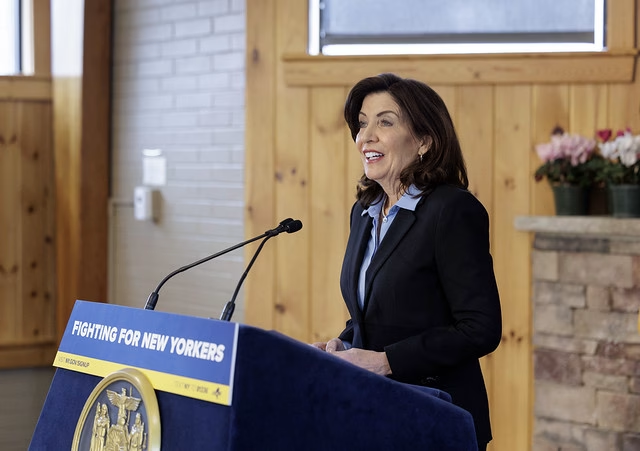
Today, Governor Kathy Hochul unveiled a major $1 billion investment in affordable housing, eyeing nearly 3,000 new or preserved homes across New York State. This move builds on her five-year, $25 billion Housing Plan, aiming to create or preserve 100,000 affordable units statewide.With communities from New York City to the North Country in sight, it’s a clear signal: tackling housing shortages and housing costs is a top-tier priority. On 17th September the $72m Center City Courtyard in Downtown Rochester that offers offers 164 affordable apartments, including 95 supportive housing units for veterans and individuals at risk of homelessness as opened complementing the Governors plans.
Strategic Funding and Sustainability
The package includes $560 million in tax-exempt housing bonds and $466 million in direct subsidies, funneled through New York State Homes and Community Renewal. Moreover, each of the 15 funded projects meets high standards for energy efficiency and carbon reduction, ensuring homes that are not only affordable but also eco-conscious. When combined with private funding, the total anticipated investment swells to around $1.5 billion.
Hochul stressed that “increasing home availability statewide” is essential to easing the housing crunch and reducing costs for families.Likewise, RuthAnne Visnauskas, commissioner at NYS Homes and Community Renewal, emphasized that the funding supports nearly 3,000 affordable, sustainable, and supportive homes, adding that over 60,000 units have already been created or preserved since the Housing Plan’s inception. Senate Majority Leader Andrea Stewart‑Cousins also chimed in, highlighting the progress in Yonkers and the wider push to build safe, modern homes across the state.
New York Housing
Highlighted Projects
Together, the 15 projects reflect the diversity of New York communities:
In New York City, funding supports Bronx’s Kittay House, mixed-use towers in Brooklyn, the Edgemere Commons in Queens, and artist live-work spaces at Westbeth, among others.
In upstate regions, awards include Northgate Landing in Albany, supportive housing in Rochester’s Gardner’s Lofts, rehab of high-rise apartments in Utica, Plattsburgh, and Watertown, and new units in Binghamton.
Each project ranges from new construction to rehabilitations, and many incorporate supportive services for seniors, veterans, and individuals experiencing homelessness.
New York Housing Investment Overview
What: $1 billion in New York State housing bonds & subsidies
Why: To create or preserve nearly 3,000 affordable, energy-efficient homes statewide
Where: Funded across 15 projects, from NYC to the North Country
Funding Breakdown: $560 million in tax-exempt bonds, $466 million in direct subsidies
Combined with private investment, the total is around $1.5 billion
Strategic Goals
Part of a five-year, $25 billion Housing Plan aiming for 100,000 units
Ensures modern, sustainable, supportive homes with carbon-reduction standards
Builds on earlier success: over 60,000 homes created or preserved under the plan so far
Leadership Support
Gov. Hochul: Emphasizes expanding home availability to ease costs and strengthen communities
HCR Commissioner Visnauskas: Highlights nearly 3,000 sustainable, supportive units funded now
Senate Leader Stewart-Cousins: Applauds investments, including Yonkers projects, as vital to state-wide housing goals
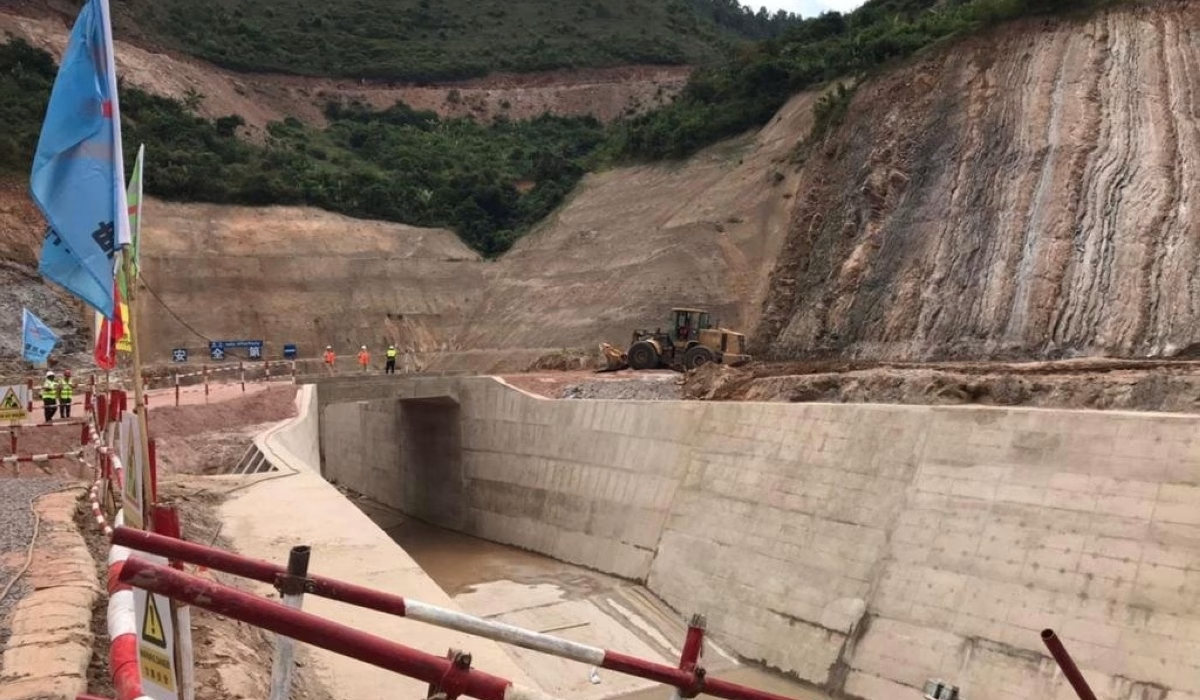
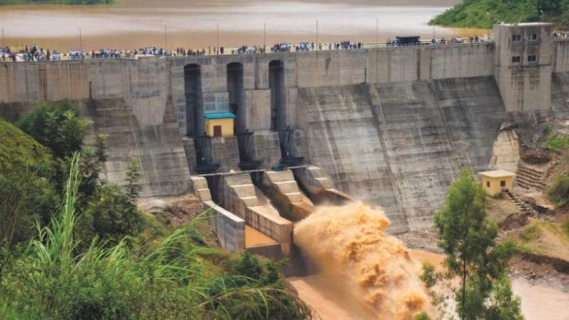
The construction of the Nyabarongo II hydropower plant is making commendable and steady progress with 50 percent completed. More progress is expected to be seen before the end of the year, according to officials from the Energy Development Corporation Limited (EDCL). The 43.5 megawatts (MW) multipurpose dam on Nyabarongo River is expected to be of monumental significance. Firstly, the dam is not only designed to generate electricity, but also support support irrigation projects. Once complete, the dam will support over 200,000 hectares of farmland by providing water.
Furthermore, it will facilitate in easing supply of water and reducing flooding in downstream areas. The project was initiated following a February 2020 framework agreement on its construction. The agreement was between the governments of Rwanda and China through China’s Exim Bank. The bank is providing a $214 million concessional loan through which the project is being financed. Nyabarongo II is being constructed between Kamonyi, Gakenke, and Rulindo districts. These are regions in the Northern and Southern provinces. The dam will stand 59 meters high and stretch 363 meters in length, forming a reservoir with a capacity of 803 million cubic meters.
Funding: The project is funded by China-based Exim bank
Expected timeline: The project is expected to continue with completion expected by 2030
The Scope of Implementation on Rwanda’s Nyabarongo II Hydropower Plant
The scope of implementation on the Nyabarongo II hydropower plant is one that is shaping up to be quite fulfilling and promising. These are some of the insights drawn from EDCL Managing Director, Felix Gakuba’s speech. He spoke during the recent Public Accounts Committee (PAC) session in parliament as he noted significant infrastructure components are under development. “We are monitoring progress daily. We have completed nearly 50 percent of the works and expect much more progress by the end of the year,” he said. Specifically, he noted that the powerhouse structure has already reached its first level, with dam’s foundation complete.
The construction of Rwanda’s Nyabarongo II hydropower plant is making commendable and steady progress with 50 percent completed.
Focus now shifts to upper parts of the dam, which are expected to take another four or five months to build. The completion of this phase will pave way for more levels to be added after structural reinforcement. Gakuba also said that construction of the transmission line has begun, with contractors already on-site. “Our staff travelled to China to inspect the equipment before shipment,” he added. Chinese company Sinohydro is responsible for the project’s engineering, procurement, and construction (EPC) contract. Furthermore, it is also responsible for installing the 110kV transmission line.
Meta Platforms Inc. has power purchase agreements (PPAs) with Invenergy for a combined 791 MW of solar and wind capacity to support its growing U.S. data center operations. The four projects are located in Ohio, Arkansas, and Texas, and expand Meta’s total renewables procurement from Invenergy to about 1.8 GW. The agreements reflect Meta’s ongoing efforts to decarbonize its data centers as it also recently signed two other PPAs in Texas with Enbridge for the Clear Fork solar project, and ENGIE for the Swenson Ranch solar project.
Factsheet for Meta-Invenergy 791 MW Solar and Wind PPAs
Developer: Invenergy
Offtaker: Meta Platforms Inc.
Total capacity: 791 MW of combined solar and wind
Projects involved:
300 MW Yellow Wood Solar Energy Center in Ohio
140 MW Pleasant Prairie Solar Energy Center also in Ohio
Decoy Solar Energy Center at 155 MW in Arkansas
196 MW Seaway Wind Energy Center in Texas
Total Meta-Invenergy capacity: 1.8 GW
Announcement date: June 26 2025
Expected commissioning: 2027 to 2028
Meta signed four PPAs with Invenergy for 760 MW of solar electricity in 2024.
Meta Inks PPAs for 791 MW Solar and Wind Power with Invenergy
Reported June 27, 2025 – In recent developments, Meta has inked deals with renewable energy developer Invenergy to source more power for its data centers. The companies have both signed four deals that will see the supply of 791MW energy through solar and wind power. Through this deal, Meta aims to supplement power supply that is used to operate its data centers. This is the latest in a string of deals by Meta aimed at meeting the company’s energy needs. Furthermore, it aligns with the company’s ambition to support artificial energy technologies using clean energy. Last year, Meta had signed four PPAs with Chicago-based Invenergy for 760 MW of solar electricity. The renewable energy company noted that the recent deal brings the companies’ total partnership to 1800MW. Meta had previously announced deals with several large energy projects such as solar. Furthermore, a geothermal startup and a proposal seeking nuclear power developers is also in the works.
The Scope of Implementation on Meta’s Data Centers
The scope of implementation on powering Meta’s data centers entails leveraging clean and renewable energy as its power source. The electricity from Invenergy’s solar and wind projects in Ohio, Arkansas and Texas will be delivered to the local grid. On the other hand, Meta will receive clean energy credits associated with the new generation capacity coming online. However, the companies did not disclose the financial details of the deals. “We’re laser-focused on advancing our AI ambitions, and to do that, we need clean, reliable energy,” said Urvi Parekh, Meta’s head of global energy.
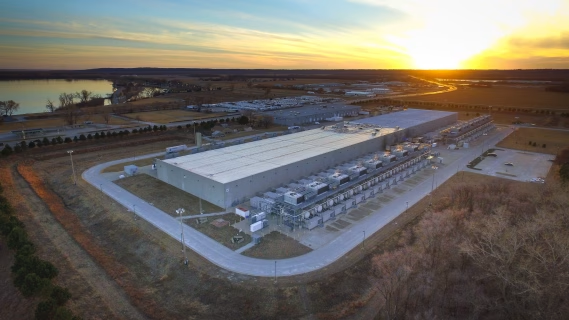
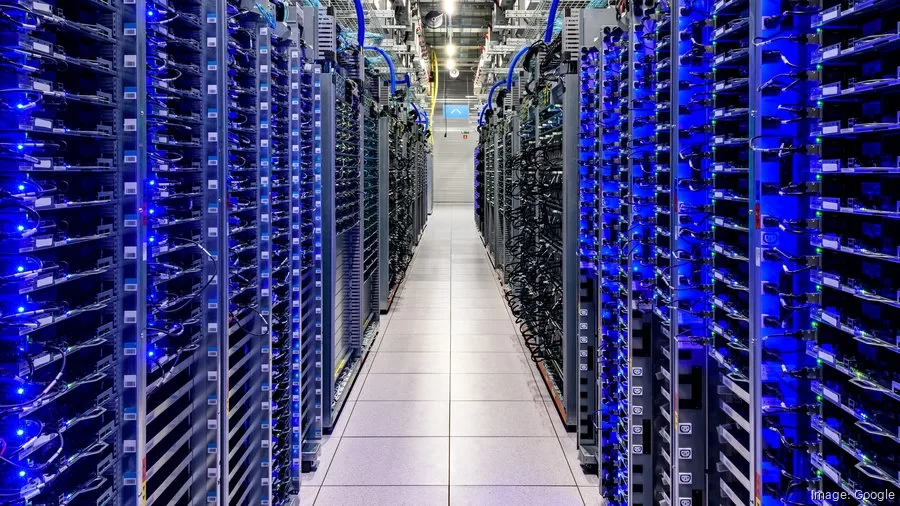
In recent developments, Meta has inked deals with renewable energy developer Invenergy to source more power for its data centers.
Meta announced earlier this month it secured a 20-year deal with Constellation Energy. The deal aims to utilize nuclear power for AI and other technology developments. As part of the agreement, Meta said it will expand the output of Constellation’s Clinton Clean Energy Center in Illinois. It is noticeable that Meta is increasingly turning its focus to AI. However, it is a project that requires an unprecedented amount of energy to develop and operate and power data centers. To meet such rising demand, companies across the U.S. are also pursuing large-scale renewables, such as Invenergy’s proposed $750 million, 300 MW wind project in South Dakota. The company said it expects to nearly double its spending this year for this pivot.
Updated November 14, 2025 -Texas environmental regulators on November 4, 2025 issued preliminary approval for Fermi America to develop 6 gigawatts of natural gas generation in the state’s Panhandle, part of the company’s proposed 11-gigawatt Project Matador energy campus. The permit is an early step in a process that still requires public hearings and final clearance from the Texas Commission on Environmental Quality (TCEQ).
The project, a collaboration between Fermi America and the Texas Tech University System, would supply electricity to energy-intensive computing operations, including artificial intelligence facilities, through a privately operated grid rather than the state’s main ERCOT network. The project comes at a time when Data center projects are facing huge challenges when it comes to power demands. The proposal will now move into a formal review process and public comment period before any final authorization is granted.
A Growing Market for AI-Driven Energy
Fermi America says the site is designed to help meet rising electricity demand from cloud computing and AI infrastructure. Company filings describe a hybrid system combining natural gas, nuclear, solar, and battery storage.
The first generators are expected to be installed by 2026. At full operation, the company estimates the initial phase could offset power demand roughly equal to that of New York City.
Industry analysts note that data centers and AI workloads are becoming a major factor in U.S. energy planning. Several states, led by Texas, have seen a wave of private power projects aimed at serving those needs without drawing directly from public utilities.
Environmental and Regulatory Scrutiny
Documents filed with the TCEQ indicate that the project’s emissions are expected to comply with federal and state air-quality standards. Regulators will continue to assess potential impacts on air quality and water use as the review proceeds.
The company says it plans to add solar generation and employ hybrid cooling systems to limit water consumption. Community hearings are expected as part of the permitting phase.
Broader Context
Project Matador is one of several large-scale energy developments proposed in the Texas Panhandle as computing firms and power providers race to secure reliable electricity supplies for AI infrastructure. The project’s backers include former U.S. Energy Secretary Rick Perry and Fermi America co-founder Toby Neugebauer.
If fully built, the 11-gigawatt site would be among the largest privately operated power facilities in the world.
Also, Fermi America recently signed two major nuclear energy agreements to advance its ambitious data center campus in Amarillo, Texas. The first agreement, with South Korea’s Doosan Enerbility, follows a Memorandum of Understanding signed earlier this year. And focuses on producing long-lead-time nuclear equipment, including reactor pressure vessels and steam generators. These components will support the deployment of four planned Westinghouse AP1000 nuclear reactors, forming the backbone of the campus’s long-term power supply.
The second deal, with Hyundai Engineering & Construction (E&C), covers Front-End Engineering Design (FEED) for the four reactors, laying the groundwork for a full engineering, procurement, and construction (EPC) contract expected in early 2026. “Doosan Enerbility and Hyundai E&C have been waiting for an American company to stop power pointing about nuclear and start building it,” said Toby Neugebauer, co-founder and CEO of Fermi America. “Their firm commitment to Fermi America positions us for action, leveraging their track record to build clean, new nuclear power at the velocity and scale the President demands and the U.S. requires.”
Project Matador: One of the World’s Largest AI and Energy Complexes
Fermi America plans Project Matador, an 11 GW hyperscale data center campus in Amarillo, Texas, next to the DOE’s Pantex plant. The Texas Tech University System partners with Fermi to develop 18 million square feet of AI-focused data centers. The campus will draw power from nuclear, natural gas, solar, and wind energy sources. Fermi, co-founded by former Energy Secretary Rick Perry, filed for an IPO on Nasdaq under the ticker FRMI. The company expects the first 1 GW online by late 2026, positioning Project Matador among the world’s largest AI-energy campuses.
In July, Fermi expanded its capacity with the acquisition of more than 600MW of natural gas generation across two deals, including nine turbines, to meet near-term demand. The company aims to deliver 1GW of AI power by 2026. While natural gas will anchor the project in its early stages, Fermi’s long-term strategy prioritizes nuclear energy as the core power supply.
Washington 27th June 2025 – Texas-based Fermi America, co-founded by former U.S. Energy Secretary Rick Perry, has announced plans to build the Largest U.S. Energy and Data Complex, powered by nuclear, natural gas, and solar energy. Dubbed the “Hypergrid” project, it will be developed in partnership with Texas Tech University and formally launched on July 4.
Massive Scale and Clean Power Ambition
The largest U.S. energy and data complex will be built near Amarillo, adjacent to the DOE’s Pantex plant, spanning nearly 5,800 acres. Fermi says the Hypergrid campus could eventually produce up to 11 GW of energy, enough to power over 8.2M homes. The first 1 GW is expected online by late 2026. It will also host large-scale AI data centers, strategically located near major gas pipelines and atop a vast natural gas field, joining the largest data centers being built around the world.
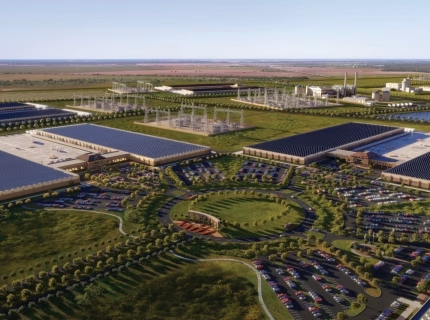
Rendering of Fermi America Campus in Texas
Nuclear Power in the Spotlight
Fermi’s announcement comes amid renewed national focus on nuclear energy. Former Secretary Perry emphasized urgency: “We’re behind—and it’s all hands on deck.” He noted that while China is currently building 22 reactors, the U.S. has none under construction. Fermi has applied for four 1-GW nuclear reactors, though the company has not confirmed specifics or revealed financing details.
Fermi America’s nuclear agreements join a growing trend of tech and energy firms reopening or expanding nuclear plants. Alongside renewable energy, following deals like Google’s $1.6 B Iowa nuclear project with NextEra.
Political Momentum and Regulatory Scrutiny
The Largest U.S. Energy and Data Complex project aligns with recent executive orders from President Trump to fast-track nuclear reactor applications and restructure the Nuclear Regulatory Commission (NRC). While these moves aim to revive the sector, they’ve drawn criticism over concerns of weakening oversight.
The NRC confirmed it is reviewing Fermi’s applications, with more public details expected soon.
Project Summary: Largest U.S. Energy and Data Complex
Developer: Fermi America
Location: Amarillo, Texas (near Pantex Plant)
Energy Capacity: Up to 11 GW (nuclear, gas, solar)
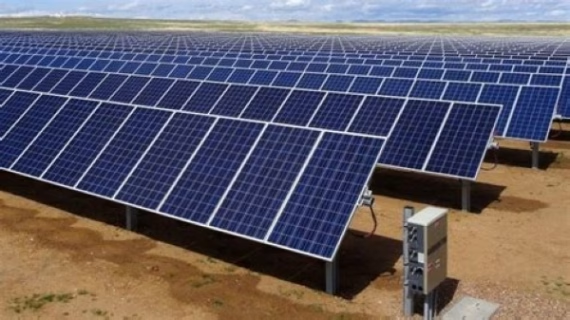
Washington’s Energy Facility Site Evaluation Council (EFSEC) has approved the Site Certification Agreement (SCA) for Cypress Creek Renewables’ proposed Carriger Solar project. The 160-megawatt (MW) solar photovoltaic (PV) plant, paired with a 63 MW battery energy storage system, is set for development two miles northwest of Goldendale. The project now advances to Governor Bob Ferguson for final approval.
Eight Years of Planning and Review
The approval follows nearly eight years of extensive planning, including a 28-month formal review by EFSEC. Cypress Creek Renewables collaborated with various stakeholders to ensure that Carriger Solar Project complies with all environmental, zoning, and community standards. The project is sited on largely unirrigated, privately-owned land, minimizing environmental disruption and avoiding impacts to sensitive cultural and ecological resources.
Clean Energy with Local Benefits
Carriger Solar Project is expected to generate clean, carbon-free electricity for the region, contributing significantly to Washington’s renewable energy goals. Once operational, it will enhance grid resilience, support the transition to sustainable energy, and offer economic benefits to the local community.
Developer Commits to Responsible Growth
“We’re hopeful that Governor Ferguson will recognize the thoughtful planning and siting of the Carriger Solar Project,” said Sarah Slusser, CEO of Cypress Creek. “We are committed to responsible and thoughtful development and eager to support Washington’s energy future.”
Cypress Creek Expands in Washington
Cypress Creek is a national leader in solar and energy storage development. The company’s Ostrea Solar project in Yakima County was approved in 2023 and is under construction, highlighting Cypress Creek’s growing role in advancing Washington’s clean energy infrastructure.
Governor Ferguson’s decision will determine the project’s next steps as Washington continues progressing toward a carbon-free energy future.
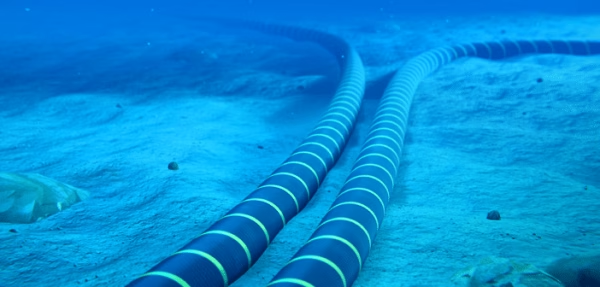
The Morocco-UK Power Project was a proposed £24 billion ($33 billion) initiative aimed at supplying the United Kingdom with solar and wind power from Morocco through subsea cables. Promoted by the Xlinks consortium, the plan sought government backing through a 25-year Contract for Difference (CfD) power deal.
After nearly two years of waiting, the UK government decided not to support the project. Instead, it opted to prioritize domestic renewable energy sources when offering subsidised price guarantees.
Despite the setback, cross-border electricity projects are becoming increasingly common. Work on the $8.2 billion Italy-Tunisia-Algeria power link, known as the Medlink interconnection project, is progressing with construction scheduled to begin in 2027. Engineering design is complete, permitting is set to begin, and feasibility studies have been led by Italy-based CESI. The Medlink project will link the three nations and export clean electricity to Europe.
Length: Approximately 4,000 km (2,500 miles), which would make it the world’s longest undersea power cable if built.
Route: From landfall near Tan-Tan in southern Morocco to National Grid connection points at Alverdiscott near the north coast of Devon, England. The cable route will follow a shallow water path, passing through the territorial waters of Spain, Portugal, and France without direct electrical connections to those countries.
Manufacturing: Xlinks proposed to manufacture the submarine power cables through a separately financed affiliate company, XLCC. The manufacturing site would be located in Hunterston, Scotland.
“After careful consideration, we as the government of UK have decided not to support the Xlinks Morocco-UK power project,” a spokesperson for the Department for Energy Security and Net Zero (DESNZ) said. This confirmed a report published by Recharge earlier today.
The government’s move to snub Xlinks cable project after protracted talks with the company will come as a surprise to energy industry executives given the company’s pledge to deliver large quantities of power at a price that is approximately half of that to be generated by new nuclear power stations.
Xlinks, which is chaired by the former Tesco chief executive Sir Dave Lewis, had been looking forward to a 25-year contract agreement for difference with the Department for Energy Security and Net Zero (DESNZ), which would have guaranteed a price for the power generated by the project.
To provide the best experiences, we use technologies like cookies to store and/or access device information. Consenting to these technologies will allow us to process data such as browsing behavior or unique IDs on this site. Not consenting or withdrawing consent, may adversely affect certain features and functions.
Functional
Always active
The technical storage or access is strictly necessary for the legitimate purpose of enabling the use of a specific service explicitly requested by the subscriber or user, or for the sole purpose of carrying out the transmission of a communication over an electronic communications network.
Preferences
The technical storage or access is necessary for the legitimate purpose of storing preferences that are not requested by the subscriber or user.
Statistics
The technical storage or access that is used exclusively for statistical purposes.The technical storage or access that is used exclusively for anonymous statistical purposes. Without a subpoena, voluntary compliance on the part of your Internet Service Provider, or additional records from a third party, information stored or retrieved for this purpose alone cannot usually be used to identify you.
Marketing
The technical storage or access is required to create user profiles to send advertising, or to track the user on a website or across several websites for similar marketing purposes.
To provide the best experiences, we use technologies like cookies to store and/or access device information. Consenting to these technologies will allow us to process data such as browsing behavior or unique IDs on this site. Not consenting or withdrawing consent, may adversely affect certain features and functions.
Functional
Always active
The technical storage or access is strictly necessary for the legitimate purpose of enabling the use of a specific service explicitly requested by the subscriber or user, or for the sole purpose of carrying out the transmission of a communication over an electronic communications network.
Preferences
The technical storage or access is necessary for the legitimate purpose of storing preferences that are not requested by the subscriber or user.
Statistics
The technical storage or access that is used exclusively for statistical purposes.The technical storage or access that is used exclusively for anonymous statistical purposes. Without a subpoena, voluntary compliance on the part of your Internet Service Provider, or additional records from a third party, information stored or retrieved for this purpose alone cannot usually be used to identify you.
Marketing
The technical storage or access is required to create user profiles to send advertising, or to track the user on a website or across several websites for similar marketing purposes.