Constructionreview

Blog

  • SSH to Lead Design of US$58 mn Radisson RED Hotel in UAE

    SSH to Lead Design of US$58 mn Radisson RED Hotel in UAE

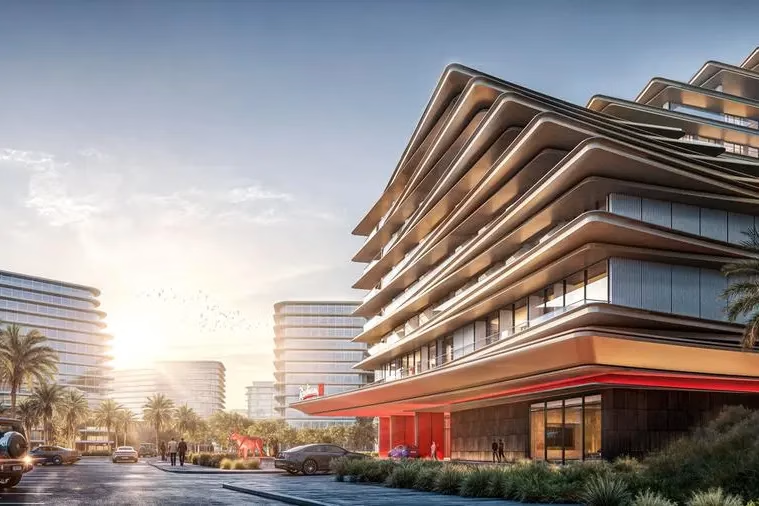
    SSH has been appointed the lead design consultant for the upcoming Radisson RED Hotel on Marjan Island in the UAE. This move is set to redefine the hospitality landscape in Ras Al Khaimah as the massive hotel debuts in one of the UAE’s most dynamic tourism hubs. The 269-room hotel is located just steps from the pristine coastline and will bring a fresh take on luxury, creativity, and coastal living. The major milestone for the Radisson RED Brand will be wrapped in a bold, design-led package.

    Merging Style with the Spirit of the Coast

    Designed with millennials and Gen Z in mind, the hotel blends Radisson RED’s iconic loft-industrial vibe with a softer, resort-inspired look that embraces natural textures and calming tones. Think warm interiors, muted palettes, and materials that echo the island’s relaxed energy. From exclusive beach access to vibrant communal spaces, the hotel promises an immersive experience that;s both visually striking and deeply welcoming. Guests can expect contemporary guestrooms and premium amenities tailored for the modern traveler.

    Also Read Dubai’s Mall of the Emirates Sets Trend with $1.4 Billion Expansion Revamp

    A Creative Collaboration with Big Ambitions

    Stirling Hospitality Advisors is spearheading the project on behalf of BB Holding, orchestrating a dynamic partnership with SSH and Radisson. According to Tatiana Veller, Managing Director at Stirling, this hotel isn’t just another beachfront stay, it is a benchmark for design and guest experience in the region. SSH Managing Director Michael Byron echoed this excitement, noting that the project provides an opportunity to push the boundaries of hospitality design and deliver something truly visionary for the UAE’s hotel scene.

    Amenities That Elevate Every Stay

    True to the Radisson RED ethos, the hotel will feature four distinctive dining venues, including a rooftop restaurant, a stylish lobby bar, and a casual poolside lounge. Additional offerings include a serene spa, an outdoor pool, a fully equipped gym, and spaces designed for corporate events and conferences. As lead design consultant, SSH will manage everything from the earliest design concepts to on-site construction supervision. This will ensure that the hotel not only looks exceptional but also functions seamlessly. With construction now underway, Ras Al Khaimah is poised to welcome one of the most anticipated lifestyle hotels in the region.

    Also Read $670M Redevelopment Plan for St. Louis’ Long-Vacant Millennium Hotel Site

    Radisson RED UAE Hotel Overview

    Project Name: Radisson RED Hotel – Marjan Island

    Location: Marjan Island, Ras Al Khaimah, United Arab Emirates

    Developer/Owner: BB Holding

    Design Lead: SSH International Consultants

    Project Advisor: Stirling Hospitality Advisors

    Brand: Radisson RED (first franchised RED property in the UAE with updated concept)

    Number of Rooms: 269 lifestyle-focused guestrooms and suites

    Target Audience: Millennials and Gen Z travellers seeking a bold, design-led experience

    Design Aesthetic: Evolved loft-industrial look with natural materials and resort-inspired finishes

    Key Amenities:

    Four food & beverage venues (rooftop restaurant, all-day dining, lobby lounge, poolside bar)

    Fully equipped gym

    Outdoor swimming pool

    Signature spa

    Exclusive private beach access

    Dedicated MICE facilities (meetings, incentives, conferences, exhibitions)

    Purpose: To elevate Ras Al Khaimah’s hospitality landscape with a modern lifestyle hotel that blends creativity, design, and relaxation

    Construction Scope (SSH):

    Pre- and post-contract services

    Full project design from concept through construction documents

    On-site construction supervision

    Status: In design and development phase
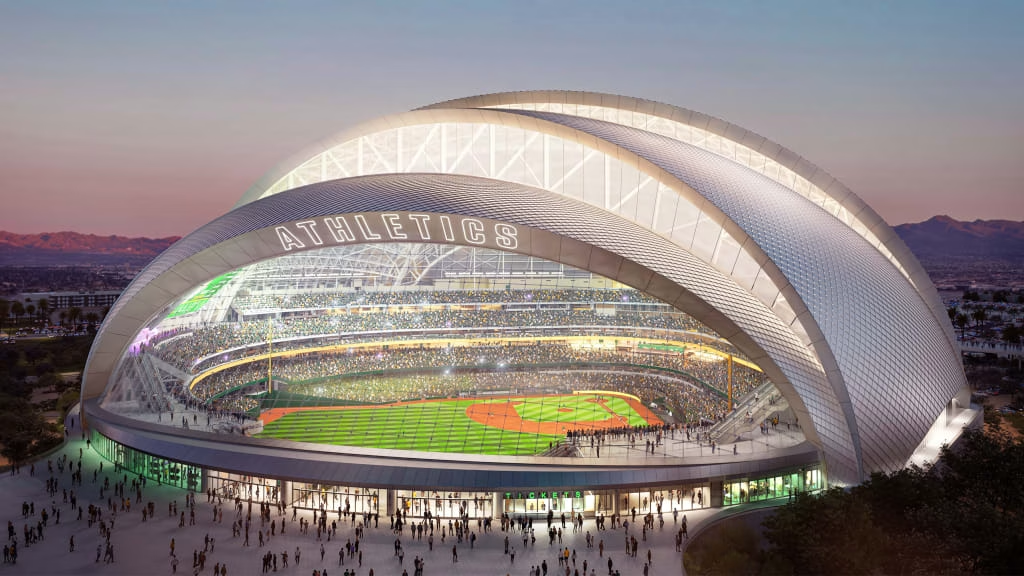
  • Las Vegas Athletics Break Ground on $1.75B Ballpark at Former Tropicana Site

    Las Vegas Athletics Break Ground on $1.75B Ballpark at Former Tropicana Site

    Major League Baseball further entrenched itself in Southern Nevada on June 23 when the Las Vegas Athletics celebrated the groundbreaking of their new ballpark. The $1.75 billion project, set to rise on the iconic Las Vegas Strip, will be built on the former site of the Tropicana resort—a iconic location that’s yielding to the city’s newest sporting landmark.

    The stadium, designed with a capacity of 30,000 seated fans and room for an additional 3,000 standing, is expected to be ready for the team’s debut season in 2028. While actual construction work has already started behind the scenes, Monday’s event made it official: Las Vegas is on track to become MLB’s newest home.

    From Casino Legacy to Ballpark Future

    One of the original casinos on the Strip, the Tropicana closed in April 2024 after nearly seven decades of operation. In October, the building was brought down in a controlled implosion, paving the way for the Athletics’ new stadium.

    “This didn’t happen overnight,” A’s president Mark Badain said. “Years of planning, persistence, and negotiation got us to this point today.”

    The project will occupy approximately nine acres of the 26-acre parcel. Along with the ballpark itself, the proposal features retail, entertainment areas, and a new resort—conceived to combine baseball with the round-the-clock energy of the Strip.

    A Combination of Public and Private Investment

    The stadium is being funded by a mix of money: $380 million in public financing approved by the Nevada Legislature in 2023, an investment by the A’s ownership group headed by the Fisher family, and additional private financing. The total price tag is higher than earlier estimates due to upgrades and inflation.

    Major League Baseball Commissioner Rob Manfred, who was at the ceremony, expressed confidence in the project schedule.

    “We’re right where we’re going to be,” Manfred said. “There’s every reason to believe this stadium will be ready for the 2028 season.”

    Designed for Desert Play—and Global Crowds

    The stadium design includes split-level seating bowls, a fixed roof to manage heat, and design elements intended to give fans glimpses of the Las Vegas Strip. One highlight is an 18,000-square-foot Jumbotron—the largest in the league.

    Team officials say they’re building not just for locals but for a global audience. “Las Vegas has its own homegrown fan base, but it also attracts nearly 45 million visitors a year,” Badain noted. “That gives us a special opportunity to welcome fans from everywhere—and hopefully turn some into A’s fans for life.”

    Read also: Chicago Fire Unveil New Renderings for $650M Riverfront Stadium at The 78

    A Franchise in Transition

    The A’s relocation to Las Vegas comes after years of failed stadium proposals in Northern California. Previous efforts in Fremont, San Jose, and Oakland never materialized. In 2023, the Las Vegas relocation was formally approved by the state, bringing an end to the long search for a permanent home.

    For the time being, the team is playing in West Sacramento at Sutter Health Park, a temporary situation that will continue until 2027. The stadium, which is normally home to the Triple-A Sacramento River Cats, has a seating capacity of just over 14,000 spectators.

    A’s a tribute to their rich baseball tradition—Philadelphia, Kansas City, and Oakland—the club is giving fans an opportunity to lock up future seats with a symbolic $19.01 deposit, a tribute to the year the franchise began.

    With demolition in the rearview and construction ongoing, the Athletics are all in on Las Vegas—not as a new home, but as a destination for the future of baseball. Barring anything, the Strip will have its newest headliner in 2028—not a singer or a magician, but a baseball team ready for its next era.

    Read also: USC Advances $350M Reimagining of the Iconic Williams-Brice Stadium

    Las Vegas Athletics New Ballpark Project in Las Vegas Strip: Factsheet

    Project Overview

    Location: Las Vegas Strip, Nevada (former Tropicana resort site)

    Total Investment: $1.75 billion

    Groundbreaking Date: June 23, 2025

    Expected Opening: 2028 MLB season

    Las Vegas Athletics Break Ground on $1.75B Ballpark at Former Tropicana Site
    Las Vegas Athletics Break Ground on $1.75B Ballpark at Former Tropicana Site

    Stadium Specifications

    Capacity: 30,000 seated fans + 3,000 standing room

    Site Area: 9 acres (of 26-acre total site)

    Key Features:

    Fixed roof for desert climate management

    Split-level seating bowls

    18,000 square-foot Jumbotron (largest in MLB)

    Views of Las Vegas Strip

    Integrated retail and entertainment spaces

    Financing Structure

    Public Funding: $380 million (approved by Nevada Legislature, 2023)

    Private Investment: Fisher family ownership group + additional private financing

    Total Cost: $1.75 billion (increased from original estimates due to enhanced features and inflation)

    Timeline & Key Milestones

    April 2024: Tropicana casino closure (after 67 years)

    October 2024: Controlled demolition of Tropicana

    June 23, 2025: Official groundbreaking ceremony

    2025-2027: Construction phase

    2028: Stadium opening and team’s Las Vegas debut

    Read also: Tampa Bay Sun FC Unveils Vision for Waterfront Stadium in Ybor Harbor

  • Cross River State Secures $3.5 Billion Afreximbank Funding for Bakassi Deep Seaport

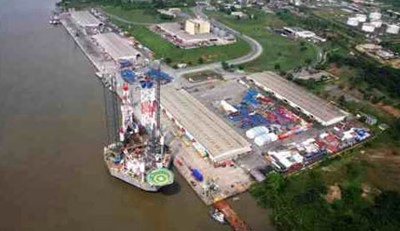
    Cross River State Secures $3.5 Billion Afreximbank Funding for Bakassi Deep Seaport

    Nigeria’s Cross River State has secured a $3.5 billion funding from Afreximbank to fund the anticipated Bakassi deep seaport. The African Export-Importbank (Afreximbank) is a Pan-African multilateral financial institution committed to funding some of Africa’s key infrastructure. Governor Bassey Otu, who was in Egypt last week for a workshop visited the financial institution in Cairo. The aim of the visit was to explore possibilities for partnership in key infrastructure projects expected in the state. The workshop held during the visit culminated in the signing of a project preparation facility for the development of the seaport. Furthermore, the governor noted that the partnership was of a world-class magnitude that would result in positioning Cross River State economically. He also expressed his excitement about the collaboration with Afreximbank and emphasized its importance. Otu noted the importance of the projects in promoting economic growth and development in the state.

    Also read:

    Nigeria’s $3.5 billion Bakassi Deep Seaport Construction

    Bakassi Deep Seaport Project Factsheet

    Project Type:

    Greenfield Deep Seaport Development

    Location

    Bakassi Peninsula, Cross River State, Nigeria

    On the Atlantic coast in close proximity to the Gulf of Guinea, providing direct access to international shipping lanes.

    Purpose

    To develop a world-class deep seaport to cater for heavy seaborne trade, reduce congestion at Nigeria’s existing ports (Lagos and Port Harcourt), and position Cross River State as a logistics and economic hub for West and Central Africa.

    Core Functions:

    • To accommodate post-Panamax ships
    • To serve containerized cargo, bulk commodities, oil and gas logistics
    • To export agricultural and industrial goods

    Key Infrastructure Features

    • Deep-draft berths to accommodate large ships
    • Container terminals
    • Bulk cargo terminals
    • Oil and gas handling facilities
    • Inland connection by planned 217 km Superhighway (standalone project)
    • Logistics and export processing zones

    Total Project Cost

    • $3.5 billion

    Funding

    • African Export-Import Bank (Afreximbank)

    Role of Afreximbank in the Project

    • Project Preparation Facility
    • Financial Advisory Services
    • Mandated Lead Arranger for full project financing and syndication

    Scope of Implementation

    • Phase: Pre-construction and planning stage
    • Project Preparation Facility Agreement signed
    • Financial Advisory Agreement signed
    • Ongoing financial and technical structuring

    Partnerships under Consideration

    G2B negotiations with ORASCOM Construction, ELSEWEDY Electric, and HASSAN ALLAM Holdings for potential EPC and infrastructure roles

    Strategic Importance

    • Will spur regional trade, industrialization, and export capacity
    • Will create jobs and increase Cross River State’s GDP
    • Aims to ease national port congestion and improve maritime logistics
    • Aligns with Nigeria’s Blue Economy and regional integration policies

    Next Steps

    • Completion of technical and feasibility studies
    • Finalization of port construction plan and port design
    • Mobilization of EPC contractors and allied infrastructure partners

    The State of Affairs Regarding the Bakassi Deep Seaport Project

    The Bakassi deep seaport is one that has been anticipated for long, with its scope of implementation seeming somewhat foggy. At the visit to Afreximbank, Out had extensive Government-to-Business (G2B) meetings with tier 1 companies. These included ORASCOM Construction, ELSEWEDY Electric and HASSAN ALLAM Holdings. One of the highlights of the engagement was the signing of the project facility agreement and financial advisory agreement. The signings were for two major projects in Cross River, the Bakassi deep seaport and the 217km Superhighway integrated Project.

    Bakassi Deep Seaport Project
    Nigeria’s Cross River State has secured a $3.5 billion funding from Afreximbank to fund the anticipated Bakassi deep seaport.

    It also entails other projects such as the Obudu Cattle Ranch and Mountain Resort Project. In his remarks, Otu hinted that “following the signing of the agreement, Afreximbank will now serve as the Mandated Lead Arranger for these projects, marking a significant partnership for the state.” The signing of the agreement was attended by top executives of Afreximbank. These include the President and Chairman of the Board, Prof. Benedict Oramah, Executive Vice Presidents and also Senior Directors Furthermore, Heads of Strategic Business Units were also present at the signing ceremony in Cairo, Egypt.

    Also read:

    Lekki Multi-Purpose Deep Seaport, the deepest of its kind in Nigeria

    Nigeria approves construction of Bakassi Deep Seaport

  • Construction Begins on $250M Final Phase of I-35 Reconstruction Project in Waco

    Construction Begins on $250M Final Phase of I-35 Reconstruction Project in Waco

    The Texas Department of Transportation (TxDOT) has begun the final phase of I-35 reconstruction through Waco, a significant milestone in the long-planned My35 improvement project that has been years in development. The latest phase, the I-35 Waco South project, commenced construction in February 2025 and will continue through early 2029.

    Stretching from 12th Street to Highway 6, the project will upgrade approximately three miles of I-35 main lanes and frontage roads. It ties directly into the completed Waco North segment, which finished in November 2022, and will be the last section of I-35 improvement through the city.

    One of the most notable changes will come at the Valley Mills Drive intersection, where the current northbound flyover will be removed and replaced as part of the DDI reconstruction.

    Construction on this I-35 is estimated cost $250 million.

    Expect Traffic Changes and Long-Term Closures

    As crews begin work today, June 23, traffic in both directions of I-35 between 12th Street and South Loop 340 is being reduced to two lanes, starting with the southbound main lanes. Nightly lane closures will be in place during this stage of work, and drivers are advised to follow signs and be careful in work zones.

    Once traffic is diverted, several northbound exits and direct connectors will be shut for the duration of the project—expected to be around two years. They include:

    Exit 331 (New Road) and Exit 333A (Valley Mills Drive/La Salle Avenue) — Northbound drivers will need to exit at S Loop 340/Marlin (Exit 330A).

    Exit 334A (17th/18th Streets) — Drivers should exit at Exit 333B (24th–19th Streets) instead.

    Eastbound S. Valley Mills Drive direct connect to northbound I-35 — This connect will also be closed.

    Loop 340 direct connect to northbound I-35 — Drivers will be diverted to exit at I-35 South east of Bagby Avenue and use the cloverleaf to return to I-35 North.

    Read also: Balfour Beatty Wins $889M Contract to Rebuild Stretch of I-30 Through Dallas

    Project Scope and Improvements

    The I-35 Waco South project involves extensive upgrades designed to increase safety, mobility, and future traffic flow. Some highlights include:

    Adding main lanes from six to eight lanes (four in each direction)

    Reconstructing overpasses and frontage roads

    Extending discontinuous frontage roads

    Realigning and redesigning entrance and exit ramps

    New sidewalks for better pedestrian and bicycle safety

    New bridges and traffic control system upgrades

    Utility and drainage system upgrades

    Building a Diverging Diamond Interchange (DDI) at Valley Mills Drive to improve traffic efficiency

    A Key Corridor for Texas

    I-35 is a significantly vital north-south route for the state of Texas, and it hauls a big volume of commercial and regional traffic from Laredo to Gainesville. It plays an extremely important role in Waco to connect the city with neighboring regions and allow the movement of goods, services, and people.

    The Waco South project is part of the overall My35 plan, a multi-phased, long-term project to improve and upgrade the I-35 corridor. With this final phase complete, Waco will have an entirely improved stretch of I-35 that enhances mobility and safety for future generations.

    TxDOT asks motorists to stay informed, drive cautiously through the work areas, and be patient as crews finish this final phase of the big infrastructure project.

    Read also: Crusoe Secures Additional $11.6B to Expand AI Data Center Campus in Abilene, Texas

    I-35 Reconstruction Project: I-35 Waco South Project Factsheet

    Project Overview

    Project Name: I-35 Waco South (Final Phase of My35 Improvement Project)

    Agency: Texas Department of Transportation (TxDOT)

    Timeline: February 2025 – Early 2029

    Budget: $250 million

    Location: Interstate 35 through Waco, Texas (12th Street to Highway 6)

    Scope of the Final Phase of I-35 Construction Project in Waco

    Length: Approximately 3 miles of I-35 main lanes and frontage roads

    Lane Expansion: From 6 to 8 main lanes (4 in each direction)

    Read also: $746m Austin Interstate-35 contract awarded to Balfour Beatty

    Key Improvements:

    Reconstructed overpasses and frontage roads

    Extended discontinuous frontage roads

    Realigned entrance and exit ramps

    New sidewalks for pedestrian/bicycle safety

    New bridges and traffic control systems

    Utility and drainage upgrades

    Diverging Diamond Interchange (DDI) at Valley Mills Drive

    Traffic Impacts & Closures

    Immediate Changes

    Both directions narrowed to 2 lanes between 12th Street and South Loop 340

    Nightly lane closures during construction phases

    Read also: Texas Instruments commits $60B for US chip facilities across Texas and Utah

  • Data center construction boom around the world

    Data center construction boom around the world

    As the world becomes increasingly digitized, the demand for data processing, storage, and transfer is reaching unprecedented levels creating a data center construction boom. The needs range for the growing e-commerce industry, data heavy development of artifical intelligence(AI) and a society dependent on digital information. This has triggered a global boom in data center construction, with new facilities springing up in nearly every region to meet the explosive growth from cloud computing, to streaming service.. The race to expand digital infrastructure is unsatiable in the near future given that it will consistently be out-matched by demand.

    North America: Hyperscale Expansion

    North America, particularly the United States, is leading the charge in data center development. Tech giants such as Amazon Web Services (AWS), Microsoft Azure, and Google Cloud are building hyperscale data centers—massive facilities capable of housing thousands of servers to operation their Large Language models (LLM).

    The Tech giants are spending colossal amounts to keep ahead in what appears to be a database capacity race. Amazon is to spend $20B in Pennsylvania to expand its data centers the largest private sector investment in the sates history.

    Virginia’s “Data Center Alley” remains a prime hotspot due to its robust fiber network, low-cost power, and business-friendly policies. CleanArc Data Center are just one of several players putting up data centers there.

    States like Texas and Arizona are also emerging as key players, offering vast land and renewable energy options.

    Europe: Balancing Growth and Sustainability

    In Europe, countries like Ireland, the Netherlands, Germany, and the Nordics are experiencing rapid data center growth. In France  Microsoft has announced plans to expand their data centers in Marseille and Paris with a price tag of $4.3b.

    In the UK the largest data center in Europe is coming up at a cost of £3.75bn in the M25 Green belt site in Herfordshire by DC01UK.

    However, increasing scrutiny over energy consumption and land use has prompted stricter environmental regulations. Developers are now investing heavily in sustainable technologies, including liquid cooling systems, green energy sourcing, and carbon offsetting.

    Sweden and Finland are attracting data centers with their cool climates and abundant hydroelectric power. Google is to spend $1b in expanding its 10 year old facility in Finland

    Asia-Pacific: A Rising Digital Powerhouse

    Asia-Pacific is becoming one of the fastest-growing data center regions globally. India is making strong advances with government-backed digital initiatives and a rising middle class driving internet usage. Singapore, after lifting its data center moratorium, is now allowing new builds under tighter energy efficiency rules. South Korea is not being left behind with reports of the world’s biggest AI data centre being constructed in Jeollanam-do Province. Meanwhile, Indonesia, Malaysia, and Vietnam are also seeing increased investment as global players seek alternatives to China’s saturated market. China also recently reported that it will be building the worlds first commercial data center located under the sea in Shanghai and cooled directly by water.

    First underwater commercial data center

    Africa and Latin America: Emerging Hubs

    While still in earlier stages, Africa and Latin America are beginning to see increased interest. South Africa is leading the way on the African continent, with Nairobi and Lagos also emerging as key locations. In Latin America, Brazil and Mexico are witnessing data center investments due to improved internet penetration and rising demand for local content and services. ByteDance, the Chinese parent company of TikTok, is reportedly exploring a significant investment in a data center in Brazil,

    These regions are seen as the next frontiers for digital infrastructure, especially as undersea cable projects improve global connectivity.

    Challenges and Opportunities

    The surge in construction brings significant economic benefits—creating jobs, enhancing internet performance, and supporting digital transformation. However, it also poses challenges related to environmental impact, water and energy consumption, and local opposition to land use. In response, many developers are adopting green building standards, reusing heat, and locating facilities near renewable energy sources.

    Looking Ahead

    The global data center construction boom is far from over. As technologies like AI, 5G, and edge computing continue to evolve, the need for robust, efficient, and sustainable data infrastructure will only intensify. The next phase of development will likely focus on decentralization, modular designs, and carbon neutrality—ensuring the world can process its growing volume of data without compromising the planet.

  • KenGen Cancels and Reopens Tender for $247.5 Olkaria VII Geothermal Plant Consultancy Work

    KenGen Cancels and Reopens Tender for $247.5 Olkaria VII Geothermal Plant Consultancy Work

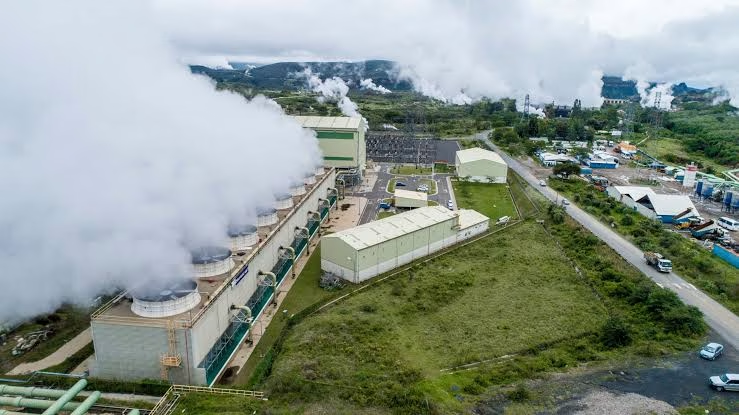
    Kenya’s state-owned electricity generator KenGen has been ordered to cancel a tender worth millions of shillings for the Olkaria VII Geothermal Plant Consultancy Work. This tender was awarded to an Italian company for consultancy services of the upcoming $247.5 million Olkaria VII Geothermal Plant.

    Reason for the Cancellation of Olkaria VII Geothermal Plant Consultancy Work Tender

    The Public Procurement and Regulatory Authority tribunal ruled out the the power producer company had unfairly awarded the tender to ELC Electroconsult SPA. ELC Electroconsult SPA had quoted a price of €18.16 million as compared to the Italian firm, Sintecnica Engineering and Steam SRL which is a joint venture. The joint venture had quoted a price of €16.71 million.

    Also read: KenGen Issues Multi Billion Olkaria I Rehabilitation Contract

    Project Factsheet

    Project name: Olkaria VII Geothermal Power Plant

    Location: Olkaria area, Hell’s Gate National Park, Nakuru County, Kenya.

    Capacity: 80MW

    Estimated cost: $247.5 million

    Expected commissioning date: The first turbine is expected to be commissioned by June 2026.

    Significance: Olkaria VII is a crucial part of KenGen’s strategy to add an additional 3,000 MW of renewable energy to the national grid over the next decade. This will further solidify the position of Kenya as a leader in geothermal energy production in Africa.

    Other Latest Milestone for KenGen

    In another big step made in one of KenGen’s geothermal projects, the company made an announcement regarding the arrival of critical equipment for its newest geothermal power plant at the Olkaria geothermal complex.

    The upcoming Olkaria I project which is located in the geologically active Rift Valley. It will add a total of 63MW of renewable energy to the national grid upon completion. This will therefore further cement Kenya’s reputation as a global leader in geothermal energy production.

    KenGen mentioned in a statement that two steam turbines and two generators that were destined for Units 2 and 3 of the facility have already been successfully delivered to the project site.  These equipment were shipped from Japan earlier this year. Lastly, as for the Olkaria I facility, its completion status was reported to be at 70%. The first turbine on the facility is expected to be commissioned by June 2026.

    Also read: 63MW Olkaria I Geothermal Power Plant Rehabilitation Project Almost Complete as KenGen Reports 70% Progress on the Project