Constructionreview

Blog

  • Latest Updates on Rail Baltica Project

    Latest Updates on Rail Baltica Project

    Updated October 22, 2025- Rail Baltica which is Europe’s flagship cross-border rail project has received a €295.5 million grant from the European Union. This funding will be used to advance construction across Estonia, Latvia, and Lithuania. The grant agreement was signed by RB Rail AS, the project’s central coordinator, during a high-level meeting in Vilnius on 21–22 October with representatives of the European Climate, Infrastructure and Environment Executive Agency (CINEA).

    Furthermore, the funding supports continued implementation of key sections and technical activities across all three countries, with approximately €47.1 million allocated to Estonia, €153.5 million to Latvia, and €94.9 million to Lithuania, including RB Rail AS’s share as joint project coordinator.

    How the Funding will be Utilized

    In Estonia, the funding will be used to complete the mainline that runs from Tallinn to the Estonia–Latvia border. This includes 10.2 km of embankment and double-track substructure in the Rapla–Pärnu section.

    Additionally, in Latvia works will focus on constructing railway embankments in four southern sections of the mainline, covering 13.3 km, and include access and maintenance roads, water drainage systems, and other necessary infrastructure. Also, funding will support construction supervision, technical design of the Rail Baltica electrification project in the Upeslejas–Latvia/Lithuania border section, and project implementation measures including FIDIC engineer services.

    Rail Baltica which is Europe’s flagship cross-border rail project has received a €295.5 million grant from the European Union
    Rail Baltica which is Europe’s flagship cross-border rail project has received a €295.5 million grant from the European Union

    Lastly, in Lithuania, the grant covers construction of key structures. These structures include overpasses and railway crossings in the Kaunas Urban Node section. Additionally, the technical studies and design work are included, covering regional station infrastructure, sections from Kaunas to the Lithuanian–Polish border, and executive design services. Land acquisition and related procedures will also be carried out in the Kaunas area. The financing allows RB Rail AS to continue overseeing cross-border project coordination in line with the Project Management Agreement.

    Rail Baltica is now in full-scale construction across Estonia, Latvia, and Lithuania, with mainline works, international stations, bridges, and crossings advancing. In Estonia, 105 km of substructure and related infrastructure, including overpasses, crossings, and traffic junctions, are under construction. Contracts for 200 km of substructure and superstructure construction have been signed, with more than 100 km currently being built, including the flagship Ülemiste Terminal.

    In Latvia, construction of the mainline prioritises the southern section near Iecava, connecting Riga to the Lithuanian border. This area is one of the most active construction zones. It entails large-scale earthworks, road crossings, and engineering structures forming part of the 202 km of infrastructure across the country. In Lithuania, work is progressing on the Kaunas–Panevėžys section, where 77 km of embankments and engineering structures are being built. By the end of 2025, construction will extend over 114 km, including track laying and a new bridge over the Neris River, the longest in the country.

    In another similar railway infrastructure development, France boasts the largest railway project in Europe, the Grand Paris Express. This project position France as a major railway transport hub in Europe.

    Reported on June 20, 2025

    Estonia has taken a major leap in the ambitious Rail Baltica high-speed rail project by signing two key construction contracts worth up to $1.06 billion. These agreements mark the official start of the development phase for Estonia’s 215 km section, aiming to physically integrate Tallinn with the rest of the Baltics and transport networks across Europe. Notably, international consortia led by GRK Suomi and Bouygues Travaux Publics are set to build the Ülemiste–Pärnu and Pärnu–Ikla stretches, respectively. Now that preparations are under way, heavy construction is expected to begin detailing after a roughly one-year planning stage.

    Pan-Baltic Impact & Security Focus

    Moreover, Rail Baltica is recognized as one of Europe’s most significant transportation projects. It will forge a direct standard-gauge link between Tallinn, Riga, Vilnius, and onward to Poland and Western Europe. In addition, the line’s acceleration has become geopolitically urgent following Russia’s war in Ukraine, by bypassing legacy rail systems and diversifying routes, the Baltic states are working to reduce reliance on Russian infrastructure. Furthermore, Lithuania’s government stresses that this rail corridor will improve military mobility and support the new TEN‑T corridor, further extending connectivity to Ukraine.

    Also Read HS2 high-speed rail Delay: Beyond 2033 & £100bn Cost Overruns

    Costs, Delays & Shared Accountability

    However, interlinked financial and logistical challenges are already emerging. In fact, joint audits from Estonia, Latvia, and Lithuania estimate €10–19 billion more than existing funding. More specifically, €2.7 billion in Estonia, €7.6 billion in Latvia, and €8.7 billion in Lithuania. In response, governments are weighing phased delivery, prioritizing core routes by 2030 and delaying secondary stops. Latvians have cautioned that any delays or failure by one partner would affect all, possibly triggering significant penalties. Meanwhile, there’s concern around a EU funding gap in 2027–28, as Connecting Europe Facility grants may pause between financial cycles.

    What Lies Ahead

    Finally, Estonia’s stage is clear: detailed development begins now, with major works commencing in 2026 on the two awarded sections. Yet the bigger picture hinges on multi-country synchronization, only if Latvia and Lithuania stay on track will cross-border services launch as planned by 2028, with full operation by 2030. Given geopolitical urgency and economic benefits, all three Baltic governments remain committed. They are applying risk sharing and phased planning to navigate funding challenges. Ultimately, Rail Baltica aspires to unite the Baltic capitals with Europe via a modern, secure rail artery, transforming regional mobility for generations.

    Also Read The $4.3B Santa Cruz-Pajaro Passenger Rail Project Takes Shape

    Project Overview

    Contracts Signed: Two major construction contracts totalling $1.06 billion, the largest infrastructure deal in Estonia’s history, covering the Ülemiste–Pärnu (approx. €394M) and Pärnu–Ikla (€332M) segments.

    Scope: Build-out of Estonia’s 215 km high-speed rail section, linking Tallinn to the Latvian border and integrating efficiently with the wider pan-Baltic network.

    Consortia Teams:

    GRK Suomi-led Alliance (Finnish, Estonian, French, Swedish firms) handling Ülemiste–Pärnu works.

    Bouygues Travaux Publics Alliance (with Budimex, Ingerop, WSP) delivering full design and construction for Pärnu–Ikla.

    Timeline: A 12-month development phase is underway to finalise designs, procure materials, and plan schedules; main construction begins in 2026, aiming to finish Estonia’s segment by 2030, in sync with broader network timelines.

    Strategic Impact:

    A 900 km modern rail corridor connecting Tallinn, Riga, and Vilnius to Poland and Western Europe (with ferry link to Finland).

    Strengthens regional connectivity, economic growth, and geopolitical independence from legacy Russian rail systems; also boosts military mobility and aligns with the EU’s TEN‑T network

    Funding & Next Steps:

    Primarily financed by Estonia via EU emission-trading revenues

    Continuation hinges on coordination with Latvia and Lithuania to prevent cost overruns or delays; Latvia faces notable risks over budget and schedule.

  • Major Milestone: Catawba Nation Celebrates Topping-Off Ceremony for Two Kings Casino

    Major Milestone: Catawba Nation Celebrates Topping-Off Ceremony for Two Kings Casino

    The Catawba Indian Nation and its partners marked a major construction milestone on October 27, 2025, with a topping-off ceremony for the Catawba Two Kings Casino Resort, signaling the placement of the final steel beam on the permanent casino building. The on-schedule $1 billion project will debut its first phase—a permanent casino replacing the temporary facility—in spring 2026, while the complete resort, including hotel accommodations and expanded dining venues, is slated for spring 2027 completion. This development represents a crucial advancement in the tribe’s pursuit of economic independence, with projections of thousands of new jobs and substantial economic growth driven by increased tourism and commercial activity in the region.

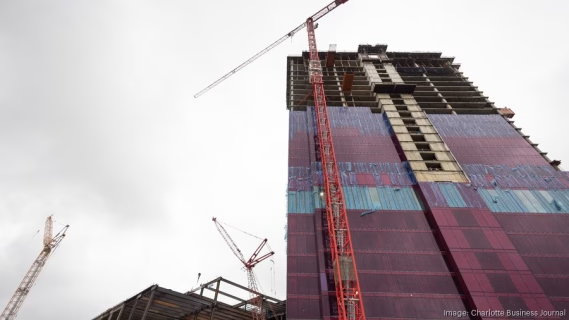
    The impressive $1B Catawba Two Kings Casino Resort has made significant strides in its first year of construction in Kings Mountain, North Carolina, just 35 miles from Charlotte and near the South Carolina border. Notably, they’ve completed foundations for both the casino complex and the 24-story, 385-room hotel. Moreover, the casino frame has reached full height, while the hotel structure has already topped ten floors, with crews adding nearly one floor each week. Clearly, this rapid progress points to major ambitions ahead.

    While the Catawba Two Kings Casino Resort moves forward with construction in North Carolina, the competition for New York’s coveted casino licenses remains heated. Among the contenders, the proposed $8 billion Metropolitan Park Entertainment Complex and Resorts World New York City’s enhanced $7.5 billion Queens expansion proposal are vying for approval, with only select projects ultimately winning licensing rights. These developments underscore the intensifying competition in the Northeast gaming market as multiple operators seek to establish major entertainment destinations.

    Also Read Bally’s Resume Construction on its $1.7 Billion Chicago casino

    Phased Openings Bring Excitement

    Secondly, the resort is being carefully phased. The introductory casino, expected in spring 2026, will debut with 1,350 slot machines, 20 table games, sports-betting kiosks, a 40-seat restaurant, bar, and a loyalty desk, replacing the popular temporary facility that’s been running since July 2021. Then, by 2027, the full-scale complex will open across roughly 2 million sq ft, featuring 4,300 slots, 100 tables, 11 dining venues, 11 bars, a players’ lounge, and 2,700 covered spaces plus 800 surface parking spots. This gradual approach ensures smooth scaling for both operations and the guest experience at the Catawba Two Kings Casino.

    Economic Engine & Community Impact

    Furthermore, the project is already delivering economic benefits. Hundreds of construction jobs have been created so far, and once fully open, the resort is expected to employ around 2,200 people, including Catawba Nation citizens and regional workers. Catawba Nation Chief Brian Harris praised the venture as an economic “game changer” that reflects resilience and long-term vision. Equally significant, pre-launch casino revenues are already funding regional charities, with greater impact expected once the full resort opens.

    Infrastructure & Leadership Support

    Finally, critical infrastructure upgrades are already complete: the Dixon School Road Bridge over I‑85 was doubled in size, and new sewer lines were installed, both coordinated and funded by the Catawba Nation. In addition, the project enjoys solid leadership: it’s managed by the Catawba Nation Gaming Authority and team including VP Trent Troxel, with Yates-Metcon leading construction, Delaware North advising on gaming and hospitality, and SOSHNY Design handling architecture. Combined, these elements set a strong foundation for a resort that’s rooted in tribal heritage while poised to thrive as a regional entertainment and economic hub.


    The Catawba Nation is celebrating the topping-off of its $1 billion Two Kings Casino.
    The Catawba Nation is celebrating the topping-off of its $1 billion Two Kings Casino.

    Catawba Two Kings Casino Project Overview

    Total Investment

    $1 billion development by the Catawba Indian Nation in Kings Mountain, NC, just 35 miles west of Charlotte

    Location & Scale

    Situated off I‑85 on a 16-acre site at Exit 5

    Permanent resort planned to span approximately 2 million sq ft, featuring gaming, hotel, retail, and entertainment zones

    Construction Status

    Foundations for casino and hotel built in 2024

    Casino structure reached full height; hotel framing now over 10 stories and rising one floor per week

    Infrastructure upgrades include a doubled Dixon School Road Bridge and new sewer lines funded by the tribe

    Phased Deployment

    Introductory Casino (Phase 1) launching Spring 2026:
    • 1,350 slot machines, 20–22 table games
    • 40-seat restaurant, bar, sports-betting kiosks, covered parking

    Full Resort (Phase 2) due in 2027:

    • 4,300 slots, 100 table games
    • 11 dining options (including steakhouse, Italian, marketplace), 11 bars, players’ lounge
    • 385-room, 24-story hotel connected to casino
    • 2,700-space underground garage plus 800 surface spots

    Job Creation & Economic Impact

    Hundreds of construction jobs currently active

    Project to support up to 1,200 construction workers at peak and create 2,200 permanent jobs for residents and Catawba Nation citizens

    Described as an “economic game changer” for Cleveland County and Kings Mountain

    Leadership & Partnerships

    Led by Catawba Nation Gaming Authority, Vice President Trent Troxel

    Construction management by Yates-Metcon, gaming/hospitality advising by Delaware North, architectural design by SOSHNY

  • Tanzania’s Government Unveils $332 Million Plan to Turn Sabasaba Grounds into Economic Hub

    Tanzania’s Government Unveils $332 Million Plan to Turn Sabasaba Grounds into Economic Hub

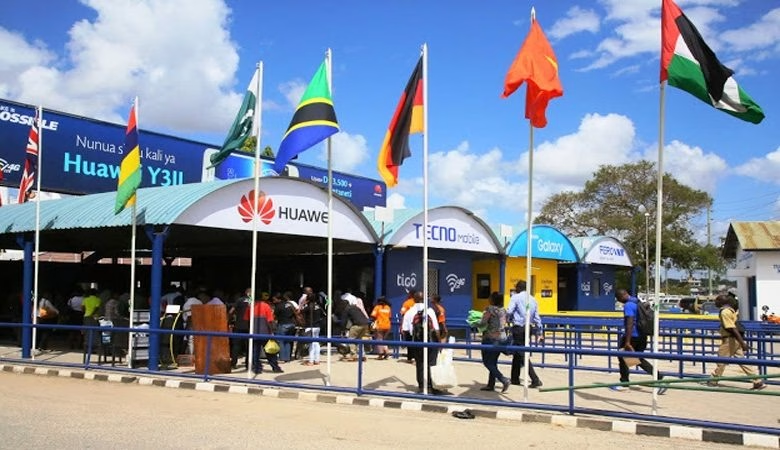
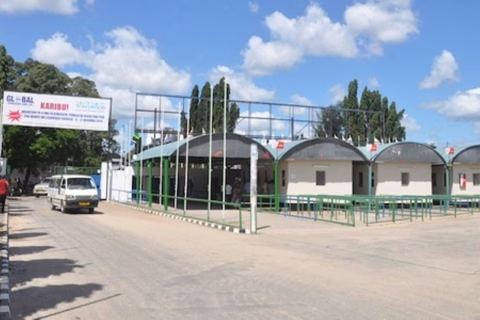
    The government has unveiled a $332 million plan to transform Tanzania’s Sabasaba grounds into a world-class commercial, innovation and cultural hub. The center is popularly known as the Mwalimu Julius Nyerere Trade Fair Grounds. The government’s new plan is to turn the grounds into a modern, mixed-use complex top enhance the business environment. Furthermore, it attracts investment and boosts Tanzania’s global competitiveness. For decades the historic located along the Kilwa Road in Temeke District has served various purposes. One of this is as the country’s international trade exhibitions.

    The transformative project will be implemented by the Tanzania Development Authority (TanTrade). This will be done in partnership with the Public-Private Partnership Center (PPPC), operating under the Ministry of Finance. Through this, both local and international investors are invited to participate through a PPP model. TanTrade Director General, Ms Latifa Hamisi noted that the initiative will reposition Sabasaba as a dynamic venue. Once complete, it will be a year-round commercial and cultural destination that meets international standards.

    Also read:

    Tanzania to Build East Africa’s Largest Mount Kilimanjaro International Conference Centre in Arusha

    The Scope of Implementation on the Multi-Million-Dollar Tanzania’s Sabasaba Grounds

    Estimated to cost $332 million, Tanzania’s Sabasaba Grounds is expected to be completed before the commencement of the AFCON 2027. The Africa Cup of Nations (AFCON) is expected to be co-hosted by Kenya, Tanzania, and Uganda. The redevelopment plan includes the construction of international exhibition centers and five star hotels. Furthermore, it will include innovation and technology hubs, office towers, residential apartments, entertainment venues and open spaces for artistic and cultural events. Upon completion, the site will operate around the clock, providing space for commerce. Furthermore, it will provide networking, leisure and community engagement.

    Tanzania's Sabasaba
    The government has unveiled a $332 million plan to transform Tanzania’s Sabasaba into a world-class commercial, innovation and cultural hub.

    The new complex will also feature modern infrastructure such as smart lighting and digital security systems. Furthermore, high-speed communication networks and high end accommodation will be inclusive. Ms Hamisi said the process of selecting an investor is ongoing. Key criteria includes revenue-sharing models, technical expertise, financial capacity, and management experience. TanTrade projects the development will stimulate job creation, expand trade opportunities, and increase government revenues.

    Also read:

    Mwalimu Nyerere Memorial Academy in Tanzania to get new hostel

    President Samia Suluhu Hassan opens Tanzania Judiciary headquarters

  • What to Know About BayWa’s Oaklands Farm Solar Park in South Derbyshire, UK

    What to Know About BayWa’s Oaklands Farm Solar Park in South Derbyshire, UK

    Oaklands Farm Solar Park is a photovoltaic (PV) plus storage project in South Derbyshire. Oakland solar park sits on roughly 191 hectares of land between Rosliston and Walton-on-Trent. The scheme, developed by BayWa r.e., is expected to deliver up to around 138 MW of solar power along with 37.5 MW of storage capacity. The UK government approved its development in June 2025 ahead of construction start in 2026. Also recently approved by the UK government for development is the Helios renewable energy project in Selby.

    UK Approves Consent for 140 MW Oaklands Farm Solar Park in South Derbyshire

    Reported June 20, 2025 – The UK government has granted development consent for the Oaklands Farm Solar Park in South Derbyshire, marking a significant step in the country’s push towards cleaner energy.

    The Oaklands Farm Solar Park, spearheaded by German renewable energy developer BayWa r.e., will deliver up to 140 megawatts (MW) of solar energy and 37.5 MW of battery storage. The announcement was confirmed by the UK Planning Inspectorate on Thursday.

    Oaklands Farm Solar Park in South Derbyshire
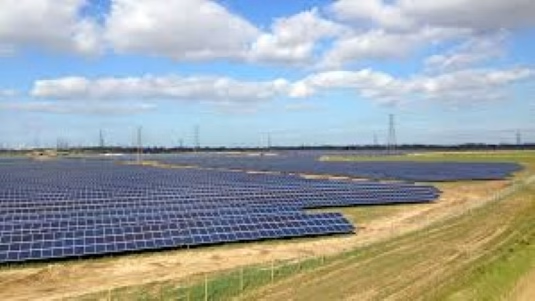
    Solar array installation.

    A 400-Acre Clean Energy Hub

    Situated on open agricultural land in South Derbyshire, the 400-acre site will house rows of solar panels mounted on 2.7-meter-high metal frames, supported by metal stanchions. The development also includes energy storage infrastructure made up of up to 91 steel shipping containers, each about 3 meters high, covering 2 acres of the site.

    These batteries will help balance energy supply and demand, increasing grid reliability during peak hours.

    Barrow EnergyDock Plans Unveiled, UK’s Largest Floating Solar Project

    Grid Connection and Environmental Planning

    The generated electricity will be connected to the national grid via an underground cable linking to the Drakelow Substation north of the site.

    While the Oaklands Farm Solar Park South Derbyshire project transforms farmland, it has been designed with environmental safeguards, including the preservation of public footpaths and enhanced hedgerow networks to maintain local biodiversity.

    [internal_link url=”https://constructionreviewonline.com/construction-projects/uks-largest-solar-pv-plant-the-600mw-cottam-solar-project/”]

    Factsheet: Oaklands Farm Solar Park

    • Developer: BayWa r.e.
    • Solar Capacity: 138–140 MW
    • Battery Storage: Up to 37.5 MW
    • Site Area: ~400 acres
    • Battery Containers: Up to 91
    • Grid Connection: Drakelow Substation
    • Location: South Derbyshire, England
    • Land Use: Agricultural with hedgerow preservation
    • Approval: UK Planning Inspectorate, June 2025
  • Building the Future: Intermountain Health $1Bn, State‑of‑the‑Art Hospital Rises in Billings

    Building the Future: Intermountain Health $1Bn, State‑of‑the‑Art Hospital Rises in Billings

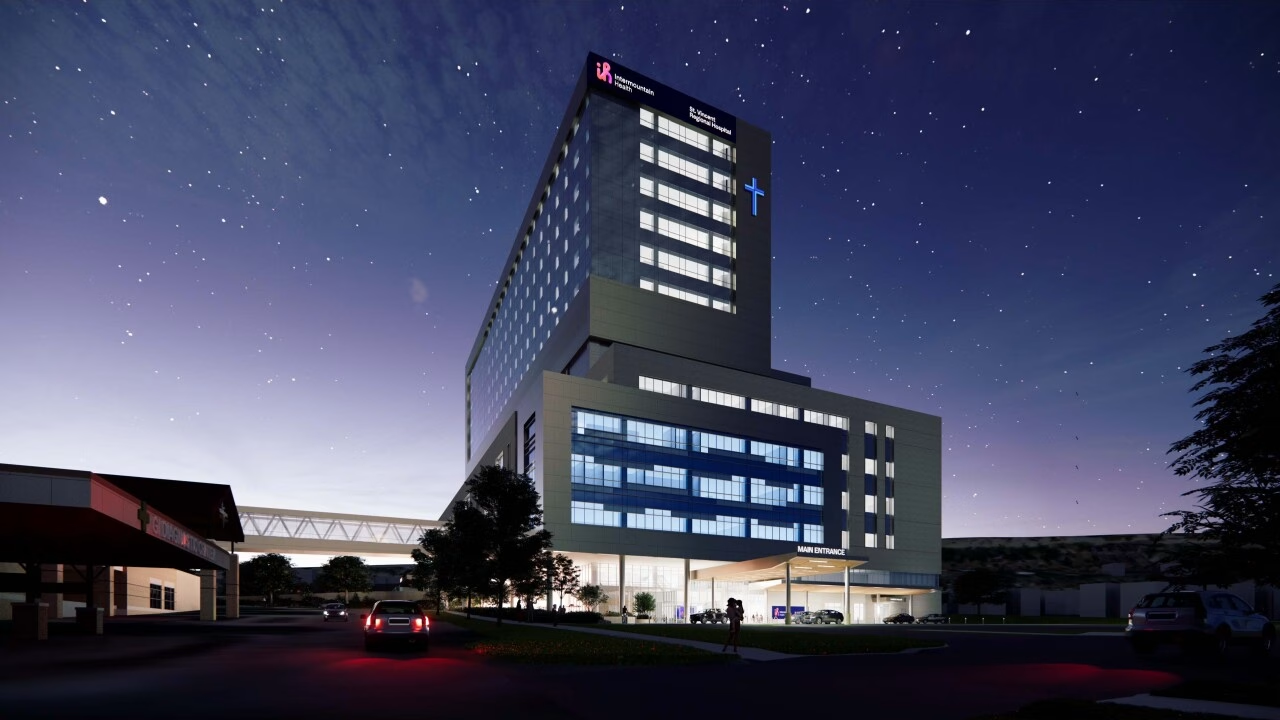
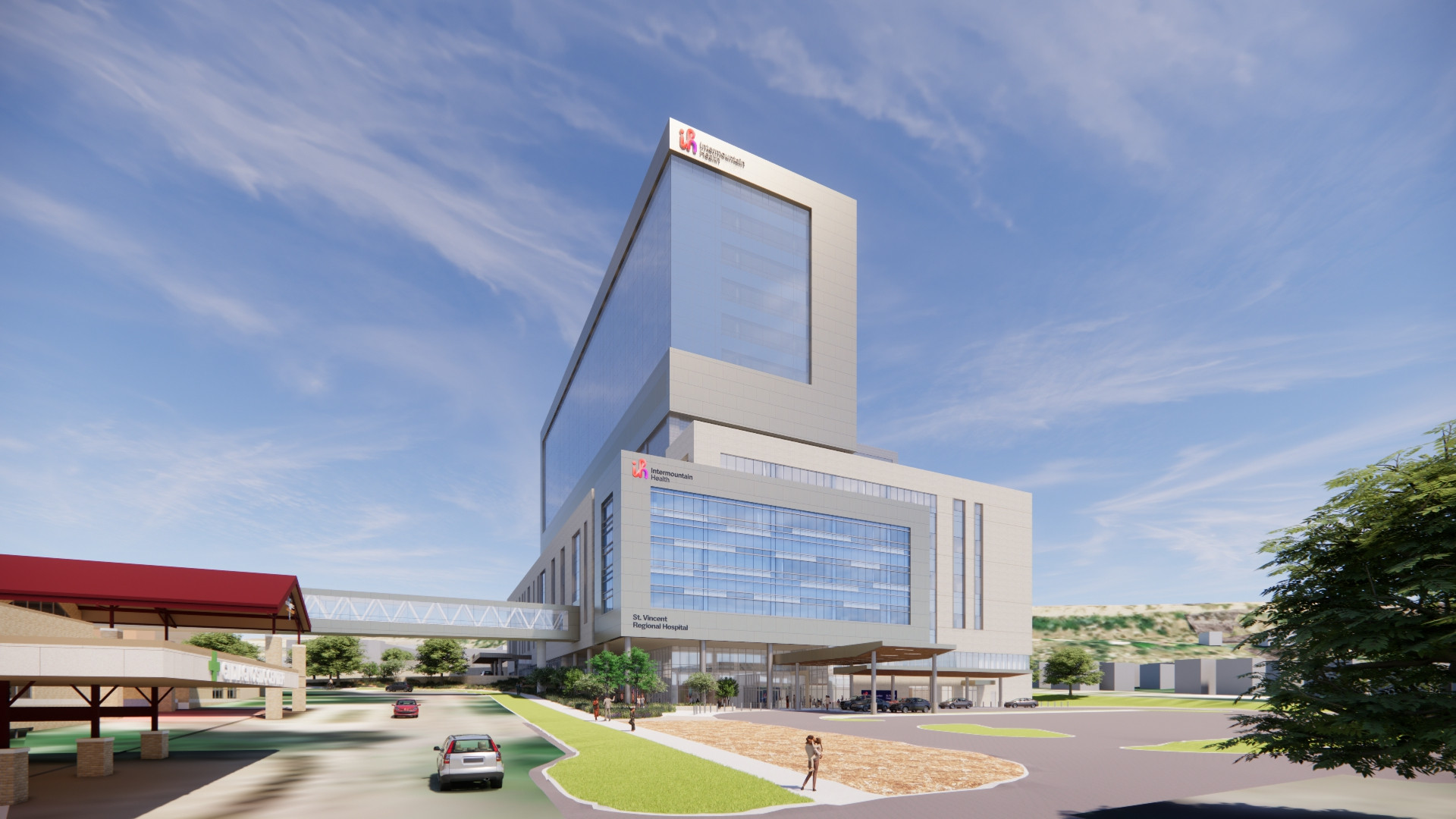
    Intermountain Health is constructing a $1 billion, 14-story, 737,000 ft² replacement hospital in downtown Billings, Montana, set to open in 2029. The facility will feature 243 universal patient rooms (with space to expand by 16), all convertible to ICU, robotics-enabled operating suites, and a full first floor dedicated to public spaces such as a chapel, pharmacy, and waiting areas. During peak construction, 600–700 workers will be onsite, and a total of 1,200 jobs will support the project, boosting the region’s economic activity. The new hospital aims to fully replace the current St. Vincent facility, transferring all its services into the new state-of-the-art building designed for evolving healthcare needs. Meanwhile, Intermountain is also building a new medical supply warehouse in Billings to support the hospital, expected to handle over 500,000 supply items annually and employ about 70 staff once operational.

    Designed for Modern Patient Care

    Moreover, the Intermountain Health in Billings state-of-the-art facility will feature 243 patient beds, with the design allowing for future expansion of up to 16 more. Its flexible “universal rooms” can adapt quickly to various levels of care, from regular inpatient to ICU needs, thus improving response time and maintaining high safety standards. Furthermore, the hospital will include robotics-enabled operating suites and a specially designed pediatric unit created in partnership with Primary Children’s Hospital in Salt Lake City, underscoring a commitment to cutting-edge technology and patient-focused design.

    Also Read Roper St Francis Healthcare Breaks Ground on $1.2B Hospital Campus in North Charleston

    Caregivers Help Shape Efficiency

    In addition, the project has drawn direct input from frontline caregivers to maximize workflow efficiency. Notably, the hospital’s nursing director, Jana Huck, led an exercise, nicknamed the “yarn test”, where staff tracked their daily movement through existing facilities. Consequently, the new layout minimizes unnecessary steps and enhances privacy, dignity, and ease for both patients and staff . As Huck explains, “we moved our rooms around to make sure…we’re providing privacy and dignity for patients,” while easing pressure on overworked nurses. Combined with design strategies such as decentralized nurse stations and separate visitor and emergency entrances, these changes highlight a lifelong care philosophy rooted in the hospital’s Catholic heritage.

    Intermountain St. Vincent Regional Hospital Unveils Design for Replacement Hospital

    Economic Boost & Legacy Foundations

    Finally, beyond healthcare innovation, the project promises significant economic benefits. At peak construction, up to 1,200 workers will be employed locally—from tradespeople to regional contractors—fueling Billings’ economy for the next four years. Additionally, while the new hospital will fully replace aging century-old buildings on campus, officials are still evaluating what to do with the existing structures. Meanwhile, a public-private parking partnership with Montana State University Billings and city authorities is in progress to improve access during and after construction. Altogether, this development will not only elevate healthcare in Eastern Montana but also leave a legacy of innovation, efficiency, and community impact for decades to come, standing alongside other key healthcare construction projects across the United States.

    Also Read Health First Unveils $230M Expansion of Palm Bay Hospital to Meet Surging Community Needs

    The Billings Intermountain Health Project Overview

    Project Cost & Size

    Nearly $1 billion investment for the replacement hospital

    14 floors, totaling 737,000 sq ft

    Location & Timeline

    Located at North 27th Street & 12th Avenue North, downtown Billings

    Groundbreaking in Spring 2025, with completion expected by 2029

    Capacity & Flexibility

    243 standard beds, plus space for 16 more in the future

    Universal rooms convertible to ICU-level care depending on need

    Advanced Facilities & Design

    Adaptable operating rooms designed for robotic surgery and evolving procedures

    Main level public spaces: chapel, pharmacy, gift shop, discharge lounge; separate entrances for patients, staff, and ER

    Economic & Workforce Impact

    Peak construction workforce: 1,200 workers, including local tradespeople

    Significant local economic boost: $13.5 million spent on housing and $6 million at grocery/restaurant sectors over project life

    Community-Centered Planning

    Design input from nurses and caregivers, including “yarn-tracking” of daily movement, to enhance efficiency, privacy, and dignity
    Legacy rooted in the Catholic mission, with plans to evaluate existing buildings for future use

  • Texas Instruments commits $60B for US chip facilities across Texas and Utah

    Texas Instruments commits $60B for US chip facilities across Texas and Utah

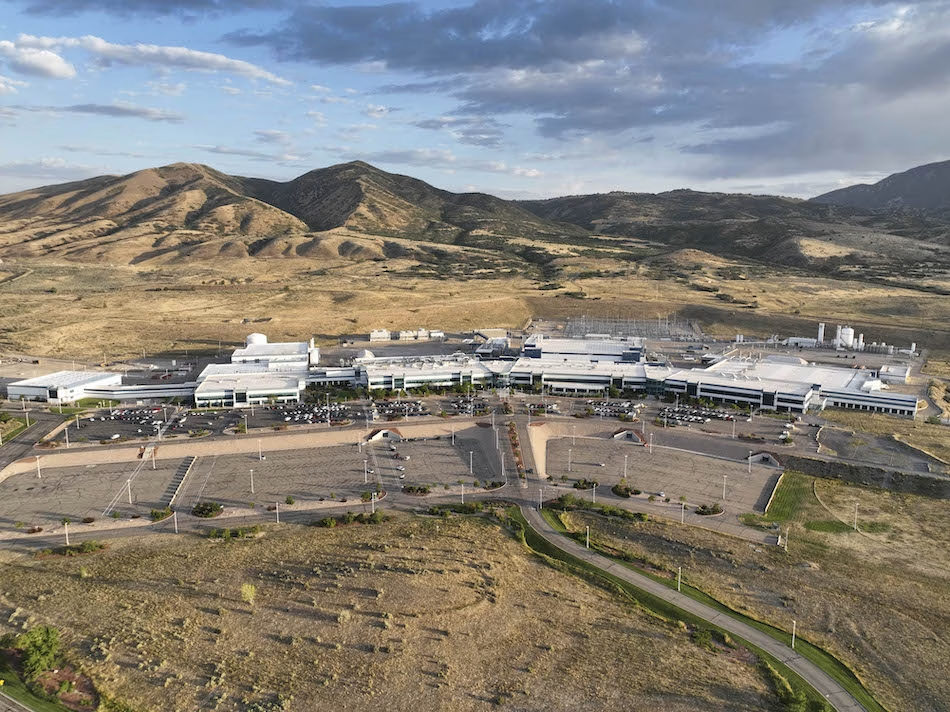
    Texas Instruments (TI) has unveiled a monumental $60 billion investment to build or expand seven chip making facilities across three mega-sites in Texas and Utah. This mammoth commitment, which company leaders are already calling the “largest investment in foundational semiconductor manufacturing in U.S. history”, will create approximately 60,000 jobs. TI also emphasized the production of 300 mm analog and embedded chips, essential for smartphones, cars, medical devices, satellites, and more, marking a shift toward reshoring critical supply chains.

    Aligned with National Policy Push

    Moreover, this move echoes President Trump’s renewed call for semiconductor manufacturing to return home. Consequently, Commerce Secretary Howard Lutnick praised the deal, noting it will underpin U.S. chip production “for decades to come”.
    TI highlighted the partnership, stating its collaboration with top companies like Apple, Ford, Medtronic, Nvidia, and SpaceX strengthens America’s technological leadership and national security. This approach matches other major U.S. projects, including Micron’s recent $200 billion pledge to expand memory chip manufacturing and R&D under the CHIPS and Science Act.

    Also Read Enbridge Celebrates Completion of Orange Grove Solar Project in Texas

    What It Means on the Ground

    On the ground, TI’s investment breaks down as: $40 billion for four fabs in Sherman, Texas (two already under construction) and $15 billion for sites in Richardson, TX and Lehi, Utah.
    Altogether, these facilities will produce hundreds of millions of chips daily. Although TI hasn’t provided a specific construction timeline, it confirmed that SM1 in Sherman is on track to enter production this year.

    A Strategic Move, Not Without Questions

    Finally, while TI frames this as a bold reshoring move, industry analysts caution that much of this investment was already planned. As one observer noted, TI’s announcement may partly reflect existing capital expansion rather than entirely new money. Nevertheless, its investment solidifies the U.S. position in foundational chip making and sets an example for future resilience, through challenges remain in execution, funding uncertainty from policies like the CHIPS Act, and potential trade tensions.

    Also Read Intel’s $20 Billion Ohio One Chip Plant Delayed Until 2030

    The Texas Instruments Chip Projects Overview

    Total Investment

    Over $60 billion planned to build and expand semiconductor facilities across the U.S.
    Split: $40 billion for Sherman, Texas (4 fabs: SM1–SM4), $15 billion for Utah site, and remaining $5 billion across Richardson, TX

    Locations & Facilities

    Sherman, Texas: Two fabs under construction (SM1 launching production this year; SM2 shell complete) plus two additional fabs planned.
    Richardson, Texas: Expansion of existing fabs (RFAB2 ramping up)
    Lehi, Utah: Second fab under construction alongside ramping up LFAB1

    Job Creation

    Project will deliver approximately 60,000 new jobs across construction and operations.

    Chip Focus

    Facilities will manufacture analog and embedded processing chips (foundational semiconductors) using 300 mm wafer processes
    Chips supply a broad range of industries: smartphones, vehicles, medical devices, satellites, AI infrastructure

    Strategic Alignment

    Branded as the largest-ever U.S. foundational semiconductor investment
    Aligned with Trump administration’s push to reshore chip manufacturing and strengthen supply chains
    Receives $1.6 billion CHIPS Act subsidy and support from major clients including Apple, Ford, Medtronic, Nvidia, and SpaceX