Constructionreview

Blog

  • Top 5 Power Demand Challenges Facing Data Center Development in 2025

    Top 5 Power Demand Challenges Facing Data Center Development in 2025

    As the world becomes increasingly digital, the demand for data centers has surged—but so have the power demand needed to keep them running. From artificial intelligence (AI) to streaming services and cloud computing, data centers now consume enormous amounts of electricity, raising urgent questions about power availability, sustainability, and infrastructure resilience.

    1. Growing Demand, Limited Supply

    Data centers are energy-hungry facilities with huge power demand. In 2025, it’s estimated that global data centers will consume over 239 terawatt-hours (TWh) of electricity annually—more than many small countries. AI workloads alone, particularly large language models and real-time processing, are responsible for a sharp rise in energy consumption.

    However, utility companies are struggling to keep pace. In the U.S., especially in high-growth tech hubs like Northern Virginia and Texas, power grids are stretched thin. The situation is even more challenging in parts of Europe and Africa, where infrastructure development lags behind digital expansion.

    2. Grid Congestion and Permitting Delays

    One of the biggest challenges is grid congestion. In regions with high data center density, power infrastructure—like substations and transmission lines—is nearing capacity. This leads to delays in connecting new data centers to the grid and limits the scale of expansion.

    Lengthy permitting processes and local opposition add another layer of complexity. It can take years to secure approvals for power connections, land use, and environmental compliance.

    3. Dirty Power and Sustainability Concerns

    Many data centers rely on fossil-fuel-based grids, which contradict efforts to reduce carbon emissions. In places where clean energy isn’t readily available, the carbon footprint of data processing becomes a public concern.

    Communities and regulators are increasingly demanding that tech companies:

    • Transition to renewable energy
    • Report on energy usage and emissions
    • Minimize impact on local water and air quality

    Some companies are taking the lead by investing in on-site solar, wind, and battery storage. Others are exploring small modular nuclear reactors (SMRs) and natural gas as backup energy sources.

    In Doña Ana County, New Mexico, a proposed $165 billion hyperscale artificial intelligence data center campus known as Project Jupiter intends to use a closed-loop water recycling system to minimize water usage and have on-site power generation, battery storage, and a microgrid to supply its own electricity.

    In Minnesota Amazon recenty cancelled plans for a Data center Project in Becker. Part of the reason is the fact that the the company  lost a battle before the Minnesota Public Utilities Commission over installing 250 diesel backup generators to power the center. In addition to this legislative changes in Minnesota had voted to roll back tax incentives previously granted to data center developments.

    The push for use of clean energy has also become a game changer. Recently google signed the largest hydroelectric power purchase agreement amounting to US$3billion. AWS has also reached power purchase agreements with renewable energy producers to support their cloud infrastructure.
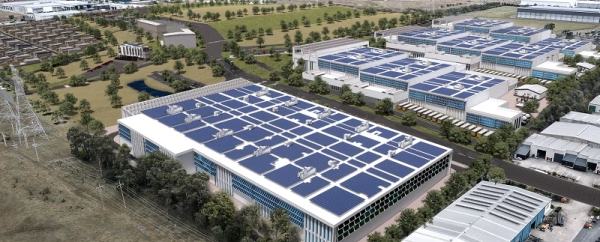
    AirTrunk’s in Western Sydney Australia is going against the grain and will leverage the use of diesel generators. It will also have battery storage units to provide power. The AirTrunk data center campus in Australia is expected to host various amenities to ensure its operations. It includes 936 cooling units and 852 diesel back-up generators. Documents also suggest the site would feature 7,488 cabinets for lithium-ion battery storage. Furthermore, at least one on-site substation is planned and the potential for three others.

    All this signals a change in attitude towards power hungry data centers in spite of the potential billions of dollars in investment.

    4. The Rise of Private Power Generation

    To overcome these challenges, some hyperscale data center operators are moving toward private power generation. This includes:

    • Building microgrids
    • Partnering with renewable energy providers
    • Securing long-term Power Purchase Agreements (PPAs)

    By decoupling from strained public grids, companies gain more control over energy costs, reliability, and carbon footprint.

    For instance Google is investing in clean energy for its plants and has partnered wth energyRe in which the South Carolina deal involves the investment in and purchase of Renewable Energy Credits (RECs) from over 600 megawatts (MW) of new solar and solar-plus-storage projects being developed in the state. In addition in Taiwan Google has entered in to a power purchase agreement in its drive toards net-zero. In Virginia Google’s $9 billion Virginia expansion announced in August 2025 raises concerns over water and power use. The company has agreed to cap water consumption in Chesterfield, funding new infrastructure if usage exceeds limits, while deploying advanced cooling to reduce demand. On power, it will connect to Dominion Energy’s expanding grid and pursue efficiency and renewable energy to manage the massive electricity needs.

    Microsoft, in May 2023, signed what it called the world’s first nuclear fusion power purchase agreement (PPA). Under the deal, the company will offtake up to 50 MW of capacity from the Orion Nuclear Fusion Power Plant currently under development in Washington.  Entergy Louisiana on the other hand wants to install three natural gas-powered turbine generators that would provide 2,250 megawatts of electricity for Meta’s facility.

    5. Innovation in Energy Efficiency

    Beyond sourcing power, efficiency is a critical piece of the puzzle. Innovations such as:

      • Liquid cooling systems
      • High-density racks using 400V direct current (DC)
      • AI-optimized energy management systems.

    are helping reduce power usage effectiveness (PUE) ratios and shrink overall energy demand per server.

    The need for adequate cooling has also put constraints on efficiency for instance a report released by the City of Racine indicates Microsoft’s Mount Pleasant Data Center will require 8.4million gallons a day putting pressure on local water resources.

    Conclusion

    Power challenges are no longer just a technical issue for data centers—they are a strategic business concern with environmental, regulatory, and societal implications. As digital infrastructure continues to expand, the pressure is on to build smarter, cleaner, and more energy-resilient data centers. The winners in this race will be those who can combine growth with sustainability and long-term energy planning.

  • Kenya’s Government Approves Dualling of the 20.2-Kilometer Nairobi Northern Bypass Project

    Kenya’s Government Approves Dualling of the 20.2-Kilometer Nairobi Northern Bypass Project

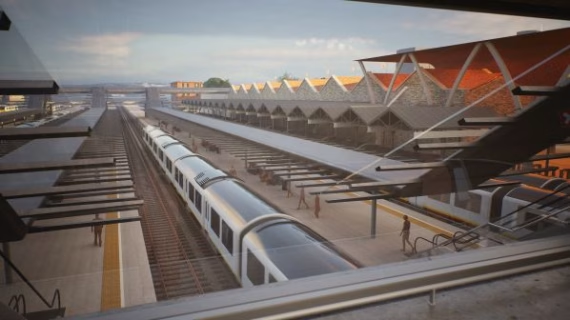
    The cabinet has given the green light to the proposed dualling of the 20.2 kilometer Nairobi Northern Bypass and railway project. The aim of the project is to upgrade and ease traffic congestion within the Nairobi metropolitan area. This emerged following a cabinet meeting under the chairmanship of President William Ruto at State House, Nairobi. Once completed, the project is expected to expand the city’s capacity to handle the growing traffic volumes within the city. Its scope entails converting the current single carriageway into a dual carriageway according to the dispatch released. Furthermore, it entails the construction of eight interchanges, overpass, and underpasses. It also includes the development of nonmotorized transport facilities such as walkways and cycle paths. Improvement of drainage systems is also in consideration and enhancements to adjacent roads. The Northern Bypass remains Nairobi’s only bypass that is still a single carriageway. This remains so as it stretches from Ruaka in Kiambu in Ruiru, connecting with both the Western and Eastern Bypasses.

    Also read:

    Kenya: Nairobi Eastern Bypass Highway, the Apr. 20km road connecting south-eastern and north-eastern neighborhoods of the city

    The Significance of the Nairobi Northern Bypass Project

    The aim of dualling the Nairobi Northern Bypass project is to reduce congestion with the upgrade expected to improve traffic flow. Furthermore, it will enhance road safety and boost access to economic hubs, industrial zones, and essential services in Nairobi and Kiambu counties. The bypass currently experiences heavy congestion during peak hours leading to transport delays. The congestion also contributes to higher transport costs, increased pollution and reduced productivity. The cabinet has also given approval to the implementation of the Nairobi Railway City Central Station and Public Realm Project.

    Nairobi Northern Bypass Project
    The cabinet has given the green light to the proposed dualling of the 20.2 kilometer Nairobi Northern Bypass and railway.

    This intends to decongest the capital and revitalize the central business district. According to the government, the flagship project is seen as a critical step in attracting private investment to the Railway City. Through this, it will modernize the outdated Railways Central Station into a state-of-the-art, multi-modal transport hub. The new stations will feature nine platforms and improved access bridges, allowing for the efficient evacuation of up to 30,000 people per hour. On the other hand, surrounding public realm improvements will unlock underutilized land, encourage economic activity and increase foot traffic.

    Also read:

    Construction of Kenya’s Nairobi Southern Bypass nears Completion

    Nairobi Western Bypass construction completion date revised to 2022

  • U.S. Nears $500 Million Deal to Fund Africa’s Lobito Corridor Railway Project

    U.S. Nears $500 Million Deal to Fund Africa’s Lobito Corridor Railway Project

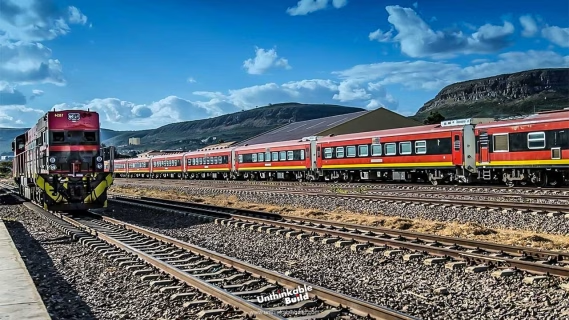
    The U.S. International Development Finance Corporation (DFC) is nearing completion of financing the Lobito Corridor railway project. The $500 million in financing is expected to expedite the construction of the multi-million-dollar railway project in Africa. Once complete, the Lobito corridor is expected to facilitate in transportation of critical minerals across the continent. It will stretch from Central Africa’s copper belt to Angola’s Atlantic coast. The move comes as the Trump administration reaffirms its support for the ambitious infrastructure project. The project is viewed as a strategic effort to boost U.S. engagement in Africa’s critical minerals sector. Speaking at the U.S.-Africa Business Summit in Luanda on Monday, DFC’s Head of Investment, Conor Coleman provided clarity. He noted that the agency is “actively negotiating” with key stakeholders on the matter. These include the Angolan government and Trafigura group to ensure the deal is finalized.

    Also read:

    Italy Commits $270 Million for Lobito Corridor

    The Significance of the Lobito Corridor Railway Project

    Africa’s Lobito Corridor Railway project is a major transnational infrastructure and investment initiative to leverage the continent’s resources. The railway line will connect the Atlantic port of Lobito in Angola to the mineral-rich regions of the DRC and Zambia. Through this, it will facilitate for ease of transportation as well as ensure accessibility. The DFC announced earlier in 2023 that it was reviewing financing for the project. However, Coleman declined to elaborate on the cause of delays but noted it was not tied to any administrative changes. He noted that the delays are not influenced by any upcoming policy changes under the Trump administration.

    Lobito Corridor Railway Project
    The U.S. International Development Finance Corporation (DFC) is nearing completion of financing the Lobito Corridor railway project.

    There’s business as usual at the DFC,” Coleman said. “You’ll see us playing a lot in critical minerals infrastructure, both digital and transportation, as well as energy, especially here on the African continent.” Congo’s government is already making plans to launch a tender in November to begin construction on its portion of the corridor. Many are hopeful that the railway will be operational within three years, according to Vice Prime Minister Jean-Pierre Bemba. The nation is one of the mineral-rich countries in the world, especially in cobalt and copper. It also holds enormous lithium reserves, all of which will be transported along the corridor to global markets. The strategic location of the Lobito Corridor offers a direct and efficient export route for these resources. Furthermore, it directly links inland African mines to global markets.

    Also read:

    The Lobito Corridor Railway Expansion Project

    US$1.3 Billion Lobito Corridor Development Deal Signed by Angola

  • Skanska Breaks Ground on $180M Expansion Project at Redmond Municipal Airport

    Skanska Breaks Ground on $180M Expansion Project at Redmond Municipal Airport

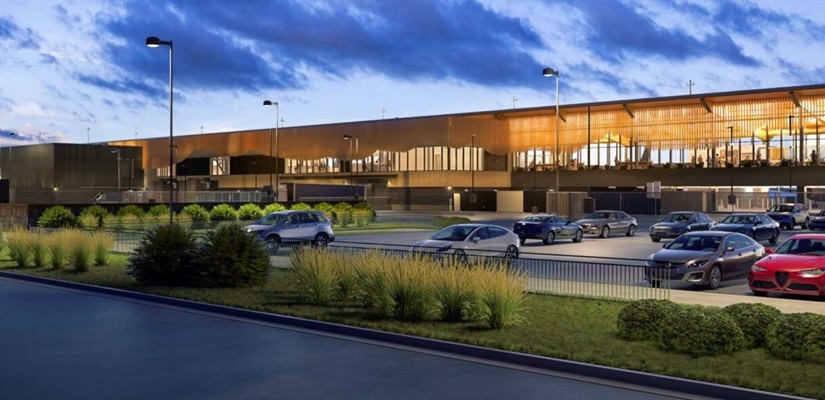
    Skanska has officially broken ground on the long-awaited Redmond Municipal Airport (RDM) expansion, an important addition to Central Oregon’s air travel infrastructure. The expansion will add 80,000 square feet of new concourse space and bring forth a variety of significant improvements to the existing terminal in an effort to create a more convenient, sustainable, and comfortable airport experience while keeping up with increasing passenger traffic.

    The development comes at a fitting time after record-breaking growth at RDM, with passenger numbers over the past decade more than doubling. The existing terminal, which was last expanded in 2008, has struggled to meet demand, so the upgrade currently in progress is both necessary and well timed.

    Redmond Municipal Airport Expansion Project: Key Features

    The new airport will feature seven new jet bridges and larger gate areas to maximize boarding and deplanement effectiveness. Additional concession space of more than 6,000 square feet will be added, with increased waiting areas and more than twice the terminal’s passenger seating capacity.

    Interior renovations will consist of complete second-floor redesign and terminal layout rearrangement to reduce the need for external boarding and enhance passenger flow through security and boarding areas. The baggage makeup area will also be expanded to support greater operational capacity.

    Design enhancements will prioritize accessibility, sustainability, and passenger health. Enhancements include:

    Increased ADA accessibility throughout the terminal

    A state-of-the-art companion care restroom

    New restrooms and post-security service animal relief area

    Enhanced public address system for clarity of announcements

    Energy-saving HVAC and additional solar panels

    Mass timber roof structure with inspiration from the surrounding environment

    Design with goal of LEED Silver certification

    Expanded public art program honoring Central Oregon culture and creativity

    “This expansion is a vital investment in the future of Redmond and the broader Central Oregon community,” said Joe Schneider, Skanska USA Building Senior Vice President and Account Manager for Oregon. “As demand to and from the region continues to grow, we are privileged to be helping to bring a new, efficient, and sustainable airport to the region that not only meets growing demand but also captures the natural beauty of the region and the sense of community that we serve.”

    Skanska is the project’s general contractor and performs the work on wood installation in-house—a signature aspect of the airport’s architectural character. The construction team further features RS&H as project architect and designer, Hennebery Eddy Architects as architect of record, and Morrison-Maierle Engineering with structural engineering emphasizing mass timber.

    Project Timeline and Funding

    Construction has commenced and is expected to be completed in 2028. The cost of the project is expected to be $180 million, funded under an even-handed funding strategy not utilizing county or local taxpayer money.

    Funding sources are:

    $20 million from the Federal Airport Improvement Program

    $18 million from the Bipartisan Infrastructure Law

    $7 million from the Infrastructure Investment & Jobs Act: Airport Terminals Program

    $90 million in Full Faith & Credit Bonds secured by airport-revenue-derived funding (e.g., parking)

    $35 million from available airport cash reserves

    $10 million in Connect Oregon grant money

    To fund long-term obligations, airline partners will contribute in terms of rates and charges, specifically in relation to slices of terminal and airfield infrastructure. Revenues from non-airline sources—concessions, hangar and land leases, and parking fees—will service the balance of debt. This strategy makes the project wholly self-financed without using city, county, or local government funds.

    Once finished, the new terminal will not only alleviate current capacity constraints but also position RDM to serve the growing numbers of passengers arriving and departing from Central Oregon in the future even better.

    Redmond Municipal Airport (RDM) Expansion Project: Factsheet

    Project Overview

    Major terminal expansion and infrastructure upgrade to accommodate surging passenger traffic in Central Oregon.

    Key Statistics

    Total Cost: $180 million

    New Space: 80,000 sq ft concourse addition

    Timeline: Construction underway, completion expected 2028

    Last Expansion: 2008

    Major Improvements

    7 new jet bridges and expanded gate areas

    6,000+ sq ft of new concession space

    Doubled passenger seating capacity

    Complete second floor redesign

    Expanded baggage makeup area

    Enhanced accessibility features (ADA compliance)

    State-of-the-art companion care restroom

    Post-security service animal relief area

    Redmond Municipal Airport Expansion Project: Design Features

    Mass timber roof structure reflecting regional character

    Energy-efficient HVAC systems

    Additional solar panels

    LEED Silver certification target

    Expanded public art program

    Upgraded public address system

    Project Team

    General Contractor: Skanska USA Building

    Architect/Designer: RS&H

    Architect of Record: Hennebery Eddy Architects

    Structural Engineering: Morrison-Maierle Engineering

    Read also: New Tampa International Airport Airside D Design Unveiled

  • KYTC Unveils Timeline and Design Plans for New Licking River Bridge

    KYTC Unveils Timeline and Design Plans for New Licking River Bridge

    The aging KY 8 Licking River Bridge, which links Newport and Covington, will be demolished in spring 2026 to make way for a new modern replacement that will serve the area’s changing infrastructure needs and urban development.

    Originally built in 1936, the existing bridge has exceeded its design life and no longer meets the demands of today’s traffic. As Covington and Newport continued to develop, KYTC officials have decided that a replacement is needed to more effectively serve cars, pedestrians, and bicyclists alike.

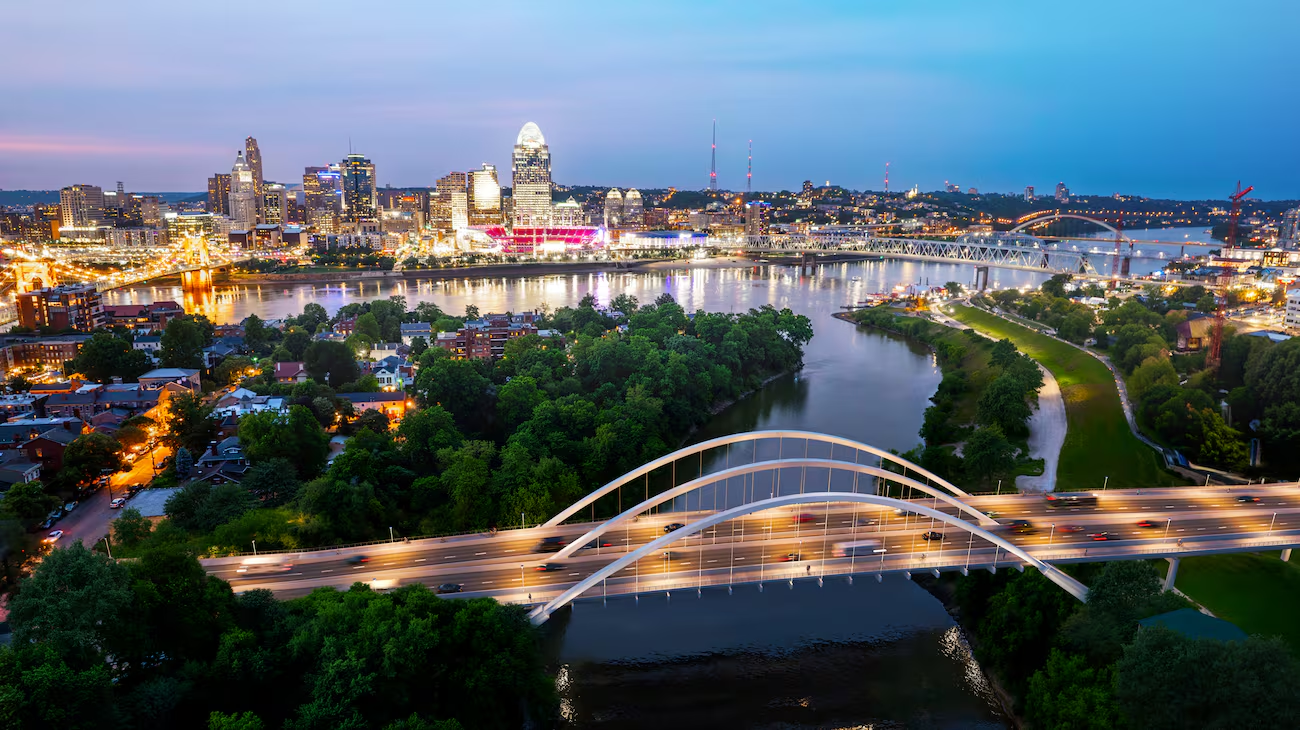
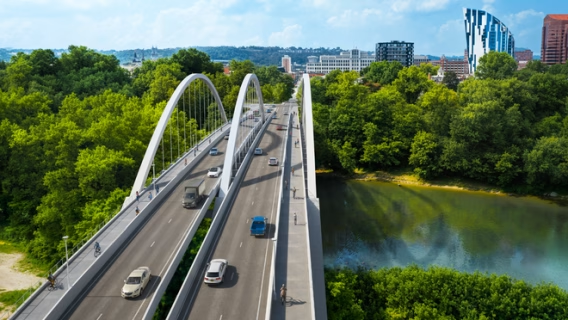
    The new bridge will be a visually striking three-steel-arch design, 58 feet above the Licking River. The design, Kentucky Transportation Cabinet Secretary Jim Gray said, was fashioned to fit in with the historic character of the neighborhoods that surround it.

    “This arch concept has a signature aesthetic design that considers the surrounding environment, including the nearby historic neighborhoods of Newport and Covington,” said Kentucky Transportation Cabinet Secretary Jim Gray in a statement.

    Current Licking River Bridge to be demolished

    Following the demolition of the current bridge, work crews will begin constructing the replacement, which will take two and a half years. KYTC is scheduled to close the bridge to traffic in January 2026. And the new span is to be open to traffic by the summer of 2028. Completion of all construction should be completed later that fall.

    Some of the prominent features of the new bridge include:

    Two traffic lanes in each direction

    12-foot shared-use paths on both sides for bicyclists and pedestrians

    A pier-supported structure crossing over the riverbanks

    Read also: Orange County Advances Plans for Futuristic $35M I-Drive Pedestrian Bridge

    Final Price tag for New Licking River Bridge is yet to be determined

    Though the project had been pegged at $68 million, KYTC officials say the final price tag will be revised as design enhancements continue.

    In a revision to earlier plans, the state will not keep the existing bridge open to pedestrian or bike traffic during construction, citing safety and the hope of shortening the overall project timeline.

    During the closure, drivers will be detoured to the 11th Street Girl Scout Bridge (KY Route 1120) to cross between Newport and Covington.

    Of specific interest, some residents had lobbied for a three-lane bridge rather than four, with the reasoning that fewer lanes could enhance safety and deter speeding. But state transportation officials are moving forward with the current four-lane plan.

    The bridge design and construction schedule were formally announced on Tuesday, June 24 by the Kentucky Transportation Cabinet (KYTC).

    Read also: Initial Work on the $3.6B Brent Spence Bridge Corridor Project Begins This Summer

    KYTC Unveils Timeline and Design Plans for New Licking River Bridge
    KYTC Unveils Timeline and Design Plans for New Licking River Bridge

    The KY 8 Licking River Bridge Replacement Project: Factsheet

    Project Overview
    Current Bridge Details

    Built: 1936

    Status: Beyond intended lifespan

    Issue: No longer meets current traffic, pedestrian, and cycling needs

    New Bridge Design

    Architecture: Three steel arches, 58 feet high above Licking River

    Design Philosophy: Complement historic character of surrounding Newport and Covington neighborhoods

    Traffic Capacity: Two lanes in each direction (4 lanes total)

    Pedestrian/Cyclist Access: 12-foot shared-use paths on both sides

    Support Structure: Concrete piers framing riverbanks

    Project leaders plan to further develop the bridge’s design while actively collaborating with local officials and historic preservation groups in Covington and Newport.

    Licking River Bridge Replacement: Project Timeline

    Bridge Closure: January 2026

    Demolition: Spring 2026

    Construction Duration: 2.5 years

    Vehicle Opening: Summer 2028

    Project Completion: Fall 2028

    Traffic Management

    Detour Route: 11th Street Girl Scout Bridge (KY Route 1120)

    Existing Bridge Status: Will NOT remain open for pedestrians/cyclists during construction

    Read also: Design Unveiled for New Cable-Stayed Brent Spence Companion Bridge

    Read also: Historic East Haddam Swing Bridge Reopens After $88.8M Rehabilitation

  • Construction of Kigali’s Long-Anticipated Waste Treatment Plant to Commence Next Month

    Construction of Kigali’s Long-Anticipated Waste Treatment Plant to Commence Next Month

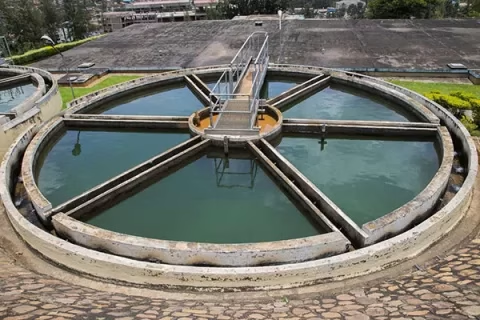
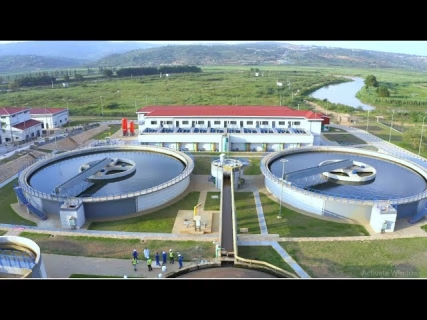
    The construction of Kigali’s waste treatment plant in the city is taking shape as city officials make plans to ensure its commencement. The project is being done in partnership with the Water and Sanitation Corporation (WASAC Group). Once completed, the plant is expected to collect and treat wastewater, converting it into clean water that can be reused. This plant is one of three expected to be built in the different districts of Kigali. The first one is being constructed in Nyarugenge District at Giti cy’Inyoni as part of the Kigali Centralized Sewerage System project. Its implementation is expected to cost $63 million and will be completed within two years. Furthermore, it consists of 92 kilometers of underground pipelines across the Kigal districts of Nyarugenge, Gitega, and Muhima.

    WASAC Group CEO, Prof. Omar Munyaneza explained the aim is to stop the excavation of pits. This will be achieved by using the pipes to direct the wastewater to treatment plants. “Instead of continuing to dig pits, we will transport the water and treat it before returning it to rivers or wetlands,” he said. Moreover, he noted that the treatment plant in Giti cy’Inyoni will commence construction next month. He noted this is led by a thorough study carried out to ensure the project’s success. “This is a long-awaited project for many Rwandans. We took the time to carefully study it to ensure its quality and proper implementation because this is the largest project related to sanitation that the country is about to start.”

    Also read:

    Construction of the Kigali Waste Treatment Plant Nears Completion at 70%

    Project Factsheet

    Location: Kigali

    Country: Rwanda

    Significance: Manage wastewater in the city

    Project duration: 2 Years

    Cost of Phase: U.S. $63 Million

    The Scope of Implementation of Kigali’s Waste Treatment Plant

    Once completed, Kigali’s waste treatment plant will have the capacity to treat 12,000 cubic meters of water daily. Initial scope aims that the plant will be able to handle wastewater from over 208,000 households. Experts have highlighted that wastewater pits can cause problems such as weakening the ground. Furthermore, it could make buildings prone to collapse especially in hilly areas. Prof. Munyaneza also noted that apart from the city waste treatment project, two more will follow. These include treatment plants in Kicukiro and Murindi to carter wastewater treatment in these areas.

    Kigali’s Waste Treatment Plant
    The construction of Kigali’s waste treatment plant in the city is taking shape as city officials make plans to ensure its commencement.

    WASAC Group also announced that a treatment plant will be established in Gasabo, with its location in the Karuruma wetlands. “While these two last projects are not yet underway, their studies have been completed, and we are still looking for the necessary funding to start them,” he said. Moreovr, he noted that the Gasabo plant will be built in Karuruma Wetland to ensure all of Kigali’s wastewater is properly managed. The CEO also provided clarity on delays as he noted that the Gity cy’Inyoni plant was delayed because of various changes. One of these is the change in the Kigali Master Plan, which transitioned from the 2013 version to the 2030 version.

    Also read:

    Rwanda’s Kigali Green City, the first of its kind to be built in Africa

    Kigali waste firm seeks to expand in East Africa