Constructionreview

Blog

  • Why Battery Storage is Becoming Essential for Solar and Wind Projects

    Why Battery Storage is Becoming Essential for Solar and Wind Projects

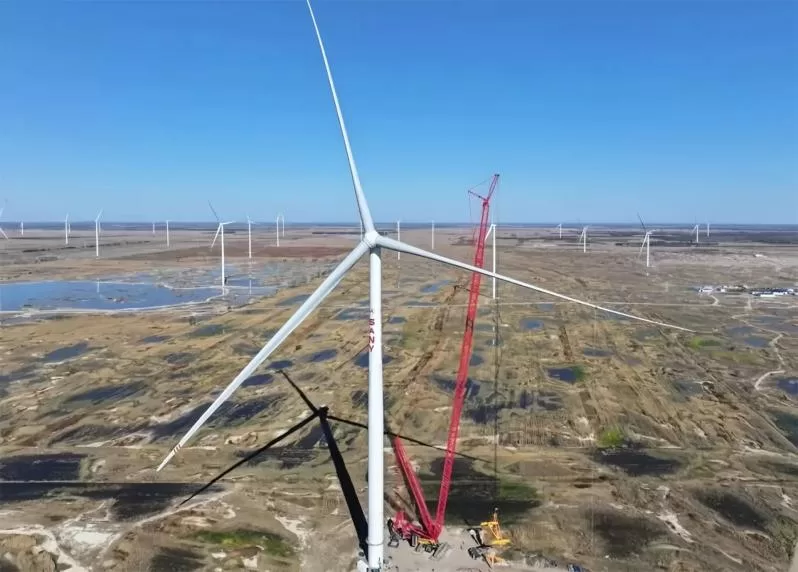
    As the global energy sector transitions to cleaner sources, a major shift is taking place in how solar and wind power are deployed. Increasingly, new solar and wind projects are being paired with Battery Energy Storage Systems (BESS), a development that is helping to overcome one of the biggest challenges facing renewable energy—intermittency. The use of grid-scale storage has become the answer and though in the past this was mainly the preserve of pumped storage but because of its obvious limitation the use of batteries have made significant inroads.

    Consistent supply

    Solar and wind power depend on natural conditions that fluctuate. Solar generation stops at night and drops during cloudy conditions, while wind turbines are only effective when wind speeds are favorable. As a result, power supply from these sources can be inconsistent. BESS offers a practical solution by storing excess electricity generated during periods of high production and releasing it when demand increases or supply drops. This ability to “time-shift” energy use makes renewable energy more reliable and grid-friendly.

    Battery costs

    Several factors are driving this growing trend. Chief among them is the sharp drop in battery costs. Over the last decade, the price of lithium-ion batteries has decreased by more than 85 percent, making large-scale energy storage more affordable and viable for utility projects. At the same time, there is increasing pressure on power grids to remain stable and resilient in the face of changing energy demands and extreme weather events. Batteries help maintain grid stability by smoothing out energy fluctuations, reducing the need for fossil-fuel-based peaker plants, and supporting frequency regulation.

    Incentives

    Governments and regulators are also playing a role. Many countries are introducing incentives, subsidies, and policy frameworks that encourage the inclusion of battery storage in renewable energy developments. In some markets, hybrid projects—where solar or wind farms are co-located with battery systems—receive faster permitting and grid connection approvals due to their ability to support system stability.

    Several projects around the world demonstrate how this approach is being implemented. In California, the Darden Clean Energy Project  pairs 1,150-megawatt (MW) solar facility and a 4,600 megawatt-hour (MWh) battery system. In Africa the 300MWh Kom Ombo BESS Project is an extension of AMEA Power’s operational 500MW Solar PV Plant that is located in Aswan Governorate, Egypt.

    As the energy landscape evolves, hybrid solar and wind projects with integrated battery storage are becoming the new standard rather than the exception. Industry analysts estimate that by 2030, more than half of new renewable projects will include some form of energy storage. These systems are not only improving energy reliability but also making renewable power more cost-effective and widely accessible. With battery storage, the full potential of clean energy can be realized—providing stable, sustainable power well into the future.
  • Tanzania Inaugurates the JP Magufuli Bridge Project, East Africa’s Longest Bridge

    Tanzania Inaugurates the JP Magufuli Bridge Project, East Africa’s Longest Bridge

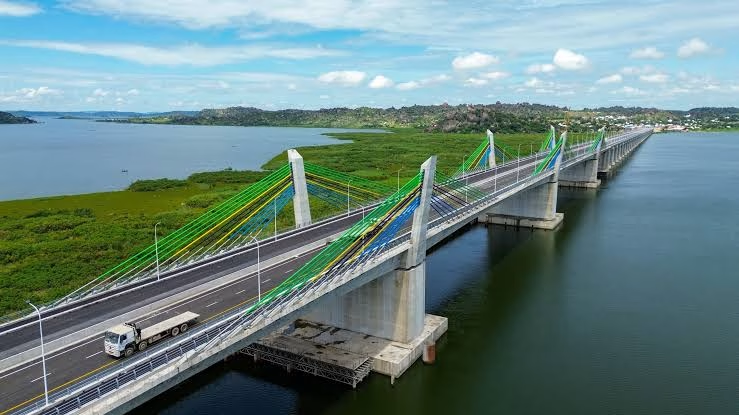
    The President of Tanzania Samia Suluhu Hassan on Thursday inaugurated the Chinese-built JP Magufuli Bridge Project. This mega bridge spans Lake Victoria and stands as the longest extra-dosed cable-stayed bridge in Africa.

    President Samia Suluhu hailed the bridge as a transformative infrastructure project. She stated that the bridge would cut the travel time across the lake from two hours to five minutes.

    Also read: East Africa’s Longest Bridge in Tanzania: The Magufuli Bridge

    Magufuli Bridge Project Factsheet

    Official name: JP Magufuli Bridge. It was originally known as the Kigongo-Busisi Bridge.

    Location: the bridge pans the Mwanza Gulf on Lake Victoria, connecting the towns of Kigongo  and Busisi in northwestern Tanzania.

    Length: 4.66 kilometers

    Cost: around $260 million – $300 million

    Construction start date: December 2019 / February 2020

    Completion date: the bridge was officially completed in May 2025.

    Inauguration date: June 19, 2025, by President Samia Suluhu Hassan

    Contractors: China Civil Engineering Construction Corporation (CCECC) in collaboration with the China Railway 15 Bureau Group Corporation (CR15G JV)

    Also read: Tanzania Completes Construction of Magufuli Bridge, Longest Bridge in East and Central Africa

    Specifications:

    • Width: 28.45 meters
    • Carriageways: Two, each 7.0 meters wide for vehicles.
    • Emergency Lanes: 2.5-meter-wide on each side.
    • Walkways: 2.5-meter-wide on both sides.
    • Median: 2.45-meter separating traffic directions.
    • Capacity: Designed to carry 160-180 tonnes, allowing 1,600 vehicles to pass at a time. Additionally, it is designed for speeds up to 120 km/h.

    Significance of the JP Magufuli Bridge Project

    Furthermore, she mentioned that the bridge will also help boost trade with neighboring countries and East Africa in general.

    The 4.66-kilometer Magufuli Brridge was built by the China Civil Engineering Construction Corporation and the China Railway 15th Bureau. According to the project’s vice manager Qin Rong, about 95 percent of the workforce was Tanzanian. The involvement of Tanzanians resulted led to skill development and valuable experience to support future national infrastructure development.

    Lastly, the Chinese ambassador to Tanzania Chen Mingjian stated that the Magufuli Bridge is a landmark project under the Belt and Road Initiative and a model of China-Tanzania cooperation. It greatly highlights its broader significance for China-Africa development.

    Also read: Multi-Billion Magufuli Bridge Expected to Open Next Month with Completion At 96.4%: East Africa’s Longest Bridge

  • Halkalı-Kapıkule High-Speed Rail Line Project selects Alstom system

    Halkalı-Kapıkule High-Speed Rail Line Project selects Alstom system

    Alstom has been selected to supply its Rigid Overhead Catenary System (ROCS) for the Halkalı-Kapıkule High-Speed Rail Line segment of the 229-kilometer Halkalı-Kapıkule high-speed train line, a vital corridor connecting Türkiye with the European Union. This infrastructure project, co-financed by Türkiye and the EU with a total value of EUR 616.7 million, is the largest such collaboration to date.

    Transformational Tunnel Infrastructure

    Alstom’s ROCS will be installed in twin tunnels—each about 7 kilometers long and 8.3 meters wide—underneath Istanbul neighborhoods and Küçükçekmece Lake. Manufactured in Valmadrera, Italy, the ROCS features a compact aluminum and copper build that offers high performance in confined spaces, low maintenance, and strong fire resistance. It is particularly suitable for tunnel environments.

    Boosting Passenger and Freight Transport

    Once completed, the Halkalı-Kapıkule High-Speed Rail Line will support train speeds of up to 200 km/h, doubling passenger capacity by 80% and increasing freight volume by 45%. This will significantly reduce road congestion, accidents, and air pollution in the region. It also strengthens Türkiye’s role in the Trans-European Transport Network (TEN-T) and the Iron Silk Road from London to Beijing.

    [internal_link url=”https://constructionreviewonline.com/news/hs2-high-speed-rail-delay-beyond-2033-100bn-cost-overruns/”]

    Strategic Collaboration

    “This Halkalı-Kapıkule High-Speed Rail Line project marks a milestone for Alstom in Türkiye,” said Kerem Bugay, Managing Director of Alstom Türkiye. “It showcases our global capabilities and deep local partnerships.”
    Serkan Atalar, Managing Director of RESA A.Ş., emphasized, “This is Türkiye’s first high-speed train project to implement a rigid catenary system. We’re proud to lead this turnkey project alongside Alstom.”


    Factsheet: Halkalı–Kapıkule High-Speed Rail Project

    • Length: 229 km (dual line)
    • Speed: Up to 200 km/h
    • Funding: €616.7 million (EU-Türkiye cooperation)
    • Route: Istanbul to Bulgarian border
    • Benefits:
      • Connects Türkiye directly with the EU
      • Reduces travel time and costs
      • Expands TEN-T and Iron Silk Road networks
      • Reduces road traffic, pollution, and accidents
    • Project Sections:
      • Çerkezköy–Kapıkule (153 km): EU co-financed
      • Halkalı–Çerkezköy (76 km): Nationally funded
  • Landmark Gipson Play Plaza at Raleigh’s Dix Park completed

    Landmark Gipson Play Plaza at Raleigh’s Dix Park completed

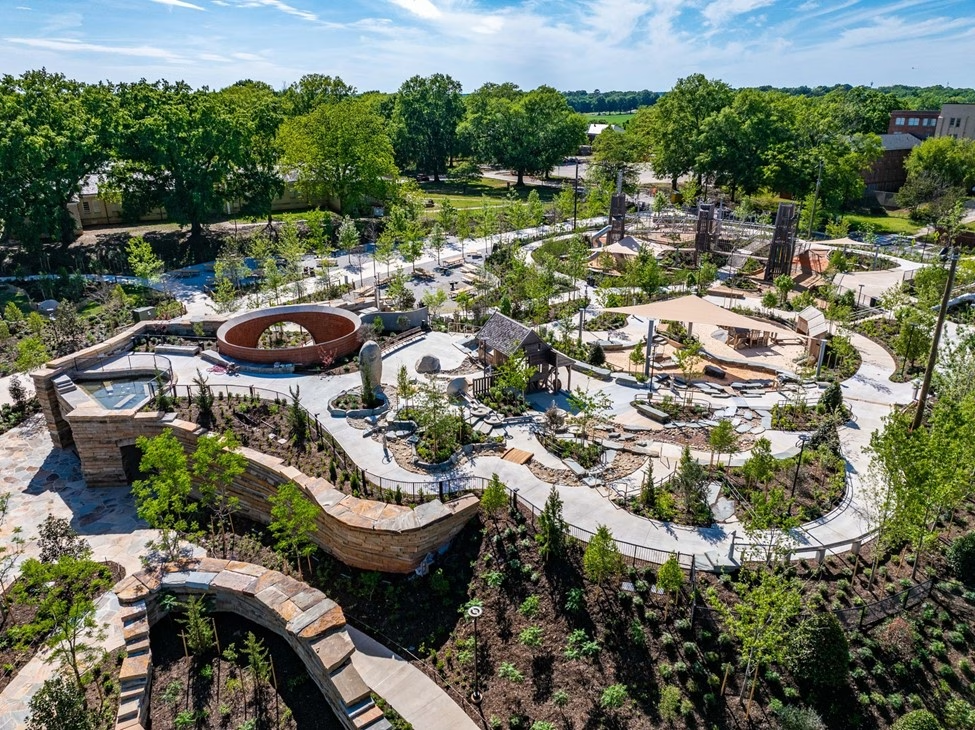
    Raleigh, NC – June 20, 2025 — According to a press release issued by Balfour Beatty, the company, in joint venture with Holt Brothers Construction, has completed the signature project of Phase 1 of the Dorothea Dix Park Master Plan. As the largest adventure playground in the Southeast, the new 18.5-acre facility is designed to welcome people of all ages and abilities.

    Built on the historic 308-acre site of Dix Park, the playground features ten distinct play zones, each requiring intricate engineering and construction techniques. The joint venture team collaborated closely with the City of Raleigh, architects, and skilled tradespeople to deliver this highly complex community project.

    Jeff Sandeen, Balfour Beatty’s President in the Carolinas, is quoted in the release saying:
    “The successful delivery of this project shows how innovative design and construction can create world-class public spaces.”

    Key features include:

    • Slide Valley, with four multi-story climbing towers and a custom underground slide
    • Fountain Plaza, featuring a hand-cut stone ceiling behind a cascading waterfall
    • Watermill Mountain and Sand Bowl, offering engineered waterplay and a beach-like dual-zone experience
    • Swing Terrace, showcasing a 91-foot-long swing with skyline views
    • Other areas such as the Sensory Maze, Picnic Grove crafted from reclaimed wood, Woodland Garden, and fully accessible pathways

    Jonte Harris, Senior Project Manager at Holt Brothers Construction, added:
    “This is a lasting gift to the Raleigh community. We’re proud to have helped bring this vision to life.”

    The press release also highlights innovations such as on-site soil integration techniques and drone mapping of underground utilities, which helped preserve the site’s character while avoiding costly delays. The team also relocated existing powerlines and designed custom cribbing to support the intricate stone ceiling structure.

    Stephen C. Bentley, Director of Parks, Recreation and Cultural Resources for the City of Raleigh, noted:
    “This was a bold vision, made real by a construction team with unmatched creativity and commitment.”

    This project builds on the Balfour Beatty–Holt Brothers partnership, which has delivered other community-focused developments across North Carolina, including the Southeast Raleigh YMCA and the NCCU Student Center.

    Also read: Universal Orlando’s $8 Billion Epic Universe Theme Park Expected to Open

    Key Facts – Gipson Play Plaza

    • Project Name: Gipson Play Plaza
    • Location: Dorothea Dix Park, Raleigh, North Carolina
    • Size: 18.5 acres
    • Significance: Largest adventure playground in the Southeastern U.S.
    • Client: City of Raleigh
    • Delivery Team: Balfour Beatty and Holt Brothers Construction joint venture

    Features:

    • 10 unique play zones
    • ADA-accessible pathways and facilities
    • 91-foot swing structure
    • Stone waterfall feature
    • Multi-story climbing towers and underground slides
    • Sensory Maze and Woodland Garden

    Innovations Used:

    • Drone mapping of underground utilities
    • On-site soil integration and mechanical aeration
    • Custom scaffolding and stonework

    Completion Date: June 2025

  • Kenya’s Stalled Roads Construction Projects Resume After Ministry of Transport Secures Ksh175 Billion in Funding

    Kenya’s Stalled Roads Construction Projects Resume After Ministry of Transport Secures Ksh175 Billion in Funding

    The government of Kenya through the Ministry of Transport, has made an announcement the resumption of the construction of more than 580 Kenya’s Stalled Roads Construction Projects across the country. This announcement comes months later after suffering a cash crunch.

    This follows the Ministry of Transport securing Ksh175 billion in loans from private investors. This funds will be utilized to clear money owed to contractors and complete the stalled road projects countrywide.

    Kenya’s Stalled Roads Construction Projects Factsheet

    Number of stalled projects: Over 580 road projects.

    Pending bills: The Kenyan government has been facing over Ksh 175 billio in unpaid bills owed to contractors for these stalled road projects.

    Funding secured: The Ministry of Transport has secured Ksh 175 billion from private investors to clear contractor arrears and resume work on the stalled road projects. This is being achieved through a new financing model. The model involves securitization of future earnings from the Road Maintenance Levy Fund.

    Also read: Kenya’s 170-Kilometer Nakuru-Nairobi Highway Construction to Commence in July

    Source of Funds for Kenya’s Stalled Roads Construction Projects

    The ministry explained that the funds to construct the roads were raised through the partial securitisation of revenue from the Road Maintenance Levy Fund (RMLF). This is the money obtained from the purchases of fuel.

    What is Securitisation?

    Securitisation refers financial mechanism that allows an institution to raise money in form of bond sales. These would later be offset using proceeds from collected levies.

    Instead of taking on a traditional loan or waiting for funds to pile up slowly over time for the government to utilize in road construction, the institution bundles a portion of its expected cash flow and sells it to investors.

    In order to address the issue of stalled roads across the country and pay pending bills, the government managed to raise Ksh175 billion from investors and committed Ksh7 out of every Ksh25 per litre of fuel levy collected to service the loan collected from investors for the next ten years.

    Some of the Roads that Benefited from the Funding

    Some roads that are currently under construction after the funding is the dualling of the Mombasa–Mtwapa road. Additionally, this road project is expected to be expanded for Ksh7.5 billion.

    The 13.5 kilometre stretch is currently 42 per cent complete. It is expected to enhance regional connectivity, boost trade, and stimulate tourism.

    Also read: $2 Billion Rironi-Mau Summit Highway Construction Commencement Set for August

  • NJTA Moves Forward with $11B Newark Bay–Hudson County Extension Despite Opposition

    NJTA Moves Forward with $11B Newark Bay–Hudson County Extension Despite Opposition

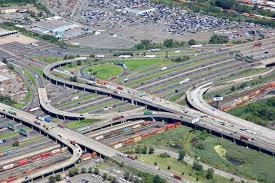
    New Jersey Turnpike Authority (NJTA) is moving forward with the $11B Newark Bay–Hudson County Extension Improvements Program, despite ongoing opposition. The program, a massive infrastructure project that will replace and widen a critical 8.1-mile section of the I-78 Turnpike Extension from Newark to Jersey Avenue in Jersey City. The project also calls for replacing the aging Newark Bay Bridge and adding lanes through Jersey City and Bayonne—duplicating current capacity in some locations. While sold as a job source and requisite infrastructure upgrade, the project is still loudly opposed on environmental and community bases.

    Phase 1 construction will begin in 2026 and will take approximately 10 years. The whole project involving the rehabilitation of 29 bridges will be completed by 2040.

    Project Scope and Timeline

    The project is planned in phases:

    Phase 1 (Exits 14 to 14A): Replacement of Newark Bay Bridge and four-lane widening in both directions. Estimated cost: $6 billion.

    Phase 2 (Exits 14A to 14B): Will expand the highway from two to three lanes in each direction.

    Phase 3 (14B to Columbus Drive): Mainly structural upgrades, i.e., shoulders but no additional lanes.

    Final Phase (Phase 4) (Columbus Drive to Jersey Avenue): Final segment will involve replacement of remaining bridges and continuing modernization.

    Economic and Safety Justifications

    Supporters cite the need to replace deteriorating infrastructure that has more than doubled its initial lifespan. The Vincent R. Casciano Memorial Bridge over Newark Bay, NJTA officials note, cannot be safely and reasonably repaired and must be replaced altogether. The agency also refers to the project offering more than 25,000 jobs during construction, facilitating freight movement, and improving long-term highway safety by offering shoulders and advanced structural elements.

    Funding for the project will come entirely from toll revenues, not taxpayer dollars. NJTA officials also noted during June 18 hearing that $500 million will be allocated to support NJ Transit and the Gateway rail project, though toll funds legally cannot be directly diverted to public transit operations.

    Concerns and Controversy

    Despite progress, resistance remains fierce among the public. Recent public hearing last June 19 in Bayonne witnessed dozens of protesters protesting environmental destruction, increased traffic, and potential displacement of community dwellers.

    Environmental Impact

    Detractors claim that the project will lead to increased automobile emissions, noise pollution, and destruction of local ecosystems. Despite permits given by the U.S. Coast Guard, claiming no material environmental impact was found, local advocacy groups remain skeptical.

    Induced Traffic

    Critics warn that adding half a highway’s capacity will encourage more driving, which may invalidate any congestion relief and dump even more traffic on already crowded neighborhood streets.

    Disruption to the Community

    There are also concerns about the use of eminent domain for the taking of property, which would displace residents and small businesses. NJTA has not finalized the final roll of impacted properties.

    Read also: Orange County Advances Plans for Futuristic $35M I-Drive Pedestrian Bridge

    Continuing Planning and Variables in Cost

    Project advisor Mike Morgan on June 18 verified that material and labor costs are still unstable. The agency is closely monitoring the cost of steel, concrete, and cement, along with the impact of federal tariffs put into place in the first place by the Trump administration.

    There are other safety upgrades, including shoulders near the Holland Tunnel, which are envisioned to improve maintenance and access by emergency vehicles. NJTA officials also said that most of the traffic on the extension is associated with the Port of Bayonne, and not commuter traffic through the Holland Tunnel.

    While the Newark Bay–Hudson County Extension Improvements Program has overcome significant regulatory hurdles and secured permits, it is an extremely controversial project. As construction is set to begin in 2026, state regulators will continue to face opposition from neighborhoods and environmental organizations even as they move forward with one of New Jersey’s most expensive infrastructure projects in decades.

    Read also: Design Unveiled for New Cable-Stayed Brent Spence Companion Bridge

    NJTA’s $11B Extension Program: Project Fact Sheet

    Project Overview

    Total Cost: $11 billion

    Timeline: 2026-2040 (14-year construction period)

    Scope: Replace and widen highway, replace Newark Bay Bridge, add lanes through Jersey City and Bayonne

    Project Phases

    Phase 1: Turnpike Exits 14 to 14A

    Replace Newark Bay Bridge

    Four-lane widening in both directions

    Cost: $6 billion

    Phase 2: Exits 14A to 14B

    Expand from two to three lanes each direction

    Phase 3: 14B to Columbus Drive

    Structural upgrades and shoulders (no additional lanes)

    Phase 4: Columbus Drive to Jersey Avenue

    Bridge replacements and modernization

    NJTA’s $11B Extension Program: Key Features

    Bridges: 29 bridges to be rehabilitated/replaced

    Jobs: 25,000+ construction jobs anticipated

    Funding: 100% toll revenue (no taxpayer funds)

    Transit Support: $500 million allocated to NJ Transit and Gateway rail project

    Current Status

    Permits secured (including U.S. Coast Guard approval)

    Construction begins 2026

    Project completion targeted for 2040

    Community opposition ongoing

    Read also: Major construction milestone reached in Gordie Howe International Bridge project