Constructionreview

Blog

  • Egypt Commences Fourth Phase of the $157M Giant Abu Rawash Wastewater Treatment Plant

    Egypt Commences Fourth Phase of the $157M Giant Abu Rawash Wastewater Treatment Plant

    Egypt has commenced the fourth phase of the $157 million giant Abu Rawash wastewater treatment plant. The notice was submitted from the Egypt’s Ministry of Housing, Utilities, and Urban Communities about the notice. However, it was relayed through the Construction Authority for Potable Water & Wastewater. No official timeline has been offered by the client for the issue of the request for proposals (RFP) for the project. Nonetheless, the tentative date for construction start is January 2026, with completion scheduled for June 2030.

    The scheme has an official budget allocation of about $157 million and involves expanding the existing 1.6 million cubic-meter-a-day (cm/d). The fourth phase aim to achieve this expansion by adding a further 400,000 cm/d of treatment capacity. The additional capacity will be treated up to secondary treatment with the treated wastewater discharged. The water will be discharged into the Barakat drainage system and then onto the Nile before entering the Mediterranean.

    Also read:

    Egypt awards contract for construction of Maghagha wastewater treatment plant

    Significance of the Abu Rawash Wastewater Treatment Plant
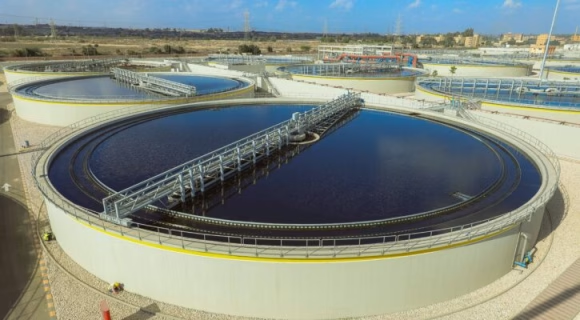
    Abu Rawash wastewater treatment plant
    Egypt has commenced the fourth phase of the $157 million giant Abu Rawash wastewater treatment plant.

    Egypt’s Abu Rawash wastewater treatment plant is one of the world’s largest wastewater treatment complexes. Increase in capacity will increase water discharge, which will in turn increase the irrigated land area to about 290,000 acres. This is expected to benefit some 2 million people and increase food production in the region. Its 400,000 cm/d first phase was built in 1992. Afterwards, it was followed by phase 2 with a total capacity of 800,000 cm/d of primary-level treatment in 2010. It was then upgraded to secondary treatment and expanded by 400,000 cm/d in 2022. The latest expansion is being funded by the African Development Bank through a $70 million grant and the rest financed by the state. In late May, a grouping of the local Hassan Allam Construction and UAE-headquartered Metito won an estimated $200m contract to upgrade and expand the Alexandria West WWTP.

    Also read:

    Elsewedy Electric to build Houd Negaih wastewater treatment plant, Egypt

    Bahr El Baqar wastewater treatment plant, the largest of its kind in the world, inaugurated in Egypt

  • 63MW Olkaria I Geothermal Power Plant Rehabilitation Project Almost Complete as KenGen Reports 70% Progress on the Project

    63MW Olkaria I Geothermal Power Plant Rehabilitation Project Almost Complete as KenGen Reports 70% Progress on the Project

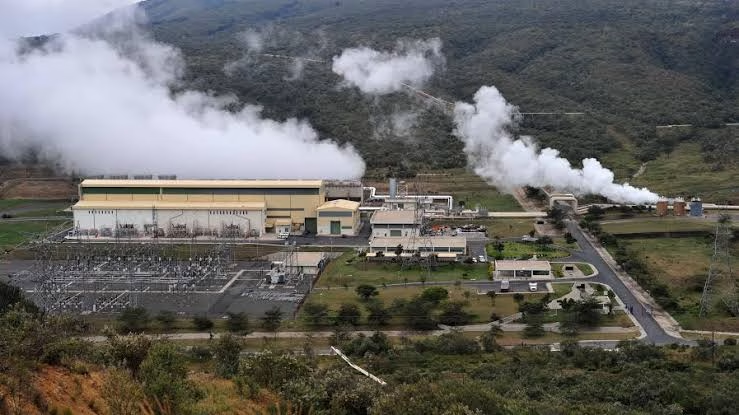
    The drive of Kenya toward a clean energy future has attained a major boost this week as the state-owned Kenya Electricity Generating Company (KenGen)  made an announcement of the arrival of critical equipment for Olkaria I Geothermal Power Plant Rehabilitation Project. This upcoming plant is KenGen’s newest geothermal power plant at the Olkaria geothermal complex.

    The planned Olkaria I project is located in the geologically active Rift Valley region. The plant is expected to adda total of 63MW of renewable energy to the national grid upon completion. This upcoming project further reinstates the reputation of Kenya as a global leader in geothermal energy production.

    63MW Olkaria I Geothermal Power Plant Rehabilitation Project Factsheet

    Location: Olkaria, Nakuru County, Kenya

    Owner and operator: Kenya Electricity Generating Company (KenGen)

    Olkaria I Units 1, 2, and 3 rehabilitation project:

    • Original capacity: 15 MW per unit. This adds up to 45 MW
    • Upgraded capacity: The rehabilitation aims to increase their combined capacity from 45 MW to 63 MW. This entails 21 MW per unit.

    Expected completion: June 2026

    Also read: KenGen Issues Multi Billion Olkaria I Rehabilitation Contract

    Equipment Delivery to the Project’s Site

    KenGen mentioned in a statement revealing that two steam turbines and two generators destined for Units 2 and 3 of the Olkaria I facility have been successfully delivered to the project’s site. These equipment were shipped from Japan earlier this year. The equipment arrived in Kenya through the Port of Mombasa. Also, they were later transported to Olkaria in time to meet key construction milestones.

    KenGen said the final set of turbine and generator units destined for Unit 1 was dispatched in late May and already in transit. KenGen expects the equipment to arrive at Mombasa and later transported to the Olkaria site by the end of the month. Other major plant components have already been delivered. Several components have been installed as work on the facility moves into its final stages.

    Furthermore, speaking at the sidelines of the Africa Energy Forum that was held in Cape Town, South Africa, the Managing Director and CEO, Eng. Peter Njenga of KenGen said: “The timely arrival and installation of these critical equipment mark a significant milestone in our mission to deliver affordable, reliable, and green energy to the people of Kenya.”

    Also read: KenGen Set to Add 42.5MW Seven Forks Solar Power Plant on Kenya’s Seven Forks Dams

    Significance of the Project

    When the project will be commissioned, the Olkaria I will improve electricity reliability getting Kenya closer to its 100% clean energy target by 2030. Additionally, Kenya seeks to phase out use of fossil fuels for energy generation.

    The addition of the 63MWvto the national grid will bring the installed capacity of Olkaria I to new heights. Kenya maintains over seven decades legacy of homegrown innovation and investment in clean energy. Lastly, this project is expected to bring Kenya close to joining the elite 1GW club of largest geothermal producers in the world.

    Also read: KenGen Seeks Consultants for 42.5MW Embu Solar Project

  • Owner’s Engineer Appointed to 1GW Abydos Solar PV Power Plant, Egypt’s Largest

    Owner’s Engineer Appointed to 1GW Abydos Solar PV Power Plant, Egypt’s Largest

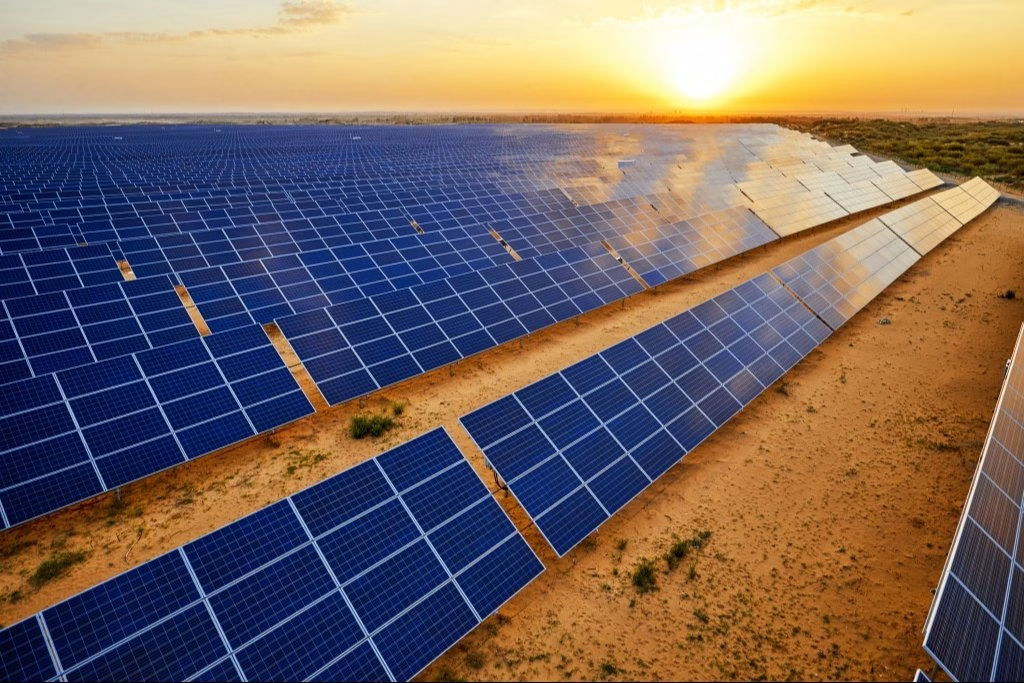
    DNV has been appointed as the Owner’s Engineer for the 1GW Abydos II Solar Photovoltaic (PV) power plant with integrated Battery Energy Storage System (BESS)—the largest of its kind in Egypt. The firm will provide advisory and oversight services from feasibility through commissioning to ensure technical robustness, regulatory compliance, and project efficiency.

    DNV’s Role in Project Delivery

    DNV will support the Abydos Solar PV Power Plant project developer AMEA Power by focusing on three core areas:

    • Design Resilience: Adapting plant layout and technology to withstand harsh desert conditions such as extreme heat and dust accumulation.

    • Grid Compliance: Reviewing grid simulations to ensure stable integration with Egypt’s national electricity network.

    • Battery Safety: Applying international BESS safety standards to minimize fire and thermal risks.

    “Projects of this scale demand both technical rigor and regional insight,” said Santiago Blanco, Executive VP at DNV. “Our role is to safeguard performance and reliability from day one, helping AMEA Power deliver an asset that is robust, future-ready, and aligned with Egypt’s long-term energy goals.”

    [internal_link url=”https://constructionreviewonline.com/news/egypt-inks-200-million-deal-with-chinas-sunrev-solar-to-construct-the-ain-sokhna-solar-energy-complex-project/”]

    Socioeconomic and Environmental Impact

    The Abydos Solar PV Power Plant is expected to create 4,000 jobs during construction and contribute significantly to Egypt’s decarbonization goals under Vision 2035. Situated on 20km² of desert land in Aswan Governorate, it avoids disruption to local communities or agriculture and features sustainable design and a 25-year PPA with the Egyptian Electricity Transmission Company (EETC).

    Factsheet: Abydos II Solar PV Project

    • Capacity: 1GW Solar PV + 600MWh BESS

    • Location: Aswan Governorate, Egypt

    • Owner: AMEA Power Ltd via AFRE

    • Cost: Approx. US$750 million

    • Financing: IFC – US$120M loan + US$480M mobilized

    • Features:

      • 144 inverter stations

      • 1.6km transmission line

      • 500kV grid substation

      • EMS and integrated control systems

      • Offices, warehouse, roads, and security perimeter

    • Construction: Began Jan 2025; completion expected May 2026

    • Environmental Clearance: ESIA Addendum in progress

    • Offtaker: EETC

    Africa’s largest solar photovoltaic farm Obelisk solar project in Egypt to receive US$184m

  • Hausmann Construction’s Work on Nebraska’s New 1,512-Bed State Prison

    Hausmann Construction’s Work on Nebraska’s New 1,512-Bed State Prison

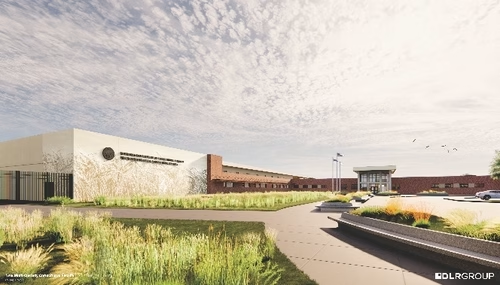
    August 2025 – Construction has officially begun on Nebraska’s new 1,512-bed correctional facility after Hausmann Construction of Lincoln received a notice to proceed on July 24. The Nebraska Department of Correctional Services confirmed the $312 million contract has been signed, advancing a project first announced in June for the site near North 70th Street and Interstate 80.

    The agreement requires the prison to reach substantial completion within 1,110 days—roughly three years and two weeks—placing the target date in August 2028. At that stage, the facility will be considered complete enough to begin serving its intended function.

    June 2025 – The Nebraska Department of Correctional Services has chosen Hausmann Construction to lead the construction of the state’s new prison, with work expected to begin breaking ground in early fall as contract terms are completed.

    Lincoln’s Hausmann submitted the lowest bid at $313.3 million, just ahead of two joint ventures: Sampson Construction/Caddell Construction ($344.3 million) and Clark Construction/MCL Construction ($341 million). Both of the runner-up partnerships included at least one Nebraska-based company.

    “We are pleased to be working with a local company that shares our values and commitment to fiscal prudence,” said Corrections Director Rob Jeffreys. “Hausmann’s staff consists of high-performing subcontractors, some of which are local — keeping the work and the economic impact local in Nebraska.”

    Nebraska Department of Correctional Services Hausmann construction
    Nebraska Department of Correctional Services Hausmann construction

    Allocation for the new prison

    The Nebraska Legislature initially allocated $350 million for the new prison, set to replace the aging Nebraska State Penitentiary, which has long faced issues of overcrowding and outdated infrastructure. Some lawmakers, however, raised concerns about whether rising construction costs and potential overruns might push the project beyond its original scope. Despite these worries, Jeffreys emphasized that the winning bid was still well below the cost of similar projects in other states. For example, South Dakota recently cleared a $650 million plan for a new state correctional facility in Sioux Falls, highlighting just how competitively Nebraska’s project was priced in comparison. This cost advantage, coupled with modern design elements focused on security, healthcare, and rehabilitation, is seen as a major step forward in addressing Nebraska’s correctional challenges without overburdening taxpayers.

    Upon completion, the new 1,512-bed prison will be located north of Interstate 80 off North 70th Street, just outside of Lincoln. Despite the optimism in the bidding, both government leaders and locals have questioned whether the project can be completed within the existing budget in the face of national trends in the cost of prison construction.

    Read also: Balfour Beatty to construct a new $320M state prison in Georgia

    Nebraska New State Prison Project Factsheet

    Client: Nebraska Department of Correctional Services

    Selected Contractor: Hausmann Construction (Lincoln, NE)

    Project Value: $313.3 million

    Legislative Budget Allocation: $350 million

    Expected Construction Start: Early Fall 2025

    Facility Specifications

    Capacity: 1,512 beds

    Location: North of Interstate 80 near North 70th Street, Lincoln area

    Purpose: Replace aging Nebraska State Penitentiary

    Design

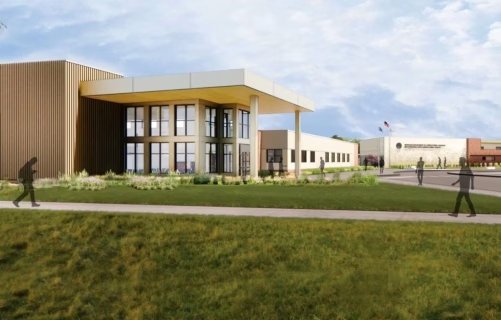
    DLR Group developed the architectural design for Nebraska’s new state prison. Their proposal emphasizes rehabilitation-focused spaces. It includes abundant natural light. The design features modern acoustics, these elements support programming and re-entry preparation.

    Bidding Process Results

    Winning Bid: Hausmann Construction submitted the lowest bid at $313.3 million and was selected for the project. The Lincoln-based firm beat out two competitive joint ventures in the bidding process.

    Runner-up Bids: Sampson Construction partnered with Caddell Construction submitted a bid of $344.3 million. While Clark Construction teamed with MCL Construction bid $341 million. Both runner-up partnerships included at least one Nebraska-based company.

    Read also: Arkansas Pushes Ahead with Controversial 3,000-Bed Prison Project Amid Funding and Community Backlash

  • Egypt’s $200 Million Deal with China’s Sunrev Solar for the Ain Sokhna Solar Energy Complex Project

    Egypt’s $200 Million Deal with China’s Sunrev Solar for the Ain Sokhna Solar Energy Complex Project

    Updated 16th October 2025: The project is being built in cooperation with TEDA-Egypt within the Suez Canal Economic Zone. It spans 200,000 square metres in the Ain Sokhna industrial zone. Phase 1, valued at US$90 million, includes two factories with a combined 4 GW capacity for solar cell and module production. Phase 2, worth US$110 million, will add silicon ingot and wafer manufacturing to localize raw material production. The first phase is expected to come online in the first half of 2026. Over 1,800 direct jobs will be created across both phases, with export revenues projected to reach US$300 million annually. The factories will serve both domestic and international markets. Egyptian officials note that the project strengthens the localization of solar manufacturing and industrial integration in the renewable energy sector.

    It also joins the list of major clean energy ventures highlighted in Egypt’s top solar power projects in development, marking a pivotal step toward Egypt’s goal of becoming a regional leader in solar technology and green industrialization.

    The Egyptian Prime Minister Mostafa Madbouly witnessed on Wednesday the signing of a contract that will enable the establishment of an integrated industrial complex for the production of solar energy components in Ain Sokhna’s industrial zone. This upcoming Ain Sokhna Solar Energy Complex Project will be part of the Suez Canal Economic Zone (SCZONE). The project will be developed by Chinese firm Sunrev Solar.

    The project will involve the construction of two integrated factories in its first phase. One of the factories will be for producing solar cells and another for solar modules. Each of the factories will boast a capacity of 2 gigawatts.

    Ain Sokhna Solar Energy Complex Project Factsheet

    Developer: Sunrev Solar

    Location: Ain Sokhna industrial zone. This is part of the Suez Canal Economic Zone (SCZONE) in Egypt.

    Cost:

    Total cost: $200 million

    Phase 1: $90 million

    Phase 2: $110 million

    Phases of development:

    Phase 1:

    • This phase will involve the construction of two integrated factories:
    • One for producing solar cells.
    • The other factory will be for producing solar modules.
    • Each factory will be having a production capacity of 2GW.

    This phase is expected to kick off operations in the first half of the year 2026.

    Also read: Scatec Reaches Egypt’s Obelisk Hybrid Solar and BESS Project Financial Close

    Phase 2:

    • This phase will mainly focus on localizing the production of key raw materials which include:

    Silicon ingots.

    Silicon wafers.

    • Generally, this phase aims to complete the full solar component value chain ranging from raw materials to finished products.

    Furthermore, as for the second phase, it will mainly focus on localising the production of key raw materials which include silicon ingots and wafers. This will therefore complete the full solar component value chain.

    SCZONE Chairperson Walid Gamal El-Din described the upcoming project as one of the zone’s largest industrial investments in renewable energy components. It will span ab area of 200,000 square metres.

    Project Cost

    Also, the project will see a total investment of $200m. A total of $90m for the first phase and $110m for the second. It will generate more than 1,800 direct jobs across both phases. Additionally, it will generate annual export revenues of up to $300 million.

    Project’s Timeline

    The foundation stone of the project is expected to be laid on Thursday 19th June. The first phase is scheduled to commence its operations in the first half of 2026. Lastly, Gamal El-Din stressed that the project indicates the confidence of major international investors in SCZONE’s business climate. Also, it supports the authority’s broader strategy to localise advanced industries and integrate solar energy production chains—from raw materials to finished products.

    Also read: Scatec Commences Construction of 1.1GW Obelisk Solar PV and BESS Project in Egypt

  • Design Unveiled for New Cable-Stayed Brent Spence Companion Bridge

    Design Unveiled for New Cable-Stayed Brent Spence Companion Bridge

    Ohio Gov. Mike DeWine and Kentucky Gov. Andy Beshear have unveiled the design of a next-generation companion bridge spanning the Ohio River, a major milestone in the Brent Spence Bridge Corridor Project — one of the nation’s most crucial transportation infrastructure investments.

    “This new cutting-edge bridge that will cross the Ohio River from Cincinnati to Northern Kentucky will not only make travel and safety between our two states better, it will be a iconic part of the Cincinnati skyline,” Governor Beshear tweeted on X. “It will cure one of the worst truck bottlenecks in the country.”

    The new bridge, constructed with the concurrent guidance of the Ohio Department of Transportation and the Kentucky Transportation Cabinet, will be a two-decked, cable-stayed bridge. It won’t contain steel between the bottom and top decks, as the Brent Spence Bridge does now — an engineering design that allows for a more airy and visually striking form.

    Unobstructed views

    According to project officials, traffic flowing from the north will travel on the top deck of the new bridge, giving drivers panoramic, unobstructed views of downtown Cincinnati. The cabling system holding up both decks will give the structure a touch of modernity, making it an architectural landmark of the future.

    “These were bridges that were safe, efficient, and affordable — but we also wanted them to be beautiful,” Governor DeWine said. “This bridge will be an iconic feature of the Cincinnati skyline and a landmark gateway that symbolizes our states’ excellence.”

    Read also: Orange County Advances Plans for Futuristic $35M I-Drive Pedestrian Bridge

    The new bridge is one aspect of a broader $3.6B project to modernize the Brent Spence Bridge Corridor, an eight-mile stretch of I-71/I-75 in Kentucky and I-75 in Ohio. Improvements to the existing Brent Spence Bridge, newly designed ramps, new bike and pedestrian paths, and upgrades designed to make the area more walkable and walkable, interconnected urban community.

    With the design now selected and federal approval by the Federal Highway Administration in hand, the project moves into final construction and engineering phases. Once finished, the companion bridge is expected to significantly reduce traffic jams, improve freight movement, and open up opportunities for regional economic development.

    Read also: Initial Work on the $3.6B Brent Spence Bridge Corridor Project Begins This Summer

    Design Unveiled for New Cable-Stayed Brent Spence Companion Bridge
    Design Unveiled for New Cable-Stayed Brent Spence Companion Bridge

    Brent Spence Bridge Corridor Project: Companion Bridge Design Unveiled

    Project Overview

    The Brent Spence Bridge Corridor Project represents one of the most significant transportation infrastructure investments in the United States, featuring a new companion bridge over the Ohio River between Cincinnati and Northern Kentucky.

    Bridge Design Highlights

    Structure Type: Cable-stayed, two-deck bridge

    Engineering Innovation: No steel required between top and bottom decks

    Visual Impact: Open, modern design creating an iconic Cincinnati skyline landmark

    Traffic Flow: Northbound traffic on top deck with unobstructed downtown Cincinnati views

    Project Scope

    The comprehensive modernization covers an 8-mile stretch of I-71/I-75 in Kentucky and I-75 in Ohio, including:

    New companion bridge construction

    Existing Brent Spence Bridge upgrades

    Reconfigured highway ramps

    New pedestrian and bicycle pathways

    Urban connectivity enhancements

    Key Benefits

    Traffic Relief: Addresses one of the nation’s worst truck bottlenecks

    Safety Improvements: Enhanced travel safety between Ohio and Kentucky

    Economic Impact: Opens new regional economic development opportunities

    Freight Movement: Significantly improved cargo transportation efficiency

    Read also: Washington releases funding for Mobile River Bridge Project Alabama