Constructionreview

Blog

  • Construction Begins on the Tallest Mass Timber Building in the U.S. — The Neutral Edison

    Construction Begins on the Tallest Mass Timber Building in the U.S. — The Neutral Edison

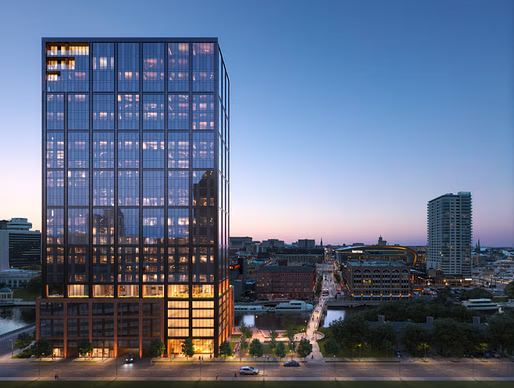
    Construction began officially on Monday, June 16, on The Neutral Edison, a 31-story tower in that will be the tallest mass timber building in the U.S. Located at 1005 N. Edison St., Milwaukee, the tower will house 353 homes and a range of upscale luxury amenities.

    The high-rise rental development is being designed with health, sustainability, and lifestyle in mind. Among the amenities it offers are a club membership covering a whole floor, fitness center, health clinic, spa, bathhouse, sauna, pool, café, and organic grocery store. The Husky’s residents will also have access to a movie theater, golf simulator, co-working spaces, dog park with grooming suites, and lounge areas. Additional amenities include in-site Tesla rentals and an e-bike and scooter sharing program. An outdoor lounge deck will also feature a small pool.

    Approximately 7,000 square feet of retail space will be on the first floor. Los Angeles’ Copa Vida will operate both the grocery store and café, as well as manage the co-working spaces. The firm is expanding its presence in the neighborhood, with other locations in Neutral’s other Madison buildings planned.

    CD Smith has gotten fully started to manage construction work. Neutral, the project’s developer received $133.3 million in construction loans from Bank OZK and Pearlmark.

    Hartshorne Plunkard Architecture is the design leader of the building, while Forefront Structural Engineers manages structural engineering services, assisted by Thornton Tomasetti with additional services.

    Project permitting process

    Neutral Edison has seen several rounds of design refinement since its original release in 2020, which delayed the approval. The permitting process wrapped up in February, including a lease for additional parking in a nearby city-owned building. The Neutral Edison finished construction will see the tower stand taller than the 25-story Ascent building—half a mile to the east—the tallest mass timber building in the Western Hemisphere. But soon the world title will be claimed by an even taller timber structure under construction in Sydney, Australia.

    The developer Neutral continues to set new precedents with green building. A second record-breaking tower is also in the works across the street from The Neutral Edison.

    The developer states that the incorporation of mass timber within the building reduces embodied carbon emissions by up to 54% and reduces energy use and operational carbon by 45% compared to traditional building methods. A significant portion of the wood will be Forest Stewardship Council-certified, and the project aims to achieve Passive House standards and Living Building Challenge 4.0 Core Certification.

    “By combining mass timber technology with a high-performing, low-carbon envelope, The Neutral Edison is redefining what sustainable architecture can be,” said Daniel Glaessl, Partner and Chief Product Officer at Neutral. “We’re thrilled to bring this forward-thinking project to life, offering an elevated and intentional lifestyle for future residents.”

    Read also: New York City lays out plans for the largest mass timber residential project on Staten Island

    Construction on Tallest Mass Timber Building in the U.S. – The Neutral Edison: Project Factsheet

    Project Overview

    Location: 1005 N. Edison St., Madison

    Developer: Neutral (Madison-based)

    Construction Start: June 16, 2025

    Height: 31 stories

    Building Specifications

    Residential Units: 353 units (high-end rental)

    Commercial Space: 7,000 sq ft (ground floor)

    Construction Type: Mass timber with high-performing, low-carbon envelope

    Sustainability Goals: Passive House standards and Living Building Challenge 4.0 Core Certification

    Key Team Members

    General Contractor: CD Smith

    Architecture: Hartshorne Plunkard Architecture

    Structural Engineering: Forefront Structural Engineers

    Additional Engineering: Thornton Tomasetti

    Financing

    Total Construction Financing: $133.3 million

    Lenders: Bank OZK and Pearlmark

    Tallest Mass Timber Building in the U.S: Amenities & Features

    Health & Wellness

    Full-floor membership club

    Fitness center and spa

    Health clinic

    Bathhouse and sauna

    Pool and outdoor lounge deck with small pool

    Lifestyle & Convenience

    Movie room and lounge areas

    Golf simulator

    Coworking spaces (managed by Copa Vida)

    Dog park with grooming facilities

    On-site Tesla rentals

    E-bike and scooter sharing program

    Environmental Impact

    Embodied Carbon Reduction: 54% compared to traditional construction

    Energy & Operational Carbon Reduction: 45% compared to conventional methods

    Timber Certification: FSC-certified materials

    Significance: Tallest mass timber building in the United States

    Project Timeline

    Initial Announcement: 2020

    Final Legislative Approval: February 2025 (including parking lease agreement)

    Construction Commencement: June 16, 2025

    Completion: 2027

    Read also: New Milwaukee Development to Feature World’s Tallest Mass Timber building
  • Aura Power Begins Construction on Grimsby Solar Farm to Power 27,000 Homes

    Aura Power Begins Construction on Grimsby Solar Farm to Power 27,000 Homes

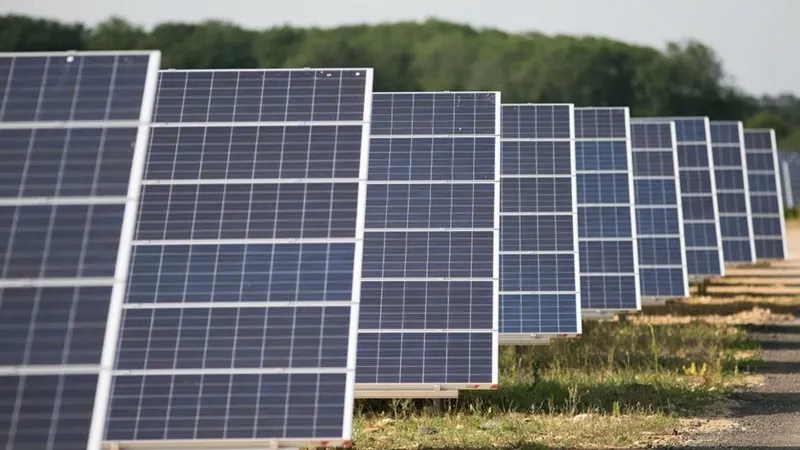
    Construction has commenced on Aura Power’s newest solar farm near Grimsby, North East Lincolnshire. The nine-month project will generate a maximum of 49.9MW of renewable energy—sufficient to power around 27,000 homes. The facility, which features a single-axis tracking system and extensive landscaping, will provide a 71% biodiversity net gain, highlighting Aura’s commitment to sustainable development.

    Aura Power secured financing for the project on June 6, with Rabobank once again providing senior debt—a continuation of their partnership on earlier projects in Kemble and Burtree Lane.

    “We’re pleased that Rabobank is once again supporting us,” said Aura Power in a press release. “Their continued backing strengthens our mission to expand clean energy access across the UK.”

    Jesse Leeuwendal, Director at Rabobank, said, “We are happy to continue our relationship with Aura Power as they accelerate the development of clean energy infrastructure across the UK. Their track record and strategic vision make them a sound partner in building a more sustainable future.”

    The Grimsby solar farm will be connected to the local grid by cabling to a nearby substation.

    Chris Tucker, Senior Project Manager at Aura Power, added, “We’re excited to see this project come to life and will work closely with the local community throughout construction to minimize any disruption. This is part of our wider mission to deliver clean, reliable, and affordable energy across the UK.”

    Read also: UK’s Largest Solar PV Plant: The 600MW Cottam Solar Project

    Construction begins on Grimsby Solar Farm: Project Factsheet

    Project Overview

    Developer: Aura Power

    Location: Grimsby, North East Lincolnshire

    Status: Construction commenced

    Timeline: 9 months construction period

    Grimsby Solar Farm Project: Technical Specifications

    Capacity: 49.9MW renewable energy generation

    Technology: Single-axis tracking solar system

    Power Output: Sufficient to supply approximately 27,000 homes

    Grid Connection: Local grid via cabling to nearby substation

    How Will the Grimsby Solar Farm Impact the Environment?

    Biodiversity Net Gain: 71% improvement

    Landscaping: Thoughtful design integration

    Sustainability Focus: Part of Aura Power’s commitment to sustainable development

    Financial Structure

    Financing Secured: June 6, 2025

    Senior Debt Provider: Rabobank

    Read also: Barrow EnergyDock Plans Unveiled, UK’s Largest Floating Solar Project

  • Cabeólica Phase II Expansion Project Cabo Verde’s First Wind and BESS Project Gets AfDB Funding

    Cabeólica Phase II Expansion Project Cabo Verde’s First Wind and BESS Project Gets AfDB Funding

    The Cabeólica Phase II Expansion Project in Cabo Verde has received a €19.6 million boost from the African Development Bank Group, supporting the country’s groundbreaking efforts to combine wind power and battery energy storage at scale.

    €19.6 Million Approved to Advance Clean Energy

    The financing package includes a €12.6 million loan from the African Development Bank (AfDB) and €7 million in concessional funding from the Bank-managed Sustainable Energy Fund for Africa (SEFA). This support will enable the installation of 13.5 megawatts of additional wind power capacity and 26 megawatt-hours of grid-connected battery storage.

    Expected to produce over 60 gigawatt-hours of clean energy annually, the Cabeólica Phase II Expansion Project will reduce reliance on diesel-based generation and cut carbon emissions by approximately 50,000 tonnes per year.

    Strengthening Cabo Verde’s Energy Security

    “The Cabeólica Phase II Expansion Project reflects Cabo Verde’s bold vision to decarbonize its energy sector,” said Wale Shonibare, Director for Energy Financial Solutions at AfDB. “It showcases how concessional finance can mobilize private investment to deliver resilient, cost-effective power systems.”

    Daniel Schroth, AfDB Director for Renewable Energy, added: “SEFA’s support enhances grid reliability while lowering power generation costs—proving how strategic financing and technology integration can drive sustainable transformation.”

    [internal_link url=”https://constructionreviewonline.com/news/amea-power-commissions-amunet-wind-power-plant-project-in-egypt-africas-largest-wind-power-plant/”]

    Cabeólica Continues to Lead Renewable Innovation

    Ayotunde Anjorin, Chairman of Cabeólica and CFO at Africa Finance Corporation, emphasized: “As Africa’s first utility-scale renewable PPP, Cabeólica is again leading the way with this transformative expansion, aligning clean energy infrastructure with national development goals.”

    The expansion covers five installations across four islands—wind expansion on Santiago and BESS deployments on Santiago, Sal, Boa Vista, and São Vicente. The battery systems will provide grid services such as voltage regulation and frequency response, reducing wind power curtailment and enhancing efficiency.

    Also Read: 220MW Meru Wind and Solar Project Moves Forward

    Long-Term Impact and Strategic Alignment

    Underpinned by a 20-year power and storage agreement with Electra S.A., the Cabeólica Phase II Expansion Project supports Cabo Verde’s target of generating 50% of electricity from renewables by 2030. It aligns with AfDB’s “Light Up and Power Africa” initiative and SEFA’s Green Baseload pillar.

  • All You Need to Know About the Multi-Million-Dollar Mombasa-Kwa Jomvu Road Project

    All You Need to Know About the Multi-Million-Dollar Mombasa-Kwa Jomvu Road Project

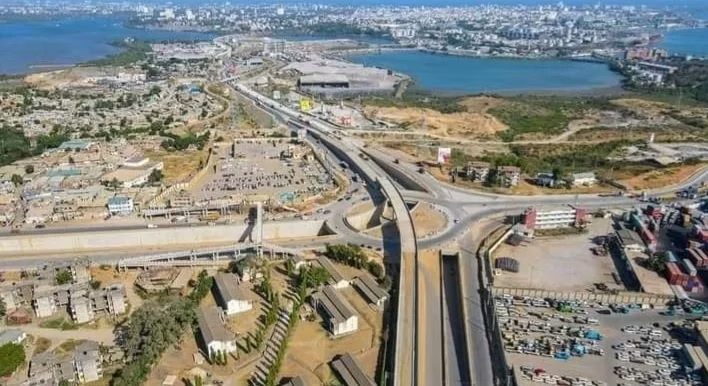
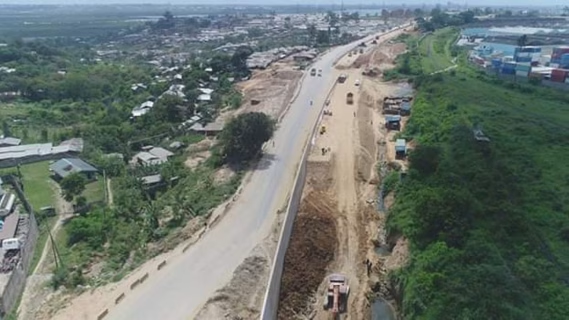
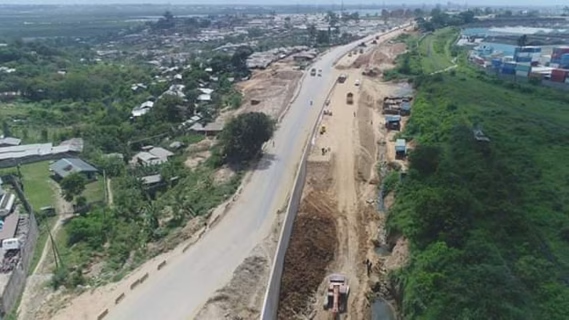
    The implementation of the multi-million-dollar Mombasa-Kwa Jomvu road project has stalled due to major setbacks. These include land compensation delays and ongoing legal disputes as noted by the National Assembly Committee. During an inspection visit to Mombasa, the committee noted that two court cases and lack of funds are the main hurdles. Stretching a distance of 11.9 kilometers, the project is being jointly funded by the African Development Fund and the Government of Kenya. Furthermore, the committee noted that although construction is scheduled for completion by September 2025, there is much to do. One of these is the compensation of evicted residents, which remains a major stumbling block. Members of Parliament were informed the issue was central to a petition submitted to Parliament by Jomvu MP Bady Twalib. Overseen by the Kenya National Highway Authority (KeNHA), the state-owned entity noted that resolution progress is being made.

    KeNHA’s representative, Eng. Henry Gakuru noted that a total of Ksh.5.3 billion had already been allocated for compensation. Kenya’s road projects seem to have major setbacks before completion as noted with the recently completed Athi River-Machakos dual carriageway. The construction progress stalled in 2019 after a dispute between contractor and 76 business owners. The main reason that sparked the delay was over dispute on compensation. This is despite the National Land Commission (NLC) gazetting affected persons in 2018 and recommending their compensation after land valuation. The road project is one of the many in Kenya that faces similar setbacks such as the Mombasa-Kwa Jomvu road project which has currently stalled.

    Also read:

    Kenya’s Government Provides Updates on the $751 Million Mombasa-Mtwapa Highway Project

    Scope of Implementation on the Mombasa-Kwa Jomvu Road Project

    Mombasa-Kwa Jomvu Road Project
    The implementation of the multi-million-dollar Mombasa-Kwa Jomvu road project has stalled due to major setbacks.

    The implementation of the Mombasa-Kwa Jomvu road project is the first phase of the wider Mombasa-Mariakani road project. The aim of the project entails converting the predominantly two-lane road to a four and six lane dual carriageway. Within the Mombasa – Mariakani area, the road forms the main axis to Nairobi. Furthermore, it is part of the Northern Corridor, which links the port of Mombasa with various landlocked Eastern and Central African countries. These includes countries such as Uganda, Rwanda, Burundi and South Sudan. Furthermore, the corridor also links the Democratic Republic of Congo (DRC). Once completed, the upgraded road will benefit an average of 20,000 vehicles per day travelling through Mariakani. Moreover, the enhancement of the road will contribute to reducing emissions and the number of road accidents. The committee gave KeNHA three months to finalize the Mombasa-Kwa Jomvu road project.

    Also read:
    Nairobi-Mombasa dual carriageway set for next year

    Mombasa SGR Terminus and 26-Kilometer CBD Rail Link Line Ready for Commissioning

  • Atom Solar Egypt Joins AMEA Power’s 300MWh Kom Ombo BESS Project in Egypt’s Transition to Green  Energy Following a $220 Million Deal

    Atom Solar Egypt Joins AMEA Power’s 300MWh Kom Ombo BESS Project in Egypt’s Transition to Green Energy Following a $220 Million Deal

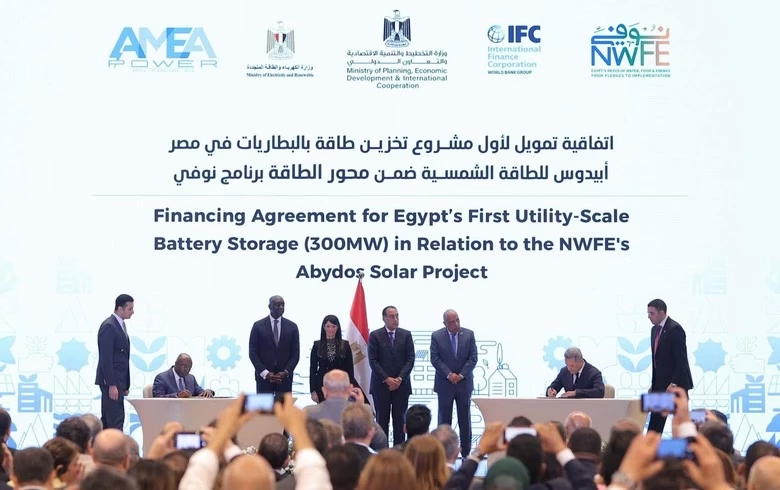
    Last Updated 1st September 2025- Egypt is rapidly rising to become Africa’s top destination for renewable energy investment. In a recent project that has joined the list of renewable energy projects in the country, Atom Solar Egypt Project has inked a $220 million deal for its development. The deal was inked between Egypt, UAE, Bahrain, and China. In another project, AMEA Power announced the financial close of the first ever utility-scale Battery Energy Storage System (BESS) project that is located in Egypt, the 300MWh Kom Ombo BESS Project. Kom Ombo BESS Project is an extension of AMEA Power’s operational 500MW Solar PV Plant that is located in Aswan Governorate, Egypt. This renewable energy plant was commissioned in December of the year 2024.

    Both projects align with and support Egypt’s national and strategic goals for a green energy transition.

    The 300MWh BESS Project will receive a total of $72 million debt package from IFC. This funding will be utilized for the integration of the project into the operational 500MW Solar PV Plant.

    300MWh Kom Ombo BESS Project Factsheet

    Project name: Abydos Battery Energy Storage System (BESS) Project. However, it is often referred to as Kom Ombo BESS due to its location

    Location: Kom Ombo, Aswan Governorate, Egypt

    Capacity: 300 MWh (Megawatt-hours)

    Project type: Utility-scale Battery Energy Storage System

    Developer and owner: AMEA Power

    Also read: AMEA Power Commissions Amunet Wind Power Plant Project in Egypt, Africa’s Largest Wind Power Plant

    The funding documents for the project were signed between Samir Nacef who is the Chief Executive Officer of AMEA Power Egypt, and Cheick-Oumar who holds the position of IFC Director for North Africa and the Horn of Africa. The signing ceremony of the BESS project was attended by H.E. Mostafa Madbouly, Prime Minister of Egypt; Dr. Mahmoud Esmat and Minister of Electricity and Renewable Energy of Egypt. Furthermore, in attendance were Rania A. Al-Mashat, Minister of Planning, Economic Development and International Cooperation of Egypt and Makhtar Diop, Managing Director of IFC.

    Significance of the Financial Close

    This milestone on the renewable energy project further cements the strategic partnership between AMEA Power and IFC. This also the includes the recently commissioned 500MW Amunet Wind Farm that is located in Ras Ghareb, Egypt. Also, the collaboration extends beyond Egypt to projects such as the 120MWp solar PV plant that is located in Metbassta, Tunisia.

    Also read: AMEA Power Signs Agreements for 300MW Aysha-1 Wind Energy Project in Ethiopia; Largest in Horn of Africa

    This BESS integration is a clear representation of the first initiative to move forward under Egypt’s accelerated 4GW Emergency Renewable Energy Program . This is a government-led effort that is designed to address the increasing electricity demand by leveraging affordable, clean energy solutions and cutting the dependence on imported natural gas.

    Also read: Scatec Reaches Egypt’s Obelisk Hybrid Solar and BESS Project Financial Close

  • Africa’s Largest Grand Egyptian Museum Set For Grand Opening After 3 Decades and More than $1 billion

    Africa’s Largest Grand Egyptian Museum Set For Grand Opening After 3 Decades and More than $1 billion

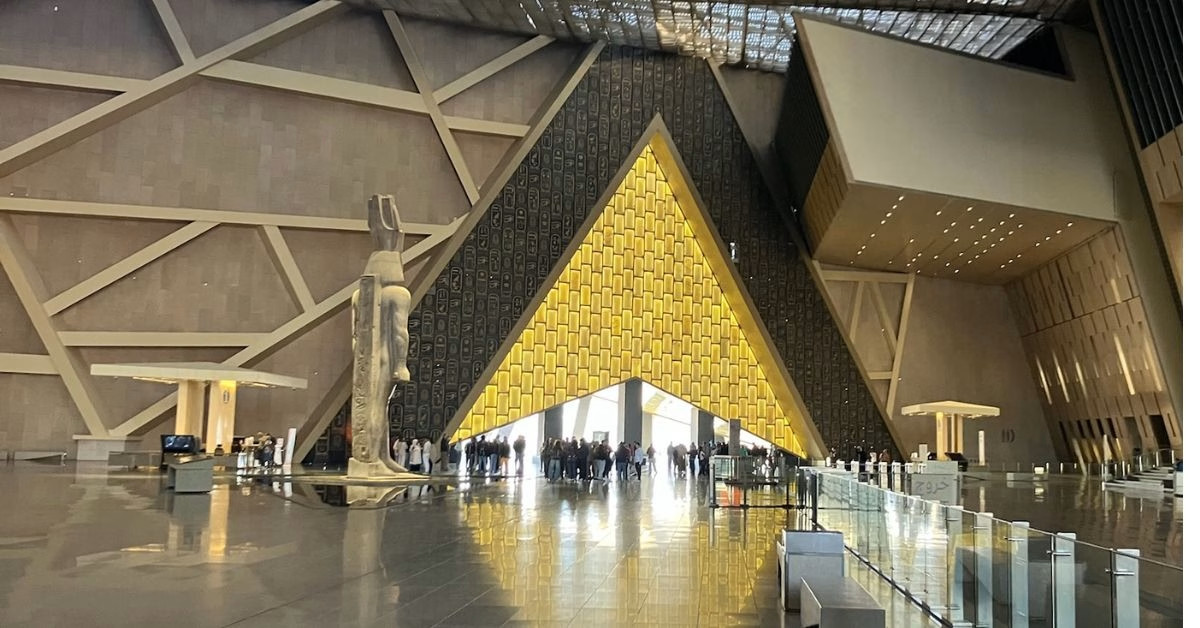
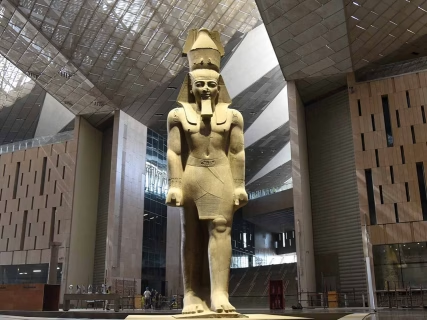
    Updated October 31, 2025: Egypt’s government will host dozens of foreign leaders and dignitaries on Saturday as it holds an official opening ceremony for the Grand Egyptian Museum. It is a $1 billion project decades in the making that was plagued by multiple delays and a ballooning of the budget. The GEM is one of the largest museums in the world, and the largest dedicated to a single civilization: ancient Egypt. Its subject matter spans some 7,000 years from prehistory to the end of the Greek and Roman eras around 400 A.D.

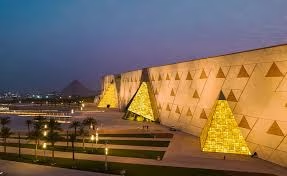
    Moreover, the initial cost for the more than 5-million-square-foot, triangular-themed structure about a mile from the iconic pyramids of Giza was estimated at $500 million. Costing over $1 billion, the project was funded through Egyptian resources and international cooperation.  In front of the main entrance stands the imposing 53-foot-high Hanging Obelisk, the only such structure in the world. The obelisk itself is about 3,500 years old, but it sits suspended overhead on a modern structure with a glass floor. The museum is one of the biggest museums in Africa as it expects its grand opening.

    June 16, 2025: Egypt has once again postponed the long-anticipated grand opening of the Grand Egyptian Museum, Africa’s largest museum. The main reason noted is because of the escalating military confrontations between Israel and Iran. These remarks were noted by Egypt’s Prime Minister, Mostafa Madbouly on Saturday. Madbouly noted that the current regional climate was not amicable for hosting a major international event, attributing to the tensions.

    Originally scheduled for July 3, the opening of the museum is expected to be delayed till the fourth quarter of the year. “The regional tensions may persist for weeks,” Madbouly noted. Furthermore, he noted that because of this anticipation, the government found that the appropriate course of action was to postpone. Expected to be a major international event, the opening ceremony will be done during a more conducive atmosphere. He also added that the new date for the opening will be announced based on future regional developments.

    Also read:

    Grand Egyptian Museum (GEM)/Giza Museum in Egypt

    The Significance of the Grand Egyptian Museum

    Grand Egyptian Museum
    Egypt has once again postponed the long-anticipated grand opening of the Grand Egyptian Museum, Africa’s largest museum.

    Located near the iconic pyramids of Giza, the Grand Egyptian Museum is hailed as Africa’s largest museum. Spanning nearly 500,000 square meters, the museum hosts a magnitude of ancient Egyptian relics and artefacts. It is also hailed as the world’s largest archeological museum dedicated to a single civilization. The facility will house approximately 57,000 artefacts based on insights from Egypt’s Ministry of Tourism and Antiques. Moreover, it houses over 100,000 artifacts, including the complete Tutankhamun collection. The museum’s collections and location also offers a comprehensive look at Egyptian history across different periods. Valued at an estimated cost of $1 billion, the museum places Egypt on the map in developing its tourism sector. The project has also facilitated implementation of other projects such as the Sphinx International Airport. The aim of this airport is to serve those visiting the pyramids and the museum.

    Also read:

    The 870,000 Square-Meters Grand Egyptian Museum Is Scheduled To Open This Year.

    The 10 Biggest Museums in Africa