Constructionreview

Blog

  • Massive $5B Investment to Drive Vantage Data Centers Expansion in Ohio and Beyond

    Massive $5B Investment to Drive Vantage Data Centers Expansion in Ohio and Beyond

    In a bold move to support its rapid expansion in the digital infrastructure space, Vantage Data Centers has secured an additional $5 billion in green financing. This major financial boost will directly support the construction of its New Albany, Ohio campus, as well as extend existing funding for further development across North America. With this new injection, Vantage now has access to a total of $8 billion to grow its operations and meet escalating demand for hyperscale data services.

    Also Read Crusoe Secures Additional $11.6B to Expand AI Data Center Campus in Abilene, Texas

    Ohio Campus to Deliver Massive Capacity by 2025

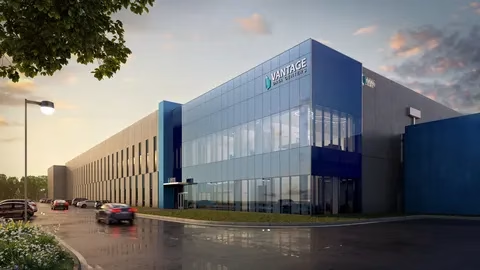
    A significant portion of the funding, $2.25 billion, has been dedicated to fully fund Vantage’s ambitious New Albany campus. Located just outside Columbus, this 70-acre site is set to house three large-scale data centers with a combined capacity of 192 megawatts and 1.5 million square feet of space. The first of these facilities is scheduled to go online by December 2025, reinforcing Vantage’s commitment to delivering high-performance digital infrastructure at scale.

    Strengthening Vantage Data Centers North American Expansion

    Alongside the Ohio project, Vantage also expanded an existing green corporate credit facility by $2.75 billion, raising the total to $5.75 billion. This will allow the company to secure land and build future campuses across key North American markets. The transaction was backed by a strong banking syndicate, including Wells Fargo Securities, TD Securities, Truist Securities, and Scotiabank. These strategic partnerships reflect growing investor confidence in Vantage’s growth strategy and operational excellence.

    Also Read Massive $12.6B Data Center Project Gains Support in Wyandotte County, Kansas

    Backed by a Green Vision

    Both financing deals were arranged under Vantage Data Centers Green Finance Framework, which emphasizes sustainability in every phase, from design and construction to operations. According to Rich Cosgray, the company’s Senior VP of Global Capital Markets, the financing signals more than just growth, it represents a commitment to environmentally responsible development. With this strong financial footing, Vantage is well-positioned to deliver fast, scalable, and sustainable digital solutions to support the evolving global economy.

    Project Overview

    Total Investment: $5 billion in new green loan financing; $8 billion total platform funding

    Location:

    Primary Focus: New Albany, Ohio (70-acre campus)

    Additional Growth: Various sites across North America

    Scope of Work:

    Construction of three pre-leased hyperscale data centers

    Total capacity of 192MW and 1.5 million square feet at Ohio campus

    Expansion of corporate credit facility for future land acquisitions and developments

    Timeline:

    First Ohio facility operational by December 2025

    Ongoing development timelines for other sites under North America platform

    Financial Partners:

    $2.25B New Albany financing led by MUFG and Societe Generale

    $2.75B upsizing of existing credit facility arranged by Wells Fargo Securities, TD Securities, Truist Securities, and Scotiabank

    Legal Advisor: White & Case LLP

    Sustainability Focus:

    All financing secured under Vantage’s Green Finance Framework

    Projects aim to meet high environmental standards during construction and operation

    Purpose:

    To meet rising demand for hyperscale data infrastructure

    To reinforce Vantage’s position as a top-tier global digital infrastructure provider
  • The Grand Inga Hydropower Project and what has held back its construction

    The Grand Inga Hydropower Project and what has held back its construction

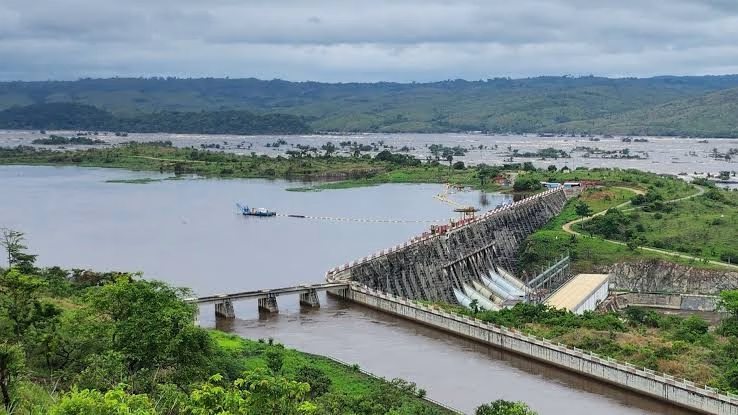
    The 42,000 Mw Grand Inga Hydro Power project is a project that has the potential to power the whole of Africa and claim the title of the largest hydro power dam in the world. That is if it is ever built.

    It was first mooted in the 1970s and Inga 1 dam and thereafter in 1982 Inga 2 were actually built but thereafter no further construction has taken place despite numerous feasibility studies.

    Key points that hinder the projects development have been civil instability and the lack of power transmission lines to export the electricity to customers on the continent. The complex geopolitical situation in the region has also discouraged investors because policy decisions and agreements are inconsistent at best.

    Investment in large Hydro projects in recent years  has faced significant opposition from civil society groups who oppose dams for their negative environmental impact. In addition to this, the emergence of cheaper wind and solar power projects has meant that the need to invest in a hydroelectic dam at a price tag of US$80B has been called to question.

    Most recent reports have been encouraging chief amongst this being news that the World Bank has pledged $1 billion to help the Democratic Republic of Congo get ready for the next stage of what could become the biggest hydropower project in the world, the Grand Inga Hydropower Project.

    Out of this amount, $250 million will go to the Inga III project, which is part of the larger Grand Inga hydropower plan. This project builds on earlier plants — Inga I (built in 1972, producing 351 megawatts) and Inga II (built about 10 years later, producing 1,424 megawatts).

    Project Factsheet

    Location: Inga Falls on the Congo River, Democratic Republic of Congo (DRC), approximately 150 km upstream from the Atlantic Ocean.

    Total potential capacity: Over 42,000 MW (some sources state up to 70 GW), which would be more than double the capacity of China’s Three Gorges Dam

    Phases:

    • Inga 1 & Inga 2: Existing dams, commissioned in 1972 and 1982 respectively, currently undergoing rehabilitation.
    • Inga 3: The first and most critical phase of the Grand Inga project.

    Proposed capacity: Originally 4,800 MW, later scaled up to 11,000 MW.

    Estimated cost (Inga 3): Around US$13.9 billion (including transmission lines).

    Power distribution (Inga 3):

    • South Africa: 2,500 MW (initially 5,000 MW expressed interest)
    • Nigeria: 3,000 MW (expressed interest)
    • DRC Mining Companies: 1,300 MW
    • DRC National Utility (SNEL) for Kinshasa and other cities: 1,000 MW

    Estimated overall cost:

    • Grand Inga Complex: Up to US$80 billion (including extensive transmission lines across Africa). Some estimates go up to US$100 billion.

    [internal_link url=”https://constructionreviewonline.com/construction-projects/the-worlds-largest-hydropower-dam-in-dr-congo-the-grand-inga-dam/”]

    The Inga projects are located on the Congo River, which is the third-largest river in the world by water volume. If fully developed, the Inga site could produce about 40,000 megawatts of electricity. That’s nearly double the capacity of China’s Three Gorges Dam, which is currently the world’s largest hydropower plant with a capacity of 22,500 megawatts.

    However, work on the Inga projects has been delayed for years due to problems like conflict, corruption, and high costs.

    Inga III is part of the World Bank’s “Mission 300” program. This program aims to bring electricity to 300 million people in Africa by 2030. The bank’s president, Ajay Banga, says this larger plan could bring in up to $85 billion from private investors.

    Inga III Project

    When completed, Inga III is expected to cost $10 billion and produce 11,000 megawatts of electricity — more than three times the amount Congo currently produces.

    Also read: Construction of the 800MW Sounda Hydropower Plant in Congo: One of the Largest Dams in the Republic of Congo

    The first $250 million will be used for technical studies, boosting the economy, improving the government-run power company, and attracting private companies to join the project.

    Congo’s government also wants to triple the number of people with access to electricity by 2030. At the moment, only about 20% of its over 100 million citizens have power. In January, the country shared a $36 billion plan to grow its electricity sector during a Mission 300 event held in Dar es Salaam.

    Also read: Zambia and Zimbabwe Seek Investors to Revive the $5 Billion Batoka Gorge Hydropower Project

  • Cleveland Browns’ domed stadium project receives Ohio Senate $600 million support

    Cleveland Browns’ domed stadium project receives Ohio Senate $600 million support

    In a new twist to an ever changing saga that pits County Executive Chris Ronayne and Cleveland Mayor Justin Bibb on one hand against HSG on the other, the Cleveland Browns’ proposed $3.4 billion domed stadium and mixed-use development in Brook Park advanced further as Ohio Senate leaders announced a plan to allocate $600 million toward the project. Unlike the Ohio House’s proposal, which used state-backed bonds, the Senate plan taps into Ohio’s $3.7 billion in unclaimed funds. Of that, $1.7 billion would establish a new Sports and Culture Facilities Fund, from which the Browns would receive a $600 million “performance grant” to be repaid over 16 years through tax revenues generated by the development. To safeguard the state’s investment, the Haslam Sports Group (HSG), owners of the Browns, would place $50 million in escrow.

    HSG’s plan includes a $2.4 billion domed stadium and $1 billion in surrounding infrastructure. While HSG has pledged over $2 billion in private capital, it is seeking public support for the remaining funding. In addition to state funds, HSG proposed $600 million in bonds from Brook Park and Cuyahoga County, to be financed through local taxes. However, County Executive Chris Ronayne has rejected the plan, calling it risky and financially irresponsible. HSG has stated it is prepared to move forward without the county’s involvement, intensifying tensions over the project’s funding and public benefit.

    Also Read: Cleveland Browns Brook Park Domed Stadium To Proceed Without County Support

    The dispute over the Cleveland Browns’ proposed Brook Park domed stadium centers on conflicting visions for the team’s future home and its public funding. The Haslam Sports Group (HSG), which owns the Browns, plans a $3.4 billion stadium and mixed-use development, backed by over $2 billion in private investment. However, it seeks $600 million in state support and another $600 million from local governments, including Cuyahoga County.

    County Executive Chris Ronayne and Cleveland Mayor Justin Bibb oppose the Brook Park plan, favoring a downtown renovation of the current stadium with $350 million in state funding. Ronayne has criticized the Brook Park project as a “risky bet,” while HSG insists the new domed stadium would provide greater year-round economic benefits and long-term viability.

    Tensions escalated when HSG announced it would proceed without county support, accusing Ronayne of spreading misleading information. Meanwhile, the group has garnered backing from NFL Commissioner Roger Goodell and is actively lobbying state lawmakers. The Ohio Senate is deliberating the funding proposal, with a final decision expected by June 30. The standoff highlights a broader debate over public versus private investment, economic impact, and the future location of the Browns’ stadium.

    If the project gets off the ground it will be one of the iconic stadium projects in development in the USA.

  • Chicago Fire FC Taps Local Firms for $650M Stadium in The 78

    Chicago Fire FC Taps Local Firms for $650M Stadium in The 78

    Chicago Fire FC has selected three Chicago-based contractors — Pepper Construction, GMA Construction Group, and All Construction Group — to lead construction of its new $650 million stadium in downtown Chicago, the club announced  on Monday, Sept. 15, 2025.

    Team owner and chairman Joe Mansueto said the decision followed a lengthy search that included national firms with extensive stadium experience. “We ran a really exhaustive process,” Mansueto said. “But in the end, it felt right to go with a team of local builders.”

    GMA Construction Group president and CEO Cornelius Griggs called the partnership a reflection of the city’s character. “This project is more than just a stadium,” Griggs said. “It’s a place for people from all walks of life to come together — and we wanted the diversity of the joint venture to mirror that.”

    Luis Puig, president of All Construction Group, emphasized the broader impact beyond sports. “This is about more than building a venue,” Puig said. “It’s about neighborhoods, communities, and workforce development.”

    The privately financed 22,000-seat venue will anchor The 78, a 62-acre development site along the Chicago River just south of Roosevelt Road. Groundbreaking is slated for early 2026, with opening targeted for 2028.

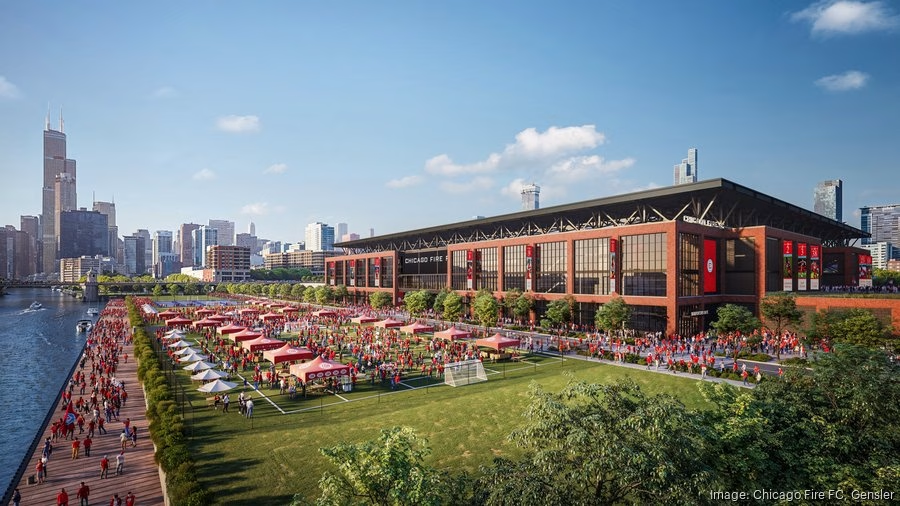
    In June 16, 2025, the Chicago Fire unveiled new renderings for their proposed $650 million riverfront stadium at The 78 development along the Chicago River. Designed by global architecture firm Gensler, the venue takes cues from the “Chicago School” style, featuring brick, steel, and glass elements meant to reflect the city’s industrial heritage and resilient spirit.

    Chicago FC will be one amonsgt a long list of major stadiums currently under development in the USA.

    Intended to open a new chapter for the club and its supporters, the stadium form reconciles the ambition for the finest of modern comforts with the ambition for the finest sense of place. It will feature panoramic views across the river and public squares open to all, serving as both a powerful architectural icon and a civic gathering space.

    Bordering Related Midwest’s 62-acre mixed-use development just south of Roosevelt Road, the stadium itself will offer fans a first-rate experience. Inside, the seating bowl is designed to seat fans much closer to the field, enhancing sightlines and elevating matchday energy. An open steel canopy will bounce back light and sound onto the pitch, boosting crowd energy and maximizing the team’s home-field advantage.

    Upscale seating and hospitality options

    The venue will have a variety of upscale seating and hospitality options on various levels: 50 suites, more than 500 Loge seats, and 3,500 Club seats—some with access to private, club-within-a-club areas.

    At the center of the stadium will be a unique supporter section, seating around 2,000 fans on safe-standing bleachers. Dedicated to providing a high-decibel and charged environment, the section will be one of the most energetic supporter sections in Major League Soccer.

    Although the Fire won’t occupy the adjacent riverfront boardwalk that the renderings portray, the club will have access to surrounding plaza space for pre- and post-game events. Operating temporarily from Soldier Field, the club last month announced plans to build the new stadium on Related Midwest-owned property.

    The Chicago Fire FC is poised to revolutionize the city’s sports landscape with a brand-new, soccer-specific stadium in the South Loop. This strategic location has the potential to catalyze the area’s revitalization, bringing new life to a long-undeveloped site.

    A World-Class Venue

    The team owner Joe Mansueto, founder of Morningstar Financial Services, providing private funding. However, the developer may seek tax increment financing (TIF) to support infrastructure development, which could involve taxpayer dollars. Undoubtedly, the new stadium for Chicago Fire FC will be a world-class venue.

    Infrastructure Upgrades

    To prepare the site for development, significant infrastructure improvements are necessary. These include relocating railroad tracks, rebuilding the seawall, and installing new water, sewer, and power lines. While Mansueto will cover significant construction costs, the city will likely fund critical infrastructure upgrades. The infrastructure undertaking is crucial for the Chicago Fire’s new stadium project.

    Read also: Construction Underway on $175M Amway Stadium in Downtown Grand Rapids

    A Bright Future

    With construction slated to begin this fall or early next year, the stadium is expected to open ahead of the 2028 Major League Soccer season. This ambitious project promises to bring new energy to the area, providing a world-class venue for Chicago Fire FC fans and contributing to the city’s vibrant sports scene. As the project moves forward, it’s clear that this development will be a game-changer for Chicago. The future of the Chicago Fire new stadium looks incredibly promising.

    Read also: USTA Launches $800M Overhaul of US Open Campus, Centered on Arthur Ashe Stadium

    Chicago Fire Unveil New Renderings for $650M Riverfront Stadium at The 78
    Renderings for $650M Riverfront Stadium at The 78

    Chicago Fire’s Proposed new Stadium: Project Factsheet

    Project Overview

    Location: “The 78,” South Loop, Chicago

    Project Type: Soccer-specific stadium

    Key Features

    Seating Capacity: 22,000 fans

    Stadium Design: Open-air with natural grass field

    Architectural Firm: Gensler

    Construction Team:

    Pepper Construction

    GMA Construction Group

    All Construction Group

    Chicago Fire FC New Stadium: Project Details

    Estimated Cost: $650 million

    Funding Source: Privately funded by Joe Mansueto, with potential tax increment financing (TIF) for infrastructure development

    Infrastructure Upgrades: Relocation of railroad tracks, rebuilt seawall, new water, sewer, and power lines

    Project Timeline

    Construction Start: Fall or early next year

    Rendering unveiling: June 16, 2025

    Expected Opening: Ahead of the 2028 Major League Soccer season. Look forward to the Chicago Fire FC new stadium’s opening and its impact on soccer.

    Read also: USC Advances $350M Reimagining of the Iconic Williams-Brice Stadium

  • Grand Prairie Water Commission Breaks Ground on $1.5B Lake Michigan Pipeline Project

    Grand Prairie Water Commission Breaks Ground on $1.5B Lake Michigan Pipeline Project

    The Grand Prairie Water Commission has officially commenced construction on a transformative infrastructure project designed to deliver treated Lake Michigan water to six southwest suburban communities in Illinois. This $1.5 billion initiative aims to ensure a sustainable and reliable water supply for over 250,000 residents in Joliet, Crest Hill, Channahon, Minooka, Romeoville, and Shorewood.

    Addressing Future Water Needs

    Current studies indicate that the deep aquifers supplying these communities are projected to become insufficient by 2030. In response, the Grand Prairie Water Commission was established in June 2024 under the Illinois Regional Water Commissions Act. Furthermore, this independent entity, governed by a board with equal representation from each member municipality, is tasked with overseeing the design, construction, and maintenance of the new water transmission system.

    Also Read Bally’s Resume Construction on its $1.7 Billion Chicago casino

    Comprehensive Infrastructure Development

    The project’s scope includes constructing a 4-million-gallon storage facility and two 55-million-gallon-per-day pumping stations in Chicago. Additionally, over 60 miles of transmission mains, three pumping stations, and three water storage tanks will be built to facilitate water delivery to the member communities. Construction is expected to continue through 2029, with water service anticipated to begin in 2030.

    Also Read Spain Earmarks Funds for Morocco-Spain Underwater Tunnel Study

    Economic Impact and Community Considerations

    Furthermore, under a 100-year agreement, Chicago will supply treated water to the commission, making it the city’s second-largest water customer. This deal is projected to generate approximately $30 million annually for Chicago’s Department of Water Management . While the project promises long-term benefits, leaders acknowledge that water bills in member communities may rise. In addition, efforts are being made to manage these increases responsibly, aiming to keep them within reasonable limits.

    A Collaborative Effort for Sustainable Water Supply

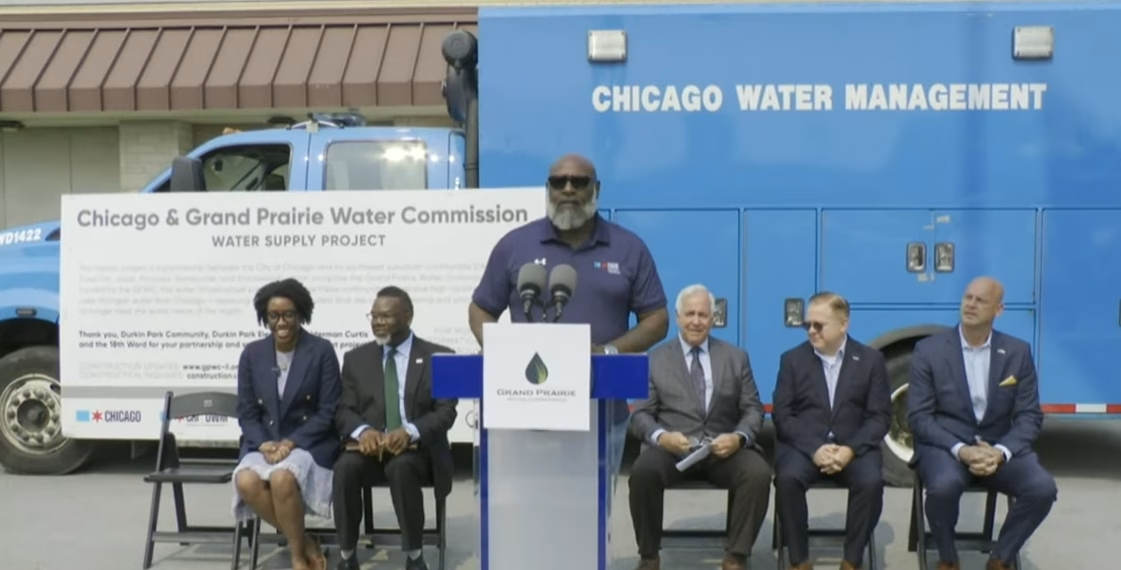
    The groundbreaking ceremony, held at Chicago’s Southwest Pumping Station, was attended by local and federal officials, including Congresswoman Lauren Underwood and Chicago Mayor Brandon Johnson. Furthermore, their presence underscores the collaborative effort and cross-jurisdictional coordination that have been pivotal in bringing this project to fruition. Further, once operational, the system will provide a joint waterworks solution using Lake Michigan as a sustainable source to meet the present and future needs of all six communities.

    Also Read The Foglia Residences: Affordable Housing for the Blind and Veterans in Chicago

    Project Overview

    Project Name: Grand Prairie Water Commission (GPWC) Alternative Water Source Program, Lake Michigan

    Purpose: To provide a sustainable and reliable drinking water supply by delivering treated Lake Michigan water to six southwest suburban communities in Illinois: Joliet, Crest Hill, Channahon, Minooka, Romeoville, and Shorewood.

    Background: The existing deep aquifers supplying these communities are projected to become insufficient by 2030, necessitating an alternative water source.

    Commission Formation: Established in June 2024 under the Illinois Regional Water Commissions Act, the GPWC is an independent legal entity governed by a Board of Commissioners with equal representation from each member community.

    Project Components:

    Construction of over 60 miles of transmission mains to convey water from Chicago to the member communities.

    Development of a 4-million-gallon storage facility and two 55-million-gallon-per-day pumping stations in Chicago.

    Installation of three additional pumping stations and three water storage tanks along the transmission route.

    Timeline:

    Engineering and design phases began in 2021.

    Construction commenced in 2025 and is expected to continue through 2029.

    In addition, system testing and startup are scheduled for early 2030, with full water service anticipated by May 2030.

    Budget and Funding:

    Total project cost is estimated at approximately $1.5 billion.

    Funding sources include low-interest state and federal loans, grants, and revenue bonds.

    Additionally, the project has secured a $373 million loan through the Water Infrastructure Finance and Innovation Act (WIFIA) program.

    Economic Impact:

    Under a 100-year agreement, Chicago will supply treated water to the GPWC, generating an estimated $30 million annually for the city’s Department of Water Management.

    Community Impact:

    The project aims to ensure long-term water reliability for over 250,000 residents, with the capacity to serve up to 388,000 people as the region grows.

    While water bills in member communities may increase, efforts are being made to manage and mitigate these costs effectively.

  • East African Crude Oil Pipeline Project Nears Completion

    East African Crude Oil Pipeline Project Nears Completion

    Last Updated 1st September 2025– East African Crude Oil Pipeline, world’s longest heated pipeline is on track to be commissioned in the near future. Following the commissioning of the project, Uganda will become Africa’s newest major crude exporter. African Energy recently visited the site, where swift progress has been made following previous funding delays.

    Also, Tilenga and 40,000 b/d China National Offshore Oil Company (Cnooc)-operated Kingfisher upstream developments, is on track for pre-commissioning in April 2026 ahead of a formal June.

    The East African Crude Oil Pipeline Project (EACOP), has a length of 1,443 kilometres. As of June, the project’s completion status was at 60% according to a report. This major project aims to boost East Africa’s growth by transporting oil from Uganda’s Lake Albert oilfields to the Port of Tanga in Tanzania. So far, it has created about 6,000 jobs.

    The update came during a visit by the Energy and Water Utilities Regulatory Authority (EWURA) Board of Directors to the project site in Chongoleani, Tanga Region.

    East African Crude Oil Pipeline Project Factsheet

    Name: East African Crude Oil Pipeline (EACOP), also known as the Uganda–Tanzania Crude Oil Pipeline (UTCOP).

    Length: 1,443 km (approximately 296 km in Uganda and 1,147 km in Tanzania).

    Diameter: 24 inches (61 cm)

    Capacity: Peak capacity of 246,000 barrels of crude oil per day.

    Cost: Approximately $5 billion.

    Positive Remarks on the Project

    After the visit, Engineer Ngosi Mwihava, Chair of the Board’s Energy Committee, said the EWURA Board is happy with the project’s progress. He added that EWURA is closely watching the project to make sure Tanzanians gain from the jobs and business opportunities it brings.

    Godfrey Mponda, EACOP’s Director of Human Resources and Corporate Affairs, said that out of the 6,000 people employed so far, 70% are locals living near the pipeline.

    Mr. Mponda noted that this shows a strong level of local involvement in the project.

    Tanga Regional Commissioner, Dr. Batilda Burian, told the Board that the region is already seeing benefits. More local suppliers have signed up with EWURA, giving them a chance to take part in the project.

    EACOP Owners

    Several partners own the EACOP project. These include: Uganda National Oil Company (UNOC), TotalEnergies E&P Uganda, CNOOC Uganda, and Tanzania Petroleum Development Corporation (TPDC).

    Their shares are divided as follows: TotalEnergies holds 62%, while UNOC and TPDC each own 15%, and CNOOC has 8%.

    The pipeline will carry oil from Kabaale–Hoima in Uganda to the Chongoleani Peninsula near Tanga. It will be able to move up to 246,000 barrels of oil per day.

    According to the EACOP website, this pipeline along with the Tilenga and Kingfisher projects will bring big benefits to Uganda and Tanzania. These include tax revenue, new jobs, more local business involvement, better infrastructure, improved logistics, and stronger trade between the two countries.

    Cost of the East African Crude Oil Pipeline Project

    With an investment of around $4 billion, the pipeline is one of the largest foreign investments in both Uganda and Tanzania.

    The EACOP website also states that the project will help improve the transport link between the two countries. It will lead to better roads, upgraded logistics systems, and faster communication through the use of fibre-optic cables.