Constructionreview

Blog

  • Kenya and France Deepen Cooperation with Multi-Million-Dollar National System Control Centre Project

    Kenya and France Deepen Cooperation with Multi-Million-Dollar National System Control Centre Project

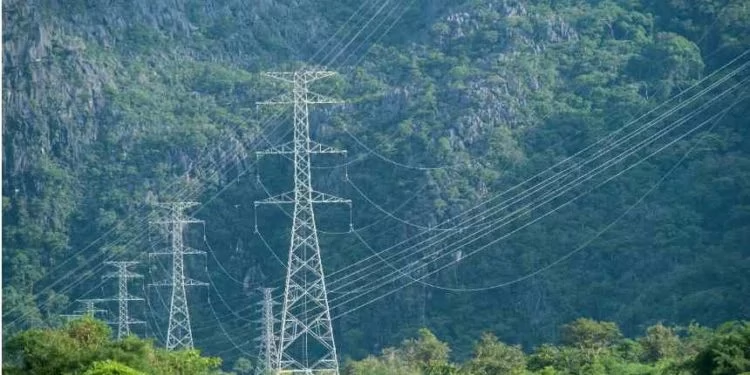
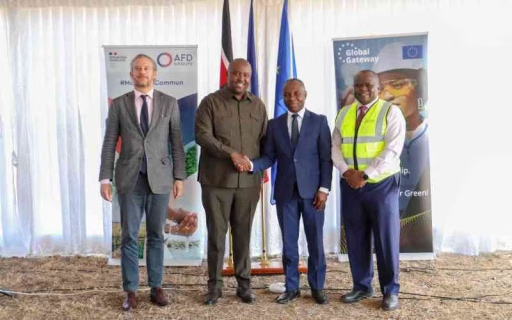
    The National System Control Centre Project received a major boost when the Ministry of Energy and Petroleum and KETRACO adopted France’s assistance. French Minister Delegate Thani Mohamed Soilihi visited the NSCC construction site in Embakasi, Nairobi, on Friday. The trip was a significant milestone in bilateral energy cooperation. The project is a French-Kenyan partnership to be funded by the French Treasury and French Development Agency (AFD). At a cost of Sh12 billion, the National System Control Centre Project aims to modernize the electricity network of Kenya. GE Vernova and Larsen & Toubro are constructing it. They have experience in integrating new technology with construction infrastructure. Once done, the NSCC will stabilize electricity, reduce blackouts, and provide renewable power. It will also improve access to electricity and minimal loss during transmission. The French Ambassador reaffirmed France’s pledge to support Kenya’s transition to energy and regional sustainability goals during the visit.

    Also read:

    Construction of Isinya (Kenya)-Namanga (Tanzania) electricity transmission line completed

    Relevance of the National System Control Centre Project
    National System Control Centre Project
    The National System Control Centre Project received a major boost when the Ministry of Energy and Petroleum and KETRACO adopted France’s assistance.

    The National System Control Centre Project is the pivot upon which the future electricity reliability in Kenya shall rotate. It enhances the stability of the power grid and allows for seamless green energy integration. It also enables economic development by powering homes and industries. The NSCC also forms part of the broader €94 million AFD RETNET program. This includes a digital substation at Makindu, Nairobi Ring infrastructure, as well as technical training. In addition, an EU grant of €7 million, brokered by AFD, pays for grid management skills. KETRACO to gain significantly in terms of operational capacity and knowledge transfer. The project will link Kenya to Eastern and Southern African power networks. It therefore increases electricity trade and economic integration in the region. It also facilitates projects like the Zambia–Tanzania Interconnector commissioned on April 2025. NSCC will be an important node of cross-border energy transmissions when completed.

    Also read:

    Last Mile Connectivity Project in Kenya Seeks Ksh21 bn Loan Funding
    Kenya Power to upgrade infrastructure in Western Kenya

  • AMEA Power Commissions Amunet Wind Power Plant Project in Egypt, Africa’s Largest Wind Power Plant

    AMEA Power Commissions Amunet Wind Power Plant Project in Egypt, Africa’s Largest Wind Power Plant

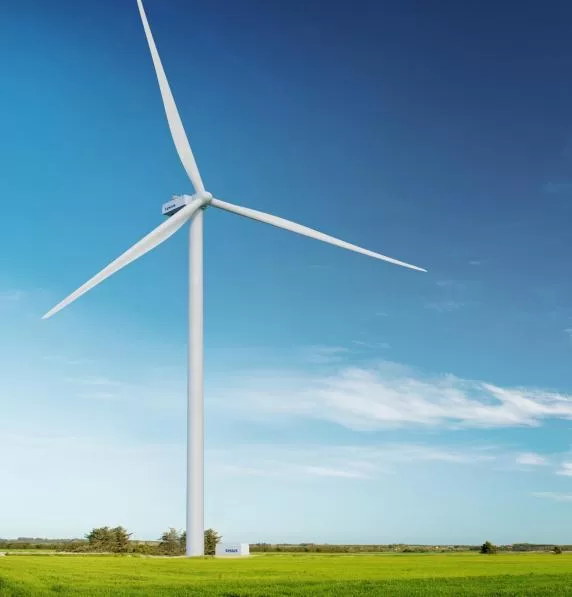
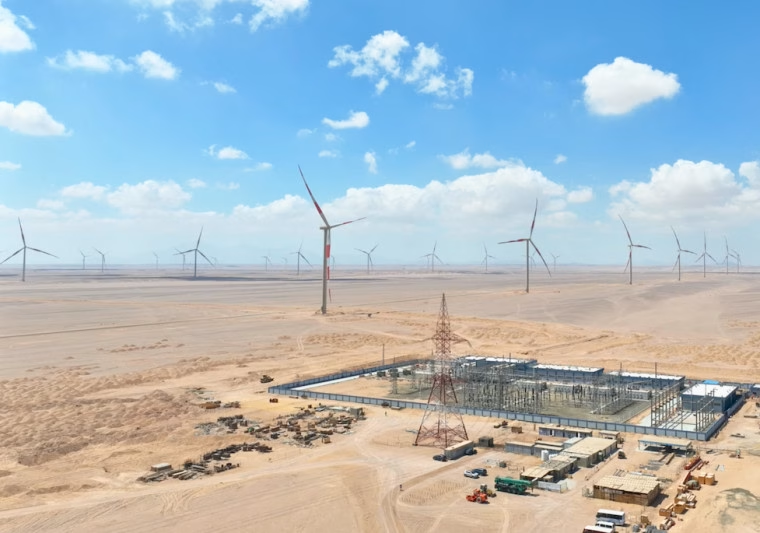
    AMEA Power has successfully started operations at its new 500-megawatt (MW) wind power plant in Ras Ghareb,  the Amunet Wind Power Plant Project located in Egypt’s Red Sea Governorate. This project is now the biggest working wind farm in Africa, showing Egypt’s strong leadership in clean energy across the continent.

    This major achievement comes shortly after AMEA Power launched a 500MW solar power plant in Aswan in November 2024. Together, these projects give the company a total of 1 gigawatt (GW) of clean energy capacity in Egypt—completed in just six months.

    Amunet Wind Power Plant Project Factsheet

    Project name: Amunet Wind Power Plant Project

    Location: Ras Ghareb, Red Sea Governorate, Egypt. Approximately 9 km northwest of Ras Ghareb city, in the wind-rich Gulf of Suez region.

    Status: Operational. The plant was successfully commissioned in June 2025, ahead of schedule.

    Capacity: 500 MW (megawatts)

    • Comprises 77 wind turbines, each with a capacity of 6.5 MW.

    Project developers and sponsors:

    Project company: Amunet Wind Power Company S.A.E. (AWPC), a special purpose vehicle incorporated in Egypt.

    Shareholders:

    • AMEA Power Ltd (60% ownership)
    • Sumitomo Corporation (40%)

    Also read: 10GW Egypt Wind Farm Marks Key Milestone; Project to Become Africa’s Largest Wind Farm Upon Completion

    The new wind farm, called the Amunet Wind Power Plant, is a joint project between AMEA Power, which owns 60%, and Japan’s Sumitomo Corporation, which owns 40%. The plant will generate about 2,500 gigawatt-hours (GWh) of clean electricity each year. That’s enough to power over 500,000 homes and will prevent 1.4 million tons of carbon dioxide (CO₂) emissions annually.

    Significance of the Project

    The construction phase brought big benefits to the local economy. At its peak, it created jobs for more than 800 workers. AMEA Power also held safety training sessions for young people in the area to help build skills and support long-term development.

    The project was finished two and a half months ahead of schedule, showing AMEA Power’s strong ability to deliver large renewable energy projects quickly and efficiently.

    Also read: Egypt’s 650MW GOS II Wind Farm Project Complete, with EWA Group Playing Crucial Logistics Role

    Amunet Wind Power Plant Project Financiers

    Funding for the wind farm came from several major international banks and institutions, including the Japan Bank for International Cooperation (JBIC), the International Finance Corporation (IFC), Sumitomo Mitsui Banking Corporation, Sumitomo Mitsui Trust Bank, and Standard Chartered Bank. Insurance support came from Nippon Export and Investment Insurance (NEXI), and extra financial support was provided by the Commercial International Bank of Egypt.

    Hussain Al Nowais, Chairman of AMEA Power, said:

    “The launch of this 500MW wind farm is a major step forward for AMEA Power and for Egypt. Adding 1GW of clean energy in such a short time is an amazing achievement. It shows our strong commitment to renewable energy. This is the future of power in Africa—clean, inclusive, and transformative.”

    Also read: Orascom Construction starts Ras Ghareb wind farm, Egypt’s largest, ahead of schedule

  • PPAW 1 Wind Energy Center in Quebec Secures US$800 Million in Financing

    PPAW 1 Wind Energy Center in Quebec Secures US$800 Million in Financing

    Invenergy and the Alliance de l’énergie de l’Est, a coalition of 209 municipalities and territories in Eastern Quebec, have announced the successful financial close of CAD 1.1 billion (approx. US$800 million) for the 350Mw Pohénégamook–Picard–Saint-Antonin–Wolastokuk 1 PPAW 1 Wind Energy Center.

    The PPAW 1 Wind Energy Center, selected by Hydro-Québec in 2023 through a competitive tender, will be jointly developed by Invenergy and the Alliance on a 50-50 equity basis. Construction is set to begin in 2025, with commercial operations expected by late 2026.

    Strong Economic and Regional Impact

    The construction of PPAW 1 Wind Energy Center is expected to produce 350Mw of energy, create 350 direct jobs, while an additional 100 manufacturing jobs have already been established at Marmen Énergie in Matane, Quebec. Over a 30-year period, the project will distribute CAD 137 million in revenue to shareholders of the Alliance de l’énergie de l’Est—including 16 regional county municipalities (RCMs) and the Wolastoqiyik Wahsipekuk First Nation—plus CAD 45 million in fixed payments to host communities.

    Des Neiges Secteur Sud Wind Project in Quebec Secures $960M Financing

    Financing Led by Canadian and International Institutions

    The financing includes a mix of equity and credit facilities. Equity is being provided by Invenergy and the Alliance, while the remaining funding comes from a consortium of banks:

    • Administrative Agent: Desjardins Group

    • Green Loan Coordinator & Documentation Agent: National Bank of Canada

    • Coordinating Lead Arrangers: Desjardins Group, CIBC, SMBC (Canada Branch), and Germany’s KfW IPEX-Bank

    • Green Loan Principles: Informed the structure of the financing

    “This financing reflects our global experience and our deep local roots in Quebec,” said Louis Robert, VP of Development – Renewable Energy at Invenergy.

    Vestas to Supply 56 Turbines for the Project

    In July 2024, Danish wind turbine manufacturer Vestas received a 347 MW order for the PPAW 1 Wind Energy Center. The order includes:

    • Turbines: 56 EnVentus V162-6.2 MW units

    • Scope: Supply, delivery, commissioning

    • Service: Multi-year AOM 5000 service agreement to ensure optimal performance

    The EnVentus platform offers modularity, customizable configurations, and high efficiency, making it a strategic choice for the challenging terrains of Eastern Quebec.

    Proven Track Record in Quebec

    Invenergy has already developed and operated five wind energy centers in Quebec, contributing over 390 MW of clean power. PPAW 1 Wind Energy Center will add an additional 350 MW, reinforcing the region’s leadership in renewable energy.

    PPAW 1 Wind Energy Center – Quick Facts

    Project Name: Pohénégamook–Picard–Saint-Antonin–Wolastokuk 1 (PPAW 1)
    Capacity: 350 MW
    Developer: Invenergy and Alliance de l’énergie de l’Est (50/50)
    Location: Eastern Quebec, Canada
    Financing: CAD 1.1 billion (US$800 million)
    Turbines: 56 × Vestas V162-6.2 MW
    Construction: 2025–2026
    Operation: Expected late 2026
    Jobs Created: 350 (construction) + 100 (manufacturing)
    Community Impact: CAD 137M to shareholders; CAD 45M to host communities

  • Construction Begins on Maricopa County’s Next-Gen Election and Tabulation Center

    Construction Begins on Maricopa County’s Next-Gen Election and Tabulation Center

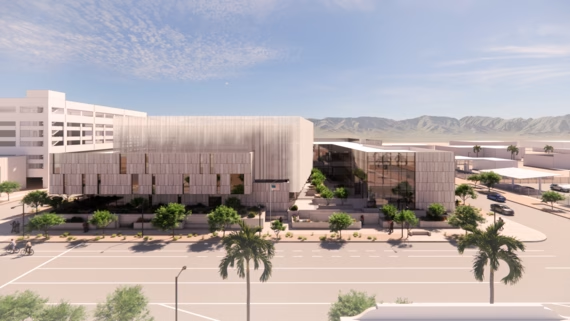
    Maricopa County has officially began construction on a modern tabulation and election center that will redefine how elections are managed. Scheduled for completion in summer 2027, the new facility is set to significantly strengthen the County’s election infrastructure ahead of the 2028 election cycle.

    Designed by architecture firm DLR Group and constructed by Core Construction, the facility will offer triple the existing warehouse space for storing election equipment and will more than double the County’s capacity for pre-tabulation processing and ballot tabulation. It also features enhanced security measures to protect ballots, voting equipment, and election personnel.

    “This facility is a game-changer,” said Thomas Galvin, Chairman of the Maricopa County Board of Supervisors for District 2. “Our priorities—following state law, ensuring transparency, and serving voters—are all embedded in this project. It raises the bar for election management across the country.”

    Funding

    The project’s $18 million construction contract was approved in February 2025, following initial design efforts that began back in September 2023. On May 22, Board members and project stakeholders marked the beginning of construction with an informal dirt toss ceremony at the site. A formal groundbreaking event had been planned for May 6 but was canceled due to medical emergencies.

    Beyond improving processing capabilities, the new facility will also provide several features to improve public access and support staff operations. These include dedicated command centers for in-person voting coordination, a space for training and onboarding temporary election workers, media-friendly zones for election coverage, and expanded observation areas to ensure transparency throughout the process.

    “Elections are about people—first and foremost, the voters, but also the professionals who make it all happen,” said Vice Chair Kate Brophy McGee of District 3. “The team behind this design focused on creating a facility that serves both groups. I truly believe this investment will make our already fair and free elections even better.”

    As of April 2025, Maricopa County reported roughly 2.6 million registered voters—a significant jump from the 1.9 million registered just ten years ago. With this growing population, the construction of a new center is expected to play a pivotal role in ensuring the County can handle increasing demands with transparency and efficiency.

    Once operational, the facility will house key election functions managed by both the Board of Supervisors and the Recorder’s Office, helping centralize operations under one secure roof.

    Read also: 150Mw Justice Energy Storage Project breaks ground in Maricopa County, Arizona

    A close-up, south-facing rendering of the future Tabulation and <yoastmark class=
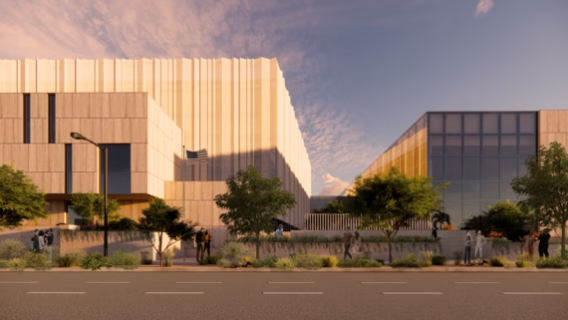
    A close-up, south-facing rendering of the future Tabulation and Election Center’s front entrance, created by project architect DLR Group.

    Maricopa County Election and Tabulation Center Project Factsheet

    Project Overview

    Facility: Modern Tabulation and Election Center

    Location: Maricopa County, Arizona

    Status: Construction commenced May 6, 2025

    Completion: Summer 2027

    Total Investment: $18 million construction contract

    Capacity Expansion: Triple existing warehouse space for equipment storage

    Processing Power: More than double pre-tabulation and ballot tabulation capacity

    Project Timeline

    September 2023: Initial design phase began

    February 2025: $18M construction contract approved

    May 22, 2025: Groundbreaking ceremony held

    Summer 2027: Scheduled completion

    2028: Operational for election cycle

    Design & Construction Team

    Architect: DLR Group

    General Contractor: Core Construction

    Construction on Maricopa County’s new Tabulation and Election Center: Key Features

    Enhanced Security

    Strengthened protection for ballots, voting equipment, and personnel

    Centralized operations under secure roof

    Operational Improvements

    Dedicated command centers for in-person voting coordination

    Training facilities for temporary election workers

    Media zones for election coverage

    Expanded public observation areas for transparency

    Capacity Enhancements

    Triple warehouse space for election equipment storage

    Doubled pre-tabulation processing capacity

    Doubled ballot tabulation capacity

    Read also: Halo Vista: A $7 Billion “City Within a City” Surrounding TSMC in Phoenix

  • All to Know About Egypt’s Planned Desert City, The Jirian

    All to Know About Egypt’s Planned Desert City, The Jirian

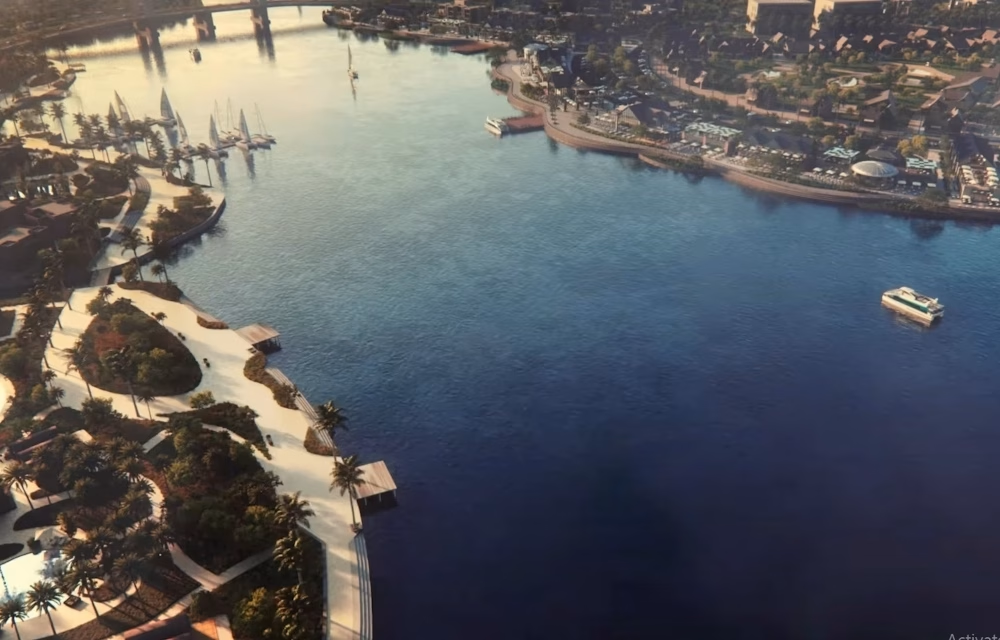
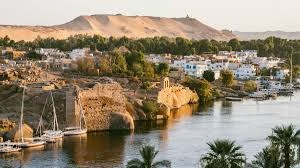
    Egypt’s desert city project, named Jirian, was unveiled officially as a model urban-agricultural venture. It will take away roughly seven percent of Egypt’s annual Nile share from productive delta land. The water taken away will pass through glass-fronted mansions before reaching a vast agriculture project. 42 km from Cairo’s city centre, Jirian occupies 6.8 million square metres of land. A Nile canal would slice through the city center, occupying one-fifth of its area.

    Jirian Project Factsheet

    Location: In the strategic Sheikh Zayed Axis, within the 6th of October City. It is situated on the Middle Ring Road, offering connectivity to key landmarks like Sphinx International Airport and the Grand Egyptian Museum.

    Developers: Palm Hills Developments, Mountain View, Nations of Sky, and Egyptian government.

    Area: The city will cover an area of around 6.8 million square meters

    Residential units: The city is planned to include more than 20,000 residential units.

    Job creation: It is expected to create around 250,000 jobs.

    Key features:

    • Residential units: The city will include a variety of housing options, such as apartments, i-Villas, a unique concept by Mountain View, villas, townhouses, and twin houses, many of which will have direct views of the “New Nile.”
    • Infrastructure and amenities: It is being developed as a self-sufficient community with a wide range of services, including:
    • Sports clubs and recreational facilities
    • Educational institutions
    • Healthcare facilities
    • Commercial and retail areas with high-end brands
    • Restaurants and cafes
    • A media city

    A yacht marina and boat docks

    Timeline:

    • Launch: The project was officially launched in 2025.
    • First phase: The first phase is anticipated to launch in 2028.
    • Completion: The entire project is slated for completion by 2030.

    Facilities

    The city would include residential sectors, shopping areas, an 80-story skyline, a yacht marina, and a free economic zone. Jirian is also linked to the New Delta project, which covers 2.28 million acres and will produce major crops. Furthermore, it will reduce Egypt’s bill for food imports. The project will also provide 250,000 opportunities for employment and house 2.5 to 3 million households. Egypt’s desert city plan is expected to be realized in five years. Five months ago, the construction began.

    Also read:

    Vivid Tower Project in Egypt’s New Administrative Capital launched

    Significance and Extent of Implementation of Egypt’s Desert City

    Egypt’s desert city plan is significant in addressing the problem of water shortage, the economic crisis, and food dependence in the nation. Officials assert that it will enhance land value with non-conventional, innovative ideas. Backed by private constructors and the military-owned Mostakbal Misr agency, the project is a full range of development. It includes industry, logistics, housing, education, and health care. The development will also include green hotels, international universities and hospitals, and a cultural and media district. Additionally, it joins ambitious projects in the country such as the Marassi Red Sea project in the aim of boosting the country’s economy.

    Egypt's Desert City
    Egypt’s desert city project, named Jirian, was unveiled officially yesterday as a model urban-agricultural venture.

    Strategic tourism value is gained from proximity to the Giza Pyramids, the Grand Egyptian Museum, and Sphinx Airport. While expenses are not revealed, the project is part of a chain of mega projects initiated under President Abdel Fattah al-Sisi. They include Egypt’s new administrative capital. However, these projects have also piled up foreign debt, which stood at $155.2 billion in late 2024. Lastly, since 97% of Egypt’s fresh water comes from the Nile, the nation is still in conflict with Ethiopia regarding the downstream effect of the Grand Renaissance Dam.

    Also read:

    Chinese Banks Fund 85% of Egypt’s $3 Billion New Administrative Capital’s CBD Towers

    Plans in for Construction of Green River Tower in New Administrative Capital, Egypt

  • Planning Completed for $4 Billion Moses Bridge Linking Africa and Asia as Construction is Set to Commence

    Planning Completed for $4 Billion Moses Bridge Linking Africa and Asia as Construction is Set to Commence

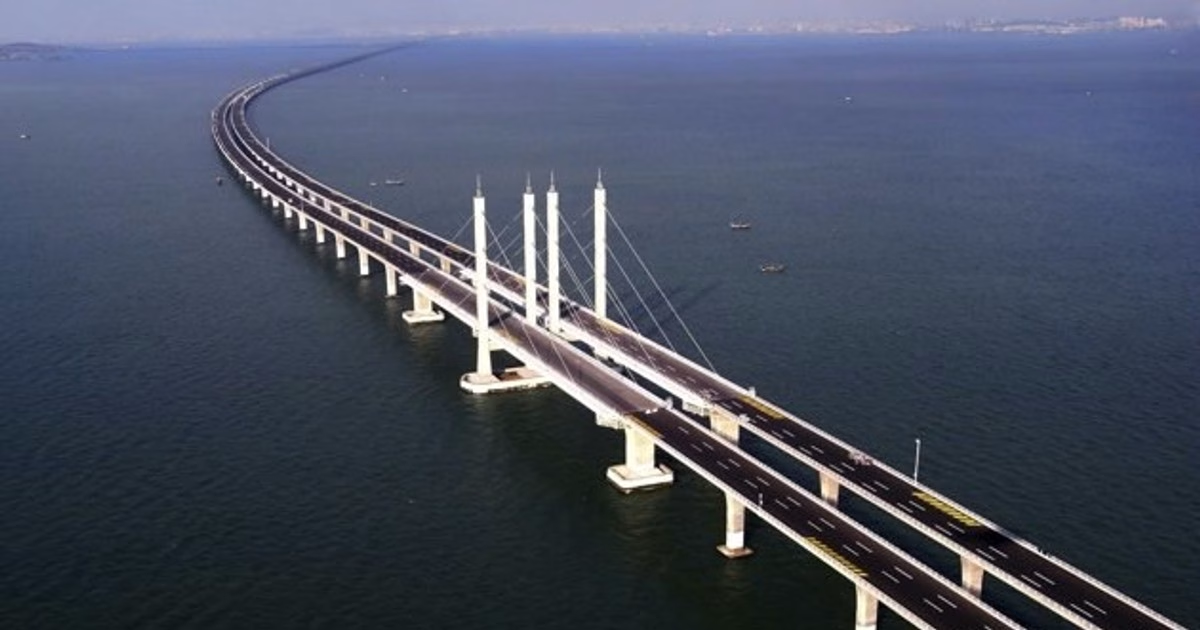
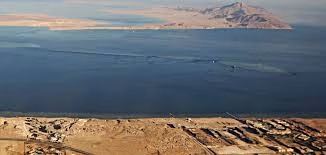
    Saudi and Egyptian governments have officially reactivated the Moses Bridge project, a historic one to connect Asia and Africa. First introduced by King Salman in 2016, the bridge will link Ras Hamid in Saudi Arabia with Sharm El-Sheikh in Egypt across the Strait of Tiran. This multibillion-dollar bridge, estimated at $4 billion, will be financed solely by Saudi Arabia. Egypt’s transport minister, Kamel al-Wazir, recently announced that planning is over. He promised that the project stands ready to be executed either as a bridge or a tunnel. Currently, travel between the two nations depends on maritime services offered by the Arab Bridge Maritime Company. However, the *Moses Bridge* is expected to significantly boost trade, tourism, and religious pilgrims. Moreover, it facilitates Saudi Arabia’s vision of its future NEOM city. With the ability to accommodate over a million pilgrims annually, the *Moses Bridge* is a promise of spiritual and economic prominence.

    Also read:

    Morocco-Spain High-Speed Rail Route Set to Link Madrid to Casablanca

    Implementation Scope and Significance of the Moses Bridge

    Moses Bridge
    Saudi and Egyptian governments have officially reactivated the Moses Bridge project, a historic one to connect Asia and Africa.

    The Moses Bridge is great in terms of strategic and cultural significance. To begin with, the project is finally implementation-ready, a significant shift after decades of dawdling. Its application encompasses infrastructure serving the movement of both passengers and cargo across the Red Sea. Second, the bridge will anchor economic ties between Egypt and Saudi Arabia through more rapid, efficient trade. Furthermore, it will serve as an alternate route for pilgrims to visit Mecca, reducing pressure on millions of pilgrims traveling to Mecca. Furthermore, the Moses Bridge enhances NEOM, enhancing regional connectivity as stipulated under Saudi Vision 2030. Symbolically, it hails shared heritage and a uniting architecture founded on shared interests. The fact that earlier propositions had been politically challenged aside, the current momentum proves strong diplomatic will. Most importantly, the bridge is an inspiration for cooperation, innovation, and long-term development between two continents.

    Also read:

    Morocco-Spain High-Speed Rail Route Set to Link Madrid to Casablanca

    Spanish Firm Awarded Contract to Conduct Morocco-Spain Undersea Rail Line Study