Constructionreview

Blog

  • 1.5 GW Al Zarraf Solar PV Project in Abu Dhabi: EWEC’s Fifth Utility-Scale Solar Project

    1.5 GW Al Zarraf Solar PV Project in Abu Dhabi: EWEC’s Fifth Utility-Scale Solar Project

    The Al Zarraf Solar PV Project is a 1.5 GW utility-scale solar initiative in the Al Dhafra region of Abu Dhabi, awarded by EWEC (Emirates Water & Electricity Company). In June 2025, EDF Power Solutions and Korea Western Power (KOWEPO) signed a Joint Development Agreement with EWEC to lead its development as an Independent Power Producer. Under the tender’s equity rules, the consortium may hold up to 40 per cent ownership, with the remainder retained indirectly by the Abu Dhabi government.

    The project is expected to generate power for approximately 160,000 homes and avoid around 2.4 million tons of CO2 emissions annually. The solar plant also forms part of Abu Dhabi’s broader strategy to increase its solar PV capacity toward 10 GW by 2030. In line with this, EWEC has also recently selected Masdar and ENGIE as the partners for its fourth utility-scale solar project, the 1.5 GW Khazna solar power project.

    Al Zarraf Solar PV Project Factsheet

    Location: Al Dhafra region, Abu Dhabi, United Arab Emirates

    Capacity: 1,500 MW AC

    Developer: EDF, KOWEPO

    Offtaker: EWEC

    Expected Output: Electricity to power 160,000 homes. Also avoid 2.4 million tons of CO2 emissions annually

    Equity Structure: Developer consortium may hold up to 40 per cent. Remaining held indirectly by Abu Dhabi government under tender rules

    Strategic Role: The fifth utility-scale solar PV project under EWEC. Also supports Abu Dhabi’s move to 10 GW AC solar by 2030 and clean energy targets.

    Status: Under development

    Al Zarraf Solar PV Project Timeline

    January 2025: EWEC issues the Request for Proposals (RFP) for the 1,500 MW Al Zarraf Solar PV project after a prior Expression of Interest (EOI) stage.

    June 2025: EDF and KOWEPO formally sign a Joint Development Agreement with EWEC to co-develop the project.

    Mid-2025 onward: Preparatory works, technical design, site pre-development, and financing structuring expected to proceed.

    2026 onwards: Target for financial close (FID). Subject to due diligence, permitting, and investor commitments. Also expected is solar panel installation, grid connection, and commissioning phases.
    1.5 GW Al Zarraf Solar PV Project in Abu Dhabi: EWEC's Fifth Utility-Scale Solar Project
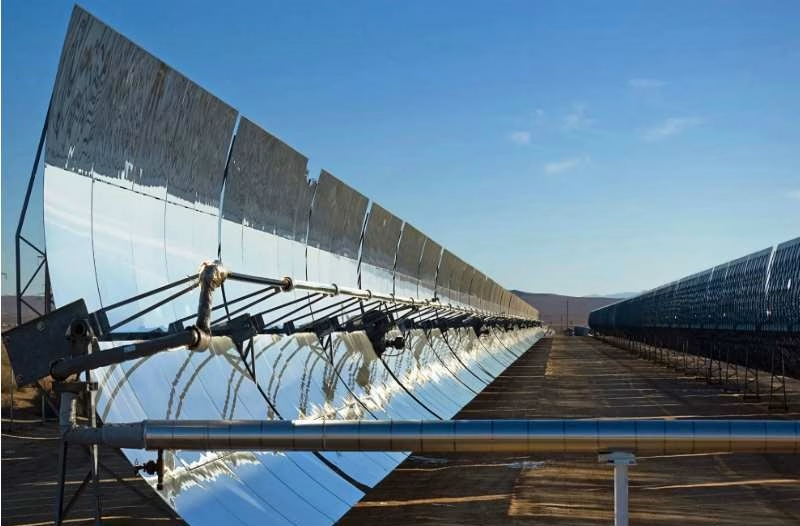
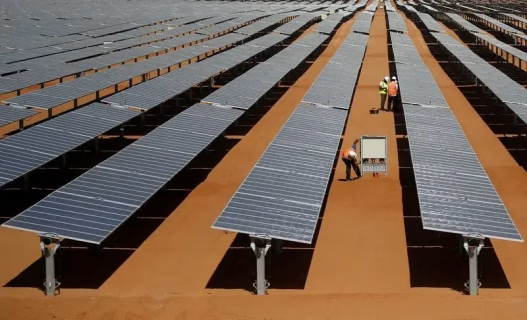
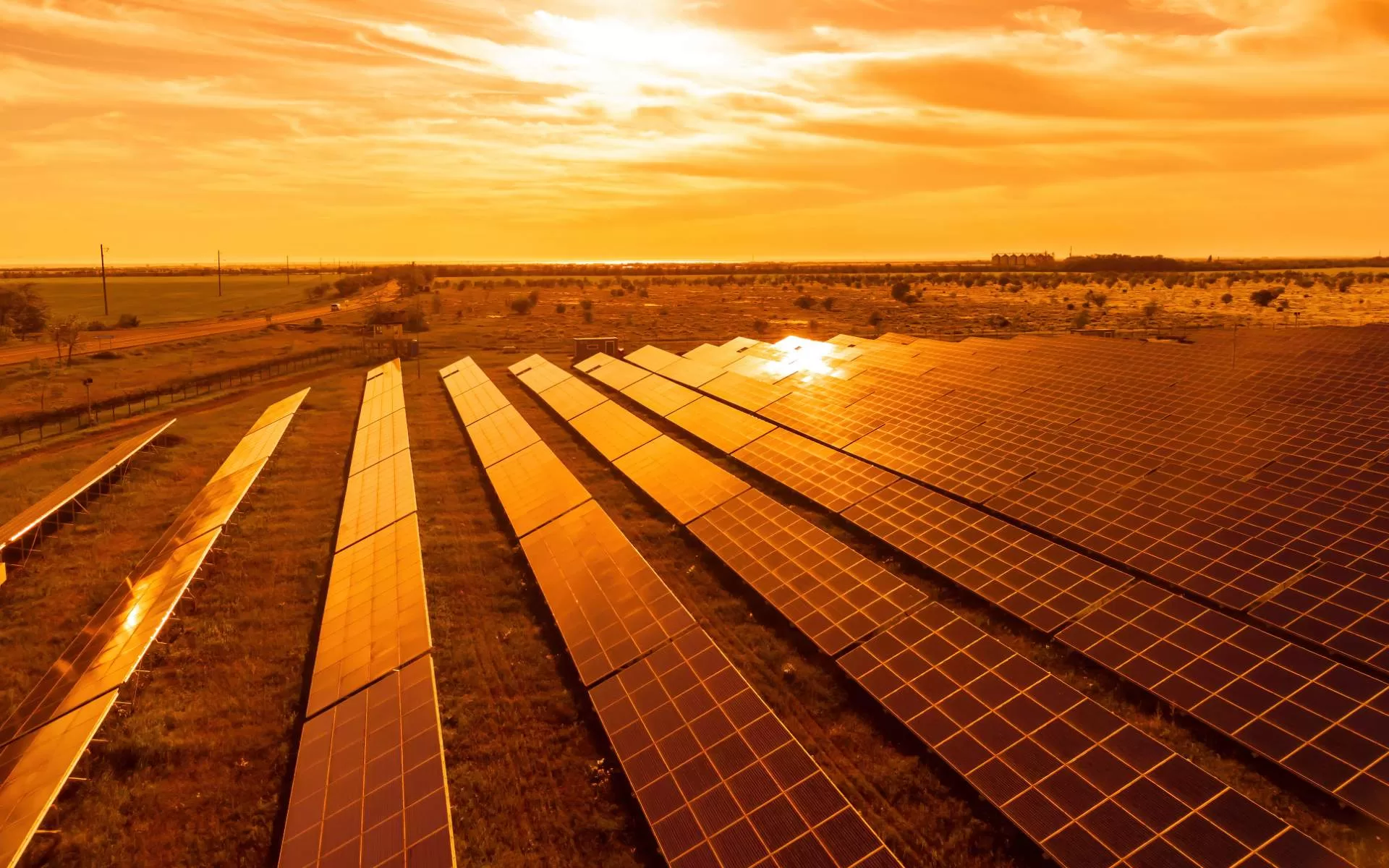
    This landmark project will mark the fifth utility-scale solar PV development for both Abu Dhabi and EWEC. Image: Solar PV Farm

    EDF and KOWEPO Ink Deal for 1.5 GW Al Zarraf Solar PV Project in Abu Dhabi

    Reported June 2, 2025 – EDF Power Solutions and Korea Western Power Company (KOWEPO) have signed a Joint Development Agreement (JDA) for the 1.5 gigawatt (GW) Al Zarraf photovoltaic (PV) solar Independent Power Producer (IPP) project in Abu Dhabi. The agreement was finalized on the sidelines of the World Utilities Congress 2025.

    This landmark project will mark the fifth utility-scale solar PV development for both Abu Dhabi and EWEC, further cementing the emirate’s commitment to clean energy leadership.

    Competitive Bidding Process Draws Global Interest

    EWEC issued the Request for Proposals (RFP) for the Al Zarraf project in January 2025. This followed an Expression of Interest (EOI) process initiated in October 2024. Of the 20 entities that submitted EOIs, 16 were qualified to proceed to the RFP stage after submitting Statements of Qualification.

    The winning consortium will finance, design, build, operate, maintain, and partially own the project. It is expected to hold up to 40% equity, while the Abu Dhabi government will retain a majority indirect stake in the IPP company. A long-term Power Purchase Agreement (PPA) with EWEC ensures payment for only the net energy generated.

    Read Also: ACWA Power commissions 700MW AlRass1 Solar Photovoltaic Project in Saudi Arabia

    Supporting Abu Dhabi’s 2030 and 2035 Solar Ambitions

    The Al Zarraf plant will be located in the Al Dhafra region and is projected to be one of the world’s largest single-site solar PV installations. It will generate enough electricity to power approximately 160,000 homes, significantly contributing to EWEC’s goal of reaching 10 GWac of solar capacity by 2030.

    Looking ahead, EWEC anticipates that Abu Dhabi will have at least 18 GW of solar PV capacity operational by 2035, aligning with the Department of Energy’s Clean Energy Strategic Target for Electricity Production.

    EDF and KOWEPO Expanding Renewable Energy Footprint in UAE

    The EDF-KOWEPO consortium is also among the final bidders for the 1.5 GW Al Khazna Solar PV IPP in Abu Dhabi. According to project intelligence provider MEED, they submitted the lowest bid as of March 2025.

    In a separate collaboration, EDF, KOWEPO, and UAE-based Masdar also announced financial close for the 1.5 GW Al Ajban Solar PV project in September 2024. This is another significant solar initiative in Abu Dhabi’s renewable energy roadmap.
  • Construction of 104 Gahanga Affordable Housing Underway

    Construction of 104 Gahanga Affordable Housing Underway

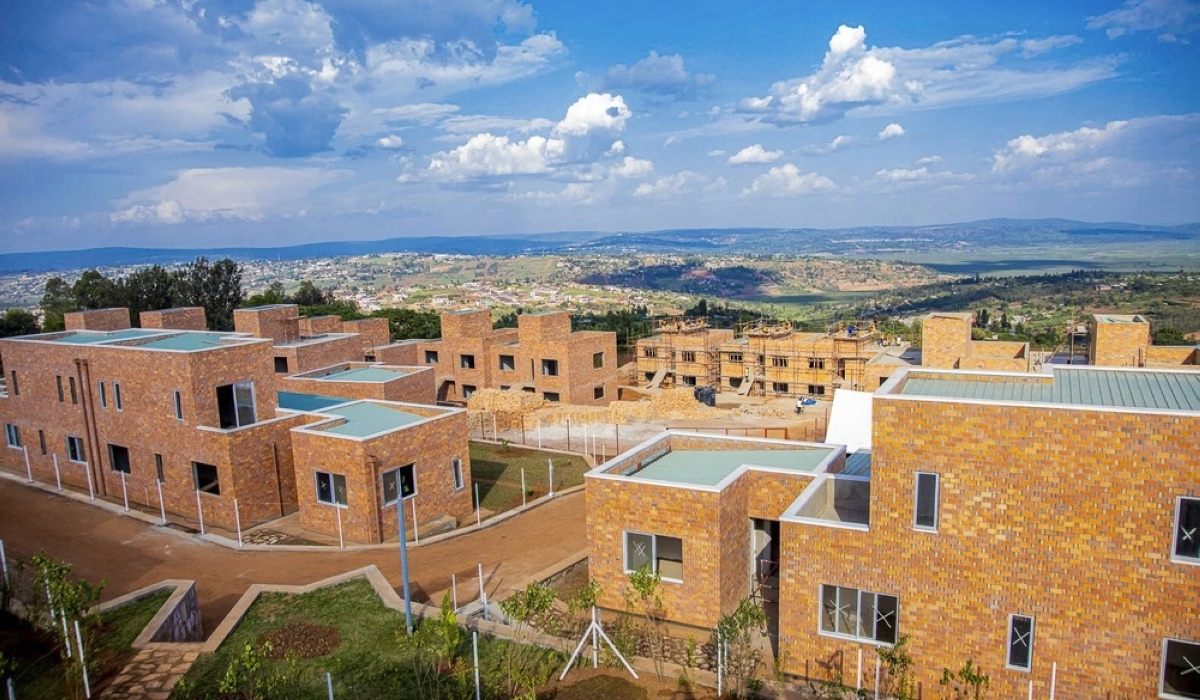
    Construction has begun on 104 affordable housing units in the Gahanga Affordable Housing Project of Kicukiro District as part of the Aheza Urban Village project. This initiative is one of several efforts aimed at addressing the growing demand for housing in Kigali.

    According to Aime Muzora, Managing Director of Girinzu Developers—the real estate firm behind the project—construction began in April and is expected to wrap up before the end of 2026, depending on how quickly buyers are ready to move forward.

    Gahanga Affordable Housing Project Factsheet

    Location: Gahanga Sector, Kicukiro District, Kigali, Rwanda. Specifically, plots of land in Kagasa cell, Gahanga, near the Cricket Stadium.

    Developer: Riverside City Estate is one of the developers involved.

    Number of units:

    • Phase one: 100 affordable homes are under construction, with some reports indicating 104 units as the initial phase.
    • Second phase: An additional 200 housing units are expected to be built in a subsequent phase.

    Unit features:

    • Each house is typically designed with three rooms (including bedrooms), a sitting room, dining room, toilets, and a kitchen.
    • They often include parking for two to three cars and an annex building with an outdoor kitchen, storage room, and a security guard room.
    • Houses are generally stretched on between 300 and 350 square meters.

    Also read: Phase 3 construction of Norrsken Kigali House in Rwanda begins

    Home Prices

    The homes range in price from $23,000 (around Rwf32.5 million) for the most budget-friendly options, up to $180,000 (approximately Rwf254.5 million) for high-end units.

    This development follows the success of the first phase of the project, Umutuzo Village, which added 90 homes in Kagasa Cell, also within the Gahanga Sector. All the units from that phase have already been sold.

    Second Phase

    The second phase consists of 104 new homes, and half of them have already been purchased. Muzora said the project includes a variety of house types to meet different needs, and noted that demand for affordable housing remains strong.

    “To make it easier for buyers, we offer a flexible five-installment payment plan that matches the construction schedule. The idea is for buyers to finish payments by the time their homes are ready,” he explained.

    He also shared that more than 60 percent of the buyers so far are Rwandan citizens, which reflects local interest in homeownership.

    Also read: Updates on the US$2 Billion Kigali Innovation City in Rwanda

    Samuel Dusengiyumva, the Mayor of Kigali, emphasized the city’s long-term commitment to expanding access to quality housing.

    “This year alone, we’ve completed 688 homes in Mpazi Model Village and are constructing another 1,600 in Nyabisindu. That brings us close to 2,500 new units,” he told reporters on Friday, May 30.

    “Our goal is to build at least 5,000 homes each year, and eventually scale up to 10,000 annually,” he added.

    Dusengiyumva noted that Kigali currently faces a shortfall of around 250,000 housing units.

    To support those who can’t yet afford to buy a home, the city also plans to develop more affordable rental options.

    “We’re working on rental housing that would cost between Rwf50,000 and Rwf100,000 per month. For instance, two young workers—a mobile money agent and a motorcycle taxi driver—could share a one-bedroom apartment and split the rent,” he said.

    Significance of the Gahanga Affordable Housing Project

    The mayor pointed out that these projects would also benefit landowners. They would benefit through vertical housing developments, while helping to reduce urban sprawl.

    “We need more private sector involvement. The housing shortage is a key reason why prices are so high,” he concluded.

    Alsa read: Kigali Green Complex (KGC), Tallest Building in Rwanda, to Commence Construction in January 20248

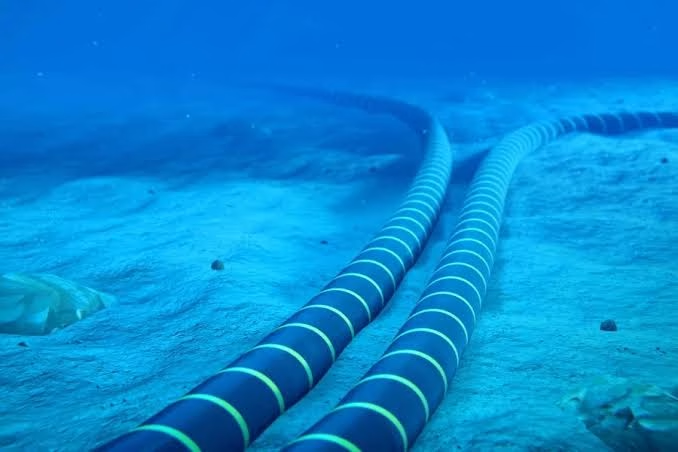
  • Xlink Pauses UK-Morocco Undersea Cable Construction

    Xlink Pauses UK-Morocco Undersea Cable Construction

    Xlinks has decided to pause its application for a Development Consent Order (DCO) related to the UK-Morocco Undersea Cable Construction Project while it awaits a crucial decision from the UK government on its Contract for Difference (CfD) bid. The government made this strategic move to better align the project’s development timeline.

    Furthermore the company, which is spearheading the 4,000-kilometre subsea cable project to transmit solar and wind energy from Morocco to the UK, formally submitted its request to pause the DCO process in a letter to the UK Planning Inspectorate on May 14. The DCO is a required legal approval for major infrastructure projects in the UK.

    Also read: Could Xlinks’ Morocco-UK Subsea Cable become the world’s most effective cross-border renewable energy project?

    UK-Morocco Undersea Cable Construction Project Factsheet

    Developer: Xlinks First Limited

    Key components:

    • Large-scale solar and wind farms in Morocco (Guelmim Oued Noun region).
    • A massive battery storage facility in Morocco to ensure consistent power supply.
    • Four parallel HVDC subsea cables transmitting power to the UK.
    • Converter stations in both Morocco and the UK.

    Technical specifications and capacity:

    • Generation capacity (Morocco): Approximately 10.5 GW – 11.5 GW of solar and wind generation.
    • Battery storage (Morocco): 22.5 GWh/5 GW.
    • Transmission capacity (to UK): 3.6 GW (delivered via two 1.8 GW bipoles), providing power for an average of 19-20 hours a day.

    Cable length: The subsea cable system will stretch approximately 3,800 km (2,360 miles) to 4,000 km.

    The total length of wire (four cables) comes to about 10,000 miles.

    Estimated cost: The project’s cost is estimated to be between £22-24 billion ($27-30 billion).

    Funding: Attracted significant development funding from investors such as TAQA, TotalEnergies, Octopus Energy, GE Vernova, and AFC.

    Electricity price: Xlinks is seeking a guaranteed price of £77 per megawatt-hour for solar energy and £87 for wind energy.

    Also read: Xlinks Morocco-UK Power Project

    Reason for the Pause

    Xlinks explained that the pause allows it to wait for the outcome of its CfD bid, a government pricing mechanism designed to guarantee renewable energy developers a stable, long-term price for the electricity they generate. Additionally, the company expects a decision later this spring and is targeting a strike price between £70 and £80 per megawatt-hour—lower than many comparable renewable energy projects.

    The Planning Inspectorate responded promptly, granting the pause on May 15. Sources close to the initiative clarified that this is not a cancellation or suspension, but a deliberate step to streamline project milestones.

    “The aim is to ensure the review process is handled as rigorously and efficiently as possible, allowing the DCO to move forward quickly once the CfD decision is made,” said one source.

    Capacity

    The Morocco–UK Power Project is an ambitious undertaking that will supply 3.6 gigawatts (GW) of clean, dispatchable energy—generated through solar, wind, and battery storage—from Morocco to the UK. With an estimated cost of up to £24 billion, the project is projected to reduce UK carbon emissions by 10% and lower wholesale electricity prices by 9.3%.

    The UK included the initiative in its strategic energy roadmap in 2022 and designated it as a project of national significance in 2023.

    Challenges Facing the UK-Morocco Undersea Cable Construction Project

    However, Xlinks has publicly voiced frustration over delays in securing formal UK government support. In a March interview with local media, Xlinks chairman Sir Dave Lewis warned that continued inaction could drive the company to relocate the project to another country. Lastly, he emphasized that the uncertainty is damaging investor confidence.

  • Egypt Completes Construction of its Largest Solar Power Plant, the 500MW Kom Ombo Power Plant

    Egypt Completes Construction of its Largest Solar Power Plant, the 500MW Kom Ombo Power Plant

    The Kom Ombo Solar Power Plant has been completed, marking an important milestone for Egypt’s renewable energy drive. The 500-megawatt facility is in the Aswan Governorate and is now Egypt’s largest solar photovoltaic plant. China Energy Construction built the solar power plant, which includes more than one million solar panels. It features a 220-kilovolt booster station, which ensures efficient transmission of electricity in Egypt.

    Chinese Ambassador Liao Liqiang announced it, emphasizing the reality that this project is consistent with Egypt’s Vision 2030 for green energy. The plant has a total direct current capacity of 560 megawatts. Once completed, it will supply clean electricity to some 256,000 households a year. It will save on carbon dioxide emissions by 760,000 tons each year. Happily, the Kom Ombo Solar Power Plant marks successful collaboration between Egypt and China in developing green infrastructure.

    Also read:

    Kom Ombo solar power plant project in Egypt

    Significance of Kom Ombo Solar Power Plant

    Kom Ombo Solar Power Plant
    The plant has been completed, marking an important milestone for Egypt’s renewable energy drive.

    This solar power plant is an international model of collaboration for climate-focused development. It demonstrates how nations can work together in a bid to achieve sustainability. It also strengthens Egypt’s role as the regional hub of solar energy infrastructure. The construction required the installation of enormous panels, the integration of electrical infrastructure, and the building of a high-capacity transmission station. With over one million solar panels fitted, the project demonstrates cutting-edge engineering at the country level. It sets a standard for future developments in the region. The project is aligned with the Egyptian government’s aim to produce 42% of the country’s electricity from renewable energy sources by 2035 with the lowest tariffs in Africa. Furthermore, it shows the commitment of the government to meet its energy demands.

    Also read:

    Scatec Commences Construction of 1.1GW Obelisk Solar PV and BESS Project in Egypt

    IRSC Signs agreement with ACO, Sungrow, and Tongwei for Egypt’s 75 MW Solar Projects

  • Mozambique’s National Road Number 1 (N1) Rehabilitation Project Secures $1.1 Billion

    Mozambique’s National Road Number 1 (N1) Rehabilitation Project Secures $1.1 Billion

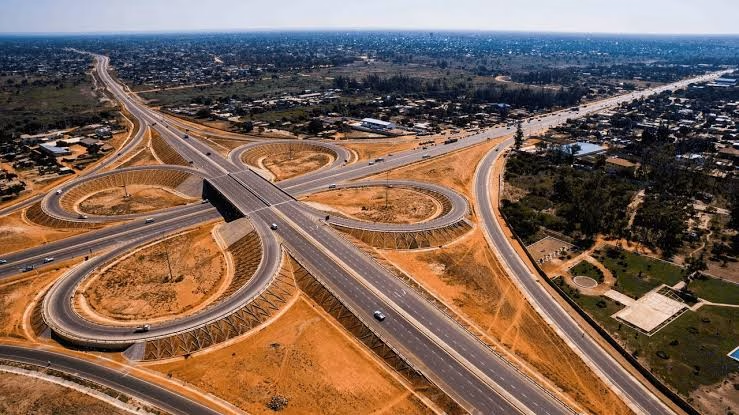
    On Thursday, May 29, the Mozambican government announced it has secured $1.1 billion (approximately 69.5 billion meticais) to begin the Mozambique’s National Road Number 1 (N1) Rehabilitation Project, the country’s main highway connecting the north to the south. The road has been in poor condition for years, creating major challenges for the transport of goods and people.

    Overall Cost

    The full rehabilitation of the 2,620-kilometer stretch of the N1 is expected to cost a total of 224 billion meticais, or $3.5 billion—far more than what has currently been secured.

    “Of the $3.5 billion required, we have already secured $1.1 billion. These funds will be released in stages as the work progresses,” said Transport and Logistics Minister João Matlombe, as quoted by Lusa. He acknowledged ongoing difficulties in securing the remaining funding but affirmed the government’s commitment to fully restoring the road.

    Also read: Mozambique and Zambia to Construct $1.5 Billion Beira-Ndola Pipeline

    Mozambique’s National Road Number 1 Rehabilitation Project Factsheet

    Key funders:

    World Bank: The primary funder, providing an US$850 million Multi-Phase Programmatic Approach (MPA) operation over three IDA cycles. The first phase of this financing package amounts to US$400 million (IDA grant).

    Saudi Fund for Development: Providing US$50 million for the rehabilitation of specific sections (e.g., Benfica-Zimpeto and 3 de Fevereiro-Incoluane).

    Government of Mozambique: Contributing counterpart financing.

    Initial Priority Sections (First Phase – World Bank financing):

    • Inchope-Gorongosa (70 km)
    • Chimuara-Nicoadala (176 km)
    • Metoro-Pemba (94 km)
    • Gorongosa-Caia (84 km) – tender launched for contractor selection.

    Project Timeline:

    • Initial announcement of rehabilitation intention: April 2022.
    • World Bank approval of first phase financing: August 2022 (effectiveness: December 2022).
    • Formalization of World Bank grant: March 2023.
    • Expected start of first phase works: May 2024 (as announced in August 2023).
    • Overall project duration (World Bank program): 10 years (2 years construction, 8 years maintenance).

    Also read: $2 Billion Mozambique’s 6000 Flat Condominium Project Launches on the Outskirts of Maputo

    Mozambique’s National Road Number 1 (N1) Rehabilitation: Which Sections will be Rehabilitated?

    As part of the first phase of work under a World Bank financing package valued at 54.4 billion meticais ($850 million), the government has begun a project to rehabilitate 340 kilometers of the N1. The targeted segments include Inchope to Gorongosa (70 km), Chimuara to Nicoadala (176 km), and Metoro to Pemba (94 km).

    Significance of the N1

    The N1 is Mozambique’s only continuous roadway connecting the southern, central, and northern regions. It has long been the site of frequent and often deadly traffic accidents, particularly involving public transportation. Authorities attribute many of these accidents to excessive speeding, compounded by the road’s deteriorated condition.

    Back in April 2022, the administration led by then-President Filipe Nyusi announced plans to rehabilitate the N1. At that time, the Ministry of Public Works, Housing, and Water Resources estimated the cost at $750 million. More recently, in February of this year, the Confederation of Economic Associations (CTA) once again stressed the urgency of restoring the N1, calling it “the backbone” of the national economy. The private sector views the road’s rehabilitation as critical for strengthening logistics corridors and improving the flow of goods and people across the country.

    Also read: US Exim Bank Approves $4.7 Billion for Mozambique LNG Project

  • Congo Secures Funding from African Development Bank (AfDB) to Conduct Hydropower Feasibility Studies

    Congo Secures Funding from African Development Bank (AfDB) to Conduct Hydropower Feasibility Studies

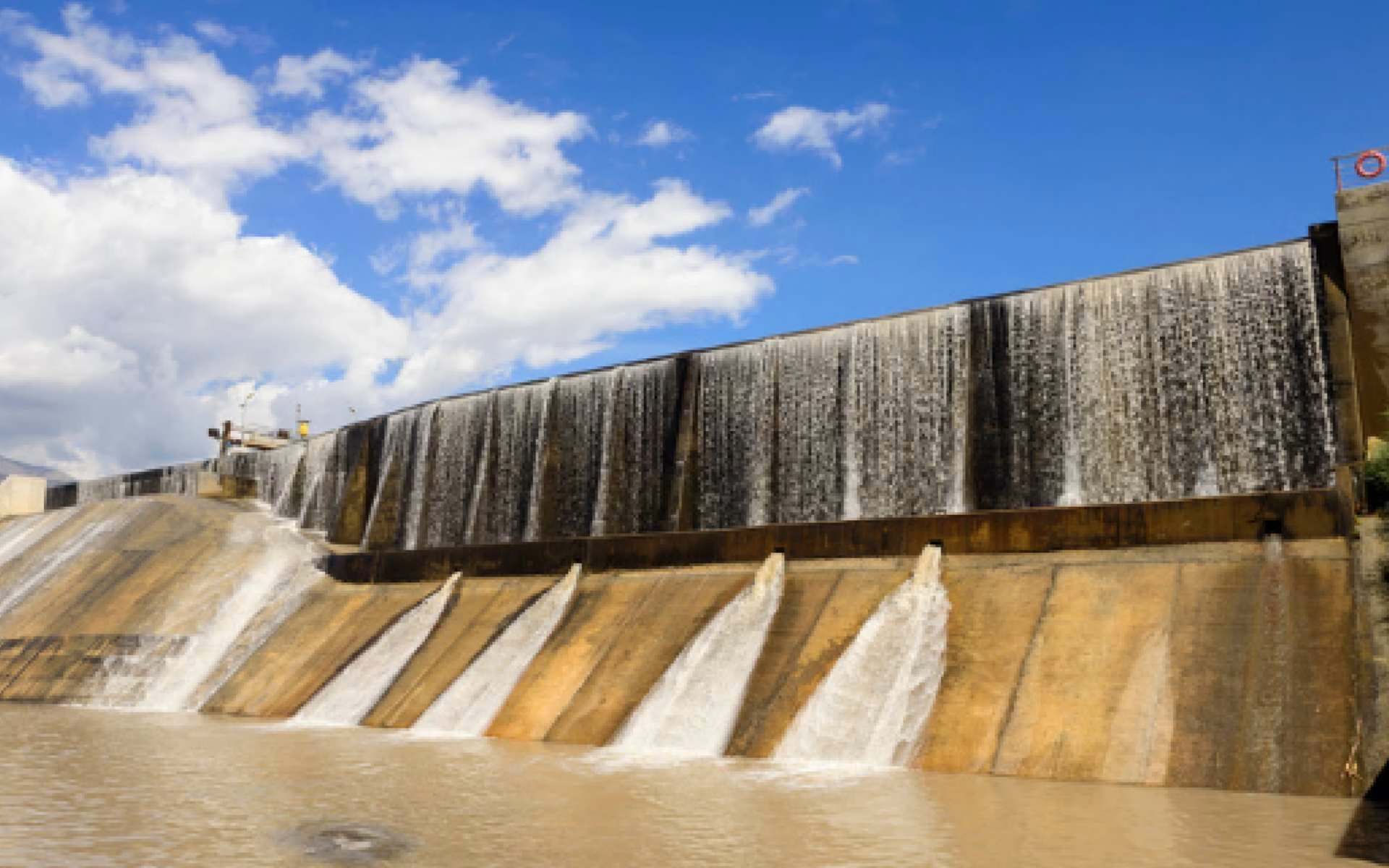
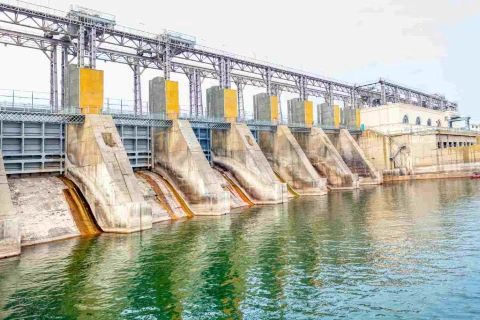
    Congo’s hydropower feasibility study has obtained funding from the the African Development Bank (AfDB) in support of the nation’s power projects. Its purpose is to assess whether it will be viable to construct hydroelectric facilities at Mbandza Ndounga and Linzolo. The Middle-Income Country Technical Assistance Fund, which is managed by the AfDB is facilitating the study. Mbandza Ndounga, located in southern Congo, is prioritized for immediate technical assessment. Linzolo, 20 km south of Brazzaville, also comes under conditional review. Both sites will be subjected to comprehensive engineering studies.

    These will look at design possibilities, topography, and environmental conditions. Investigations will help determine whether it is viable to build hydropower plants on a full scale. Significantly, the objective here is to increase energy access and reduce dependence on imported electricity. This is part of broader national efforts to unify the electricity network. Besides, it enhances economic development through energy infrastructure development support. The studies constitute a fundamental step before arriving at construction decisions.

    Cameroon-Congo: Studies for construction of Chollet hydroelectricity dam?to begin in Q1 2021

    State of Affairs Regarding Congo’s Hydropower Feasibility Studies

    Congo’s hydropower study feasibility of the Linzolo and Mbandza Ndounga dams is an addition to several of the nation’s current energy projects. One of these is the Liouesso Hydropower Plant in the north which has been launched in recent years. It has greatly boosted power reliability in the region. Additionally, the Sounda Gorge project has been on the cards for long, with huge construction potential. Smaller river-based schemes are also being considered. These comprise rural electrification micro-hydropower projects. Despite the developments, there is continued electricity and grid shortage in the nation.

    Congo’s Hydropower Feasibility Studies
    Congo’s hydropower feasibility study has obtained funding from the the African Development Bank (AfDB) in support of the nation’s power projects.

    Therefore, Congo’s hydropower feasibility studies at Linzolo and Mbandza Ndounga can be a game-changer. The new sites, if possible, would be able to yield long-term benefits. They would reduce fossil fuels consumption and stabilize regional energy supply. As a result, this would enable industries to develop and improve residential access to electricity. In addition, strategic investment in hydropower is capable of drawing private sector attention. Although development is not yet guaranteed, the studies are a firm indication of intent.

    Also read:

    Construction of the 800MW Sounda Hydropower Plant in Congo: One of the Largest Dams in the Republic of Congo

    Congo inaugurates $109m Hydroelectric dam