Constructionreview

Blog

  • Nigeria’s FEC Approves $651.7 Million for the Construction of 7th Axial Road

    Nigeria’s FEC Approves $651.7 Million for the Construction of 7th Axial Road

    Nigeria’s Federal Executive Council (FEC) has approved $651.7 million that will be utilized for the construction of the 7th Axial Road. This road is a crucial evacuation corridor that connects the Lekki Deep Seaport to major transportation routes that serve the northern and southern parts of Nigeria.

    This information was revealed by the Minister of Works David Umahi on Monday following the conclusion of the FEC meeting that took place in Abuja at the Presidential Villa.

    Project Factsheet

    Location: Nigeria, connecting the Lekki Deep Seaport in Lagos State to the Sagamu-Ore Expressway.

    Strategic importance: It’s designed as a crucial evacuation corridor for goods from the Lekki Deep Seaport, including products from the Dangote Refinery and Fertilizer plant, facilitating their movement to the southern and northern states of Nigeria.

    Length: The road project involves the construction of a 50-kilometer dual carriageway, along with an additional five kilometers of bridges.

    Funding: The Federal Executive Council (FEC) has approved a total of $651.7 million for the project. Funding is being secured from the China Exim Bank, following a presentation by President Bola Ahmed Tinubu to the Chinese President.

    Significance:

    • Ease pressure on existing ports in Lagos.
    • Reduce logistics costs for businesses operating in the Lekki Free Trade Zone and beyond.
    • Strengthen economic integration between the southern and northern regions of Nigeria.
    • Support high-volume industrial and maritime activities in the Lekki area.


    Also read: 700-Kilometer Lagos-Calabar Highway Completion Set for January 2026

    Length of the 7th Axial Road

    Furthermore, Umahi said that the road will entail 50 kilometers of dual carriageway. It will have an extra five kilometers of bridges. The road will facilitate the movement of goods from the Lekki Deep Seaport. These goods will include products from the Dangote Refinery and Fertilizer plant.

    The corridor will link Epe to the Sagamu–Ore Expressway. This connection will create a key logistics link to 17 southern states and also wider northern region.

    “The 7th Axial Road is an evacuation corridor. It takes us from the Lekki Deep Sea Port, evacuating the goods of the Dangote refinery, Dangote fertilizer, and all the goods of the Deep Sea Port. Additionally, it takes us straight to Epe, and it takes us straight to the Shagamu-Ore Road, which is the exit to the 17 southern states and the other northern states within that axis.

    Therefore, it has been approved for a total of $651.7 million,” Umahi said.

    Also read: 1,068-Kilometer Sokoto-Badagry Superhighway Construction Project in Nigeria: Breaking the 48-year Delay

    Financier of the Project

    The road project is expected to acquire funding from the China Exim Bank. Also, the Minister highlighted that the 7th Axial Road project was initially approved during the last administration of President Muhammadu Buhari.

    Strategically located within the Lekki Free Trade Zone, the road is expected to support high-volume industrial and maritime activity. It will serve key developments such as the Dangote Refinery and other export-driven institutions.
     

  • ALDOT Moves Forward with Mobile River Bridge and Bayway Project Under New Construction Team

    ALDOT Moves Forward with Mobile River Bridge and Bayway Project Under New Construction Team

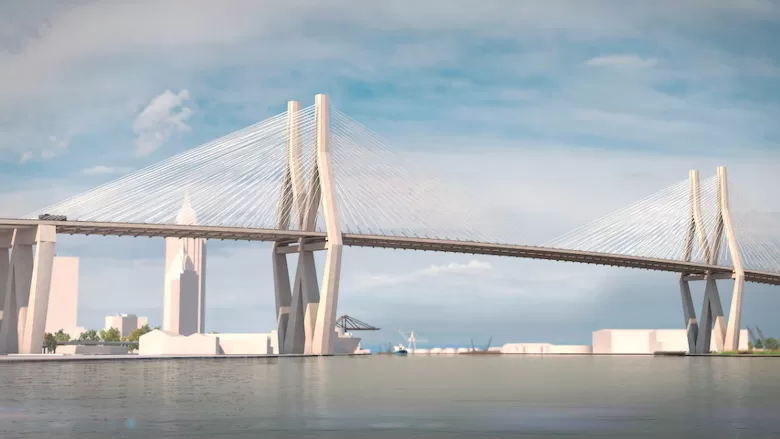
    The Alabama Department of Transportation (ALDOT) on May 6 announced the long-awaited Mobile River Bridge and Bayway Project will proceed under the direction of a new construction team—Kiewit Massman Traylor (KMT).

    KMT, a New Orleans-based joint venture, previously had been selected to design and build the cable-stayed bridge portion of the project. Now, the company is taking on a larger role as the lead contractor on the project and already has begun key pre-construction work in Mobile.

    “This is an important and positive development for the Mobile River Bridge and Bayway project,” said ALDOT Chief Engineer Ed Austin. “Kiewit Massman Traylor and their team are hitting the ground running as they take over this portion of the project.”

    The I-10 Mobile River Bridge and Bayway Widening Project is a major infrastructure initiative designed to improve safety, reduce traffic congestion, and increase capacity along one of Alabama’s most critical transportation corridors. In addition to building a new cable-stayed bridge across the Mobile River, the project involves widening Interstate 10 to ease traffic bottlenecks, enhance the movement of hazardous materials, and support continued operations within Mobile’s maritime industry.

    Support for Mobile River Bridge and Bayway Project

    Momentum for the project grew after the U.S. Department of Transportation recently named the Mobile River Bridge among 180 infrastructure projects prioritized for accelerated grant approvals.

    Last July, the project reached a key milestone when ALDOT was awarded a $550 million federal grant, celebrated by local, state, and federal leaders. “We appreciate the commitment from Secretary Duffy and the Trump Administration to expedite the completion of the funding process,” said ALDOT spokesperson Tony Harris at the time.

    In March, ALDOT and the previous construction team, Mobile Bayway Constructors, agreed to part ways for undisclosed reasons. At the time, KMT had been ranked as the second-best option for the job.

    Since stepping in, KMT has developed and launched a Pile Load Test Program to assess the strength and stability of the concrete foundation piles that will support the bridge and associated structures. Testing will occur at six locations along the proposed bridge route, using 24-inch square precast concrete piles. According to ALDOT, this phase of the project is not expected to impact traffic on Interstate 10.

    At an estimated total cost of $3.5 billion, the Mobile River Bridge and Bayway Project is the most expensive road construction project in Alabama history. But, before construction can begin, ALDOT will have to finalize a guaranteed maximum price contract and secure a federal loan under the Transportation Infrastructure Finance and Innovation Act (TIFIA).

    Read also: Kiewit Hired as Construction Manager for $800M I-55 Bridge Replacement

    Mobile River Bridge and Bayway Project Fact Sheet

    Project Overview

    Lead Contractor: Kiewit Massman Traylor (KMT), a New Orleans-based joint venture

    Announcement Date: May 6, 2025

    Estimated Cost: $3.5 billion (Alabama’s most expensive road construction project to date)

    Key Objectives

    Improve safety along the I-10 corridor

    Reduce traffic congestion in the Mobile Bay area

    Increase transportation capacity

    Enhance movement of hazardous materials

    Support Mobile’s maritime industry operations

    Read also: NASA Breaks Ground on New Causeway Bridge in Wallops Island, Virginia

    Project Components

    New cable-stayed bridge across the Mobile River

    Interstate 10 widening

    Bayway improvements

    Mobile River Bridge and Bayway Project Current Status

    KMT has begun pre-construction work

    Pile Load Test Program launched to assess foundation stability

    Testing at six locations using 24-inch square precast concrete piles

    No traffic impact expected during testing phase

    Funding

    $550 million federal grant awarded in July 2024

    Project prioritized among 180 infrastructure projects for accelerated grant approvals

    TIFIA loan pending finalization

    Next Steps

    Finalize guaranteed maximum price contract

    Secure federal TIFIA loan

    Begin main construction phase

    Read also: West Haven’s 70-Year-Old I-95 Bridges Being Replaced in $136M Project

  • Bensley Elementary School Reaches Major Construction Milestone with Final Beam Placement

    Bensley Elementary School Reaches Major Construction Milestone with Final Beam Placement

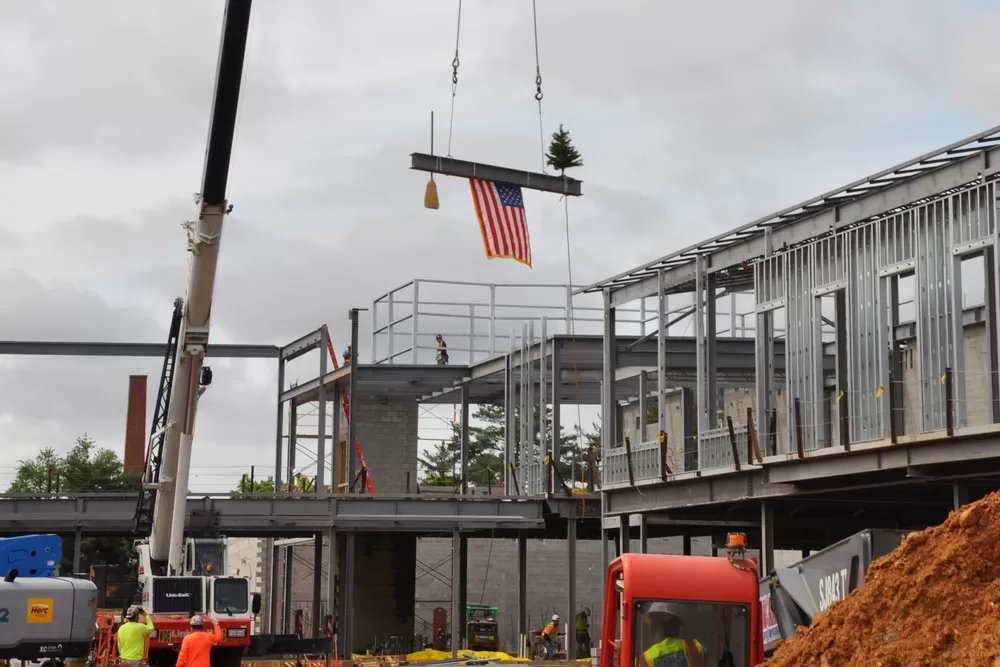
    Chesterfield County Public Schools marked a major step forward in the construction of the new Bensley Elementary School on Tuesday, May 6, by raising the final steel beam into place.

    The ceremonial event brought together students, faculty, local officials, and community members to celebrate this significant achievement. Guests signed the beam and added artwork and messages before it was lifted to the top of the two-story structure, symbolizing both pride and progress.

    The beam also carried additional significance in the form of special tributes: a good luck symbolizing evergreen tree, a broom for a fresh start, and an American flag in recognition of patriotism and dedication by the construction workers.

    Cost for the New Bensley Elementary School

    The construction of the new Bensley Elementary School, a $52 million project, is moving forward toward opening its doors in 2026 and has the capacity to accommodate 1,000 students, as reported by the school district. Superintendent Dr. John Murray spoke at the time, saying, “This event is not about building — it’s about faith in education by our community. We’re on the verge of finishing a contemporary learning space that will serve both kids and educators for decades to come. When we bring children back in 2026, it will be to a school that honors Bensley’s heritage and commits to its future.”

    “This beam doesn’t just represent steel and structure—it reflects a community’s shared dream coming to life,” said Ann Coker, chair of the Chesterfield County School Board. “What we’re building here goes beyond classrooms. It’s a foundation for the future, a space that will inspire learning and growth for years to come.”

    Designed from the county’s standard elementary school design, the new school incorporates input from teachers and families, such as in color scheme and floor plan. Construction is proceeding on schedule, with completion anticipated prior to the 2026–27 school year opening.

    Additionally, the new Bensley Elementary School construction is one of a system-wide series of upgrades to school buildings across Chesterfield County, with all students benefiting from access to up-to-date, inspiring learning spaces.

    Read also: Texas A&M University win award at the Associated Schools of Construction (ASC) Regions Competition

    Bensley Elementary School Reaches Major Construction Milestone with Final Beam Placement
    Bensley Elementary School Reaches Major Construction Milestone with Final Beam Placement

    New Bensley Elementary School Construction: Project Factsheet

    Chesterfield County Public Schools

    Project Milestone: Topping-off ceremony held May 6, 2025

    Key Facts

    Budget: $52 million

    Capacity: 1,000 students

    Opening: 2026-27 academic year

    Design: Based on county’s standard elementary school model

    Notable Features: Two-story structure with design input from educators and families

    Read also: Purdue University approves new Daniels School of Business building

    New Bensley Elementary School Construction Milestone

    The traditional “topping-off” ceremony included:

    Final steel beam placement

    Community signatures and artwork on beam

    Symbolic items: evergreen tree (good fortune), broom (fresh start), American flag (patriotism)

    Attendance by students, faculty, officials, and community members

    Read also: Balfour Beatty to Lead $60 Million Stormwater Capture Project at Bassett High School in California

  • International Paper Begins Construction on $260M Box Plant in Waterloo, Iowa, Set to Be Largest in U.S.

    International Paper Begins Construction on $260M Box Plant in Waterloo, Iowa, Set to Be Largest in U.S.

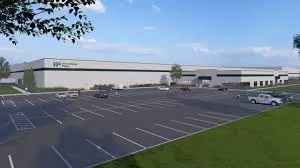
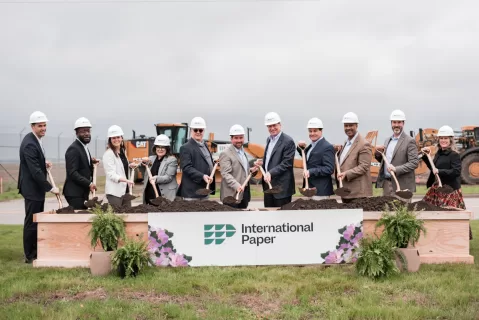
    International Paper has officially started building a new $260 million packaging box plant in Waterloo, Iowa. When finished, the factory will be the biggest box‐making facility in the US and replace the firm’s existing Waterloo facility.

    Located in the heart of the Midwest, the advanced plant will specialize in the protein segment with custom, eco‐friendly packaging options. Equipped with the newest technology and designed to the most current safety specifications, the structure is designed to allow International Paper to meet expanding market demand without harming the environment.

    “We are excited to begin this major investment in both our company and the Waterloo community,” said John Berry, Group Vice President at International Paper. “This project underscores our commitment to expanding in strategic markets, enhancing our capabilities, and delivering dependable, high-quality products to our customers. We’re grateful for the support—from local leaders to our partners—that made today’s groundbreaking possible.”

    Read also: Philip Morris Plans $600M Zyn Manufacturing Plant in Aurora, Colorado

    Economic Impact of International Paper’s New Packaging Facility in Waterloo

    The development will generate more than 200 permanent member positions, approximately 85 of them local hires. Approximately 130 site workers will be hired throughout the construction process, as well as 40 trade partners and 10 design firms each supported by five to ten auxiliary vendors. Nearly half the work involved in constructing—40 to 50%—will be done by Iowa-based contractors, translating into broader indirect benefits to Iowa hospitality and service industries.

    Since 2019, the company has invested $171 million in capital projects across Iowa, the new plant is expected massively increase these investments.

    Groundbreaking marked the start of assembling 2,000 tons of fabricated steel and pouring over 35,000 cubic yards of concrete for foundations, floors, walls, and the roof structure. The facility is slated to begin operations in the fourth quarter of 2026, ushering in a new era for packaging production in the U.S.

    Read also: T1 Selects Texas for $850M Solar Cell Manufacturing Facility

    <yoastmark class=

    International Paper’s New Box Plant in Waterloo: Project Factsheet

    Project Overview

    Investment: $260 million

    Location: Waterloo, Iowa

    Status: Construction officially commenced

    Completion Date: Q4 2026

    Significance: Will be the largest box-manufacturing site in the United States

    Facility Details

    Replaces: Existing International Paper Waterloo operation

    Purpose: Production of customized, sustainable packaging solutions

    Primary Market: Protein segment

    Features: State-of-the-art technology and latest safety standards

    Strategic Goal: Meeting growing market demand while minimizing environmental impact

    Impact

    Permanent Jobs: 200+ team-member positions (including ~85 local hires)

    International Paper Waterloo Facility Construction Phase:

    130 on-site workers

    40 trade partners

    10 design firms

    Each supported by 5-10 additional suppliers

    Local Economic Benefit: 40-50% of construction work by Iowa-based contractors

    Additional Benefits: Indirect positive impact on regional hospitality and service industries

    Read also: BioMADE Announces Plans for $132M Flagship Biomanufacturing Facility in Maple Grove

  • Scatec Commences Construction of 1.1GW Obelisk Solar PV and BESS Project in Egypt

    Scatec Commences Construction of 1.1GW Obelisk Solar PV and BESS Project in Egypt

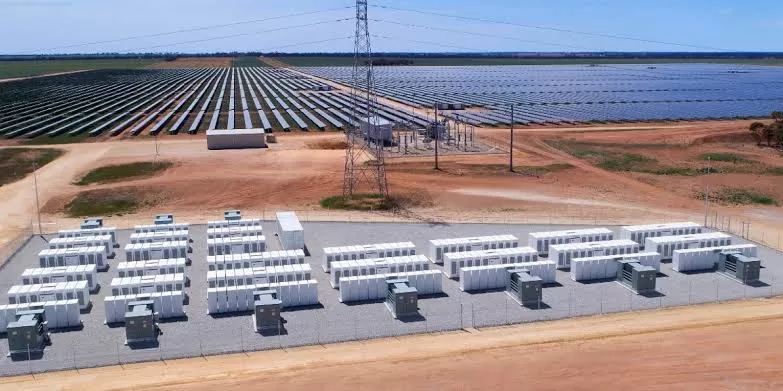
    Scatec ASA has officially commenced construction on its 1.1 GW Obelisk Solar PV and BESS project in Egypt. The BESS will have a capacity of 100 MW/200 MWh . The electricity generated from the entire project will be sold under a 25-year, USD-denominated Power Purchase Agreement (PPA) with the Egyptian Electricity Transmission Company (EETC), secured by a sovereign guarantee.

    The energy project is expected to be developed in two phases. The first phase will consist of 561 MW of solar capacity along with the 100 MW/200 MWh battery system. It is scheduled to become operational in the first half of 2026. Also, as for the second phase it is expected to have 564 MW of solar capacity and is projected to reach commercial operations in the second half of the year 2026.

    Obelisk Solar PV and BESS Project Factsheet

    Project name: Obelisk Solar PV and BESS

    Developer: Obelisk Solar Power, a Special Purpose Vehicle (SPV) wholly owned by Scatec ASA.

    Location: Nagaa Hammadi, Qena Governorate, Egypt.

    Capacity:

    Solar PV plant: 1.1 GWac (Gigawatts alternating current)

    Battery Energy Storage System (BESS): 100 MW / 200 MWh (Megawatts / Megawatt-hours).

    Development phases: The project will be constructed in two phases:

    • Phase 1: 561 MW solar + 100 MW/200 MWh battery storage. Targeted Commercial Operation Date (COD) is the first half of 2026.
    • Phase 2: 564 MW solar. Targeted Commercial Operation Date (COD) is the second half of 2026.

    Financing:

    • The European Bank for Reconstruction and Development (EBRD) is considering providing financing.
    • Also, Equity bridge loans totaling $120 million have been secured to support the project’s financing during construction. Additionally, just to note, this includes $90 million from the Arab Energy Fund and $30 million from the EBRD.

    Also read: Egypt’s 650MW GOS II Wind Farm Project Complete, with EWA Group Playing Crucial Logistics Role

    Significance:

    • To enhance the reliability of solar power generation in Egypt through the integration of battery storage.
    • To support Egypt in meeting its renewable energy targets.
    • Lastly, it introduces one of the first utility-scale Battery Energy Storage Systems in Egypt, paving the way for future similar projects.

    Key dates:

    • Concept Reviewed (EBRD): February 27, 2025 (Project ID 55308), December 11, 2024 (Project ID 55885).
    • Construction commencement: May 5, 2025.
    • Phase 1 commercial operation date: First half of 2026.
    • Phase 2 commercial operation date: Second half of 2026.
    • Lastly, the project deadline has been set at December 31, 2025.

    Estimated cost: USD 120 Million (This could be a specific financing tranche or an earlier estimate).

    Also read: Construction of Africa’s Largest Solar PV and First Utility-Scale BESS in Egypt

    Project’s Funding

    Also, in order to support the funding of the project, Scatec has already secured USD 120 million in equity bridge loans (EBLs), deferring equity contributions until the end of the project’s construction.

    Additionally, the Arab Energy Fund is expected to provide $90 million EBL that will mature in Q2 2028. Furthermore, European Bank for Reconstruction and Development (EBRD) will contribute $30 million that will mature in Q1 2027.

    A Boost for Scatec’s Portfolio

     “Also, we are proud to break ground on Egypt’s first hybrid solar and battery project. This energy project builds on our portfolio in regards to similar developments. Furthermore, Egypt has set ambitious targets to build out significant renewable energy capacity the coming years. Additionally, the implementation of this milestone further strengthens Scatec’s position as a leading renewable energy producer in the country,” said Scatec CEO Terje Pilskog

    Lastly, Scatec has signed a mandate letter with a consortium of development finance institutions that will enable them to secure long-term, non-recourse project financing on favorable terms, with financial close expected in the coming months. Also, rospective equity partners are actively engaged in discussions, which are well advanced and expected to conclude within the same period.

    Also read: IRSC Signs agreement with ACO, Sungrow, and Tongwei for Egypt’s 75 MW Solar Projects

  • Contractor Selected for the New Milwaukee Airport Terminal Construction

    Contractor Selected for the New Milwaukee Airport Terminal Construction

    Updated 1st july 2025 – J.H. Findorff & Son has been awarded the contract to build a new international terminal at Milwaukee Mitchell International Airport, marking a major step in a long-awaited redevelopment plan.

    When will the terminal construction works begin?

    The $95.2 million terminal reconstruction project will see the replacement of the aging Concourse E, which was originally built in the 1960s and closed in 2016. Delayed by the pandemic, the project is now back on track and set to break ground as early as August 2025, with construction expected to last two years.

    Findorff will serve as general contractor, overseeing site work, excavation, selective demolition, and fueling system upgrades. The terminal will be directly connected to the main terminal building, creating expanded capacity for both international and domestic travel. The work is being organized into four bid packages.

    Gilbane Building Company will act as construction manager, with design services provided by architecture firm Alliiance. Demolition of the existing concourse will be handled by HM Brandt of Lannon.

    Originally estimated at $55 million in 2019, rising construction and design costs have pushed the budget to $95.2 million. Funding will come from a mix of federal and state grants as well as airport revenues. Officials also plan to apply for final-year federal terminal grant funding.

    Other projects ongoing at the Milwaukee Airport

    Meanwhile, other developments are underway at the airport, including a $75 million cargo facility led by ARCO/Murray and a $17.2 million pedestrian bridge expansion managed by Zenith Tech Inc., both expected to finish by 2026.

    The new terminal is expected to significantly enhance passenger experience, improve operational capacity, and position Milwaukee as a more competitive hub for international air travel.

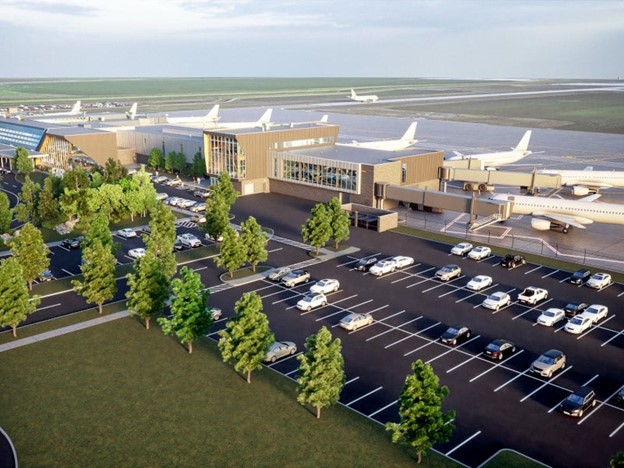
    May 6th 2025Milwaukee Mitchell International Airport is set to begin construction this summer on a long-awaited upgrade: the Milwaukee Mitchell Airport modern terminal project. The new facility will replace the outdated and disconnected International Arrivals Building with a larger, integrated terminal designed to accommodate both international and domestic passengers.

    Following a recent approval by the Milwaukee County Board’s Committee on Finance, up to $95.2 million has been allocated for the project, which will begin with the demolition of Concourse E—closed since 2016.

    Price Tag Grows as Project Gets Back on Track

    Initially budgeted at $55 million in 2019, the Milwaukee Mitchell Airport modern terminal has seen its estimated cost rise by nearly $40 million. The design budget expanded from $4.5 million to $7.1 million, and construction costs jumped to $88 million, driven by pandemic-related delays, inflation, and rising material costs.

    Airport Director Brian Dranzik said the project was rebid earlier this year, giving officials a clearer financial picture: “We now have a good number to work from, and that’s why we’re seeking the expenditure authority.”

    Regional Gateway Gets a Needed Upgrade

    The modern terminal will transform passenger flow at the airport, allowing international travelers to connect directly into the main terminal rather than using the existing separate building. Once completed, the Milwaukee Mitchell Airport modern terminal will include 2 to 5 new gates and offer improved customs processing and traveler amenities.

    The airport plans to finance the development through a combination of state and federal grants and its own revenues.

    A Boost for Jobs and the Local Economy

    Milwaukee County Executive David Crowley supports the project, highlighting its economic impact and importance to the region’s connectivity. Local business and labor groups, including the Milwaukee Metropolitan Association of Commerce, have also praised the initiative.

    Construction is expected to start in July or August 2025 and take approximately two years to complete.

    Project Fact Sheet

    • Project: Milwaukee Mitchell Airport modern terminal

    • Total Cost: $95.2 million

    • Start Date: July–August 2025

    • Completion Target: 2027

    • Features: 2–5 gates, integrated design

    • Funding: Airport funds, state/federal grants

    • Replaces: Old Concourse E and International Arrivals Building

    Project Timeline

    Year Milestone
    2016 Concourse E closed
    2018 Funding for international terminal approved
    2019 Project budgeted at $55 million
    2020 Delayed due to COVID-19
    2023–2024 Cost revision and rebidding
    April 2025 $95.2M approved by Finance Committee
    July–Aug 2025 Construction of Milwaukee Mitchell Airport modern terminal begins
    2027 Target completion