Constructionreview

Blog

  • A Closer Look at Woodside’s $17.5B Louisiana LNG Project

    A Closer Look at Woodside’s $17.5B Louisiana LNG Project

    Updated November 24, 2025 -On October 22, 2025, Woodside named Williams, a major U.S. gas infrastructure firm, as a 10 percent partner in its Louisiana LNG project and designated the company to operate 80 percent of the associated Driftwood Pipeline. Williams will contribute US $378 million upfront for the equity stake and US $1.9 billion toward construction funding. With Williams’ investment, Woodside says its net capital commitment to the project falls to US $9.9 billion from US $11.8 billion.

    Woodside also already sold a 40 percent stake in the infrastructure company of the project to Stonepeak for US $5.7 billion. The developer approved US $17.5 billion in capital for the Louisiana LNG project in April, and continues to seek partners to further de-risk the project. The U.S. LNG landscape also continues to strengthen its take on energy markets as seen with US $44 billion Alaska LNG pipeline project latest pull of Asian market offtakers.

    The project has capacity cap of up to 16.5 million tonnes per annum (Mtpa) of liquefied natural gas. Start of production is expected by 2029. Backed by major international investment and local support, the project also has an expansion potential to 27.6 Mtpa. Betchel is spearheading its construction, with early works already over 20 percent complete.

    Groundbreaking Ceremony in Southwest Louisiana

    Reported Sept 15, 2025 – Woodside Energy recently marked a major milestone in the $17.5 billion Louisiana LNG Project with a groundbreaking ceremony in southwest Louisiana. Momentum on the project has evidently taken pace since a final investment decision (FID) was reached in April 2025. Woodside’s Louisiana LNG project is advancing steadily, with more than 22 percent of the first train completed as of the groundbreaking ceremony. This is as the LNG project continues to push toward 2029 completion date.

    During the groundbreaking ceremony for Woodside’s Louisiana LNG Project, CEO Meg O’Neill described the project as a “game-changer” for both Woodside and Louisiana. O’Neill also highlighted its role in boosting shareholder returns, securing U.S. energy exports, and creating tens of thousands of jobs. She also emphasized on the project’s scale, calling it the largest foreign direct investment in Louisiana’s history.

    Woodside’s $17.5 Billion Investment in the Louisiana LNG Project

    Reported 10th September – Louisiana is on its path to secure a spot in the world energy market. This comes after Australia’s Woodside Energy sought to set up major energy infrastructure in the state. This energy infrastructure development is already underway. Upon fruition, it is expected to significantly boost to the state’s economy.Woodside’s $17.5B Louisiana LNG Project Partners with Williams Ahead of 2029 Completion
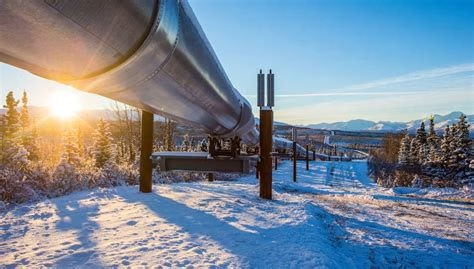


    Woodside Energy‘s intentions of proceeding with its $17.5 billion investment in the Louisiana LNG project are vividly clear. The project marks a momentous leap toward meeting the world’s sustained need for traditional fuels. It also positions the U.S. – and Louisiana specifically – as a cornerstone supplier of low-cost natural gas to world markets. Woodside also recently signed a nine-year supply deal with Turkey’s state energy company, BOTAS, to deliver up to 5.8 bcm of LNG, with the earliest deliveries set for 2030.

    This also comes as the Australian gas and oil company signs a hydrogen supply deal (Sept 25, 2025) with Japan’s JSE and Korea Electric Power Corporation (KEPCO) from its H2Perth Hydrogen Project currently under development in Western Australia.
    Outlook on Woodside’s Louisiana LNG Project After Latest Update

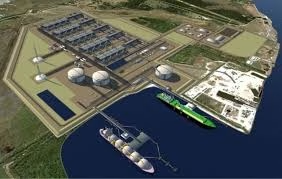
    The project was acquired in 2023 by Woodside with its acquisition of Tellurian. Development is  phased. Early development features construction of three liquefaction trains with a capacity of about 16.5 million metric tons of LNG annually. Woodside also has permission to ramp up output to as much as 27.6 million tons a year. This emphasizes on the project’s scope and flexibility.

    Calling the ultimate investment decision a “historic moment,” Woodside CEO Meg O’Neill underscored the pioneering scale of the project. “Louisiana LNG is a game-changer for Woodside,” she said. “It makes our company a global LNG leader and enables us to deliver enduring returns to shareholders.”

    To reassure investors of the project’s capital intensity, Woodside estimates an internal rate of return of over 13% and anticipates net operating cash flow of $2 billion annually from the first phase commencing in 2030.

    Woodside further de-risked the investment in February by signing an agreement to sell a 40% stake in the supporting infrastructure of the project to Stonepeak for $5.7 billion. This capital injection will pay for about 75% of expenditure in 2025 and 2026. “This de-risked and compelling investment world-class project maximizes Woodside’s underlying strength in project delivery, operations, and customer connection to create long-term value,” O’Neill commented on the move.

    Alongside Woodside’s $17.5 billion Louisiana LNG project in Calcasieu Parish, Sempra’s Cameron LNG terminal stands as another major Gulf Coast export facility, highlighting Louisiana’s role as a hub for U.S. liquefied natural gas.

    Additionally, in Texas, the proposed Texas GulfLink deepwater port, planned about 30 miles southeast of Freeport also received a Clean Air Act permit from the EPA.
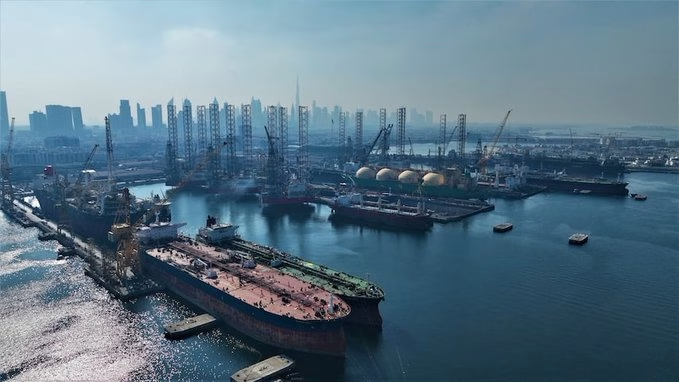
    The Dubai-based shipyard, part of DP World, will deliver the project for AMIGO LNG, a joint venture between Epcilon LNG of Texas and LNG Alliance of Singapore.

    Woodside Energy Louisiana LNG Project

    Key Facts

    Investment: $17.5 billion

    Announcement Date: April 28, 2025

    Production Timeline: Anticipated to begin producing gas in 2029

    Project Origin: Acquired by Woodside in 2023 through Tellurian acquisition

    Project Scale

    Initial development: Three liquefaction trains

    Initial capacity: 16.5 million metric tons of LNG annually

    Permitted expansion capacity: Up to 27.6 million tons annually

    Financial Outlook

    Expected Returns

    Internal rate of return exceeding 13%

    Anticipated net operating cash flow of $2 billion annually from first phase (2030 onwards)

    Strategic Partnership

    40% stake in supporting infrastructure sold to Stonepeak for $5.7 billion

    This investment covers approximately 75% of capital expenditure for 2025-2026

    Louisiana’s Rise as Global Energy Powerhouse

    The Louisiana LNG development not only adds depth to Woodside’s global portfolio through balancing long-life, flexible LNG assets with high-return oil assets. It also solidifies Louisiana’s rapidly growing energy leadership.

    With industry giants, Cheniere’s Sabine Pass and Sempra’s Cameron LNG already established in the state, Louisiana is proving to be a perfect export hub. This momentum is not tapering down as more major projects continue to outcrop in the state. These include Venture Global’s $28 billion CP2 LNG, the recent launch of its Calcasieu Pass, and the $18 billion development at Plaquemines LNG. Combined, these projects emphasize the state’s leadership in the LNG export market while supporting economic development through the creation of jobs and higher tax revenues. Additionally, the Monkey Island LNG project will also add to Louisiana’s portfolio of major LNG projects in the U.S.

    More Energy Investments

    Simultaneously, Louisiana is diversifying its energy base. Woodside’s LNG project is one of an increasing number of forward-looking investments, including CF Industries’ proposed $4.2 billion blue ammonia plant in Ascension Parish, which will use carbon capture to make 1.4 million metric tons of low-carbon ammonia annually. Air Products is also moving forward on its multi-billion-dollar Louisiana Clean Energy Complex, which is clean hydrogen-oriented.

    Other new developments such as Energy Transfer’s Lake Charles LNG and Commonwealth LNG signal further expansion. Alongside this are clean energy initiatives such as the AES Oak Ridge Solar Project and the Woodland Biofuels green hydrogen facility demonstrate the state’s clean energy vision. Louisiana is also making investments in robust carbon capture and storage infrastructure, further enhancing its energy resilience.

    In combining historic energy prowess with innovation, Louisiana is building a balanced path forward. Projects like Woodside’s LNG terminal and CF Industries’ ammonia plant not only indicate the state’s adaptability but also secure its central role in energizing the here and now and fueling the energy transition ahead.

    Read also: CF Industries to Build $4B Ammonia Production Facility in Ascension Parish

  • Construction Technology CONFEX 2025 30th April to 1st May, Dubai

    Construction Technology CONFEX 2025 30th April to 1st May, Dubai

    Shaping the Future of Construction and Real Estate Currently in its 8th edition, the Construction Technology ConFex is the region’s biggest and best ConTech | PropTech event in the region for transformation of the built environment. Meet 1000+ project owners, developers, contractors, AEC consultants and technology companies to discover cutting-edge solutions and new approaches to work that increase performance, competitive edge and viability in the industry. Don’t miss the industry’s annual meeting for all things digital and sustainable.
    Location: JW Marriott Hotel Marina, Dubai
    Event date: 30 April – 01 May 2025

  • U.S. Shows Investment Interest in Africa’s 5,660-Kilometer Gas Pipeline Project, the Nigeria-Morocco Gas Pipeline

    U.S. Shows Investment Interest in Africa’s 5,660-Kilometer Gas Pipeline Project, the Nigeria-Morocco Gas Pipeline

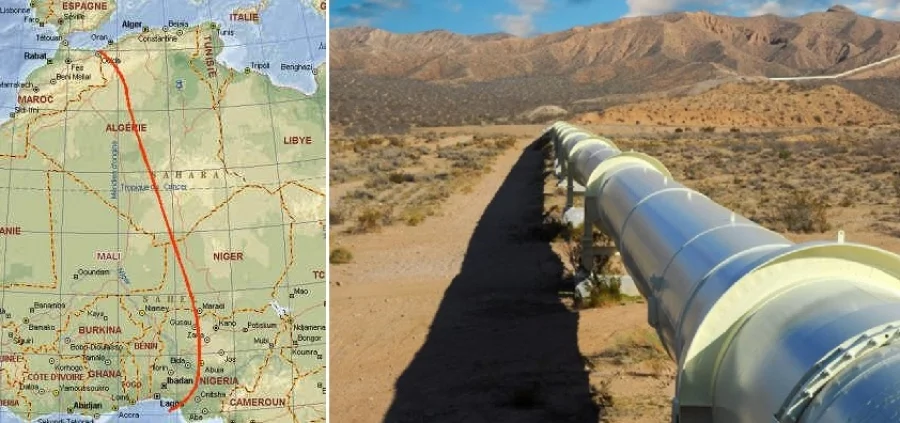
    The Nigeria-Morocco gas pipeline project has attracted the interest of the United States. Nigeria’s Finance Minister, Wale Edun, made the announcement after high-level negotiations during the 2025 Spring Meetings of the IMF and World Bank in Washington, D.C. According to him, the U.S. is seeking opportunities in Nigeria’s natural gas sector with particular interest in the ambitious gas pipeline project. The minister, along with Central Bank Governor Olayemi Cardoso, hosted U.S. State Department visitors who emphasized the importance of Nigeria’s ongoing economic reforms. The reforms are being considered necessary to build investor confidence. U.S. support for investments that align with Nigeria’s economic agenda is something Minister Edun indicated the U.S. is keen on providing. Additionally, he referred to the extensive natural gas reserves in the country as one of the largest attractions for foreign partners. Therefore, the project is becoming a strategic undertaking that can propel regional cooperation and long-term energy security.

    Also read:

    New MoU signed for the cross-border Nigeria-Morocco Gas Pipeline project

    Project Factsheet:

    Significance:

    • Enhances energy security across West Africa and strengthens the Alliance of Sahel States.
    • Enhances investor confidence because of economic reforms in Nigeria and international interest.
    • Encourages regional cooperation through the shared infrastructure of 13 African countries.
    • Positions Africa as a strategic energy supplier to Europe via cleaner natural gas exports.

    Infrastructure:

    • 5,660-kilometer offshore pipeline from Nigeria to Morocco across 13 countries.
    • Will be the longest offshore gas pipeline in the world when completed.
    • Construction of the project backed by ECOWAS, SMH of Tanzania, and Senegal’s Petrosen.
    • Aims to boost gas supply to Europe and balance regional energy distribution.

    Developer:

    • Jointly developed by the Nigerian National Petroleum Company Limited (NNPCL) and Morocco’s ONHYM.
    • Backed by regional economic and energy organizations across Africa.
    • Began following bilateral agreements between Morocco and Nigeria in 2016.
    • One of the most ambitious cross-border infrastructure projects in Africa.

    Funding and Partnerships:

    • Project estimated at $25 billion total cost.
    • Financing anticipated via international and regional collaboration.
    • Potential U.S. interest indicates possible further funding and technical participation.
    • Agreements in 2022 to start construction works.

    Challenges:

    • Coordinating execution across 13 countries with varying regulatory frameworks.
    • Overseeing scale, cost, and offshore construction complexity over several years.
    • Maintaining environmental and technical standards along the whole route.
    • Synchronizing infrastructure rollout with Europe’s future energy demand.

    The Significance of the Nigeria-Morocco Gas Pipeline Project

    The Nigeria-Morocco gas pipeline project is essential for regional energy integration and economic development. It will provide gas to thirteen West African countries before it arrives in Europe. This will improve energy access, reduce energy poverty, and improve cooperation in Africa. Besides, it aligns with global energy transition goals by promoting cleaner alternatives. The project measures 5,660 kilometers in length, the longest offshore gas pipeline globally. Furthermore, it would cross thirteen countries, from Morocco to Nigeria.

    Nigeria-Morocco Gas Pipeline Project

    The 2022 agreements brought ECOWAS, Tanzania’s SMH, and Senegal’s Petrosen to join the project. There is to be a phased construction to meet technical and environmental needs. It will also boost gas supply to Europe and West Africa’s energy resilience when completed. Through improved gas supply, the project will improve industrial activity and regional stability. Its economic future encompasses not only exporting gas but jobs and infrastructure generation as well. With American attention, the initiative could receive broad international finance as well as technical assistance. Moreover, it is a benchmark towards collaborative energy goals between the West and African partners.

    Also read:

    Morocco-Nigeria Gas Pipeline Tenders to be Launched by Morocco in 2025

    Nigeria-Morocco Gas Pipeline (NMGP) Project

  • How Far with Equinor & Polenergia’s Bałtyk 1, 2, and 3 Offshore Wind Farm Projects in the Polish Baltic Sea

    How Far with Equinor & Polenergia’s Bałtyk 1, 2, and 3 Offshore Wind Farm Projects in the Polish Baltic Sea

    Bałtyk I is an offshore wind farm being developed as a joint venture between Equinor and Polenergia. Planned to have a capacity of up to 1,560 MW, it is one of the largest offshore wind projects in Europe. The wind farm is progressing through the environmental approval and permitting stages, with construction and commercial operation timelines to be announced.

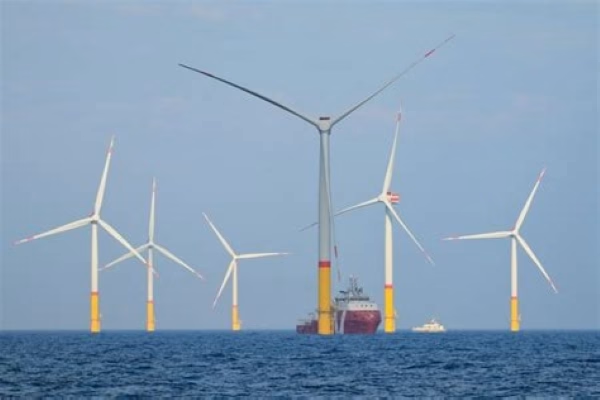
    Additionally, the Equinor and Polenergi JV is also developing the Bałtyk II and Bałtyk III offshore wind farms as large-scale renewable energy projects. They are also located in the Polish Baltic Sea. Combined, they have a total capacity of 1,440 MW. Construction activities began following the projects’ environmental approvals and financial close in May 2025.

    Cadeler, a global offshore wind contractor, is scheduled to start turbine transportation and installation at the Bałtyk II and III farms in 2027. The operations will utilize both O-Class and P-Class installation vessels, with full commercial operation expected by 2028. The company also recently won a contract for the transportation and installation of 26 Siemens Gamesa 14 MW offshore wind turbines at the BC-Wind offshore wind farm. The wind farm is also located in the Polish Baltic Sea.

    Bałtyk I Offshore Wind Farm Project Factsheet

    Developers: Equinor and Polenergia (50-50 JV)

    Location: Polish Baltic Sea, approximately 80 km offshore

    Capacity: Up to 1,560 MW

    Technology: Fixed-bottom turbines

    Environmental Approval: Granted. Awaiting December 2025 auction participation

    Auction Status: Prequalification application submitted for Poland’s Phase II offshore wind auction

    Commercial Operation: Expected by 2030

    Bałtyk II and III Offshore Wind Farm Project Factsheet

    Developers: Equinor and Polenergia (50-50 JV)

    Location: Polish Baltic Sea, approximately 22 to 37 km offshore

    Capacity: 720 MW each (1,440 MW combined)

    Turbines: 50 Siemens Gamesa SG 14-236 DD turbines each

    Turbine Transportation and Installation: Cadeler

    Technology: Fixed-bottom turbines

    Environmental Approval: Granted

    Financial Close: Reached in May 2025

    Construction Start: Onshore infrastructure commenced in June 2025

    Offshore Works Schedule: H1 2026

    Turbine Installation: 2027

    Commercial Operation: Expected by 2028

    How Far with Equinor-Polenergia's Bałtyk 1, 2, and 3 Offshore Wind Farm Projects in the Polish Baltic Sea
    Bałtyk 1, 2, and 3 combined will power up to 4 million homes

    Equinor and Polenergia Secure Key Environmental Approval for Bałtyk 1 Offshore Wind Farm

    Reported April 29, 2025 – Equinor and Polenergia secured the final environmental decision for the Bałtyk 1 Offshore wind farm project from the Regional Director for Environmental Protection (RDOŚ) in Gdańsk. This approval marks a significant step toward what is expected to become one of the largest offshore wind farms in the Polish Baltic Sea. It also makes it eligible to participate in Poland’s 2025 offshore wind auction scheduled for December 17, 2025.

    In preparation, Equinor and Polenergia have also submitted a prequalification application for Bałtyk I, marking it as the first project to apply for this auction. Additionally, with a capacity of up to 1,560 MW, Bałtyk I is positioned as the largest and one of the most advanced offshore wind projects in Poland.

    With a planned capacity of up to 1,560 MW, Bałtyk 1 will be located approximately 80 kilometers offshore. Electricity generated by the project will be transmitted to the Krzemienica substation. Infrastructure through Ustka and Redzikowo municipalities will be used.

    On Track for 2025 Offshore Wind Auction

    The developers also highlighted the importance of holding the second-phase auction in 2025 to sustain offshore development momentum.

    Adam Purwin, CEO of Polenergia, emphasized the need for continuity to avoid delays and maximize the energy potential of Poland’s coast. Michał Jerzy Kołodziejczyk, Equinor’s Country Manager in Poland, also noted that Bałtyk 1 offshore wind farm is the most advanced project in this phase of development.

    Also Read: First Turbine Installed at, “EnBW He Dreiht”, Germany’s Largest Offshore Wind Farm Under Construction

    Commitment to Local Industry and Supply Chain

    Equinor and Polenergia are actively engaging Polish businesses in the offshore wind supply chain. Supplier meetings have also attracted participation from over 300 local companies with several domestic firms already being contracted as tier-1 suppliers. Contractor meetings for Bałtyk 1 will also be held soon.

    A Clean Energy Future for Poland

    Together, the three Bałtyk projects will deliver up to 3,000 MW of clean energy. This is enough to power 4 million homes. Bałtyk 1 expects first power by 2030, while Bałtyk 2 and 3 expect it by 2028.

    Summary

    • Bałtyk 1 receives final environmental approval from RDOŚ in Gdańsk

    • Project eligible to compete in Poland’s 2025 offshore wind auction

    • Planned capacity of up to 1,560 MW, located 80 km offshore

    • Over 300 Polish companies engaged in supply chain opportunities

    • Bałtyk 1, 2, and 3 combined will power up to 4 million homes

  • Penn Medicine Expands Cancer Care With New Proton Therapy Center

    Penn Medicine Expands Cancer Care With New Proton Therapy Center

    Penn Medicine has began construction on a major expansion of its network of cancer treatment facilities: a $224 million Roberts Proton Therapy Center at Penn Presbyterian Medical Center, set to open in late 2027.

    The new facility will be Penn Medicine’s fourth proton therapy location, solidifying its place as a world leader in advanced cancer therapy. With a goal of delivering targeted radiation therapy with fewer damages to healthy tissue, proton therapy serves patients by providing fewer side effects and quality of life improvements during and after treatment.

    Building on a Global Reputation

    The initiative supports Penn’s strategic plan to expand access to advanced therapies via its Abramson Cancer Center, as well as its preparation for a major expansion of its flagship Roberts Proton Therapy Center at the Perelman Center for Advanced Medicine. Since 2010, that first center — the globe’s largest and busiest proton therapy center — has treated close to 11,000 patients, children and adults.

    “We’re not just investing in capacity, but in the future of cancer treatment,” said Dr. James Metz, chairman of Radiation Oncology at the Perelman School of Medicine. “Having this new center to open enables smooth care for our patients as we start modernizing our original building.”

    The work on the upgrade to proton therapy in the Perelman Center will commence a few months after the Penn Presbyterian location opens.

    Read also: Turner Tops Out Massachusetts General Hospital, Building Healthcare for a Changing Climate

    Penn Medicine Roberts Proton Therapy Center Expansion: Project Factsheet

    Location: Penn Presbyterian Medical Center, University City, Philadelphia

    Project Overview:

    Construction of a new $224 million Roberts Proton Therapy Center, expanding Penn Medicine’s network of advanced cancer treatment facilities and reinforcing its global leadership in proton therapy.

    Expected Opening: Late 2027

    Facility Details:

    43,000-square-foot expansion extending the Penn Presbyterian campus toward 38th Street

    Two Proteus ONE proton therapy systems for high-precision cancer treatment

    One TrueBeam photon therapy system (expected operational by fall 2025), doubling photon therapy capacity at Penn Presbyterian

    Impact:

    Expand access to advanced proton and photon therapy through Penn’s Abramson Cancer Center

    Support a seamless transition during future upgrades at the flagship Roberts Proton Therapy Center at the Perelman Center for Advanced Medicine

    Advance Penn Medicine’s leadership in cancer treatment, research, and education

    Improve patient outcomes through highly targeted therapies that reduce side effects and preserve quality of life

    Read also: Children’s Mercy Hospital Kansas Unveils $152M Expansion Plan

    What’s Inside the New Center?

    The growth will add another 43,000 square feet to Penn Presbyterian, extending the campus footprint toward 38th Street. Two state-of-the-art Proteus®ONE proton therapy machines will be the foundation of the new building, delivering high-precision treatments with less damage to healthy surrounding tissue.

    With the proton therapy equipment, the project will have a new treatment room housing a TrueBeam photon therapy system, a standard form of radiation therapy employing high-energy X-rays to kill cancer cells. The new TrueBeam should be operational by fall 2025, effectively doubling Penn Presbyterian’s photon therapy treatment capacity.

    Getting Around Campus While Under Construction

    In order to accommodate the Penn Medicine’s new proton therapy center construction, Medical Drive is currently closed. Patients and visitors should enter through Filbert Street to parking and the main entrance of the Cupp Building. Penn Medicine will continue to send notifications regarding traffic patterns and directions on the Presbyterian website.

    A Broader Vision for Cancer Care

    This growth is more than new facilities — it’s one component of Penn Medicine’s broader vision to establish new standards in cancer care, research, and education. By pushing the boundaries of technology today, Penn is rewriting what cancer care will look like tomorrow — for patients here and around the world.

    Read also: El Camino Health Breaks Ground on New Rehab Hospital in Sunnyvale

  • New Developments: The Commanders’ Return to D.C. Takes Shape

    New Developments: The Commanders’ Return to D.C. Takes Shape

    The Washington Commanders are officially returning to D.C. with new stadium. The team and D.C. Mayor Muriel Bowser announced a historic agreement on April 28, 2025 to bring the NFL franchise back to the nation’s capital, making the announcement in a social media video that was narrated by Super Bowl-winning quarterback Joe Theismann. Theismann talked in the video about his experiences playing at RFK Stadium and what a new stadium would mean to the city.

    The new stadium will be built on the site of the old RFK Stadium, the Commanders’ home from 1961 to 1996 before they relocated to FedEx Field in Landover, Maryland. Groundbreaking on the project is expected next year, subject to approval by the D.C. Council, with the new stadium set to open in 2030.

    Under the deal announced on April 28, 2025, the Washington Commanders will return to D.C., investing $2.7 billion in a new stadium at the historic RFK Stadium site, while the city will contribute approximately $1.1 billion over the next eight years toward the broader redevelopment project. The broader development will transform 170 acres along the Anacostia River into parklands, residential space, and a sports complex. Just 16 acres will go toward the stadium itself.

    Read also: USC Advances $350M Reimagining of the Iconic Williams-Brice Stadium

    Mayor’s budget proposal reallocates $395 million

    In her Fiscal Year 2026 budget unveiled on May 27, Mayor Bowser repurposed $395 million that the city had set aside for a now-canceled jail project. The city now earmarks that money for site preparation, utilities, roads, and other foundation work at RFK.

    The Council must approve the $1.1 billion in city spending (including the $395 million reallocation). Debate centers on ensuring community benefits—and avoiding a large annual subsidy—before officials can finalize the lease. A vote will likely occur in the first two weeks of June.

    Once the Council grants approval, crews will tear down RFK’s old structures to clear the site. Officials haven’t fixed demolition timelines yet but expect work to begin in late 2025 or early 2026.
    Major construction work on the stadium itself will start in the fall or winter of 2026, after teams complete all planning, permits, and site work.

    Parallel to the stadium build, the plan includes new parks, housing, retail spaces, a sportsplex and other amenities across the RFK campus. Early phases of those surrounding developments will roll out beginning in 2027 through 2029.

    Read also: Sacramento Republic FC Reveals Latest Rendering for $321M Railyards Stadium

    What the Commanders’ New Stadium in D.C. Means for Fans and the City

    The road to returning to D.C. has been a long time in the making. The new ownership group of the Commanders, which purchased the team from Dan Snyder in 2022, weighed potential sites in Washington, Maryland, and Virginia. A breakthrough was made earlier this year when Congress passed a bill granting the District authority over the RFK Stadium site — legislation that was signed into law by President Joe Biden after aggressive lobbying by team owner Josh Harris and NFL Commissioner Roger Goodell.

    As exciting as the possibility of the Commanders return to D.C. is, there are still challenges ahead. The stadium deal still needs to be approved by the D.C. Council, and not all members are on board. Council Chairman Phil Mendelson and others have questioned the use of public funds for the stadium.

    “I don’t believe taxpayer money should be spent on a stadium,” Mendelson said to The Washington Post earlier this month.

    As talks continue, this much is sure: The Commanders’ long anticipated homecoming is closer than it has been in years — and if all aligns properly, fans could be cheering in a state-of-the-art new stadium at the historic RFK site by the start of the next decade.

    Read also: $2.1B Highmark Stadium Hits 50% Completion with Topping Out Ceremony

    Commanders’ New Stadium in D.C.: Project Factsheet

    Project Overview

    The Washington Commanders will return to Washington, D.C. with a new stadium at the historic RFK Stadium site, ending their stay in Maryland that began in 1996.

    Timeline:

    Groundbreaking expected next year (pending approval)

    Stadium completion targeted for 2030

    Investment:

    Total development: Approximately $4 billion

    Commanders contribution: $2.7 billion

    D.C. government: $1.1 billion over 8 years

    Development Scope:

    170-acre redevelopment along Anacostia River

    Stadium footprint: 16 acres

    Additional features: Green spaces, housing, sports complex

    Commanders’ New Stadium: Key Milestones

    Agreement announced by Commanders and Mayor Muriel Bowser

    Congress transferred RFK land control to the District

    D.C. Council approval still required, with some opposition from Chairman Phil Mendelson and others

    Read also: Construction Underway on $175M Amway Stadium in Downtown Grand Rapids