Constructionreview

Blog

  • Progress at Liverpool Bay Carbon Capture Storage Project in UK After €520M Saipem EPC Contract Award

    Progress at Liverpool Bay Carbon Capture Storage Project in UK After €520M Saipem EPC Contract Award

    Italian oil and gas contractor, Saipem, has been awarded a €520 million contract by Eni for UK’s Liverpool Bay Carbon Capture Storage (CCS) project. The Engineering, Procurement and Construction (EPC) contract is for 3 years, by when the Liverpool CCS project will be complete. United Living Energy Limited was also awarded a 3 years £250 million contract. Their role has been described as a primary contractor for the Liverpool Bay CCS project.

    Project factsheet

    Owner: Liverpool Bay CCS Limited

    Location: Liverpool Bay, UK

    Developer: Eni

    Project partners: Encyclis, EET Viridor, Heidelberg Materials, Progressive Energy

    EPC contractor: Saipem

    Saipem EPC contract cost: €520 million

    Project start date: 2020

    Current status: Construction

    Start of construction: 2025

    Project completion date: 2028

    Saipem’s €520 Million EPC Contract and the Project’s Construction Phase

    Saipem’s EPC contract for the CCS facility in Liverpool Bay is aimed at developing a compression station. This will involve the conversion of the existing gas compression and treatment facility at Point of Ayr, in north Wales into a CO2 compression station.

    The electrical CO2 compression station will allow for permanent carbon storage in the Liverpool Bay area which currently houses depleted offshore sites. Additionally, the €520 million EPC contract will also include development in both offshore and onshore segments of the Liverpool Bay CCS compression station.
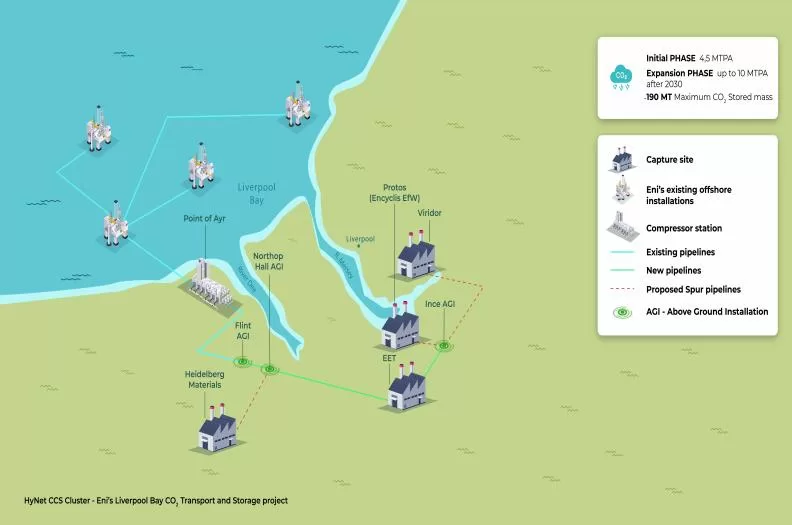
    Progress at UK's Liverpool Bay Carbon Capture Storage Project After €520M Saipem EPC Contract
    Liverpool Bay Carbon Capture Storage network sits in the HyNet North West Industrial Decarbonisation Cluster, one made up of industries in the North West of England and North Wales

    Saipem’s EPC contract for the development of the Liverpool Bay CCS compression station will also include project commissioning. This will feature assistance to commissioning of the new facility in 2028.

    The project’s construction phase will also include changes to parts of the offshore platforms, as well as 149km of onshore and offshore pipelines. Also included in the construction plans is the installation of 35km of new pipelines to connect industrial CO2 emitters to the Liverpool Bay CCS network. These emitters include cement manufacturers, waste plants, and low-carbon hydrogen producers, among others.

    The Liverpool Bay Carbon Capture Storage (CCS) Project

    Eni, an energy company driven by a philosophy to support “socially fair energy transition” globally, runs the Liverpool Bay Transport and Storage infrastructure.

    Liverpool Bay Carbon Capture Storage network sits in the HyNet North West Industrial Decarbonisation Cluster. The cluster is made up of industries in the North West of England and North Wales.

    Upon CO2 transport to the carbon capture storage facility in the Liverpool Bay area, the green-house undergoes changes, among them compression, before storage. Storage in Liverpool’s HyNet CCS cluster is done in the depleted natural gas reservoirs lying offshore.

    Progress at UK's Liverpool Bay Carbon Capture Storage Project After €520M Saipem EPC Contract
    The CO2 compression station will allow for permanent CO2 storage in offshore depleted fields under Liverpool Bay. Currently, the UK has a target of storing up to 30 million tons of CO2 by 2030

    Benefits of the Liverpool Bay CCS Project

    The project is driven by two main objectives. These are achieving Net Zero and supporting the UK’s economic growth. The Liverpool Bay CCS facility will also make the HyNet North West one of the world’s first low-emission industrial clusters. The industrial cluster is also one of the UK’s most energy-intensive manufacturing districts.

    Also read: Matrix’s Eccles and Kilmarnock BESS projects in Scotland, England to foster UK energy transition

    Net Zero Goal By 2030

    Since the CCS project inception in October of 2020, the project has seen tremendous progress. This also includes the government granted permission to transport CO2 in March 2024. Currently, the UK has a target of storing up to 30 million tons of CO2 by 2030. This initiative is plainly underscored by the government’s £21.7 million pledge to support the development of CCS projects in the UK in October last year.

    Currently, the Liverpool Bay CCS facility is in its initial phase with an initial target capacity of 4.5 million tons per annum (MTPA). This number is expected to increase to 10 MTPA after 2030. In the long-run, this will effectively lead to the storage of a maximum of 190 metric tons (MT) of CO2.

    Economic Support

    The CCS project is in itself geared towards economic development. This is achieved by the investments channeled to the transport and storage of CO2. This then creates another chain of new jobs in the thousands, which the project developer, Eni, puts at 2,000 in the construction phase alone.

    The EPC project by Saipem will also use more than 1,000 local resources during the construction phase. This was also emphasized by Eni less than a week ago after the project reached financial closure, and marking the start of the construction phase.


    Also read: Microsoft Invests in AtmosClear’s Carbon Capture Facility in Louisiana with World’s Largest Deal

  • Tanzania’s ETDCO completes Tabora–Ipole power line

    Tanzania’s ETDCO completes Tabora–Ipole power line

    The Electricity Transmission and Distribution Construction and Rehabilitation Company (ETDCO) has completed the construction of a 132kV transmission line from Tabora to Ipole. Covering 102 kilometres, the Tabora–Ipole power line is expected to improve electricity reliability for residents of Sikonge District and support local economic development.

    Tabora–Ipole power line’s project factsheet

    • Project name: Tabora–Ipole Transmission Line

    • Developer: ETDCO

    • Client: TANESCO (Tanzania Electric Supply Company)

    • Length: 102 kilometres

    • Voltage: 132kV

    • Cost: Part of the Sh161 billion Tabora–Katavi Project

    • Capacity: 12 megawatts for Sikonge District

    • Commissioned: 28 April 2025

    • Next phase: Ipole to Mlele District (133 kilometres)

    Speaking during the commissioning event in Tabora Region, ETDCO’s Acting General Manager, Mr Sadock Mugendi, confirmed that the project had been completed fully. He said residents in Sikonge District would now enjoy a more stable electricity supply.

    Mr Mugendi thanked the government and the Ministry of Energy, through TANESCO, for trusting ETDCO with the project. Moreover, he noted that final preparations were underway to complete the next phase from Ipole to Mlele District in Katavi Region, which will cover about 133 kilometres.

    In addition, he urged citizens to protect the new infrastructure. He pointed out that the government had made a heavy investment to ensure long-term benefits for the country.

    Meanwhile, Mr Sospeter Oralo, the Project Manager from TANESCO, said the wider Tabora–Katavi project had cost around Sh161 billion. He explained that the completion of the first phase would allow Sikonge District to receive up to 12 megawatts of power through the new Tabora–Ipole power line.

    READ ALSO: Nigeria signs $328.8 million electricity transmission deal with China to boost power grid

    Tanzania’s progress in power distribution

    Tanzania has made steady progress in improving its power grid. Recent investments, like the Tabora–Ipole power line, are part of a broader plan to expand electricity access across the country. Also, the government earlier launched the Rural Energy Expansion Programme to connect more remote areas to the national grid.

    Projects like the Julius Nyerere Hydropower Station are expected to further strengthen Tanzania’s energy mix by adding more renewable electricity.

    However, challenges such as high project costs and delays still affect the sector. Despite these hurdles, Tanzania continues to invest heavily to ensure reliable power reaches more people.

    Tanzania plays an important role in regional energy cooperation. It is a member of the Eastern Africa Power Pool (EAPP), which promotes cross-border electricity trade. Tanzania is currently working on projects that will link its grid with Zambia, Kenya, and Uganda.

    Notably, the Tanzania–Zambia Power Interconnector is expected to create more stable energy flows between Southern and Eastern Africa. These efforts aim to improve energy security across the region and lower electricity costs in the long term.

  • DEWALT Ignites a New Era in African Construction: Innovation, Inclusion, and Impact at the Core

    DEWALT Ignites a New Era in African Construction: Innovation, Inclusion, and Impact at the Core

    In a strategic move set to redefine Africa’s construction landscape, DEWALT, a flagship brand of Stanley Black & Decker, has officially launched its operations in Kenya, positioning the country as a pivotal gateway into the African market. This expansion underscores DEWALT’s commitment to innovation, workforce empowerment, and sustainable development across the continent.

    Stanley Black & Decker’s General Manager for the Middle East and Africa, Parmesh Venkateswaran, emphasized the company’s dedication to fostering skills development through partnerships with institutions like the De Paul Technical Training Centre. This collaboration aims to equip the next generation of construction professionals with essential skills in carpentry and woodworking, addressing the industry’s evolving needs.

    Furthering its commitment to inclusivity, DEWALT has partnered with BuildHer, an organization dedicated to empowering women in the construction sector. This initiative seeks to create equal opportunities by providing women with the tools and training necessary to thrive in a traditionally male-dominated industry. Together, DEWALT and BuildHer are targeting the training of over 300 women annually, redefining gender norms and injecting new energy into the industry.

    At the forefront of DEWALT’s Kenyan launch is a showcase of groundbreaking innovation. The GRABO Suction Lifter offers powerful suction capability designed to lift heavy construction materials with safety and ease. The XR Concrete Nailer delivers precise and powerful fastening, minimizing recoil while maximizing productivity. And the POWERSHIFT™ battery system—an industry-disrupting cordless platform—offers seamless battery interchangeability across tools, enhancing mobility, safety, and efficiency while significantly reducing downtime on-site.

    Also included in the innovation lineup is the POWERSTACK™ battery platform, which leverages pouch cell technology to deliver more power in a smaller footprint, and the DEWALT PERFORM & PROTECT™ suite, aimed at improving worker safety by reducing vibrations, controlling dust, and minimizing tool kickback.

    Commercial Director for Stanley Black & Decker, Umair Shahzad, highlighted the significance of these advancements, stating, “Our commitment to innovation is not just about creating new tools but about empowering the builders of tomorrow across Africa.” He further noted that DEWALT’s presence in Kenya serves as a testament to the company’s dedication to supporting the construction industry with cutting-edge technology and a sustainable vision.

    As DEWALT establishes its footprint in Kenya, the company is poised to play a transformative role in Africa’s construction sector—driving progress through high-performance tools, inclusive workforce programs, and a deep-seated mission to build smarter, safer, and more sustainably.

    For more information about the comprehensive range of tools and solutions from DEWALT, please visit dewalt.ae

  • All about the Elisabeth Solar Project in Yuma County, Arizona and when it will begin operations

    All about the Elisabeth Solar Project in Yuma County, Arizona and when it will begin operations

    Recently theThe Bureau of Land Management (BLM) officially approved the Elisabeth Solar Project, a major renewable energy initiative that will be developed on approximately 1,411 acres of public lands within the Agua Caliente Solar Energy Zone near Dateland in Yuma County. The project is expected to start operations in 2026 harnessing the suns power to light homes and industries and bring transformation to the region.

    The project, proposed by Elisabeth Solar, LLC, will involve the construction, operation, maintenance, and eventual decommissioning of a large-scale photovoltaic (PV) energy and battery storage facility. Once operational, the project is expected to generate up to 270 megawatts (MW) of solar power and store up to 300 MW of energy, making it a significant contributor to the region’s clean energy grid.

    Project Details

    Energy produced by the Elisabeth Solar Project will connect to the Arizona Public Service (APS) and California Independent System Operator (CAISO) grids through the Hoodoo Wash switchyard, enhancing regional energy reliability and supporting growing demand in both Arizona and California.

    “Providing reliable, domestically sourced energy for the American public is a top priority,” said Ray Castro, BLM Yuma Field Manager. “We’re committed to working with Tribal, federal, state, and local governments, communities, stakeholder groups, and industry to move this project forward.”

    The Project is part of the federal government’s broader strategy to encourage renewable energy development on public lands, supporting national goals for a clean energy economy while balancing environmental protections and community engagement.

    Also Read: Groundbreaking at Box Canyon Solar project, Arizona

    Background on the Elisabeth Solar Project

    The Agua Caliente Solar Energy Zone, where the Elisabeth Solar Project will be located, was designated under the BLM’s Solar Energy Program to prioritize development in areas with high solar potential and lower environmental conflict. This initiative reflects BLM’s commitment to responsible renewable energy development through careful site selection and stakeholder collaboration.

    The Elisabeth Solar Project underwent extensive environmental reviews and public consultation processes, ensuring that cultural, ecological, and recreational values were considered. The project also aligns with efforts to meet federal renewable energy targets, including the Biden-Harris Administration’s goal of a carbon-free power sector by 2035.

    Project Fact Sheet

    Project Name: Elisabeth Solar Project
    Developer: Elisabeth Solar, LLC
    Location: Agua Caliente Solar Energy Zone, Yuma County, Arizona
    Land Area: Approximately 1,411 acres of public land
    Energy Generation Capacity: Up to 270 megawatts (MW)
    Energy Storage Capacity: Up to 300 megawatts (MW)
    Interconnection: Hoodoo Wash Switchyard connecting to APS and CAISO grids
    Project Components: Photovoltaic solar panels, battery energy storage system, access roads, substation, transmission infrastructure
    BLM Office: Yuma Field Office
    Environmental Review: Completed under the National Environmental Policy Act (NEPA)
    Next Steps: Construction commencement, ongoing coordination with local and Tribal governments

  • IRSC Signs agreement with ACO, Sungrow, and Tongwei for Egypt’s 75 MW Solar Projects

    IRSC Signs agreement with ACO, Sungrow, and Tongwei for Egypt’s 75 MW Solar Projects

    Arab Consulting Office (ACO), has partnered with global technology leaders Sungrow and Tongwei, and signed a strategic framework agreement with IRSC for renewable energy solutions to jointly develop Egypt’s 75MW Solar Projects across the country.

    Furthermore, the agreement signed lays the foundation for a long-term partnership that will utilize Tongwei’s high-efficiency PV modules and Sungrow’s advanced inverter and energy storage solutions, with ACO serving as the local partner and system integrator.

    Also read: $440 Million Abydos 1 Solar Plant Inaugurated in Egypt

    Egypt’s 75MW Solar Projects Factsheet

    Key partners and their roles:

    • Arab Consulting Office (ACO): An Egyptian company that will serve as the local partner and system integrator for the projects. ACO has over a decade of successful collaboration with IRSC and a six-year alliance with Sungrow in Egypt’s clean energy sector.
    • Sungrow: A global technology leader that will provide advanced inverter and energy storage solutions for the solar projects. Egypt is considered a cornerstone of Sungrow’s regional strategy.
    • Tongwei: A global leader in PV module manufacturing that will supply high-efficiency PV modules for the projects. Furthermore, Egypt represents a strategic milestone in Tongwei’s global expansion.
    • IRSC for Renewable Energy Solutions: The counterparty in the agreement, focused on developing renewable energy projects in Egypt to support industrial decarbonization and the country’s green economy transition.

    Significance:

    • The 75 MW solar projects will directly contribute to Egypt’s national efforts to increase the share of renewable energy, as outlined in its Vision 2030.
    • This collaboration is seen as a model for the successful adoption of clean technologies within Egypt’s industrial sector.
    • Also, the initiative reinforces the commitment of all parties to deliver world-class renewable energy projects and accelerate Egypt’s transition towards a sustainable future.
    • This agreement adds to IRSC’s growing portfolio of renewable energy projects supporting industrial decarbonization in Egypt.
    • Lastly, these projects directly contribute to Egypt’s Vision 2030. Eventually, they will support the national efforts to increase the share of renewable energy in the country’s energy mix and advance decarbonization goals.

    Also read: Construction of Africa’s Largest Solar PV and First Utility-Scale BESS in Egypt

    Comments on the Agreement

    Speaking at the signing ceremony, Aya Zanaty, Chairperson of ACO, said: “This agreement is a new chapter in Egypt’s clean energy journey. Through this strategic collaboration, we are reinforcing our commitment to delivering world-class renewable energy projects that accelerate Egypt’s transition towards a sustainable future.”

    She added: “This partnership builds on over a decade of successful collaboration between ACO and IRSC across multiple clean energy projects in Egypt. It also strengthens ACO’s six-year alliance with Sungrow, during which we have co-delivered several utility-scale and commercial & industrial (C&I) solar projects optimized for Egypt’s unique climate and grid conditions.”

    Commenting on the agreement, Andrew Daniel, Chairperson of IRSC, said: “Our partnership reflects a shared vision of empowering communities through sustainable energy solutions. By combining global expertise with local execution, we aim to drive impactful change and support Egypt’s leadership in the renewable energy sector.”

    A Boost for IRSC’S Portfolio

    This strategic agreement adds to IRSC’s growing portfolio of achievements. Following the successful delivery of numerous renewable energy projects supporting industrial decarbonization, IRSC continues to set new benchmarks for integrating sustainable technologies at scale. Through its expanding network of local and international partners, IRSC is playing a pivotal role in shaping Egypt’s transition to a greener economy.

    Moustafa Abdelmonem, North Africa Director at Sungrow, commented: “Egypt is a cornerstone of Sungrow’s regional strategy, and we are proud to bring our advanced inverter and energy storage technologies to one of the region’s most promising renewable energy markets. Lastly, this agreement with ACO and IRSC reflects our shared commitment to delivering reliable, scalable, and future-ready energy solutions that align with Egypt’s national goals and long-term sustainability vision.”

  • Italy Commits $270 Million for Lobito Corridor

    Italy Commits $270 Million for Lobito Corridor

    The Italian Government has committed a total of $270 million towards the development of the Lobito Corridor. This is a major railway infrastructure project connecting three countries: Zambia, Angola, and the Democratic Republic of Congo (DRC). The railway project aims to boost regional connectivity and accelerate economic integration through enhanced trade routes.

    This informationwas revealed by Africa Finance Corporation (AFC) President Samaila Zubairu during a press briefing in Washington D.C. The briefing was held alongside Zambia’s Finance and National Planning Minister Dr. Situmbeko Musokotwane and Angola’s Transport Minister Ricardo de Abreu.

    Also read: US$1.3 Billion Lobito Corridor Development Deal Signed by Angola

    Project Factsheet

    Infrastructure: The core of the corridor is the Benguela Railway, which was constructed in the early 20th century and later rehabilitated. The project involves the operation, management, maintenance, and potential expansion of this railway line and associated infrastructure. A new 485-mile rail line is also planned to connect Angola and Zambia.

    Participating countries: Angola, the Democratic Republic of Congo (DRC), and Zambia are central to the Lobito Corridor initiative. Tanzania has also recently joined the project, envisioning a link between the Atlantic and Indian Oceans.

    Strategic Importance:

    • Trade facilitation: The corridor offers a more direct and efficient route for exporting minerals (like copper and cobalt) and other goods from the DRC and Zambia to global markets, reducing transportation costs and transit times compared to existing routes through southern or eastern African ports.
    • Economic diversification: It aims to stimulate economic growth in the participating countries by attracting investments in various sectors, including agriculture, manufacturing, and logistics, and creating employment opportunities.
    • Regional integration: The Lobito Corridor is expected to enhance regional connectivity and foster greater intra-African trade.

    Key players and initiatives:

    • A consortium called Lobito Atlantic Railway (LAR), comprising Trafigura, Mota-Engil, and Vecturis, was awarded a 30-year concession for the operation of the railway.
    • The European Union (EU) and the United States (US) are jointly supporting the development of the corridor under the G7’s Partnership for Global Infrastructure and Investment (PGII) and the EU’s Global Gateway strategy.
    • Several Memoranda of Understanding (MoUs) and agreements have been signed between the participating countries, the EU, the US, the Africa Finance Corporation (AFC), and the African Development Bank (AfDB) to facilitate the project.

    Also read: Tanzania’s Lobito Corridor Plan

    Other Contributions Towards the Project

    Other than the $270 million, Mr. Zubairu also revealed that the Italian Government has provided another $50 million directly to AFC to support ongoing work on the corridor.

    Mr. Zubairu noted that the African Development Bank (AfDB) has also pledged its support for the project. This further enhances the corridor’s credibility and appeal to the African and international investors. “The Lobito Corridor has attracted strong continental and external support. This makes it a highly promising partnership that will strengthen regional links and significantly boost intra-African trade.” he said.

    Significance of the Project

    Finance Minister Dr. Musokotwane pointed out the importance of the project for Zambia and the wider region. This is particularly in light of expanding mining activities in both Zambia and the DRC. “The Lobito Corridor will be a key project in transporting critical minerals,” he said. He also said that the railway line is expected to create jobs. It will also facilitate regional integration, and stimulate economic development.

    Dr. Musokotwane also showed gratitude to the United States and the Trump administration for their support of the Lobito Corridor. He emphasized the strategic importance of the project in promoting Africa’s general infrastructure goals.

    The Lobito Corridor project is part of a broader effort to improve trade infrastructure across Africa. Lastly it is expected to position the continent as a competitive player in the global minerals supply chain.