
The Kansas City Royals have selected the construction teams for their planned downtown ballpark district, naming a Mortenson–McCownGordon joint venture as construction manager at risk for the new stadium and JE Dunn to help shape the surrounding mixed-use district.
The announcement on September 14 moves the $3 billion Crown Center redevelopment into its next phase, with the Royals targeting completion of the new ballpark in time for Opening Day 2030. The stadium itself represents a $1.9 billion investment within the broader $3 billion development.
The open-air ballpark will span about 1.25 million square feet and seat approximately 34,000 fans. It will anchor an 85-acre district planned around sports, entertainment, retail, hospitality, residential and public spaces.
The development is a partnership between the Royals and Hallmark Cards, which together are planning a major transformation of Crown Center while keeping the franchise in Kansas City.
Who is building what?
The Royals have divided the construction responsibilities between two teams.
Stadium: Mortenson and McCownGordon will work as a joint venture and serve as the construction manager at risk for the 1.25-million-square-foot ballpark.
Mortenson brings extensive MLB and sports-venue construction experience, while Kansas City-based McCownGordon adds local construction expertise and relationships. The companies have also selected Parson + Associates to support community engagement.
Ballpark district: JE Dunn will partner with the Royals on the surrounding 85-acre mixed-use neighborhood. The Kansas City-based builder has experience delivering large-scale commercial, institutional and sports-related developments.
Royals President of Real Estate and Development Brooks Sherman said the combination brings national sports-construction experience together with Kansas City expertise.
The $3 billion figure needs some context
The $3 billion headline figure covers the broader Crown Center redevelopment.
The stadium itself accounts for approximately $1.9 billion. Kansas City has committed up to $600 million toward that stadium project, including $90 million in anticipated city infrastructure funding and $510 million in city-supported bonds.
The city’s contribution is structured around revenues generated by the stadium and surrounding economic activity rather than a direct commitment from the city’s general fund. The state of Missouri is also expected to provide support under the Show-Me Sports Investment Act.
That distinction matters when evaluating the project’s financial exposure. The $600 million should not be described as the city’s contribution to the entire $3 billion district.
What does construction manager at risk mean for costs?
The Mortenson–McCownGordon joint venture will use a construction manager at risk delivery model for the stadium.
That arrangement is designed to give the owner greater cost and schedule control as the project moves toward construction. But it does not mean the builder automatically absorbs every dollar of an overrun.
The actual allocation of risk will depend on the project’s guaranteed maximum price, contingencies, exclusions and provisions governing approved changes.
That makes the final construction contract important to watch as the stadium moves from planning into construction.
The public side also has a defined financial commitment through the city’s $600 million stadium package. The city says its contribution will be supported through stadium-related revenues and economic activity rather than its general fund.
What will change at Crown Center?
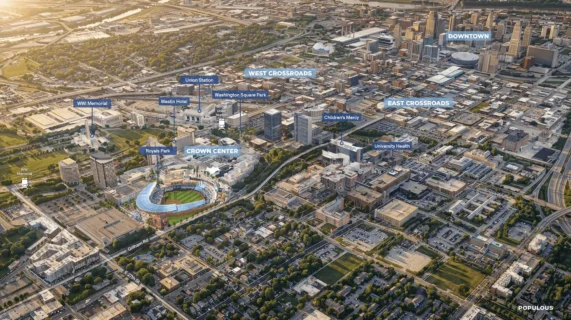
The 85-acre district will transform a major section of Crown Center into a new sports-anchored urban neighborhood.
The Royals and Hallmark plan to combine the ballpark with residential, retail, hospitality, entertainment and public spaces. The development will also connect with existing downtown infrastructure, including the Kansas City streetcar and nearby Union Station.
The project will therefore involve more than stadium construction.
Workers will have to coordinate demolition, site preparation, infrastructure and vertical construction within an active urban environment. Mortenson has specifically identified demolition, excavation and sequencing as challenges associated with building a major league ballpark within the existing Crown Center setting.
For nearby workers, residents and visitors, that means construction will bring changes to traffic, pedestrian movement and access as different parts of the district are built.
Who designed the stadium—and what will it look like?
The Royals have tapped Populous, the Kansas City–based sports architecture firm behind Kauffman Stadium, to design the new 34,000-seat ballpark and lead the overall Crown Center district plan. Early master-plan documents and renderings show a modern, open-concourse stadium oriented toward downtown, with wide pedestrian plazas, ground-floor retail and buildings wrapping the park to create a denser, walkable block pattern instead of surface parking. The design emphasizes skyline views from upper decks and terrace areas, and flexible spaces intended for concerts and community events, aiming to activate the site year-round while integrating the ballpark into the surrounding neighborhood.
When will construction start?
The Royals expect the ballpark to be completed for Opening Day 2030, with construction expected to begin in 2027.
The next phase will involve site-enabling work, demolition, excavation and infrastructure before the main stadium structure rises.
Because the stadium sits within a much larger mixed-use development, the sequencing of the district will be just as important as the stadium schedule.
The builders will have to coordinate the ballpark with surrounding streets, utilities, public spaces and future development parcels.
Jobs and local economic impact
The project is expected to create thousands of construction jobs and generate additional employment as the mixed-use district develops.
When the Royals and Hallmark unveiled the Crown Center plan in April, the team estimated that the overall development would create 20,000 construction-phase jobs. The project was also described as majority privately funded.
The September construction announcement adds another local component.
The Royals have committed to the Missouri Works Initiative, which the Greater Kansas City Building and Construction Trades Council said will expand access to construction-industry jobs and entry points for local workers.
Mortenson and McCownGordon have also said their team will work with Kansas City businesses, trade partners and workers, while Parson + Associates will support community engagement.
What happens to Kauffman Stadium?
The new Crown Center ballpark is intended to become the Royals’ new home, replacing Kauffman Stadium at the Truman Sports Complex.
The Royals currently play at Kauffman Stadium, where the team’s lease with Jackson County is set to expire in 2031. The move downtown follows the failure of a 2024 Jackson County sales-tax proposal that would have helped fund renovations to Kauffman Stadium and Arrowhead Stadium.
The Crown Center plan gives the Royals a different path: a privately led downtown development combined with public financing support for the stadium.
The Royals’ stadium project also adds another major NFL and professional sports venue to Mortenson’s growing construction portfolio. In August, Clark Construction Group, Mortenson and SmootDC were selected to build the new Washington Commanders stadium at the former RFK Stadium site in Washington, D.C. The approximately 1.8-million-square-foot, 65,000-seat enclosed venue is scheduled to begin construction in spring 2027 and reach completion in spring 2030.
What could still affect the schedule?
The 2030 opening target now has a construction team behind it, but several factors will determine whether the schedule holds.
Site work and demolition will have to progress before the major stadium structure can rise.
Infrastructure coordination will be critical because the stadium forms part of an 85-acre urban redevelopment rather than a standalone suburban site.
Financing and contract execution will also remain important as the stadium moves toward construction.
Labor and material conditions could affect costs and sequencing during the multi-year build.
The construction manager at risk structure can help control costs and schedule, but it cannot eliminate every construction risk. The final contract terms will determine how individual risks are allocated between the Royals and the construction team.
What to watch next
The immediate focus will shift from selecting the builders to mobilizing the project.
Key milestones include:
- Finalizing construction contracts and pricing.
- Advancing demolition and site-enabling work.
- Coordinating infrastructure and utility work across Crown Center.
- Beginning stadium construction in 2027.
- Developing the surrounding mixed-use district in phases.
- Keeping the stadium on track for Opening Day 2030.
The builder selection gives the Royals the teams responsible for turning the Crown Center vision into a physical development.
The bigger test now is execution: delivering a $1.9 billion stadium inside a broader $3 billion redevelopment while coordinating public infrastructure, private investment and a major urban construction program.
Factsheet: Royals Crown Center Ballpark District
- Overall redevelopment: About $3 billion
- Stadium investment: About $1.9 billion
- City commitment: Up to $600 million toward the stadium
- City funding: $90 million anticipated infrastructure funding plus $510 million in city-supported bonds
- Stadium: Approximately 1.25 million square feet
- Capacity: Approximately 34,000 seats
- Stadium construction manager at risk: Mortenson–McCownGordon joint venture
- District partner: JE Dunn
- District size: Approximately 85 acres
- Project partners: Kansas City Royals and Hallmark Cards
- Construction start: Expected in 2027
- Target opening: Opening Day 2030
- Construction-phase jobs: About 20,000 projected for the overall development

Leave a Reply