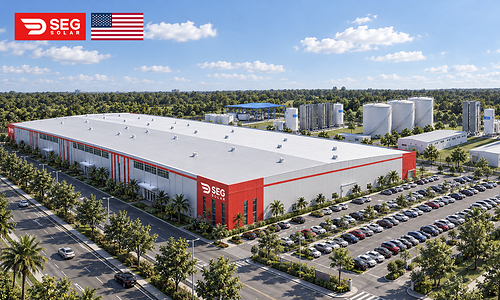
SEG Solar plans to invest $950 million in a 4-gigawatt (GW) heterojunction (HJT) solar cell manufacturing facility in Tomball, Texas, adding upstream production capacity to an industrial campus where the company already manufactures solar modules and is developing additional production lines.
The Houston-headquartered manufacturer signed a land agreement for the proposed facility at its Tomball Industrial Campus in the greater Houston area on October 29. The development is expected to create more than 700 local jobs and enter operation in two phases, each with 2 GW of annual production capacity. SEG targets the first phase for 2028 and the second for 2029.
The proposed cell factory represents a significant expansion of the campus’s manufacturing scope. Rather than concentrating on assembling finished solar modules, SEG intends to bring the production of the solar cells themselves into the same location, alongside module manufacturing and selected component production.
Cell manufacturing fills an important gap in the Texas campus
The proposed facility will sit next to two existing or developing module manufacturing operations. SEG’s Tomball #1 facility has 4 GW of annual module production capacity, while Tomball #2, which remains under construction, is designed for another 4.6 GW.
Together, the two module facilities represent 8.6 GW of planned annual production capacity. The proposed 4 GW cell factory would add an upstream manufacturing stage, although its capacity would not cover the full combined nameplate capacity of both module facilities.
The distinction matters because solar cells are the electricity-generating components inside finished photovoltaic modules. Module factories assemble these cells into panels, incorporating electrical connections, protective materials, glass and other components.
By manufacturing cells alongside modules, SEG aims to reduce its reliance on externally sourced cells and gain greater control over the origin and supply of an important part of its finished products.
The company also plans to incorporate warehousing, a research and development center, a certified testing laboratory and additional component production at the Tomball campus. Planned manufacturing lines include ethylene-vinyl acetate (EVA) film and junction boxes, both used in solar module production.
The resulting campus would combine several stages of solar manufacturing rather than operate as a standalone panel assembly site.
HJT technology gives the expansion a different manufacturing focus
The new facility will produce heterojunction solar cells, a technology that combines a crystalline silicon wafer with thin layers of amorphous silicon to improve the electrical properties of the cell.
HJT technology is designed to reduce energy losses and support high conversion efficiency. Its temperature performance and potential for bifacial module applications also make it attractive for utility-scale solar installations, where developers seek higher electricity output from available project sites.
For SEG, the choice of HJT technology is also significant because the company has already been developing HJT module production at its Texas operations.
The proposed cell factory would bring domestic cell production closer to that module manufacturing activity, allowing the company to develop a more integrated HJT supply chain.
However, the 4 GW cell capacity should not be interpreted as an additional 4 GW of finished solar module production. Cells and modules represent different stages of the manufacturing process, and the amount of cell capacity available will not necessarily match the total module capacity across the campus.
Domestic manufacturing and solar project sourcing
SEG is positioning the investment around the growing importance of domestic sourcing in the U.S. solar industry.
The country has expanded its solar module manufacturing base, but domestic production of solar cells has historically lagged behind module assembly. That imbalance has left manufacturers dependent on imported cells even as more panel factories open in the United States.
Bringing cell manufacturing into Tomball could help address part of that gap and give SEG greater control over the sourcing of materials used in its U.S.-made modules.
The development also has implications for solar developers and project owners seeking to meet domestic-content requirements associated with U.S. clean-energy incentives.
However, producing cells and modules in the United States does not automatically establish that every finished product or solar project qualifies for a particular domestic-content benefit. Eligibility depends on the applicable rules, sourcing calculations and documentation for each project.
SEG says its Texas-made modules using U.S.-produced HJT cells will give customers a more domestic supply option, with the company overseeing multiple stages of production.
Construction schedule and outstanding project details
The company has identified 2028 and 2029 as the targeted operating dates for the two manufacturing phases. However, its October 29 announcement does not provide a construction commencement date, the identity of the engineering or construction contractor, or a detailed commissioning schedule.
SEG has also not disclosed the financing structure for the planned $950 million investment or identified the principal equipment suppliers for the cell production lines.
Those details will be important in determining how quickly the project can progress from a land agreement to a functioning manufacturing operation.
The proposed investment follows the company’s earlier expansion at Tomball. SEG opened its first module manufacturing facility at the campus in August 2026 and has continued developing the second facility. The new cell factory would extend that expansion into another major stage of solar manufacturing.
If completed on the announced schedule, the development would give the Tomball campus a broader role in the U.S. solar supply chain, bringing cell production, module assembly and selected component manufacturing together at one industrial location.
The expansion of U.S. energy infrastructure extends beyond renewable energy manufacturing to the existing power-generation fleet. In a separate development, CPV Group has arranged $825 million in consolidated financing for its 1,470 MW Shore and Maryland natural-gas power plants, refinancing existing debt and lowering borrowing costs across the two facilities. The transaction highlights a parallel area of investment in the U.S. energy sector, where companies are also restructuring and strengthening the financial position of established electricity-generating assets.
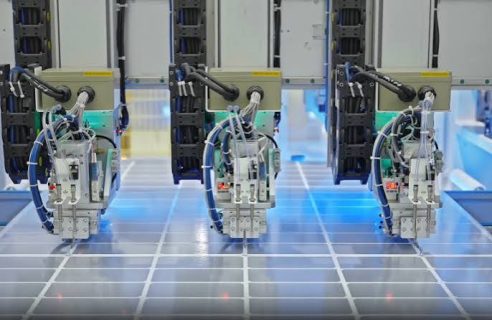
SEG Solar HJT solar cell manufacturing facility: Factsheet
- Project: SEG Solar HJT solar cell manufacturing facility
- Location: Tomball Industrial Campus, Tomball, Texas
- Developer: SEG Solar
- Planned investment: $950 million
- Manufacturing technology: Heterojunction (HJT) solar cells
- Planned annual capacity: 4 GW
- Development phases: Two phases of 2 GW each
- Target operating dates: 2028 and 2029
- Expected employment: More than 700 jobs
- Adjacent manufacturing facilities: Tomball #1 (4 GW) and Tomball #2 (4.6 GW)
- Additional planned facilities: Warehousing, R&D center, certified testing laboratory, EVA film and junction box production lines



Leave a Reply