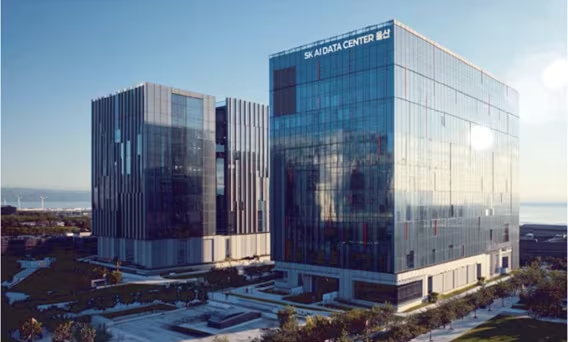
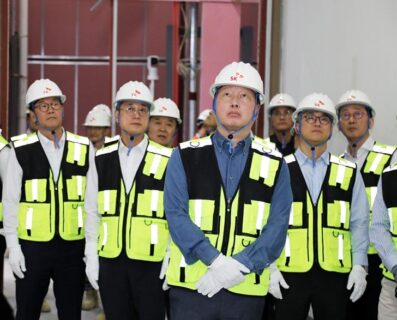
SK Group Chairman Chey Tae-won said Friday that the SK AI Data Center Ulsan, the facility SK Telecom is building with Amazon Web Services in South Korea, was nearing 900 megawatts of planned capacity. Chey told reporters at the 2026 Ulsan Forum that discussions with global technology companies were moving quickly and that an announcement could come soon.
The figure marks a sharp scale-up from the project’s original design. SK Telecom, the telecommunications arm of SK Group, launched the SK AI Data Center Ulsan as a 103-megawatt facility. In addition, the company has said the site will require about 7 trillion won ($5.2 billion) in investment, and it has positioned Ulsan as the starting point for a plan to build up to 15 gigawatts of AI data center capacity across South Korea by 2035.
SK AI Data Center Ulsan Scales Toward Gigawatt Capacity
The SK AI Data Center Ulsan is under construction on a former SK Chemicals site in the Mipo National Industrial Complex. It broke ground on August 29, 2025, with SK Telecom and its construction affiliate SK Ecoplant leading the build alongside AWS and Ulsan Metropolitan City.
The facility was originally planned to house 60,000 GPUs across a phased 103-megawatt buildout, with an initial 40-megawatt phase targeted for November 2027 and full capacity by February 2029. SK Telecom said in July that it now intends to expand the Ulsan site itself to 1 gigawatt, and to develop more than 2 gigawatts of AI data center capacity across the wider Gyeongsang region.
Thus, the near 900-megawatt figure Chey cited sits between the original plan and that expanded regional target. “Ulsan has almost come all the way to 900 megawatts,” Chey said.
Furthermore, the Ulsan cluster is only the first piece of a larger buildout. SK Telecom plans an additional gigawatt of capacity in the southwestern Jeolla region, bringing domestic capacity to 5 gigawatts by 2029 in stages, before reaching the full 15-gigawatt target by 2035.
Mipo Industrial Complex Site Draws on Existing Power and Cooling Infrastructure
The SK AI Data Center Ulsan sits on roughly 36,000 square meters of land that SK Telecom and SK Broadband purchased from SK Chemicals for 28.3 billion won ($20.8 million). Also, the site was chosen for its proximity to SK Gas’s Ulsan liquefied natural gas combined-cycle power plant, a 1,122-megawatt facility capable of supplying the large-scale, round-the-clock electricity that AI computing demands.
The facility is also designed to draw on LNG cold energy for cooling, on top of a hybrid cooling system built for racks running between 20 and 40 kilowatts each. Chey said SK Innovation is developing energy and electrification solutions specifically for AI data centers, and that the group has further partners and investment plans to expand that capacity.
Additionally, Chey suggested Ulsan’s manufacturing base could make it a testing ground for applying AI to industrial operations, pointing to SK Innovation’s Ulsan refining and petrochemical complex as a possible link between the group’s computing infrastructure and its traditional industrial business.
SK Horizon Spinoff Brings KKR and IMM Capital Into the Buildout
SK Telecom restructured its AI infrastructure business in August 2026, spinning off SK Broadband’s data center assets into a new company, SK Horizon, to house and expand its AI data center portfolio. SK Horizon’s remit covers 318 megawatts of existing capacity across eight sites, plus data centers under construction, including the SK AI Data Center Ulsan and a facility in Guro.
As a result, global investment firm KKR and the IMM Investment-Stonebridge consortium agreed to a combined 3.08 trillion won ($2.2 billion) equity investment in SK Horizon. KKR will hold a 29 percent stake and the IMM consortium 20 percent once the transaction closes, while SK Telecom retains 51 percent and management control.
Moreover, Chey warned during the forum that the AI industry needs sustainable business models to justify investment at this scale. “I am worried if we make huge investments, but there is not much return,” he said.
Staged capacity growth chasing AI and cloud demand is not confined to South Korea. In Ekurhuleni, South Africa, Teraco has spent several years steadily expanding its JB4 hyperscale data center at the Bredell Campus, which launched with just 19 megawatts of critical power load and 8,000 square meters of data hall space. Teraco has since completed a second JB4 phase adding liquid-to-liquid cooling built specifically for high-density AI workloads, taking the facility to 50 megawatts and making it the largest standalone data center on the continent. The pattern in both markets is the same: initial capacity plans keep being revised upward as AI compute demand outpaces the schedules built around it.
Project Overview
- Project Name: SK AI Data Center Ulsan
- Developer: SK Telecom (SK Group), in partnership with Amazon Web Services
- Location: Mipo National Industrial Complex, Ulsan, South Korea
- Project Type: Hyperscale AI data center campus
- Site Area: Approximately 36,000 square meters, acquired from SK Chemicals for 28.3 billion won ($20.8 million)
- GPU Capacity: Up to 60,000 GPUs
- Original Planned Capacity: 103 megawatts (phase 1: approximately 40 megawatts by November 2027; full capacity by February 2029)
- Current Status: Nearing 900 megawatts of planned capacity as of September 2026, according to SK Group Chairman Chey Tae-won
- Expansion Targets: 1 gigawatt at the Ulsan site; more than 2 gigawatts across the wider Gyeongsang region; up to 15 gigawatts nationally by 2035
- Estimated Investment: Approximately 7 trillion won ($5.2 billion) for the Ulsan project
- Power Strategy: Sited beside SK Gas’s 1,122-megawatt Ulsan LNG combined-cycle power plant; designed to also draw on LNG cold energy for cooling
- Cooling System: Hybrid cooling supporting 20 to 40 kilowatts per rack
- Construction Start: Groundbreaking held August 29, 2025
- Regulatory Framework: Designated national infrastructure under South Korea’s Act on Promotion of Data Centers for Vitalization of the Digital Economy
- Financing Structure: Held under SK Horizon, an AI data center infrastructure company spun off from SK Broadband in August 2026, with KKR and the IMM Investment-Stonebridge consortium holding a combined 3.08 trillion won ($2.2 billion) equity stake
Project Team
- Owner and Developer: SK Telecom
- Parent Group: SK Group
- Cloud and Technology Partner: Amazon Web Services
- Construction: SK Ecoplant
- Power Supply Partner: SK Gas
- Energy and Electrification Solutions: SK Innovation
- Infrastructure Holding Company: SK Horizon
- Financiers: KKR; IMM Investment-Stonebridge consortium
- Public Body: Ulsan Metropolitan City

Leave a Reply