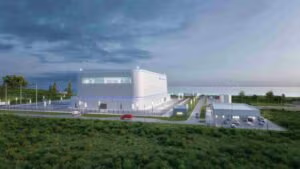
Blue Energy and GE Vernova Hitachi Nuclear Energy have advanced plans for a proposed 2.5 GW power project in Victoria, Texas, through a new agreement covering engineering design, licensing and safety analysis.
The project would use a staged generation strategy to supply a nearby data center. Blue Energy plans to bring approximately 1 GW online from two GE Vernova 7HA.02 gas turbines in 2030 before adding up to 1.5 GW from as many as five BWRX-300 small modular reactors beginning in 2032.
The agreement advances the development toward a final investment decision expected in 2027.
Gas phase would provide the first 1 GW
The project is designed to address the nearby data center’s initial electricity demand with gas-fired generation while the nuclear phase advances on a longer development path.
Two GE Vernova gas turbines would provide approximately 1 GW of power under the first phase.
Blue Energy would then expand the site with up to five BWRX-300 SMRs. The additional 1.5 GW would increase the project’s planned capacity to 2.5 GW.
That sequence forms the central strategy behind the project: establish large-scale generation earlier with proven gas turbine technology, then add nuclear capacity as the SMR phase progresses through development and deployment.
The Victoria Power Project joins a growing pipeline of large-scale power developments responding to rising electricity demand. In California, Recurrent Energy recently secured $695 million in financing to ramp up construction of its 330 MW Cobalt Solar project in Riverside County, with commercial operations targeted by the end of 2027.
Additionally, the push for dedicated power is accelerating alongside the construction of increasingly larger AI campuses. In Ohio, NVIDIA has secured infrastructure for an 8 GW AI data center campus in Pike County, where SB Energy is also advancing major new generation, including 9.2 GW of natural gas capacity. The Victoria Power Project reflects a different approach, combining natural gas and nuclear generation to help meet the enormous electricity requirements of future AI and data center development
Agreement advances the nuclear development work
The latest agreement launches the next phase of Blue Energy’s collaboration with GE Vernova Hitachi.
The companies will advance engineering design, licensing and safety analysis for the Victoria project and its planned BWRX-300 deployment.
Blue Energy’s development model also relies on prefabrication, transportation and supermodule assembly, an approach the company calls the “Blue Way.” The company says the model is intended to support more predictable project delivery through off-site fabrication and modular construction.
The agreement does not authorize full construction. Instead, it advances the work needed ahead of Blue Energy’s planned 2027 final investment decision.
Darlington provides an early reference for the reactor design
The first BWRX-300 is under construction at Ontario Power Generation’s Darlington site in Canada, providing the first construction reference for the reactor technology proposed for Victoria.
That project does not determine Victoria’s development path. The Texas project will require its own investment, licensing and project decisions before construction can proceed.
For Victoria, the next decisive milestone is the 2027 final investment decision. If Blue Energy moves forward, the company aims to begin supplying the nearby data center with approximately 1 GW in 2030, followed by the planned nuclear expansion beginning in 2032.
Victoria project factsheet
- Project: Victoria gas-plus-nuclear power project
- Location: Victoria, Texas
- Planned capacity: Up to 2.5 GW
- First phase: Approximately 1 GW
- First-phase technology: Two GE Vernova 7HA.02 gas turbines
- First-generation target: 2030
- Nuclear phase: Up to 1.5 GW
- Nuclear technology: Up to five GE Vernova Hitachi BWRX-300 SMRs
- Nuclear-generation target: Beginning in 2032
- Intended customer: Nearby data center
- Current development milestone: Engineering design, licensing and safety analysis
- Final investment decision: Expected in 2027
- Construction approach: Prefabrication, transportation and supermodule assembly
- Current status: Proposed project advancing through development


Leave a Reply