The Constitution pipeline revival project has moved into a new federal environmental review as Williams pursues renewed authorization. The proposed 125-mile natural gas pipeline would connect Pennsylvania production with markets in New York and New England. FERC released its environmental assessment in August 2026, bringing the long-delayed energy infrastructure development closer to another federal decision.
The project originally received FERC approval in 2014 but stalled after New York denied its Clean Water Act Section 401 certification in 2016. Williams later halted development, leaving the pipeline incomplete for almost a decade.
Constitution Pipeline revival project enters federal environmental review
Williams and Iroquois Gas Transmission System filed petitions seeking renewed federal certificates in December 2025 and February 2026. FERC subsequently opened a new environmental review process for both projects.
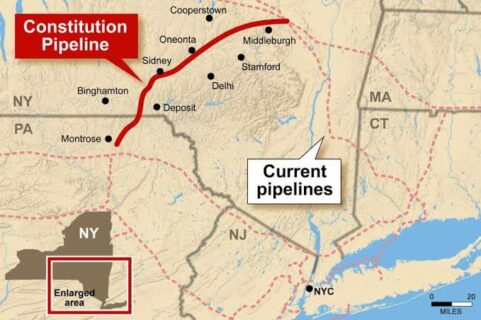
The Constitution Pipeline would include approximately 125 miles of 30-inch-diameter natural gas pipeline. Its route would cross Susquehanna County in Pennsylvania and four counties in New York.
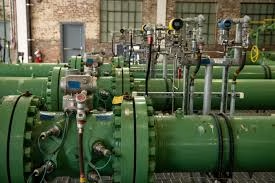
The infrastructure would also include two meter stations, 10 communication towers and 11 mainline valves. Construction would require a pig launcher, pig receiver, access roads and contractor yards.
Meanwhile, Iroquois would expand the existing Wright Compressor Station in Schoharie County. The expansion would add approximately 22,000 horsepower of compression capacity.
FERC published the environmental assessment on August 26, 2026, after releasing it for public comment. The commission said comments must reach it by 5 p.m. Eastern Time on September 21.
The assessment concluded that approving the proposed projects would not constitute a major federal action significantly affecting environmental quality. However, that finding does not itself constitute final project authorization.
Williams plans major construction activity
Williams says the Constitution Pipeline would increase firm gas supply by approximately 650,000 dekatherms per day. The company estimates that construction could support more than 2,500 jobs.
Its latest project fact sheet estimates nearly $915 million in total construction-period economic output. Williams also projects approximately $475 million in GDP contribution during the 12-month construction period.
Furthermore, the company estimates approximately $295 million in construction-related labor income. It also projects about $105 million in federal, state and local tax revenue.
Williams says the pipeline could supply the equivalent of approximately three million homes. It also argues that additional gas capacity could address regional supply constraints during periods of high demand.
However, the project still faces regulatory and legal issues. New York previously rejected its water-quality certification, while state officials have continued challenging the renewed federal review.
The renewed application therefore does not mean construction can begin immediately. FERC’s environmental review must proceed alongside outstanding regulatory and legal matters.
Constitution Pipeline Revival project faces remaining approvals
FERC’s June 2026 schedule established November 19 as the 90-day federal authorization decision deadline. The agency has therefore set a defined timetable for its next major decision.
The latest environmental assessment represents a significant change from the project’s previous regulatory position. However, the September 21 public-comment deadline remains an important step before FERC reaches its decision.
Williams has also continued advancing other Northeast gas infrastructure. The company secured key environmental permits for its separate Northeast Supply Enhancement project in 2025.
The Constitution Pipeline revival also highlights the expanding range of U.S. energy infrastructure projects under regulatory review. Alongside gas transportation projects, developers are pursuing carbon management infrastructure. ExxonMobil’s $5 billion Rose carbon capture project in Texas recently received state approval for its underground carbon storage development.
A Project Once Declared Dead
First proposed by Williams Companies, the pipeline would deliver up to 650,000 dekatherms a day to markets in New York and New England. Supporters contended it would lower energy costs, enhance reliability, and provide a cleaner alternative to heating oil.
The plan won federal approval but saw the project implode in 2016 when New York State denied a critical water quality permit, citing environmental concerns. That decision became a landmark victory for environmental advocates and a warning for other developers who face state-level opposition. Williams ultimately stopped construction, and for years, the Constitution Pipeline seemed relegated to history.
Why It’s Back
In early 2025, Williams resubmitted permit applications to both state and federal regulators, reviving discussions around the project. The move coincides with growing concerns about energy reliability and winter price spikes in the U.S. Northeast — a region that, despite its proximity to major gas reserves, often pays among the highest energy prices in the country.
The company argues that the pipeline could help stabilize gas supply, lower consumer costs, and reduce emissions by encouraging a shift away from heating oil. According to a new S&P Global analysis, construction of the pipeline could yield as much as $11.6 billion in total energy savings for consumers over a 15-year period.
Economic Case and Energy Impact
The S&P Global report estimates that the Constitution Pipeline could:
Support nearly 2,000 jobs annually (direct, indirect, and induced) over the contract period
Add $4.4 billion to gross state product (GSP) across Connecticut, Massachusetts, New York, and Rhode Island.
Generate $432 million in federal and state tax revenues.
Local gas prices could decrease by up to 6% during peak demand months, smoothing out seasonal price spikes.
“Constitution Pipeline would bring much-needed capacity to the U.S. Northeast,” said Ed Kelly, executive director of North America Gas & LNG Consulting at S&P Global. He cited that the region experiences extreme winter price spikes roughly once every five years – with prices reaching as high as 36 times of the annual average on peak days. Avoiding just one such event, the report suggests, could justify the entire project cost.
Environmental and Community Opposition
Opponents are undeterred. Environmental groups say new fossil fuel infrastructure runs counter to state climate goals, threatens water pollution, and extends the use of natural gas. Residents in communities along the route continue to express concerns about eminent domain, disruption of ecosystems, and the possibility of leaks.
Advocates counter that increased gas deliverability would actually reduce regional emissions by replacing more carbon-intensive heating oil, which emits roughly 28 percent more greenhouse gases than natural gas. The issue speaks to a larger policy tension: how to balance near-term energy security with long-term climate commitments.
An Uncertain Future
Even with renewed momentum, the project’s future is still uncertain. Williams still needs key state environmental approvals, and its progress will likely be met with legal challenges. The most optimistic projections peg the start of construction for late 2027-but that’s anything but a sure thing.
For now, the Constitution Pipeline is a case study in the broader U.S. energy transition — where questions of cost, climate, and infrastructure collide. Whether it finally gets built or not may depend less on engineering than on evolving political and environmental realities.
While the Constitution Pipeline remains under debate, Texas’ Eiger Express Pipeline is set to begin construction, with developers reaching final investment decision (FID) in August 2025, while Glenfarne’s Alaska LNG project continues to advance, Baker Hughes agreed on November 10, 2025, to supply key equipment for the development.
Constitution Pipeline Project Factsheet
Overview of Project
Developer: Williams Companies
Status: Under review (permit resubmitted early 2025)
Original Proposal: 2014, Federal approval granted, stopped 2016
Technical Specifications
Length: 135 miles
Route: Susquehanna County, PA → Schoharie County, NY
Capacity: 650,000 dekatherms/day
Purpose: To deliver Marcellus Shale natural gas to Northeast markets
Economic Projections: 15 Year Period
Consumer Savings: $11.6 billion (S&P Global estimate)
Jobs: 2,000 annually (direct, indirect, induced)
Economic Output: $4.4 billion added to regional GSP
Tax Revenue: $432 million (federal + state)
Price Impact: Up to 6% reduction during peak winter demand
Key Timeline
2014-2016: Initial permitting and federal approval
2016: NY State water quality permit denied; project halted
2025: Permit applications resubmitted
2027+: Construction could start (subject to approval)
Constitution Pipeline: Current Debate
Proponents argue:
Improved energy reliability and supply stability
Lower heating costs for consumers
Emissions reduction vs. heating oil (28% less CO₂)
Regional energy security
Opponents say:
Climate goal conflicts (new fossil fuel infrastructure)
Water quality and ecosystem risks
Eminent domain concerns
Long-term carbon lock-in
Regulatory Hurdles
NY State environmental permits (key barrier)
Federal agency reviews
Expected legal challenges
Uncertain approval timeline
Project Team
Developer: Constitution Pipeline Company, LLC.
Operator: Williams.
Pipeline infrastructure partner: Iroquois Gas Transmission System, L.P.
Federal regulator: Federal Energy Regulatory Commission.
Environmental review authority: Federal Energy Regulatory Commission under NEPA.
State environmental authority: New York State Department of Environmental Conservation.
Pipeline route: Williams and Constitution Pipeline Company facilities across Pennsylvania and New York.
Compressor facilities: Iroquois Gas Transmission System at the existing Wright Compressor Station.
Federal permitting: FERC is reviewing renewed certificates for the Constitution Pipeline and Wright Interconnect projects.
Environmental assessment: FERC staff prepared the 2026 environmental assessment.
Construction workforce: Williams estimates approximately 1,600 direct construction jobs within the broader employment estimate.


Leave a Reply