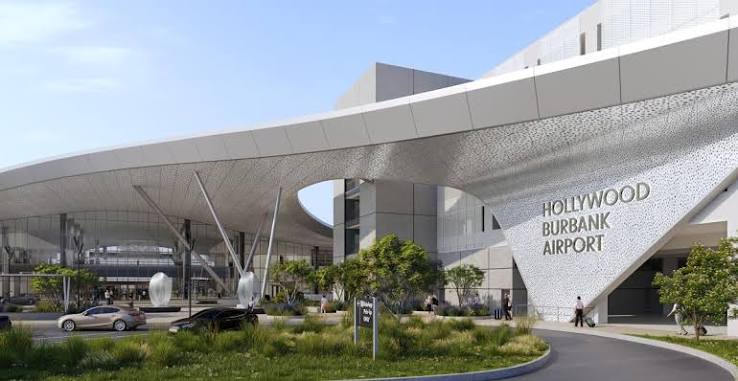
Hollywood Burbank Airport staged a full-scale rehearsal inside its new passenger terminal on Saturday, Sept. 19, walking volunteers through check‑in, security, gates and baggage claim ahead of an Oct. 13 launch for commercial flights.
Roughly 1,500 community members took part in the timed simulation, giving the airport a chance to spot bottlenecks in wayfinding, staffing and technology before real travelers begin using the 355,000‑square‑foot building.
“The main reason that we built this new terminal is safety projects. As you can imagine, a 96‑year‑old terminal does not comply with current FAA standards,” said Mike Christensen, communications manager at Hollywood Burbank Airport.
Inside the test
The exercise, held from 9 a.m. to noon at 2627 N. Hollywood Way, treated participants like passengers on a real trip: they received boarding instructions, moved through mock checkpoints and completed surveys afterward so staff could prioritize fixes. Those who took part received exclusive airport merchandise.
Airport officials described the event as a “passenger simulation trial,” designed to validate how people flow from parking through the terminal and back out again under realistic loads.
Timeline and scale
Branded “Elevate BUR,” the replacement terminal features 14 gates and about 50% more passenger space than the 1930s‑era complex it replaces.
Key dates:
- Mock flight test: Saturday, Sept. 19, 2026
- Community Day (free public preview): Thursday, Oct. 8, 2026
- Ribbon‑cutting ceremony: Monday, Oct. 5, 2026
- First commercial flights from the new terminal: Tuesday, Oct. 13, 2026
The Burbank‑Glendale‑Pasadena Airport Authority approved the roughly $1.30 billion project, one of the largest capital builds delivered by a Southern California joint powers agency in this cycle.
What’s new for passengers
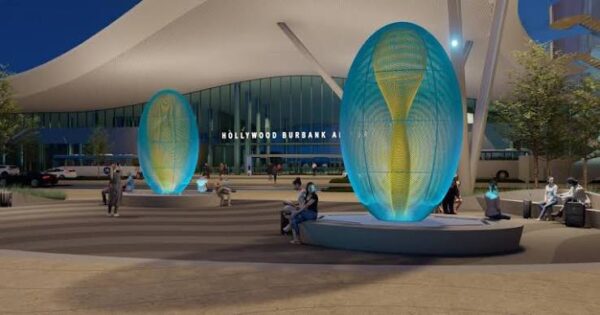
Upgrades include new restaurants and retail stores, animated digital displays, higher ceilings and wireless charging at every gate’s seating, along with modernized security lanes and baggage systems meant to ease peak‑hour congestion.
The airport handles roughly 133,000–155,000 aircraft operations and serves between 6.2 million and 6.5 million passengers annually, according to airport figures.
“We hope that the Burbank airport — the new version of it — will give us new stops further East,” said Burbank resident Gina Crawford, one of the volunteers. “This is a much more convenient airport for anybody who lives in the San Fernando Valley or on this side of the hill.”
Why this matters beyond Burbank
The new terminal arrives as Southern California gears up for major events, including the 2027 Super Bowl in Inglewood and the 2028 Summer Olympics across the region. A smoother, higher‑capacity Burbank option could relieve pressure on larger hubs while offering a faster door‑to‑gate experience for valley residents and studio crews.
Once the new building is fully operational, the airport plans to demolish the old terminal complex, which has been in service since the 1930s and no longer meets current FAA runway‑safety standards.
Partners and delivery
The new terminal was delivered by the Burbank‑Glendale‑Pasadena Airport Authority, the joint powers agency that owns and operates Hollywood Burbank Airport. Corgan served as lead architect, with CannonDesign as associate architect, while Syska Hennessy Group handled mechanical, electrical and plumbing engineering for the all‑electric facility. Jacobs is also listed among firms supporting major airport modernizations that include BUR’s replacement terminal, which is pursuing LEED Gold certification.
Financing for the roughly $1.30 billion project was approved by the Authority and is being funded through airport revenues and debt instruments typical for joint‑powers airport projects. The terminal is being delivered as an all‑electric facility with integrated solar technology, positioning it as only the second all‑electric airport terminal in the U.S. and a showcase for sustainable design ahead of the 2027 Super Bowl and 2028 Olympics.
Burbank isn’t the only mid-size U.S. airport racing to finish a new terminal this year. About 1,500 miles to the northeast, Des Moines International Airport is advancing its $557 million “Lift DSM” terminal project, a multi-phase replacement and expansion that officials expect to begin welcoming passengers in January 2027. Like Burbank, Des Moines is replacing decades-old infrastructure with a modern, higher-capacity facility designed to handle record passenger volumes and position the city for future growth
Fact sheet: Hollywood Burbank Airport’s new terminal
- Project name: Elevate BUR (Hollywood Burbank Airport Passenger Replacement Terminal)
- Location: 2627 N. Hollywood Way, Burbank, CA
- Total cost: About $1.30 billion
- Size: 355,000 square feet
- Gates: 14
- Capacity boost: Roughly 50% more passenger space than the old terminal
- Key dates:
- Mock flight test: Sept. 19, 2026
- Community Day (public preview): Oct. 8, 2026
- Ribbon‑cutting: Oct. 5, 2026
- First commercial flights from new terminal: Oct. 13, 2026
- Why rebuild: The 96‑year‑old terminal does not meet current FAA runway‑safety standards; the new facility is designed for compliance and modern operations.
- Passenger amenities: New dining and retail, animated digital displays, higher ceilings, wireless charging at every gate seat, modernized security and baggage handling.
- Annual traffic (recent range): About 133,000–155,000 aircraft operations; 6.2–6.5 million passengers.
- Next step after opening: Demolition of the old terminal complex once the new building is fully operational.

Leave a Reply