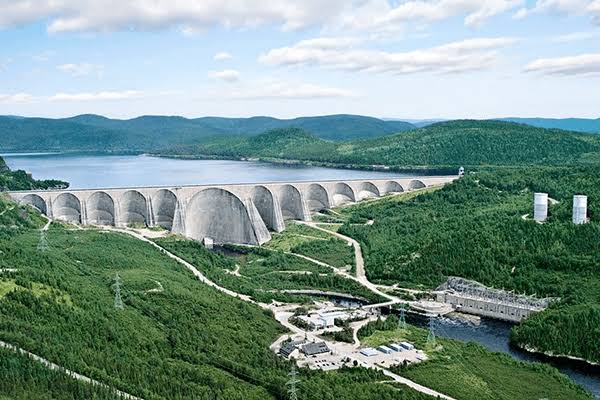
New York City is now receiving electricity generated hundreds of miles away in Quebec through a transmission system buried beneath roads, rail corridors and waterways.
The Champlain Hudson Power Express (CHPE) is a 339-mile high-voltage direct current (HVDC) transmission system that began commercial operation in May 2026. It can deliver up to 1,250 megawatts of hydropower to New York, enough to supply roughly 20% of the city’s electricity demand and more than 1 million homes.
Unlike conventional transmission projects that rely on large overhead towers, CHPE is almost entirely underground or underwater. Its final destination is a converter station in Astoria, Queens, where electricity is converted for use on New York City’s existing grid.
How does the power get from Quebec to New York?
The journey begins at existing hydropower facilities in Quebec.
Electricity generated by Hydro-Québec initially travels through the Canadian grid as alternating current. At the Hertel substation, it is converted to HVDC for the long-distance journey to New York.
HVDC is particularly suited to long transmission corridors because it can move large amounts of electricity efficiently over long distances.
From Quebec, the cables cross into New York near Lake Champlain. The system then continues for roughly 339 miles through underground and submarine sections.
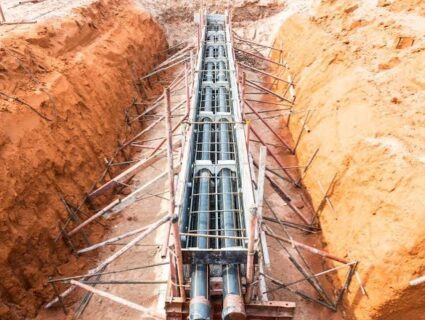
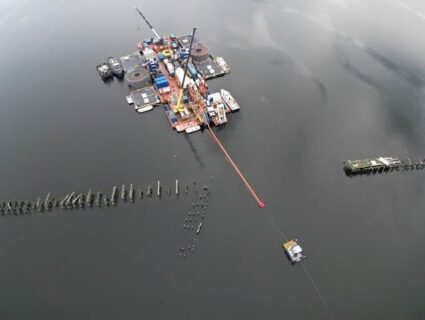
About 193 miles of cable runs beneath lakes and rivers, including Lake Champlain, the Hudson River and the Harlem River. Another roughly 146 miles is underground, primarily within existing road and railroad rights-of-way.
Why was the line buried?
The decision to bury CHPE was driven by both engineering and land-use considerations.
New York has faced significant resistance to new overhead high-voltage transmission corridors, particularly in populated and scenic areas. Putting the cables underground and underwater avoids large new towers and reduces the project’s visible footprint.
The approach, however, creates its own construction challenges.
Across New York, crews installed about 147 miles of underground transmission line using conventional trenching and trenchless techniques. Horizontal directional drilling allowed the project to pass beneath sensitive areas and existing infrastructure without opening the entire surface corridor.
The construction required coordination with landowners, railroads, utilities and regulators across numerous jurisdictions.
Crews also built and later removed more than 100 miles of temporary heavy-haul access roads. More than 300 horizontal directional drilling crossings covered nearly 400,000 feet.
What happens when the electricity reaches New York City?
The transmission line ends at the Astoria Converter Station in Queens.
This is where the system’s HVDC electricity is converted back into alternating current, the form used by the local power grid.
Electricity arrives at Astoria as 345-kV DC. The converter station changes it to high-voltage AC before sending it through the New York Power Authority’s Astoria Annex substation.
From there, the electricity enters the local system and mixes with other power before reaching customers through Con Edison’s distribution network.
Kiewit served as the engineering, procurement and construction partner for the converter station, working with Hitachi Energy on the HVDC technology.
How much electricity does CHPE deliver?
At full capacity, CHPE can deliver 1,250 MW.
State officials estimate that the project will provide about 10.4 terawatt-hours of clean energy annually, potentially supplying up to 20% of New York City’s electricity needs.
The project is also expected to reduce carbon emissions by about 37 million metric tons through 2040.
Its significance goes beyond the amount of electricity delivered. CHPE allows New York City to bring large amounts of renewable power into the city without constructing a new overhead transmission corridor across the state.
What does CHPE mean for New York’s grid?
CHPE is part of New York’s broader effort to increase renewable electricity and reduce reliance on fossil-fuel generation.
The project is classified as a Tier 4 project under the state’s Clean Energy Standard, which is designed to bring large-scale renewable electricity into New York, particularly for downstate demand.
The system also demonstrates how electricity demand in major cities can be connected to remote energy resources. Instead of generating all the additional power near consumers, transmission can move electricity from areas with abundant generation to areas with high demand.
That model is increasingly relevant as cities add new electricity loads, including data centers and other energy-intensive infrastructure.
Why the project matters
CHPE is essentially an invisible piece of major energy infrastructure.
Most New Yorkers will not see the cables carrying electricity beneath the ground or under rivers. Yet the system creates a direct connection between Quebec’s hydropower resources and New York City’s electricity network.
The project also demonstrates the complexity of building long-distance transmission in densely developed regions. Hundreds of miles of cable, waterways, roads, rail corridors, permits and interconnections had to be coordinated before the system could begin operating.
With commercial operation now underway, CHPE provides a working example of how large blocks of electricity can travel across borders and into a major urban power market without relying on a new network of overhead transmission towers.
The completed CHPE project also offers a useful comparison with the transmission expansion now proposed in the Upper Midwest. While CHPE moves hydropower from Quebec into New York City, PowerOn Midwest is designed to strengthen the regional grid across South Dakota and neighboring states as electricity demand grows. The two projects use different technologies and serve different markets, but both show how transmission is becoming critical to connecting large power resources with the places where electricity is needed.
Project Partners
- Kiewit Corporation: Primary engineering, procurement and construction contractor for the New York portion, including about 147 miles of underground transmission line and the Astoria Converter Station in Queens.
- Hitachi Energy: Technology partner providing the specialized HVDC technology and engineering for the Astoria converter station.
- Hydro-Québec: Supplies the hydropower generated in Quebec for delivery to New York City.
- HDD subcontractors and project stakeholders: Four horizontal directional drilling subcontractors supported underground crossings, while utilities, railroads and New York State and New York City agencies supported construction across the route.
Project Factsheet: Champlain Hudson Power Express
- Project: Champlain Hudson Power Express (CHPE)
- Type: HVDC transmission system
- Length: 339 miles
- Route: Quebec → Lake Champlain → Hudson and Harlem rivers → Astoria, Queens
- Capacity: 1,250 MW
- Annual energy: About 10.4 TWh
- Potential NYC supply: Up to 20% of city electricity demand
- Underground cable: About 146 miles
- Submarine cable: About 193 miles
- Construction start: November 2022
- Commercial operation: May 13, 2026
- Converter station: Astoria, Queens
- Estimated total cost: About $6 billion
- Policy classification: Tier 4 under New York’s Clean Energy Standard


Leave a Reply