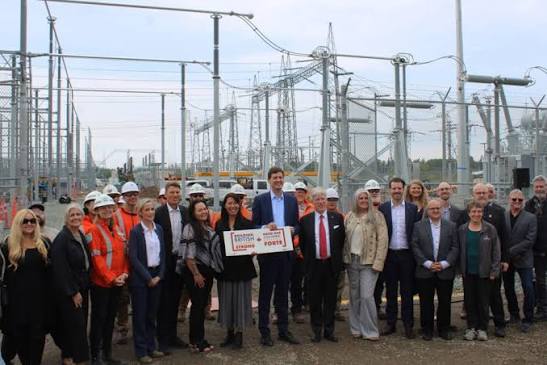
Construction has begun on the first phase of British Columbia’s North Coast Transmission Line (NCTL), a major grid expansion designed to more than double transmission capacity in northern B.C. and support new industrial development across the region.
Phase 1 covers a 165-kilometre, 500-kilovolt transmission segment between the Williston Substation near Prince George and the Glenannan Substation west of Fraser Lake. BC Hydro is developing the project in multiple phases, with Phase 2 planned to extend the expanded transmission system farther west toward Terrace.
The federal government and British Columbia have committed $3.9 billion toward Phases 1 and 2 through the Canada–British Columbia Co-operative Prosperity Agreement. The funding will support the expansion of the province’s electricity network as demand from mining, LNG, ports and other emerging industries continues to grow.
The NCTL addresses a capacity constraint on the existing 500-kV transmission system between Prince George and Terrace. Once Phases 1 and 2 are complete, the expanded system is expected to more than double the availability of clean electricity along B.C.’s North Coast.
Phase 1 Targets 2030 Completion
Phase 1 is scheduled for completion by mid-2030, while construction on Phase 2 is expected to begin in 2027 and reach completion by winter 2032.
The project has already moved through several major development milestones. In November 2025, the Canada Infrastructure Bank provided BC Hydro with a $139.5 million loan to accelerate pre-construction activities, including engineering, route clearing and consultations with First Nations.
The federal government also referred the NCTL to the Major Projects Office on November 13, 2025, recognizing the transmission project as nationally significant infrastructure for northern British Columbia and Canada’s critical-minerals sector.
The transmission expansion will provide additional electricity capacity for industrial developments that require large amounts of power. The federal government specifically identified the Ksi Lisims LNG project and critical-minerals developments in B.C.’s Golden Triangle among the projects that could benefit from the expanded grid.
North Coast Transmission Line Project Expected to Support Thousands of Jobs
Beyond the transmission infrastructure itself, the NCTL is expected to support substantial economic activity by enabling industrial projects across northern B.C.
The project is expected to support approximately 9,700 direct full-time jobs associated with industrial developments enabled by the additional transmission capacity. Construction across Phases 1 and 2 could employ as many as 1,400 workers at peak activity.
British Columbia also expects the industrial development supported by the expanded grid to contribute nearly $10 billion annually to provincial GDP and generate approximately $950 million per year in provincial and municipal revenue.
The expanded transmission system is also expected to reduce emissions by as much as 3 million tonnes annually, according to the federal government.
First Nations Set to Take Ownership Stake
Indigenous participation forms a significant part of the project’s development model.
First Nations could co-own up to 50% of the new transmission line, with the project partners working to finalize ownership agreements by the end of 2026. The ownership structure would give participating First Nations a direct economic stake through returns, jobs, capacity-building opportunities and long-term revenue.
The Lheidli T’enneh First Nation is among the Indigenous partners helping advance the project.
The federal and provincial governments have positioned the NCTL as part of a broader effort to develop northern British Columbia while diversifying trade and reducing the province’s economic dependence on the United States.
The transmission project also forms part of B.C.’s Look West strategy, which identifies major infrastructure investments intended to strengthen connections with Pacific markets and support the province’s mining, energy and trade sectors.
NCTL Forms Part of Broader Northwest Infrastructure Push
The NCTL also sits within the planned Northwest Critical Conservation Corridor, which the federal government says will support critical-minerals and energy development alongside telecommunications, transportation and clean-power infrastructure in northwest B.C. and Yukon.
The project builds on existing transmission infrastructure through separate upgrades to the Northwest Transmission Line system. Federal funding announced through the First and Last Mile Fund will support those upgrades and complement the NCTL expansion.
With Phase 1 now entering construction, the project moves from engineering and preparatory work into physical development of the expanded transmission network. The next major milestone will be the planned start of Phase 2 construction in 2027, extending the upgraded system toward Terrace.
North America’s Transmission Buildout Accelerates
The North Coast Transmission Line reflects a broader wave of transmission investment driven by rising electricity demand across North America. While the B.C. project will expand clean-power access for industrial growth in western Canada, major U.S. transmission projects are also adding capacity across increasingly constrained regions.
That trend extends to Idaho and Nevada, where the Southwest Intertie Project-North has broken ground on its final 285-mile, 500-kV transmission segment. The project will strengthen the western power grid by adding long-distance transmission capacity between the two states, highlighting the push across North America to build larger networks as electricity demand grows.
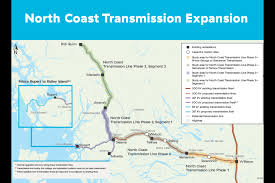
Project Facts: North Coast Transmission Line (NCTL)
- Developer: BC Hydro
- Location: Northern British Columbia, Canada
- Phase 1: 165 km
- Voltage: 500 kV
- Phase 1 route: Williston Substation near Prince George to Glenannan Substation near Fraser Lake
- Phase 1 completion: Mid-2030
- Phase 2 construction: Expected to begin in 2027
- Phase 2 completion: Winter 2032
- Federal/provincial commitment: $3.9 billion for Phases 1 and 2
- CIB financing: $139.5 million loan for pre-construction activities
- Peak construction workforce: Up to 1,400 workers
- Direct full-time jobs supported by industrial development: Approximately 9,700
- Expected annual provincial GDP contribution: Nearly $10 billion
- Expected annual provincial and municipal revenue: Approximately $950 million
- Potential annual emissions reduction: Up to 3 million tonnes
- First Nations ownership: Up to 50% of the new transmission line


Leave a Reply