Constructionreview

Blog

  • Girgarre Solar Farm Victoria Now Fully Operational: A Milestone for Clean Energy in Australia

    Girgarre Solar Farm Victoria Now Fully Operational: A Milestone for Clean Energy in Australia

    The completion of the Girgarre Solar Farm Victoria, a $140 million renewable energy project in the heart of the state, is a major step forward in Australia’s clean energy transition. Now generating electricity and feeding power into the national grid, the solar farm strengthens Victoria’s shift toward locally produced, sustainable energy.

    Project Overview

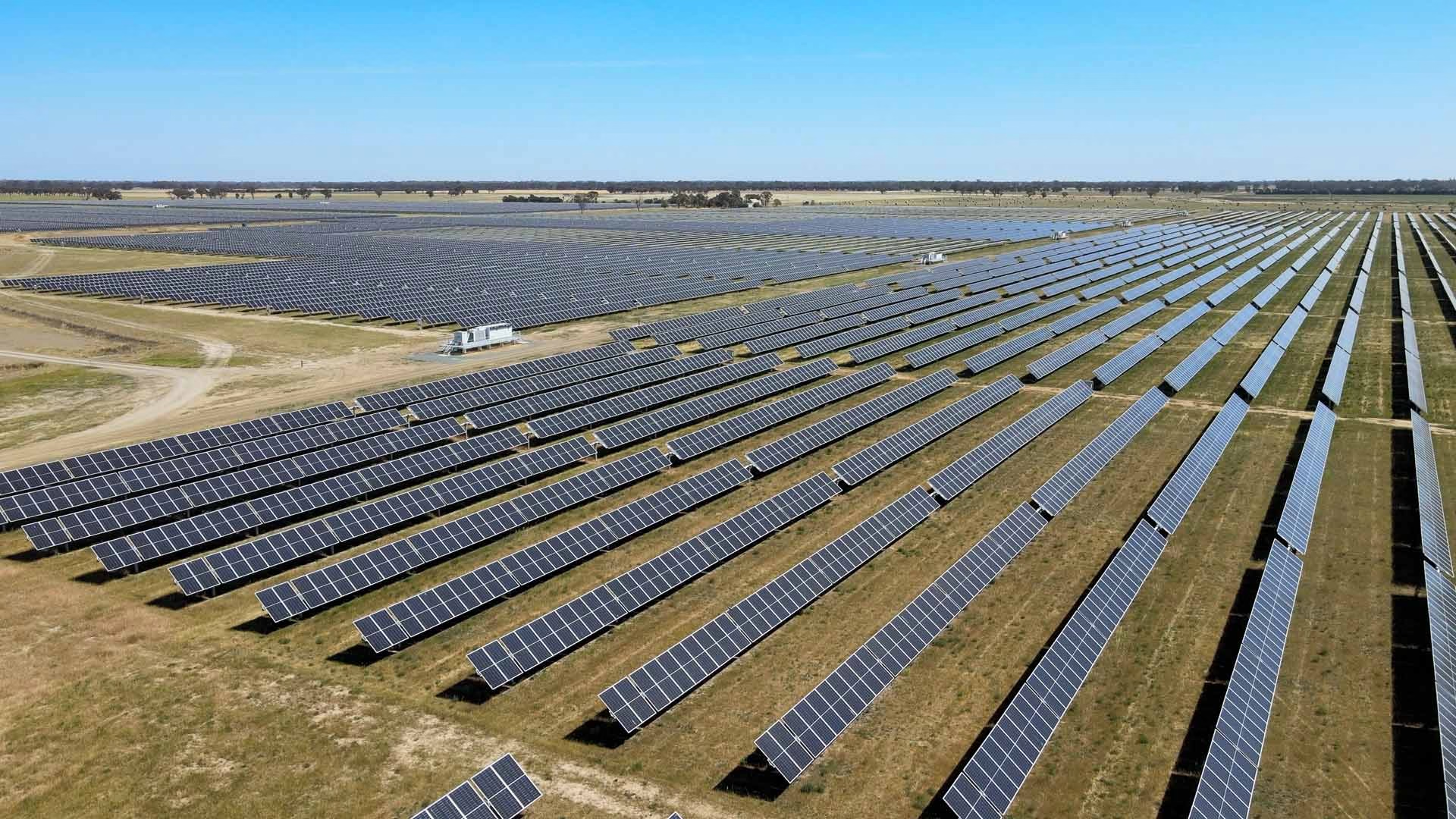
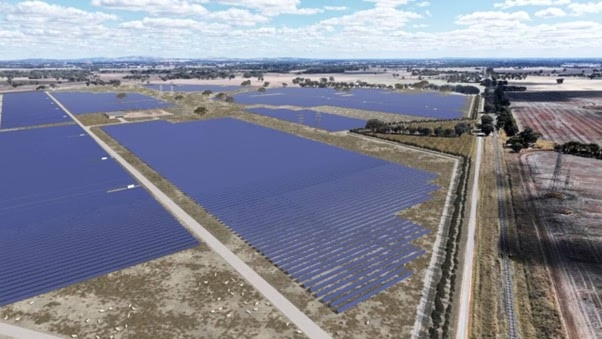
    Located approximately 50 km west of Shepparton in central Victoria, the Girgarre Solar Farm Victoria spans 250 hectares and features over 169,000 bifacial photovoltaic (PV) modules. With a capacity of 93 MW, it will generate around 200 GWh of clean energy annually—enough to power over 43,000 homes across Victoria.

    Construction and Commissioning Timeline

    Construction of the project began in September 2023, led by Victoria-based EPC contractor Beon, with commissioning  in May the following year. The solar farm has now reached full operational status. Nearly 50% of the workforce during construction was sourced from the local region, delivering both environmental and economic benefits. In September 2025 the 250MW Goorambat East Solar Farm also located in Victoria is now ready for commissioning increasing the number of operational solar farms in the state.

    picture
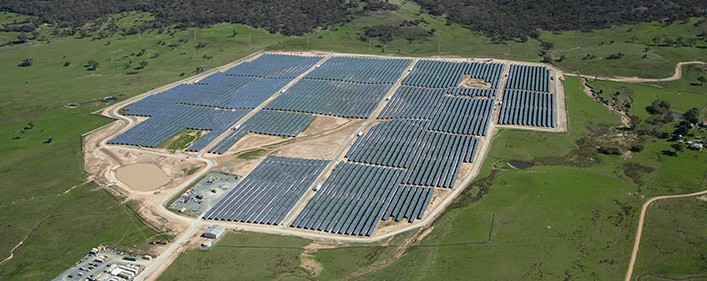
    380 MW Aldoga Solar Farm in Australia Completed 7 Months Ahead of Schedule

    Power Purchase Agreement and Energy Security

    Electricity from the Girgarre Solar Farm Victoria is already secured under a long-term power purchase agreement (PPA) with Japanese-owned retailer SmartestEnergy. This PPA ensures a steady market for the clean power and provides long-term investment stability.
    Potentia Energy’s Growing Project Portfolio

    Girgarre is the fourth completed solar project in Australia for Potentia Energy (formerly Enel Green Power). Previous projects include:

    • Bungala One and Two in South Australia (220 MW combined)
    • Cohuna Solar Farm in Victoria (27 MW)

    Potentia is also working on several large-scale developments including:

    • Quorn Park Hybrid Project in NSW (96 MW solar + 20 MW / 40 MWh battery)
    • 75 MW Wind Farm in WA
    • Battery storage projects in QLD and SA ranging from 125 MW / 500 MWh to 300 MW / 1,200 MWh

    These projects are part of Potentia’s broader pipeline of over 7 GW of renewable energy initiatives across Australia.

    Leadership Perspective

    “This project has been many years in the making, but the renewable energy now flowing from Girgarre Solar Farm Victoria is powering homes and businesses across Victoria, supporting Australia’s transition to a sustainable energy future.”
    — Werther Esposito, CEO, Potentia Energy

    Fact Sheet: Girgarre Solar Farm Victoria

    Location: 50 km west of Shepparton, Victoria
    Capacity: 93 MW
    Annual Output: ~200 GWh
    Homes Powered: ~43,000
    Solar Panels: ~169,000 bifacial PV modules
    Site Area: 250 hectares
    Cost: Over $140 million (USD $90.9 million)
    Developer: Potentia Energy
    PPA Partner: SmartestEnergy
    Construction Began: September 2023
    Commissioning Began: May 2024
    Fully Operational: May 2025

  • KeNHA Commences 749-Kilometer Elwak-Modogashe Road Construction

    KeNHA Commences 749-Kilometer Elwak-Modogashe Road Construction

    Several months after securing funding from both the World Bank and the African Development Bank (AfDB), the Kenya National Highways Authority (KeNHA) has officially launched the construction of the Elwak-Modogashe Road Construction Project (Isiolo–Mandera road).

    This major infrastructure project spans 749 kilometers and comes with a price tag of Ksh85 billion. It is set to link four counties in northern Kenya: Isiolo, Wajir, Garissa, and Mandera.

    Elwak-Modogashe Road Construction Project Factsheet

    Length: Approximately 749 kilometers

    Route: The highway connects four counties: Isiolo, Garissa, Wajir, and Mandera. It spans key towns including Isiolo, Kulamawe, Modogashe, Samatar, Wajir, Tarbaj, Kutulo, El Wak, Rhamu, and Mandera.

    Phased implementation: The project is being carried out in four main phases:

    • Isiolo–Kulamawe–Modogashe: Approximately 200 kilometers. The Isiolo-Kulamawe (77km) and Kulamawe-Modogashe (118km) sections have seen construction works begin.
    • Modogashe–Samatar–Wajir
    • Wajir–Tarbaj–Kutulo–Elwak
    • Elwak–Rhamu–Mandera: The 140-kilometer El Wak–Rhamu section has resumed construction after previous delays due to security concerns.

    Funding:

    • Cost: The entire 749-kilometer road is estimated to cost KSh 85 billion.

    Major funders:

    World Bank: Approved approximately US$756.3 million (KSh 81 billion) in 2020 for the upgrade of a 365km section of the Isiolo–Mandera Road and 30km of spur roads, as well as the installation of a fiber optic cable.

    African Development Bank (AfDB): Provided a KSh 27.5 billion (US$215 million) loan for the 140-kilometer El Wak–Rhamu section.

    Timelines:

    • World Bank approval Date: September 8, 2020
    • Project effectiveness date: December 22, 2020
    • Planned completion date: June 30, 2028 (for the entire Isiolo-Mandera corridor). The El Wak-Rhamu section has a planned completion date of June 29, 2027.

    Also read: KeNHA Resumes Construction on the 122-Kilometer Mamboleo Junction-Miwani-Chemelil-Muhoroni-Kipsitet Highway

    Recent footage captured ongoing construction activities, with engineers actively monitoring the progress to ensure the project follows the outlined specifications and plans.

    The Road to be Implemented in Four Phases

    The development is being implemented in four stages. The first segment, stretching 200 kilometers from Isiolo through Kulamawe to Modogashe, is currently 40 percent finished.

    The next phase will cover the Modogashe–Samatar–Wajir section. Phase three will extend from Wajir through Tarbaj and Kutulo to Elwak, while the final segment will connect Elwak to Rhamu and Mandera.

    Significance of the Project

    This road is intended to enhance the movement of people and goods while also improving digital connectivity and access to essential services for communities along the route.

    A KeNHA representative noted that the new highway will strengthen links with northern neighbors such as Somalia, Ethiopia, Eritrea, and Djibouti. “Before these roads were introduced, the northern region often felt isolated from the rest of Kenya. But when discussing international trunk roads, we must consider connections to countries like Somalia and Ethiopia,” the official remarked.

    Also read: Kenya’s 170-Kilometer Nakuru-Nairobi Highway Construction to Commence in July

    KeNHA also mentioned that most of the 60-meter-wide road passes through public land. Nonetheless, the agency confirmed that individuals encroaching on the land would be relocated to facilitate construction.

    In addition, engineers have begun laying down a high-capacity optical fibre cable along the highway to enhance internet connectivity throughout the region.

    Signing of the Elwak-Modogashe Road Construction Agreement

    The agreement for the highway and fibre optic installation was initially signed in March 2021 between the Kenyan government, represented by the Frontier Counties Development Council (FCDC), and the World Bank. Following the agreement, the World Bank released Ksh81 billion to support the road network under the Horn of Africa Gateway Development Project (HoAGDP).

    Also read: Kenya Secures $215 Million El Wak-Rhamu Road Construction Funding

  • Granite Construction Lands $26M Contract to Upgrade SFO Taxiway Infrastructure

    Granite Construction Lands $26M Contract to Upgrade SFO Taxiway Infrastructure

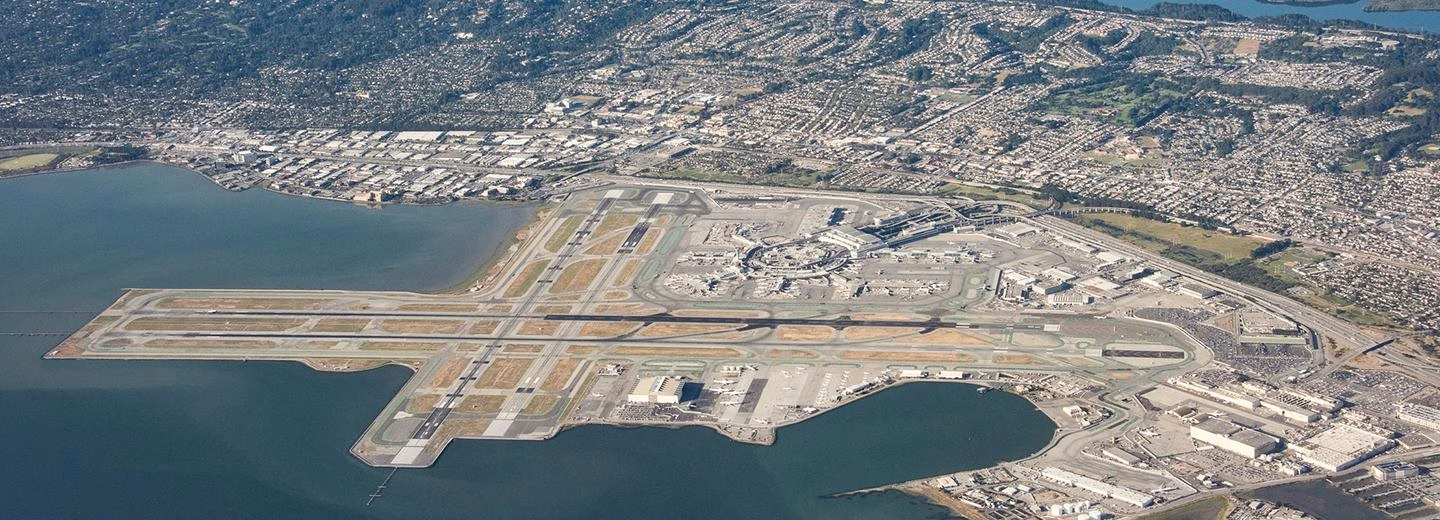
    Granite Construction Inc has been awarded a US$26 million contract by San Francisco International Airport (SFO) to rehabilitate Taxiway Z and a portion of Taxiway S. This project, funded by SFO, is part of the airport’s Capital Improvement Program (CIP), which aims to modernize and improve infrastructure, including runways, taxiways, and terminals.

    Scope of the Rehabilitation Project

    In addition, the project encompasses the reconstruction of asphalt concrete pavement, replacement of airfield lighting with energy-efficient LED systems, modernization of signage, a 12kV electrical duct bank upgrade, and enhancements to pavement markings and drainage systems. Additionally, ranite’s Santa Clara hot plant will supply 24,105 tons of hot mix asphalt for the project. Construction is scheduled to commence in August 2025 and conclude by November 2025.

    Granite’s collaboration with SFO on this project aligns with the objectives of the company; trust, transparency, early contractor collaboration, and alternate delivery methods. Furthermore, this partnership supports Granite’s long-term goal to participate in additional alternate procurement projects with SFO, leveraging established relationships to deliver longer projects while minimizing risk.

    Also Read Pittsburgh International Airport US$1.57 Billion Terminal Transformation

    Strategic Collaboration and Long-Term Goals

    As part of its commitment to sustainability, Granite will utilize materials from its nearby Santa Clara hot plant, ensuring high-quality materials and efficient delivery. Further, this approach not only supports local industry but also reduces transportation emissions associated with material delivery. 

    “We are excited to be part of this critical infrastructure project at SFO. Our collaboration with SFO on the Taxiway Z Rehabilitation Project underscores our commitment to delivering exceptional projects and advancing the safety and efficiency of airport operations,” said Brent Fogg, the vice-president of regional operations at Granite.

    Overview of the Granite Construction SFO Project

    Contractor: Granite Construction Inc.

    Client: San Francisco International Airport (SFO)

    Contract Value: Approximately $26 million

    Funding Source: San Francisco International Airport

    Construction Timeline: August 2025 – November 2025

    Location: San Francisco, California

    Taxiways Involved: Rehabilitation of Taxiway Z and a portion of Taxiway S

    Key Upgrades:

    Full-depth reconstruction of asphalt concrete pavement

    Replacement of airfield lighting with energy-efficient LED systems

    Modernization of signage systems

    Upgrade of a 12kV electrical duct bank

    Enhanced pavement markings

    Improved drainage systems

  • Houston Ship Channel Project 11 expansion Secures $131 Million Boost

    Houston Ship Channel Project 11 expansion Secures $131 Million Boost

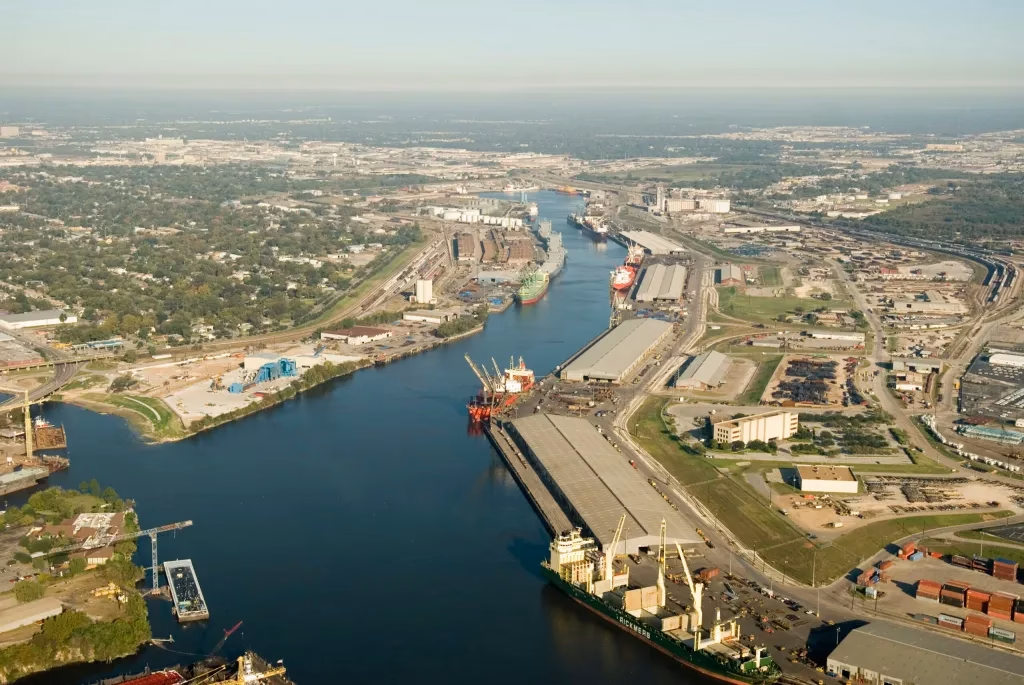
    The US Army Corps of Engineers (USACE) has earmarked a substantial US$131 million in its Fiscal Year 2025 work plan for the Houston Ship Channel Project 11 expansion. This allocation includes US$33 million dedicated to the ongoing construction of Project 11 and an additional US$98 million for operations and maintenance to ensure the channel remains navigable through regular dredging. Project 11 aims to widen and deepen the channel, facilitating the accommodation of larger vessels and bolstering the efficiency of Maritime Commerce.

    Assumption of Maintenance Approval and Financial Implications

    In a significant development, the USACE has approved the federal Assumption of Maintenance (AOM) for Segment 1B of the Houston Ship Channel, stretching from Redfish Reef to Bayport Terminal. This follows the earlier approval of Segment 1C, from Bayport to Barbours Cut Ship Channel, in 2022. These approvals culminate a nearly five-year collaborative effort and are projected to save Port Houston a net present value of approximately US$380 million over the next half-century. The dredging activities for Segment 1C will conclude by late Q2 and early Q3 of 2025, marking the completion of Port Houston-led portions of Project 11. 

    Also Read Kinder Foundation’s $150M Gift to Launch Nation’s Largest Pediatric Cancer Center in Houston

    Environmental Initiatives and Sustainability Efforts

    Port Houston is actively pursuing environmental sustainability alongside infrastructural enhancements. The port has introduced 20 clean diesel yard tractors at both Barbours Cut and Bayport Terminals, replacing older, less efficient models. Furthermore, Project 11 incorporates several ecological initiatives, such as the construction of new bird islands, marshes, and oyster reefs, utilizing dredged materials beneficially. These efforts will improve regional air quality by reducing vessel emissions through more efficient navigation and decreased congestion.

    Also Read North Houston Highway Improvement Project (NHHIP)

    Strategic Importance of the Houston Ship Channel

    The Houston Ship Channel stands as a critical asset to national commerce, being the busiest US port in terms of waterborne tonnage. Its capacity to handle increasing cargo volumes and larger ships is vital for supporting the region’s economic growth and the nation’s supply chain. Over US$ 50 billion has been invested by employers and manufacturers at the Port of Houston to accommodate the rising demand for exports and imports. Additionally, an intriguing aspect of Project 11 is its commitment to environmental stewardship, with nearly 100% of the non-silt material dredged from the Galveston Bay portion being used to create and enhance local habitats. 

    Houston Ship Channel Project 11 expansion Project Overview

    Objective: Widen and deepen the Houston Ship Channel to accommodate larger vessels and enhance navigation safety.

    Scope: The 11th major expansion of the channel, known as Project 11, aims to improve approximately 41 miles of the 58-mile channel system.

    Funding: The U.S. Army Corps of Engineers allocated $131 million in its Fiscal Year 2025 work plan for the project, including $33 million for construction and $98 million for operations and maintenance.

    Timeline: Construction began in 2021, with key segments targeted for completion by November 2025.

    Job Creation: Project 11 anticipated to support approximately 3.37 million jobs.

    Economic Value: The Houston Ship Channel contributes an estimated $906 billion in annual economic value.

    Port Activity: The Port of Houston is the busiest U.S. port by waterborne tonnage, handling more vessel traffic than the next three largest U.S. ports combined.

    Also Read Crusoe Secures Additional $11.6B to Expand AI Data Center Campus in Abilene, Texas

  • Wärtsilä to Develop 30MW Victoria Island Power Plant in Lagos, Nigeria

    Wärtsilä to Develop 30MW Victoria Island Power Plant in Lagos, Nigeria

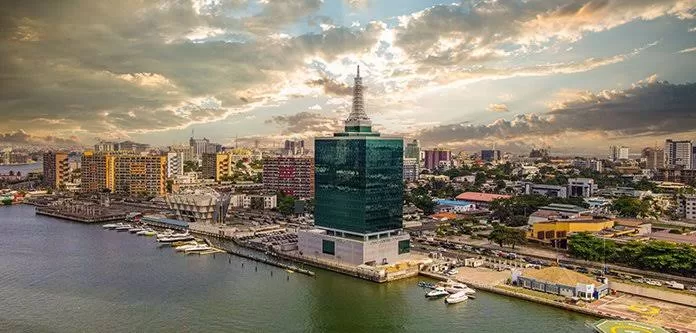
    Technology group Wärtsilä is expected to supply power generation equipment for a new 30 MW Victoria Island Power Plant that is being constructed in Lagos by a Nigerian independent power producer (IPP).

    Additionally, Wärtsilä is expected to operate and maintain the power plant for a duration of five years on behalf of the customer. Furthermore, the engineering, procurement, and construction (EPC) responsibility, together with the operation and maintenance (O&M) agreement, has been awarded to Wärtsilä by Victoria Island Power Ltd (VIPL). This company is the special purpose company incorporated by Lagos-based Elektron Energy for this project. The equipment supply contract had been booked earlier by Wärtsilä in Q4 2024.

    Victoria Island Power Plant Project Factsheet

    Location: Victoria Island, Lagos, Nigeria

    Capacity: 30 MW

    Technology: Reciprocating Internal Combustion Engine (RICE) technology. The facility will initially comprise three Wärtsilä 34SG gas engine-generator sets, with provision for one additional engine-generator set in the future.

    Fuel source: Natural Gas

    Project developers/owners:

    • Victoria Island Power Ltd. (VIPL), a Special Purpose Company incorporated by Lagos-based Elektron Energy.
    • Elektron Energy (conceptualized, developed, and funded the IPP).
    • EPC (Engineering, Procurement, and Construction) Contractor: Wärtsilä
    • Operations & Maintenance (O&M): Wärtsilä will operate and maintain the power plant for a period of five years

    Timelines:

    • Clearing and preparation activities at the site are due for completion within Q2 2025.
    • Construction is expected to start after Q2 2025.
    • Commissioning is expected 15 months after construction commences (estimated Q3/Q4 2026).
    • The O&M agreement is timed to commence prior to the new build project reaching commercial operations date (COD)

    Funding Partners/Institutional Investors:

    • ARM Harith Infrastructure Fund LP
    • Nigerian Sovereign Investment Authority (NSIA)
    • InfraCredit
    • Bank of Industry
    • FBN Quest
    • Stanbic Infrastructure Partners

    Also read: Implementation of 4 GW Worth of Power Stations in Lagos

    The Power Plant to be Embedded within Eko Electricity Distribution Company

    The power plant running on natural gas will be embedded within the Eko Electricity Distribution Company (EKEDC) at their NEPA Close Site. Additionally, it has been developed via the collaborative efforts of Elektron Energy and their local partners. The upcoming plant will enhance the availability and reliability of power supply to the consumers served by EKEDC. Also, VIPL has secured power purchase agreements (PPAs) with individual customers on a service-based tariff philosophy.

    “I was impressed by Wärtsilä’s state-of-the-art manufacturing facilities during my visit to the Sustainable Technology Hub in Vaasa, Finland in late Q3 2024 . Indeed I am happy with the readiness of the engine-generator sets. In parallel, clearing and preparation activities at the NEPA Close Site are going on well and are expected to be completed within Q2 2025, after which construction can start. Commissioning of the project is expected 15 months thereafter. As for the Operations & Maintenance agreement, it is timed to commence begin to the new build project reaching commercial operations date (COD)”, Deen summarised.

    Also read: Nigeria’s Geregu Power Plc Seeks to Increase its Capacity to 1.2 GW with Geregu 1 Power Plant Upgrade and the Birth of Geregu 3

    “Wärtsilä’s major competence in the engine power plant and services aspects indicate a unique combination of a global company with a local presence that provides developers and financiers the comfort to invest and gives end-customers the confidence to sign up for PPA’s with medium to long-term tenures. The Wärtsilä solution is widely adopted by industrial, utility & IPP customers worldwide and the excellent credentials and track record have been recognised as a great value proposition by lenders, insurance companies, and multi-lateral funding institutions,” said Marc Thiriet, Energy Business Director, Africa at Wärtsilä Energy.

    The Facility to have 34SG Gas Engine-Generator Sets

    The facility will have a total of three Wärtsilä 34SG gas engine-generator sets with related auxiliaries and is configured to accommodate an extension with one additional engine-generator set at a later stage. The Wärtsilä modular power plant design concept enables this in a cost-effective manner with minimal disruption to ongoing operations.

    Lastly, this project is a first-of-its-kind for Nigeria. It is expected to serve as a model to enable similar, optimally sized and locally funded power projects in Nigeria.

    Also read: Nigeria signs $328.8 million electricity transmission deal with China to boost power grid

  • USC Advances $350M Reimagining of the Iconic Williams-Brice Stadium

    USC Advances $350M Reimagining of the Iconic Williams-Brice Stadium

    The University of South Carolina is forging ahead with a sweeping reimagining of Williams-Brice Stadium, following the USC Board of Trustees’ recent approval to move into the next phase of a $350 million renovation, upgrade plans. The decision, made on Thursday, May 22, builds on initial groundwork laid in October and marks a major step forward in modernizing the iconic home of Gamecock football.

    Designed to elevate the fan experience and enhance operational efficiency, the renovation will bring major upgrades to nearly every part of the stadium. Plans call for the addition of premium seating, improved student sections, overhauled locker rooms, revamped concourses with upgraded concessions and restrooms, and essential back-of-house improvements to support stadium operations.

    Construction Team

    Two construction powerhouses—Contract Construction and Manhattan Construction Company—have been selected to lead the build. Irmo-based Contract Construction has a long-standing relationship with USC, having worked on prior projects including the 2020 stadium upgrades and the Long Family Football Operations Center. Manhattan Construction, based in Tulsa, Oklahoma, brings national experience with major venues like AT&T Stadium and Globe Life Field in Texas.

    “We’re excited to see this project progressing and thankful to our Board for their continued support,” said Athletics Director Jeremiah Donati. “Our partners—Populous, Legends, Contract Construction, and Manhattan Construction—have worked tirelessly in planning this phase. With each step, we’re getting closer to transforming Williams-Brice into a next-generation experience. Fans can expect to see concept renderings soon that I believe will truly excite them.”

    Read also: Commanders Announce Return to D.C. with New Stadium at Historic RFK Site

    Early Renderings

    Early renderings presented to the board showcased a bold vision for the stadium’s future, including massive video boards flanking the south end zone and field-level upgrades such as a redesigned locker room, a new field-level club, and a dedicated recruitment lounge.

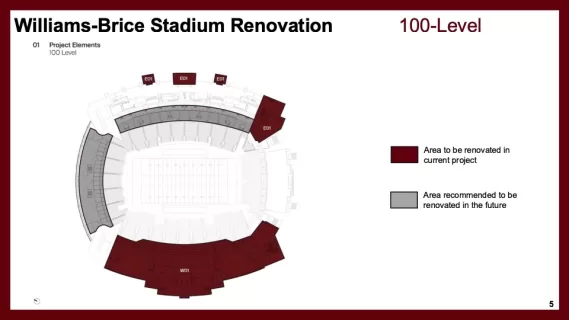
    A central component of the renovation focuses on expanded premium seating. The West Side’s 100 level is set to feature 10 Founders Suites, each accommodating up to 42 fans with 14 exterior seats. On the 200 level, 33 new suites—nine large and 24 standard—are planned, along with North and South Club areas that will include premium food offerings and dedicated kitchen support space. The large suites are expected to hold 32 guests, while the smaller ones will serve groups of 20.

    “Our fans deserve a first-class experience when they attend football games and other events at Williams-Brice Stadium,” said USC Board of Trustees Chairman Thad Westbrook. “These renovations are not only about enhancing game day—they’re a strategic investment in the long-term future of Gamecock athletics.”

    USC has also joined forces with Legends, a global company known for curating premium fan experiences and driving revenue through targeted, data-driven strategies. Legends will work closely with the athletics department to optimize engagement and revenue generation.

    Design

    Leading the design effort is Populous, a renowned international architectural firm with experience transforming sports venues across the collegiate and professional landscape. Their portfolio includes work with Texas, Oklahoma, Missouri, and Florida State.

    USC will fund the $350 million project through athletic revenue bonds. If the Joint Bond Review Committee and the State Fiscal Accountability Authority grant approval later this summer, construction could start as early as the end of the 2025 football season.

    Once USC completes the transformation of Williams-Brice Stadium, the project will significantly redefine the Gamecock fan experience—blending tradition with innovation to deliver a future-ready facility.

    Read Cleveland Browns Brook Park Domed Stadium To Proceed Without County Support

    USC Advances $350M Reimagining of the Iconic Williams-Brice Stadium
    USC Advances $350M Reimagining of the Iconic Williams-Brice Stadium

    Williams-Brice Stadium Reimagining– Project Factsheet

    Location: Williams-Brice Stadium, University of South Carolina, Columbia, SC

    Project Cost: $350 million

    Approval Date: May 22, 2025 (Phase 2 approved by the USC Board of Trustees)

    Phase 1 previously approved in October 2024

    Funding Source: Athletic revenue bonds

    Construction Timeline: Construction targeted to begin after the conclusion of the 2025 football season

    Pending approval from the South Carolina Joint Bond Review Committee and the State Fiscal Accountability Authority (expected late summer 2025)

    Design Firm: Populous

    Construction Firms:

    Contract Construction

    Manhattan Construction Company (Tulsa, OK)

    Scope of the Williams-Brice Stadium Reimagining:

    Creation of additional premium seating areas

    Student section upgrades

    Locker room renovations

    Concourse improvements (including concessions and restrooms)

    Back-of-house additions to improve service

    Key Features (Based on Current Concepts):

    Two large video boards in the south end zone

    New field-level club and recruitment lounge

    10 Founders Suites on the 100 level (West Side)

    33 suites on the 200 level (9 large, 24 regular)

    North and South Clubs with premium food service areas

    Read also: USTA Launches $800M Overhaul of US Open Campus, Centered on Arthur Ashe Stadium