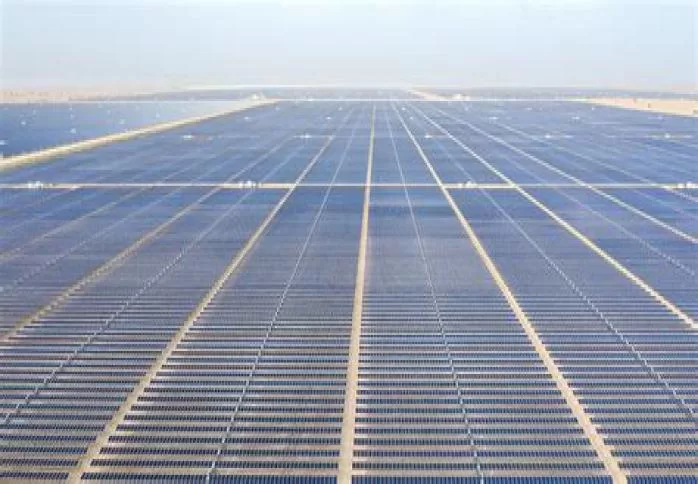
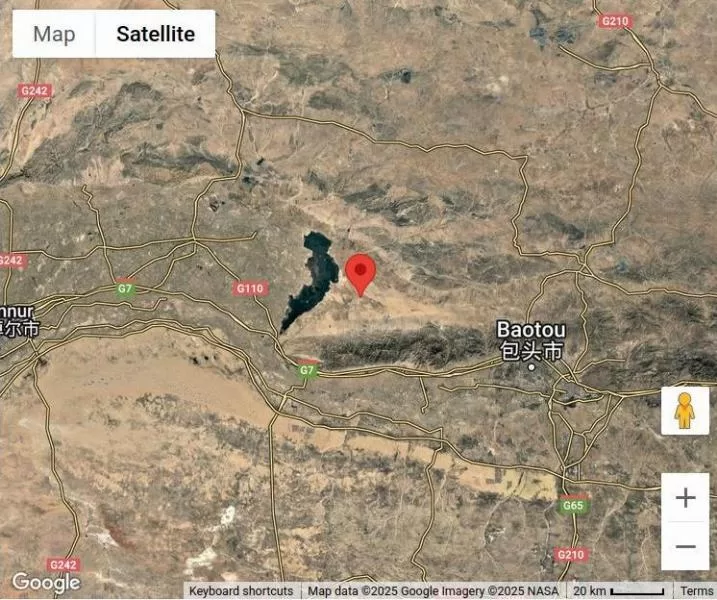
JA Solar had began delivery of high-efficiency PV modules to the 2 GW Suji Sandland Solar Project in Urad Front Banner, Inner Mongolia ahead of its planned completion this year. The solar project in Inner Mongolia is part of the third phase of China’s large-scale renewable energy initiative. This initiative is committed to sustainability and ecological restoration.
According to developers like JA Solar, desert areas like Suji Sandland pose “ecological and environmental challenges”. In response to this, concerted efforts by the government and local renewable developers like China Huaneng Group are putting these areas into sustainable and profitable use.
In the latest mark of progress, JA Solar will supply its DeepBlue 4.0 Pro modules to Suji Sandland for use in clean solar energy generation. The PV module will also be used in the desert zone’s green transition.
Under-modular planting incorporated in the Suji Sandland Solar Project will help restore Suji Sandland’s ecological system
The project’s sustainability and ecological restoration
Lying on 42,000 acres of arid land, the 2 GW solar project will produce 2.96 billion kWh of electricity annually. This will be used in both local and remote consumption.
According to the PV panel supplier, the 2 GW Suji Sandland Solar Project will also save approximately 900,000 tons of standard coal, and reduce CO2 emissions by 2.68 million tons annually.
Under-modular planting will also be incorporated in the project in ecological restoration efforts. This will help build a micro-ecosystem and fight desertification.
JA Solar delivering PV panels to the 2 GW Suji Sandland Solar Project in Inner Mongolia ahead of its completion underscores two important goals. Renewable energy transition and ecological restoration.
East Anglia 3 offshore wind project is gearing up construction progress after signing charter agreements worth more than £16 million for provision of construction vessels. ScottishPower Renewables, a UK subsidiary of Iberdola Group, made the agreement with NR Marine Services and OEG. Together, NR Marine and OEG will provide 3 vessels to help with crew transfer and other support to progress the construction of the East Anglia 3 offshore wind farm. This comes at an especially important time as the project targets completion by 2026.
East Anglia 3 project factsheet
Location: 69km from the Suffolk coast, UK
Developer: ScottishPower Renewables
Wind farm area: 305 km2
Operational capacity: 1.4 GW
Turbine units: Up to 100
Turbine height: Approx. 262 meters
Rotor diameter: Approx 230 meters
Offshore converter station(s): 1
Onshore converter station(s): 1
Project application approval date: 7 August 2017
Start of construction: July 2022
Project completion date: 2026
The construction vessels
Caister-based NR Marine Services will provide two crew transfer vessels (CTVs), while Great Yarmouth-based OEG will provide a support vessel.
Image of the NR Rebellion crew transfer vessel.
The NR Rebellion and NR Hunter will commence operations to progress East Anglia 3’s construction this April and later this year respectively. And with East Anglia 3 wind project’s operational date months away, OEG’s vessel, Tess, will glide the Southern North Sea waters, approximately 69 km off the Suffolk coast, keeping guard at the wind farm site.
Image of OEG’s guard vessel, Tess.
A look at the East Anglia 3 offshore wind project
As part of Iberdola’s £6.5 billion ($7.7 billion) East Anglia Hub, East Anglia 3 is expected to produce up to 1,400 MW (1.4 GW) of renewable energy once completed in 2026. This is enough power to supply over 1.3 million households in the region, with an expected operational lifespan of up to 25 years.
The East Anglia 3 will also have one offshore converter station. The offshore converter station will connect to an onshore converter station located in Bramford. This will be through four subsea export cables, and several other underground cables with terminal connection at the landfall site.
East Anglia 3’s onshore underground cables will stretch for over 37 km from the landfall point in Bawdsey to the converter station in Bramford.
Onshore development will comprise of 2 electrical and 3 fiber optics underground cables. The cables will stretch for over 37 km from the landfall point in Bawdsey to the converter station in Bramford. The onshore station will then connect to Bramford’s National Grid substation.
More on the project’s offerings and the new agreement
Alongside championing for renewable energy transition, East Anglia 3 is also banking on the local economy through offering jobs and supporting businesses. The latter is even more evident with the latest ScottishPower’s multi-million vessel agreements with Norfolk marine companies. “It is a source of great pride here at OEG that our collaboration with ScottishPower Renewables continues to flourish as our shared commitment to developing a truly robust local supply chain endures.” Said George Moore, the business development director for OEG.
Geared up to being the second largest offshore wind project in the world once operational in 2026, the latest mark of progress is a “win-win for the region and the UK”. And even more progressive is the workmanship spirit that the contract award winners put forth. “[… ] we [NR Marine Services] look forward to playing our part in seeing East Anglia THREE take shape over the coming weeks and months.” Said the director of NR Marine, Owen Nutt.
In a major step forward for Saudi Arabia’s Vision 2030, Diriyah Company has awarded a US$1.4 billion construction contract to bring the Royal Diriyah Opera House and its surrounding developments to life. The project will be delivered by a powerhouse joint venture between El Seif Engineering Contracting Co. Ltd. (ESEC), China State Construction Engineering Corporation Ltd. (CSCEC), and Midmac Construction Co. Ltd. The deal was signed during a formal ceremony attended by the joint venture partners, with Diriyah Company Group CEO Jerry Inzerillo leading the proceedings. Moreover, the announcement marks a key milestone in transforming Diriyah into a global cultural and tourism destination.
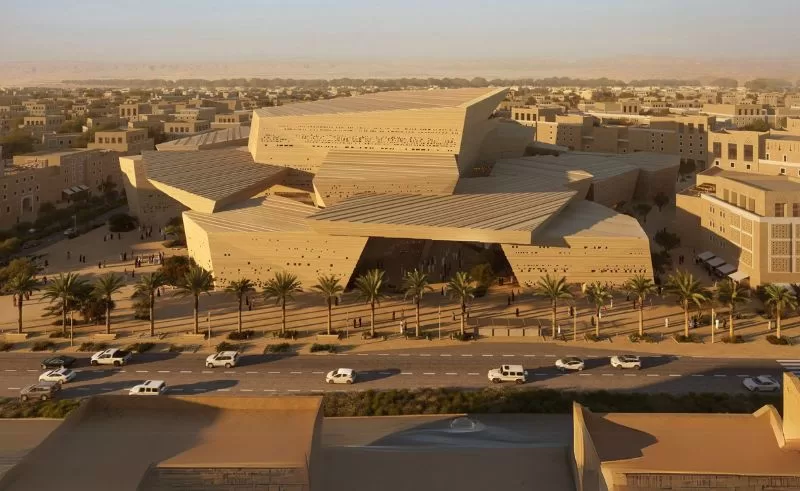
Set to become the crown jewel of the Kingdom’s performing arts scene, the Royal Diriyah Opera House promises to be both a cultural and architectural icon. Additionally, it was designed by world-renowned Norwegian architects Snøhetta, the building blends modern elegance with traditional Najdi aesthetics, using locally sourced materials like stone, palm,and earth. It will also feture cutting-edge sustainability measures, including water conservation systems, passive cooling techniques, and intelligent natural lighting. Inside, the main auditorium will seat 2,000 guests, complemented by a 450-seat studio theatre. Additionally, a rooftop amphitheatre with room for another 450. With a total seating capacity of 3,100, the venue will host everything from grand opera productions to global concerts and theatrical performances.
Contractors: El Seif Engineering Contracting Co. Ltd. (ESEC), China State Construction Engineering Corporation Ltd. (CSCEC), and Midmac Construction Co. Ltd.
Beyond the opera house itself, the contract includes the development of a luxury five-star hotel and a high-end residential complex, all within the broader opera district. These additions are set to elevate Diriyah’s urban fabric and reinforce its role as a magnet for culture, luxury, and innovation. Oversight of the opera house will fall under the Royal Commission for Riyadh City.
Backed by the Public Investment Fund (PIF), Diriyah is one of the largest and most ambitious urban regeneration projects in the world. Once complete, it will be home to nearly 100,000 residents and povide tens of thousands of jobs across creative and knowledge-based industries. What’s more, it is expected to attract 50 million visitors annually and generate around SAR70 billion ($18.6 billion) for Saudi Arabia’s GDP, firmly positioning Diriyah as a global cultural and economic powerhouse.
NATO’s decades-old war room headquarters in Mons, Belgium, is finally getting a long-overdue upgrade. Known as SHAPE (Supreme Headquarters Allied Powers Europe), the complex has been the heart of NATO’s strategic operations since 1967. But after nearly 60 years of service, it’s showing its age and not in a charming way. Starting in May 2026, construction will begin on a modern facility designed to meet the alliance’s evolving needs, with the new headquarters expected to be fully operational by 2030. The existing site, which was built quickly after NATO’s relocation from France, was only ever meant to be temporary. Yet, it’s continued to serve as the brain of NATO’s military planning, particularly for deterrence and defence strategies against Russia.
The contrast between SHAPE and NATO’s main headquarters in Brussels couldn’t be more stark. While diplomats and top brass up north enjoy the amenities of a €1 billion high-tech building, complete with a gym and shopping centre, those at SHAPE are still working in outdated conditions,relying on infrastructure built for a very different era. The push for a new facility gained real traction in December last year, when NATO members finally approved funding after a decade of planning. Acording to a NATO spokesperson, the current complex “has exceeded its life expectancy” and can no longer support the demands of modern military operations. The new facility, estimated to cost €800 million, will bring SHAPE in line with today’s technological and security standards.
But the €800 million is just the beginning. Additional costs, including a new communications and information system priced around €110 million, as well as expenses for transition efforts, parking, and other support infrastructure, are still being tallied. The shift to the new facility isn’t just about bricks and mortar; it’s about rethinking how SHAPE operates. “It involves adapting SHAPE’s processes and procedures to take full advantage of the modern infrastructure,” said the spokesperson. This transition phase alone could take up to two years, as the command centre reshapes not only its physical space but also its internal workflows.
The war room upgrade comes at a time when NATO is also strengthening its supply chains and industrial capacity. Earlier this year, Germany’s Rheinmetall announced a €1 billion investment in Bulgaria to build two new factories, including Europe’s largest gunpowder plant and a 155-mm artillery shell production facility. Together with the SHAPE reconstruction, these projects highlight NATO’s dual strategy of modernizing command infrastructure while securing the ammunition and equipment needed for future defense operations.
Project Overview
Location: Mons, Belgium
Project cost: €1 billion
Project scope: approximately 132,000 m²
Sections: Core Business Building and the Admin Building
If all goes according to plan, the Belgian authorities aim to complete construction by May 2030. However, the full transformation, including the demolition of the old buildings and the creation of additional support areas like parking, isnt expected to wrap up until May 2033. After decades of making do, NATO’s military planners in Wallonia are finally getting the command centre they need to meet today’s global challenges.
Texas Christian University (TCU) is moving ahead with a widespread campus expansion, following approval of several major projects by the Board of Trustees. Among the highlights: two big student residential complexes adding 3,200 student beds and the major renovation of historic Ed Landreth Hall and Auditorium.
According to the Thursday statement from the university, the housing developments will be developed under a public-private partnership facilitated by more than $500M in external investment. The construction is to be finished prior to the fall 2027 semester.
Developers American Campus Communities (ACC) and Endeavor Real Estate Group were selected through a national competitive process. “We’re proud to collaborate with partners who share our vision for student-focused growth,” said Board of Trustees Chair Kit Moncrief. “This substantial investment underscores the strong belief in the future of TCU and the lifelong value of our education.”
Student Affairs Vice Chancellor Kathy Cavins-Tull noted that the new residential facilities are designed to foster academic, social, and personal development.
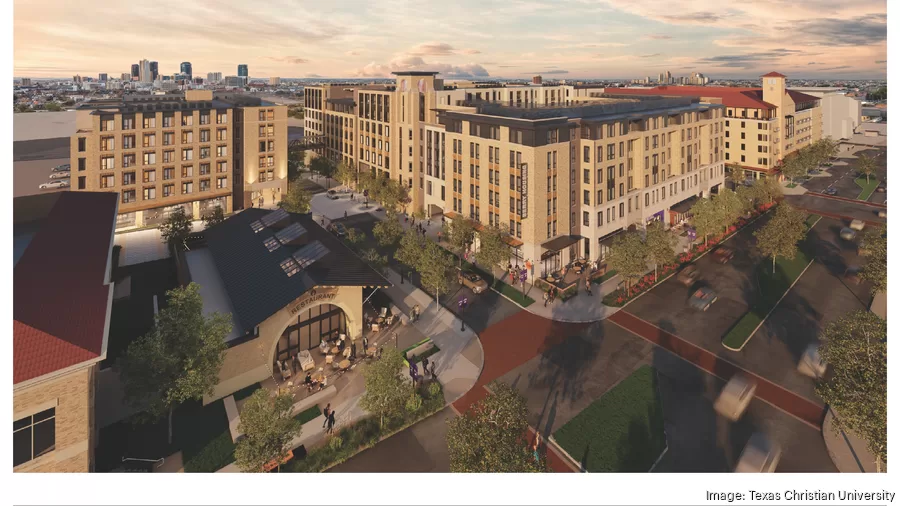
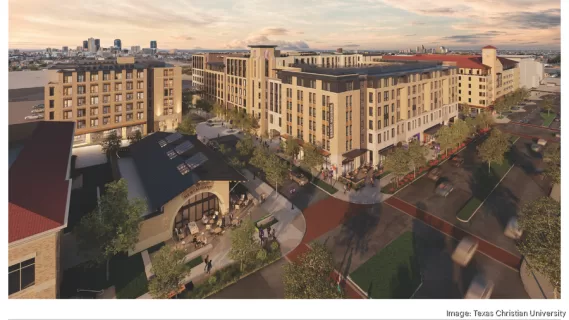
A rendering of Morado on Berry, a mixed-use development TCU is developing in partnership with Endeavor Real Estate Group near the intersection of West Berry Street and South University Drive.
TCU Campus Expansion: New Housing Projects
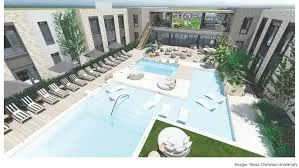
The first of the new buildings, Morado on Berry, will provide 780 graduate and upper-division student apartment-style units. With Austin-based firm Endeavor as its design partner, the complex will feature in-unit washer and dryer sets, modern kitchen spaces, private study and lounge areas, a rooftop pool, and 25,000 square feet of retail space along Berry Street. State records indicate that the project is due to be ready for opening by August 2027.
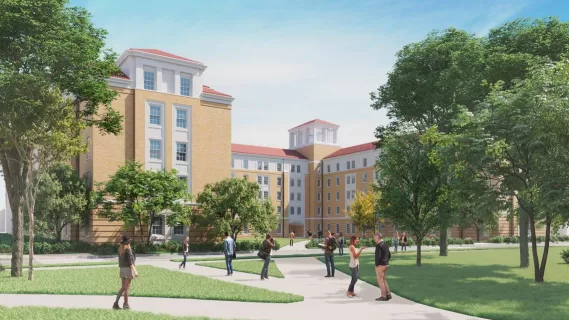
TCU will also share leadership of a second ACC-funded project that expands four on-campus locations by adding 2,450 beds. The housing blend will accommodate first-year, sophomore, and upper-class students in a variety of traditional residence halls and townhouse-style units. The communities will include lounges, outdoor space, and study support facilities.
Of the new beds, approximately 1,320 will go to first-year students, 1,000 to sophomores, and 120 townhouses to other student populations. This part of the expansion spans more than 1.2 million square feet and will cost more than $280 million.
ACC also will build a $42M, 950-space parking garage on the east side of campus with work beginning in July and completion in 2027.
A rendering of the rooftop pool at the Morado on Berry
Ed Landreth Hall Renovation
Besides residential campus expansion projects, TCU will renovate and modernize the historic Ed Landreth Hall and Auditorium, located on South University Drive. The renovation is expected to be finished by the 2028-29 academic year. And aims to enhance the building’s functionality as well as its heritage with the College of Fine Arts.
The restoration will have state-of-the-art rehearsal spaces, new teaching studios, and refurbished performance area with improved acoustics, expanded wings, refurbished seating, and a new fly tower to accommodate advanced stage and lighting technology.
“We’re not just restoring a historic space — we’re creating a more welcoming and inspiring home for the arts,” said Vice Chancellor for Finance and Administration Bill Nunez. “This renovation will elevate both student learning and the audience experience, while preserving one of TCU’s most treasured academic landmarks.”
Addressing Growing Pains
While the progress is a giant leap, university officials admit that the construction will have some short-term hurts. Over a thousand parking spaces will be sacrificed in the process, and first-year students will no longer be permitted to bring cars on campus.
These are made in the face of ongoing complaints from neighboring neighborhoods, which have requested stricter enforcement of party-related disturbances and off-campus parking by non-residents.
Despite these challenges, the university says these initiatives are in line with its LEAD ON: Values in Action strategic plan and long-term Campus Master Plan, positioning TCU for a healthier, more vibrant future.
A rendering of the new student housing planned for the east side of TCU’s campus.
TCU Campus Expansion: Project Factsheet
Overview
Texas Christian University is embarking on a major campus expansion with over $500 million in external investment through public-private partnerships. The project includes new student housing adding 3,200 beds and renovation of the historic Ed Landreth Hall and Auditorium, with completion targeted before Fall 2027.
Key Housing Developments
Morado on Berry: 780 graduate and upper-division apartment-style units
Features: In-unit laundry, modern kitchens, private study areas, rooftop pool
Includes 25,000 sq ft of retail space along Berry Street
Opening: August 2027
TCU On-Campus Housing Expansion: 2,450 additional beds across four locations
Distribution: 1,320 beds for first-years, 1,000 for sophomores, 120 townhouses for upper-class students
Total area: 1.2+ million square feet
Cost: $280+ million
New Parking Structure: 950-space garage on east campus
Construction begins: July 2025
Completion: 2027
Cost: $42 million
Ed Landreth Hall Renovation
Completion target: 2028-29 academic year
Enhancements: State-of-the-art rehearsal spaces, new teaching studios, improved acoustics, expanded wings, refurbished seating, new fly tower
Implementation Challenges of TCU’s Campus Expansion and Renovation Projects
Temporary loss of 1,000+ parking spaces
First-year students will no longer be permitted to bring cars on campus
Addressing neighborhood concerns regarding parking and noise
In what is termed to be a major step toward regional integration, climate resilience, and food security, Kenya and Uganda have officially launched the implementation phase of the Angololo Water Resources Development Project (AWRDP). This is a transformative cross-border initiative that is set to be beneficial to over 300,000 residents in the Sio-Malaba-Malakisi (SMM) River Sub-basin.
The ceremonial launch of the project was held in Busia County. Kenya’s Cabinet Secretary for Water, Sanitation, and Irrigation Eng. Eric Mugaa and Principal Secretary Julius Korir joined Uganda’s State Minister for Environment, Beatrice Atim Anywar to kick off the project officially. Also present was the Deputy Governor of Busia County Arthur Odera.
Angololo Water Resources Development Project (AWRDP) Factsheet
Total estimated cost: USD 137 million (approximately Sh17 billion).
Implementing partners: Governments of Kenya and Uganda, Nile Basin Initiative (NBI) through the Nile Equatorial Lakes Subsidiary Action Program (NELSAP), with technical oversight from NELSAP.
Significance:
Economic growth: Intensify economic activities, including agro-processing and aquaculture.
Job creation: Create employment opportunities in construction, agriculture, aquaculture, and related services, particularly targeting youth.
Project status and timeline:
Conceptualization: 2010
Pre-feasibility studies: Completed in 2010 with support from the Royal Governments of Sweden and Norway.
Feasibility studies, detailed Designs, Environmental and Social Impact Assessment (ESIA), and Resettlement Action Plan (RAP): Conducted between 2020 and 2022.
Bilateral agreement signing: Officially signed on April 17, 2025, marking the launch of the implementation phase.
Furthermore, the project is in line with President William Ruto and Deputy President Kithure Kindiki’s Bottom- Up Economic Transformation Agenda (BETA). It emphasizes rural development via modern irrigation to enhance food production and households earnings.
As part of this agenda, the Kenyan government recently launched the National Irrigation Sector Investment Plan (NISIP). This is a bold 10-year roadmap aimed at revolutionizing irrigation, boosting agricultural productivity, and attracting private investment in the water sector.
According to CS Mugaa, “This investment plan offers the fastest and most cost-effective pathway for Kenya to achieve its agricultural water development and food security goals. It supplements our national development frameworks. This includes Vision 2030, the 2017 National Irrigation Policy, and BETA.”
Identified in the year 2010 by the governments of Kenya and Uganda, the Angololo Water Resources Development Project is now entering its construction phase.
Funding of the Project
The funding is from the African Development Bank (AfDB) and the NEPAD Infrastructure Project Preparation Facility (NEPAD-IPPF). The project is being implemented under the Nile Equatorial Lakes Subsidiary Action Program (NELSAP) of the Nile Basin Initiative (NBI).
The goal of the project is to modernize agriculture, improve energy access, promote environmental sustainability, and enhance food security in the region.
Key Project Components
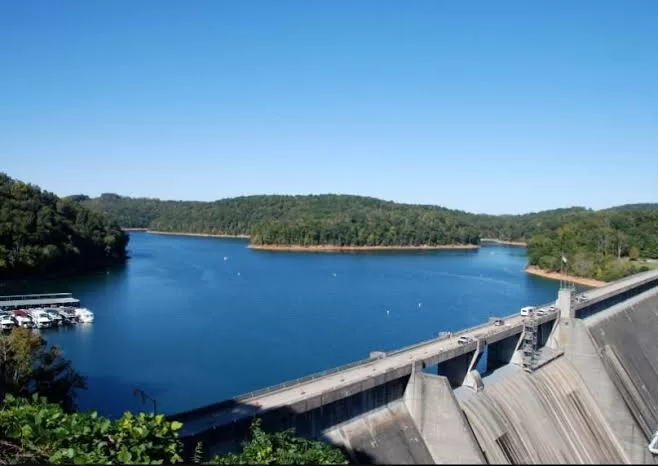
A 40-meter-high composite dam that has a storage capacity of 31.6 million cubic meters
A 1.3 MW hydropower plant. There are also future plans to install 20 MW floating solar pontoons
A 4,000-hectare irrigation scheme that will enable year-round food production
A domestic and livestock water supply systembthat will serve more than 270,000 people
Restoration of 30% of the 447 km² upstream watershed so as to improve catchment health
A fisheries and aquaculture program that will boost local food security and livelihoods for locals
Flood control infrastructure that would protect homes and farmlands downstream
To provide the best experiences, we use technologies like cookies to store and/or access device information. Consenting to these technologies will allow us to process data such as browsing behavior or unique IDs on this site. Not consenting or withdrawing consent, may adversely affect certain features and functions.
Functional
Always active
The technical storage or access is strictly necessary for the legitimate purpose of enabling the use of a specific service explicitly requested by the subscriber or user, or for the sole purpose of carrying out the transmission of a communication over an electronic communications network.
Preferences
The technical storage or access is necessary for the legitimate purpose of storing preferences that are not requested by the subscriber or user.
Statistics
The technical storage or access that is used exclusively for statistical purposes.The technical storage or access that is used exclusively for anonymous statistical purposes. Without a subpoena, voluntary compliance on the part of your Internet Service Provider, or additional records from a third party, information stored or retrieved for this purpose alone cannot usually be used to identify you.
Marketing
The technical storage or access is required to create user profiles to send advertising, or to track the user on a website or across several websites for similar marketing purposes.
To provide the best experiences, we use technologies like cookies to store and/or access device information. Consenting to these technologies will allow us to process data such as browsing behavior or unique IDs on this site. Not consenting or withdrawing consent, may adversely affect certain features and functions.
Functional
Always active
The technical storage or access is strictly necessary for the legitimate purpose of enabling the use of a specific service explicitly requested by the subscriber or user, or for the sole purpose of carrying out the transmission of a communication over an electronic communications network.
Preferences
The technical storage or access is necessary for the legitimate purpose of storing preferences that are not requested by the subscriber or user.
Statistics
The technical storage or access that is used exclusively for statistical purposes.The technical storage or access that is used exclusively for anonymous statistical purposes. Without a subpoena, voluntary compliance on the part of your Internet Service Provider, or additional records from a third party, information stored or retrieved for this purpose alone cannot usually be used to identify you.
Marketing
The technical storage or access is required to create user profiles to send advertising, or to track the user on a website or across several websites for similar marketing purposes.