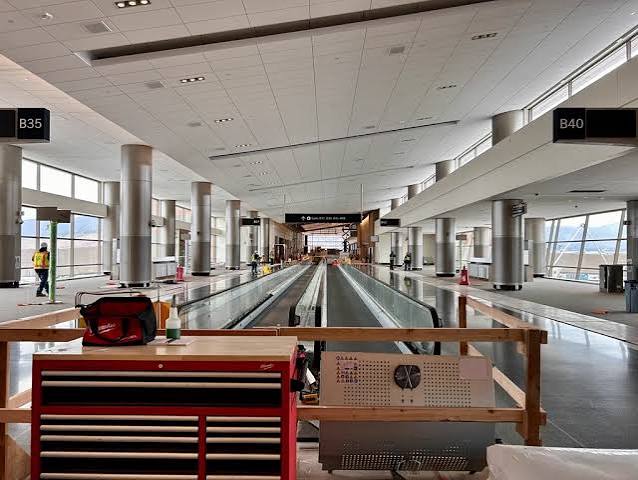
nal Salt Lake City International Airport will open the final seven gates of its $5.1 billion redevelopment on Tuesday, October 27, formally completing a rebuild that began in 2014.
The opening is a scheduled milestone, not a surprise. But it closes one of the more difficult infrastructure projects in modern U.S. aviation: replacing an entire hub airport while keeping it open. For more than a decade, crews built new terminals, concourses, tunnels, and taxiway connections beside active aircraft movements, while Salt Lake City kept roughly 35 million annual passengers moving through the airport.
The question is not simply what opened. It is how a major U.S. hub rebuilt itself without shutting down.
What opens Tuesday
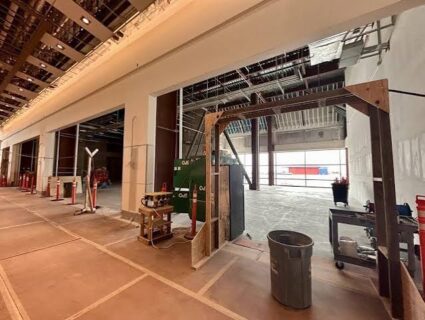
The final phase brings seven additional gates on the east end of Concourse B, along with six new concessions. The gates will primarily serve United Airlines, with two common-use gates available to other carriers.
With them, The New SLC reaches its full planned footprint: 94 aircraft gates, four hardstand positions, 101 concessions, and six international gates. The airport says the completed complex is designed to handle 34 million passengers a year.
A celebration marking the end of construction is planned for October 24, three days before the gates open to travelers.
Why the old airport had to go
Salt Lake City’s original terminal complex dated to the 1960s. It was built for about 10 million passengers a year; by 2014, the airport was handling roughly 21 million, and the aging facilities no longer met modern seismic standards.
Rather than renovate around an operating airport indefinitely, officials chose a full replacement: build a new airport beside the old one, shift operations into the new facilities, then demolish the old complex and build eastward on the cleared land.
That decision created the project’s defining constraint. Salt Lake City could not close. It had to build a new hub while flights continued.
How they built around live flights
The airport and its engineering team used what HNTB called an “airport operations come first” approach. Work zones were defined only after engineers established the clearances needed for gate access, aircraft pushback, and tug movements.
Cranes posed a particular problem. Their locations, lifting heights, and operating hours had to be coordinated through weekly FAA 7460 meetings, while crews mapped temporary crane roads around the concourses and evaluated whether equipment would obstruct the control tower’s sightlines.
Weather added another layer. Instrument-landing-system requirements limited some construction activity, making weather the single biggest operational headache for crews working near active airfield infrastructure.
The solution was sequencing. Phase 1 opened in September 2020 with the new central terminal, parking garage, elevated roadway, and west sections of Concourses A and B. Airlines moved into the new facilities, freeing the old 1960s terminals for demolition.
Then the airport used temporary remote hardstands—where passengers reached parked aircraft by shuttle—while it built Concourse A-east and extended Concourse B. Those temporary operations stayed in place until enough permanent gates opened to retire them.
The pandemic changed the plan
COVID-19 arrived as the first phase was nearing completion. In early 2020, the project had between 1,800 and 2,000 workers on site each day; passenger traffic at Salt Lake City then collapsed from as many as 30,000 people a day to about 1,500.
Airlines refused to shut down, and the airport kept construction moving. But the collapse in travel changed the demolition strategy. Instead of following an original plan that would have kept two of the three old concourses operating through a roughly 25-stage closure sequence, officials decided to demolish all three at once.
Airport officials estimated that decision saved nearly $300 million and cut about two years from the schedule.
The pandemic also disrupted financing. The airport delayed a planned $1.15 billion bond sale because it wanted clearer passenger-revenue forecasts before issuing more debt. Federal pandemic relief later covered roughly a year of debt-service payments.
The ground beneath the airport
Salt Lake City sits on an ancient lakebed in a seismically active region, with groundwater only about seven feet below the surface. That made the ground itself part of the engineering challenge.
Crews drilled hundreds of three-foot-diameter holes roughly 45 feet deep in a 10-by-10-foot grid, then pressure-filled them with stone to reduce liquefaction risk. The project also relied on driven piles, generally 65 to 75 feet deep, along with sheet piles and dewatering systems.
The risk was not theoretical. A magnitude 5.7 earthquake struck near Salt Lake City in March 2020, while Phase 1 was in its final stages.
How the cost grew
The project did not begin as a $5.1 billion program. When Salt Lake City broke ground in July 2014, it announced a $1.8 billion Terminal Redevelopment Program intended to replace the terminal and concourses.
The scope then expanded. In 2016, officials added the North Concourse, turning the terminal replacement into a broader Airport Redevelopment Program. Later estimates rose to $3.6 billion, then $4.1 billion, before the final program reached $5.1 billion.
The increase reflects more than inflation. Salt Lake City expanded from replacing a terminal to rebuilding the airport’s concourses, roadways, parking, tunnels, utilities, and airfield connections.
The financing relied on airport revenue rather than local taxes. The program used airport funds, airline and passenger fees, passenger facility charges, rental-car facility charges, federal grants, and airport revenue bonds. In June 2025, the city authorized up to $700 million in additional bonds to help finish the remaining work.
Who built it
HNTB served as a lead program consultant and civil engineer, developing the phasing and access plans that allowed construction to proceed around live operations. HOK was the lead terminal designer.
The Holder Construction–Big-D Construction joint venture handled the terminal, Concourse A, parking, roadways, tunnels, utilities, and airfield paving. Austin Commercial and Okland built Concourse B under an approximately $545 million construction-manager-at-risk contract.
Delta Air Lines, the airport’s largest carrier, was involved from the early planning stages and extended its Salt Lake City lease by 10 years, strengthening the financing case for the rebuild.
What took so long
The airport was not simply building a terminal. It was replacing a functioning hub in stages, while preserving enough gates, baggage capacity, utilities, and aircraft movement to keep airlines flying.
Phase 1 opened in September 2020. Concourse B-west followed on October 27, 2020, opening with 21 gates—ahead of the original schedule despite the pandemic, earthquake, and construction complications.
Phase 2 followed in 2023 with 22 east Concourse A gates. Phase 3 opened in October 2024, adding the 1,175-foot Central Tunnel, the Concourse B Plaza, and additional Delta gates.
Final phase, Phase 4, then extended Concourse B east in stages: 10 gates and six concessions opened in October 2025, four more opened on July 14, 2026, and the final seven open October 27.
Each opening allowed the airport to retire temporary shuttle-served hardstand operations and shift more traffic into permanent gates.
Sustainability and design
The airport says the old terminals and concourses were demolished with about 85 percent of their materials recycled. The new complex was designed with a LEED Gold target, a net-zero roadmap, and fully electric ground-support equipment.
The design also includes artwork by Gordon Huether, including installations in the Central Tunnel and the final Concourse B-east section. The airport describes The New SLC as the first new hub airport built in the United States in the 21st century.
What remains
The October 27 opening completes The New SLC, but not every capital project at the airport. A separate main-terminal renovation, first estimated at $653 million and now projected above $700 million, is expected to begin in 2027.
Concourse C also remains a future option. The airport says it would be triggered only if passenger traffic approaches the 35 million annual-passenger threshold.
Salt Lake City’s rebuild shows that an airport can modernize without closing—but not quickly, cheaply, or without compromise. It required a $1.8 billion terminal project to grow into a $5.1 billion full-airport replacement, a pandemic-era replanning decision, temporary shuttle operations, and years of construction beside active taxiways.
The final gates opening this week are the visible end of that process. The less visible achievement is that, throughout it, Salt Lake City never stopped flying.
Salt Lake City’s completed $5.1 billion rebuild offers a preview for Cleveland Hopkins, which has unveiled a conceptual master plan to replace its three active concourses—A, B, and C—with two new concourses totaling about 40 gates. Like Salt Lake City, Cleveland must keep operating through a multiyear transformation: its $1.6 billion first phase, covering parking, a ground-transportation center, and a new terminal headhouse, runs through 2032, while the new concourses are tentatively planned for 2033 to 2039. Salt Lake City shows that a hub can be rebuilt without closing—but also that doing so can take more than a decade, require complex phasing, and cost far more than the first estimate.
Project Factsheet: The New SLC
Project: The New SLC, Salt Lake City International Airport redevelopment
Owner: Salt Lake City Corporation, through the Salt Lake City Department of Airports
Total cost: $5.1 billion
Groundbreaking: July 2014
Final opening: Tuesday, October 27, 2026
Duration: About 12 years
Local tax dollars used: None
The New SLC replaced Salt Lake City’s 1960s-era terminal complex with a new hub airport built while the existing airport remained open. The airport calls it the first new U.S. hub airport built in the 21st century.
What the completed airport includes
- 94 aircraft gates
- Four hardstand positions
- Six international gates
- 101 concessions
- Design capacity for 34 million annual passengers
- New central terminal, parking garage, elevated roadway, and two concourses
Major milestones
- September 15, 2020: Phase 1 opened, including the central terminal, parking garage, and west sections of Concourses A and B.
- October 27, 2020: Concourse B-west opened with 21 gates.
- 2023: Phase 2 added 22 east Concourse A gates.
- October 2024: Phase 3 opened the Central Tunnel, Concourse B Plaza, and additional Delta gates.
- October 27, 2026: The final seven Concourse B-east gates and six concessions open, completing the program.
Cost and financing
The project began in 2014 as a $1.8 billion terminal replacement. It expanded after the North Concourse was added in 2016 and later grew to $3.6 billion, $4.1 billion, and finally $5.1 billion.
Funding came from airport funds, airport revenue bonds, passenger facility charges, customer facility charges, federal grants, and future bonds. Salt Lake City authorized up to $700 million in additional bonds in June 2025 to help finish the program.
Major challenges
- Building beside active taxiways while flights continued.
- COVID-19, which cut daily passenger traffic from about 30,000 to 1,500 in 2020.
- A magnitude 5.7 earthquake near Salt Lake City in March 2020.
- Seismic and groundwater risks on an ancient lakebed site.
- Weather-related limits on crane and airfield construction.
What remains
A separate main-terminal renovation, initially estimated at $653 million and now projected above $700 million, is expected to begin in 2027. Concourse C remains a future expansion option if passenger traffic approaches 35 million annually.

Leave a Reply