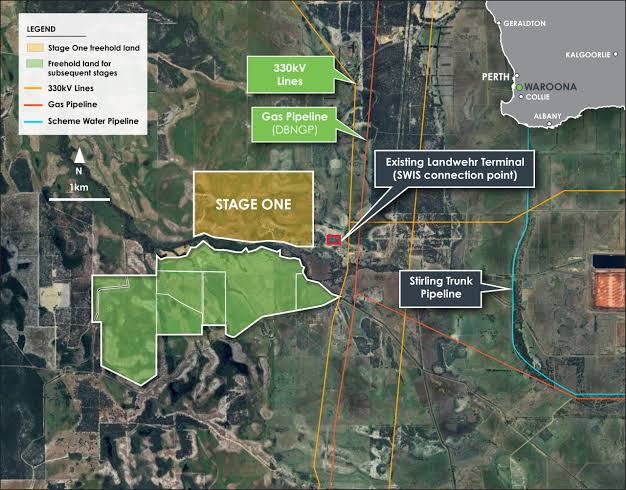
The Waroona renewable energy project in Western Australia is advancing construction following a $196 million financing agreement. The development is moving closer to financial close, strengthening prospects for completing its first construction phase. The latest funding agreement provides a major boost to the 132MW solar facility and 81.5MW battery energy storage system. Together, these installations will form one of the largest solar-battery hybrid developments on Western Australia’s main electricity grid.
Perth-based Frontier Energy executed a syndicated facility agreement worth up to A$280 million on November 2, 2026. The agreement involves an international lending consortium led by Natixis Corporate & Investment Banking (Natixis CIB) and Sumitomo Mitsui Banking Corporation (SMBC). Its $196 million equivalent represents project financing rather than the entire construction budget.
Furthermore, the agreement follows earlier credit approvals and underwriting commitments secured by the developer. Frontier expects to achieve financial close in November 2026, subject to outstanding contractual requirements. These include signing a Capacity Investment Scheme agreement with Australia’s federal government and completing interest-rate hedging arrangements.
The company expects the first debt drawdown during the first quarter of 2027. Meanwhile, construction activities have already commenced following the mobilization of the appointed engineering contractor.
Waroona Renewable Energy Project secures funding for construction
The syndicated financing package comprises three facilities supporting construction and operational requirements.
The largest component provides up to A$250 million for construction and term financing. Additionally, the agreement includes a A$13 million bank guarantee facility and A$17 million debt service reserve facility.
The debt carries senior secured, non-recourse project financing arrangements. Its legal maturity stands at three years following financial close, with lenders retaining discretion over a one-year extension. Repayments follow a notional 18-year repayment profile.
Importantly, the financing complements A$110 million raised through an equity placement completed earlier in 2026. Together, these funding sources are expected to finance Stage One through its first electricity generation.
The project also benefits from Australia’s Capacity Investment Scheme. The federal revenue-underwriting arrangement provides downside revenue protection until 2042. This support strengthens the project’s financial position by reducing exposure to lower-than-expected electricity market revenues.
Australia’s renewable energy financing environment continues to face challenges, with funding uncertainty affecting major developments. The $1.74 billion AGL and Akaysha green energy deals facing funding challenges highlights the financial pressures confronting large-scale renewable energy investments. Against this backdrop, Waroona’s syndicated financing agreement represents an important step towards securing construction funding and advancing Australia’s renewable energy capacity.
Waroona Renewable Energy Project construction gathers momentum
The first development phase combines a 132MW solar photovoltaic facility with an 81.5MW battery storage installation. The battery will provide approximately 562MWh of storage capacity, equivalent to 6.9 hours at its rated output.
Western Australian contractor Monford Group holds the fixed-price engineering, procurement and construction contract. Its responsibilities include constructing and commissioning the integrated solar and battery facility.
Meanwhile, Global Power Services has secured the engineering and construction contract for the project’s 330kV substation. Frontier has also completed major equipment procurement arrangements with international manufacturers.
LONGi will supply the photovoltaic modules, while Trina Storage will provide the battery system. Additionally, Nextpower will supply solar tracking equipment, with SMA Australia providing inverters.
Trina Storage’s battery package includes lithium iron phosphate technology. Its supply agreement incorporates a 20-year warranty and long-term services arrangement.
The project will also connect to Western Australia’s South West Interconnected System through infrastructure developed alongside Western Power. Existing connection arrangements allow electricity exports of up to 99MW and battery charging imports of up to 95MW.
Frontier expects the first solar tracking equipment deliveries in November 2026. Initial photovoltaic module deliveries are scheduled for January 2027.
Once operational, the development will capture daytime solar generation and dispatch stored electricity during periods of stronger evening demand. The developer targets first electricity generation in 2028.
Beyond Stage One, Frontier intends to expand the development significantly. Its longer-term ambition targets approximately 1GW of solar generation and 660MW of battery storage by 2031.
Stage Two already has development approval and proposes approximately 120MW of solar generation alongside 80MW of battery storage.
Also read: 1.4 GW Bungaban Wind Energy Project: $2.7bn Construction Targets 2027 after Federal Green Light
Project Fact Sheet
Name: Waroona Renewable Energy Project.
Location: Approximately 120 kilometres south of Perth, Western Australia.
Developer and owner: Frontier Energy Limited.
Development phase: Stage One construction.
Stage One solar capacity: 132MW.
Battery storage power capacity: 81.5MW.
Battery storage capacity: Approximately 562MWh.
Financing agreement: Up to A$280 million (approximately $196 million).
Battery technology: Lithium iron phosphate (LFP).
Battery duration: Approximately 6.9 hours.
Construction and term facility: Up to A$250 million.
Bank guarantee facility: Up to A$13 million.
Debt service reserve facility: Up to A$17 million.
Equity financing: A$110 million placement completed in 2026.
Main EPC contract: Fixed-price engineering, procurement and construction agreement.
Grid connection: Western Power’s South West Interconnected System.
Electricity export capacity: Up to 99MW.
Battery charging import capacity: Up to 95MW.
Financial close target: November 2026.
Expected first debt drawdown: First quarter of 2027.
Expected first generation: 2028.
Long-term expansion target: Approximately 1GW solar and 660MW battery storage by 2031.
Project Team
Developer and project owner: Frontier Energy Limited.
Main engineering, procurement and construction contractor: Monford Group.
Substation engineering and construction contractor: Global Power Services.
Solar photovoltaic module supplier: LONGi.
Battery energy storage system supplier: Trina Storage.
Solar tracking equipment supplier: Nextpower.
Inverter supplier: SMA Australia.
Grid infrastructure and connection partner: Western Power.
Lead project finance lenders: Natixis Corporate & Investment Banking and Sumitomo Mitsui Banking Corporation.
Debt finance adviser: Azure Capital.
Federal revenue support partner: Australian Government, through the Capacity Investment Scheme.


Leave a Reply